


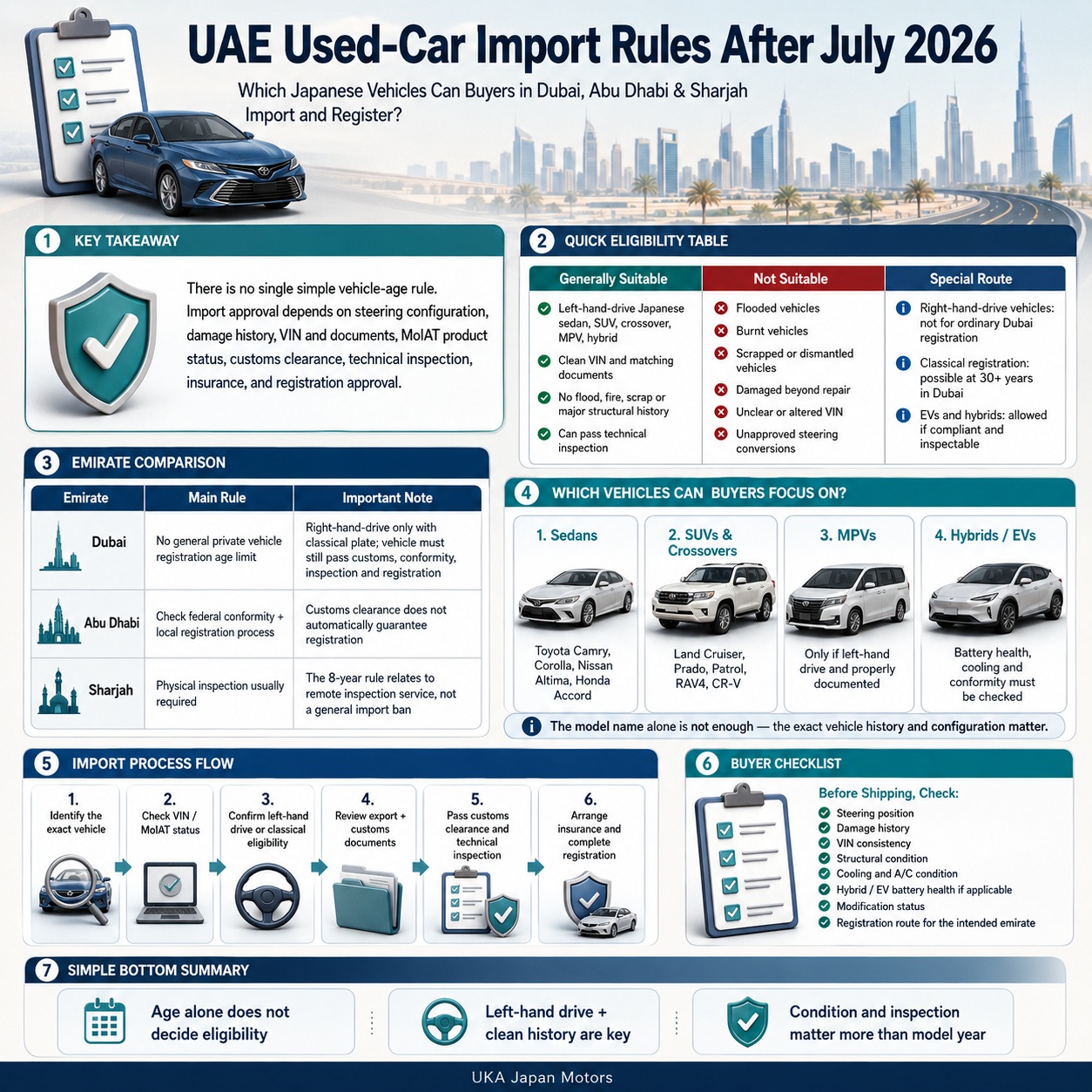
Importing a Japanese used vehicle into the UAE is not determined by its model year alone.
A car may be relatively recent but still be unsuitable for registration because it has right-hand drive, a prohibited damage record, missing documentation, an altered chassis number, incompatible specifications, or modifications that do not meet UAE requirements. An older vehicle, by contrast, may remain registrable if it is left-hand drive, structurally sound, properly documented, compliant and able to pass the required technical inspection.
This distinction is particularly important after July 2026. Buyers sometimes hear that imported cars must be below a certain age and assume that every vehicle older than that threshold is prohibited. The official framework is more detailed.
Dubai’s Roads and Transport Authority states that there is no general age limit for registering a vehicle in Dubai. However, the vehicle must still satisfy customs, conformity, steering-position, technical-inspection and registration requirements. Federal guidance also requires the vehicle to receive a positive inspection result, hold valid insurance and be supported by an accepted ownership or clearance document. question is therefore not simply:
How old is the vehicle?
It is:
Is this particular vehicle legally eligible, technically compliant and realistically suitable for registration and long-term use in the UAE?
This guide explains how that assessment applies to Japanese sedans, SUVs, crossovers, MPVs, hybrids, electric vehicles and classics intended for use in Dubai, Abu Dhabi or Sharjah.
Direct Answer: Which Japanese Used Vehicles Can Be Imported Now?
As of the UAE rules and official services available after July 2026, buyers should generally focus on Japanese vehicles that meet all of the following conditions:
- The vehicle has left-hand drive for normal road registration.
- Its vehicle identification number can be verified.
- It is not recorded as burnt, flooded, scrapped, dismantled, damaged beyond repair or affected by another prohibited safety condition.
- The chassis and body structure have not been repaired in a way that compromises safety.
- Its customs, export and ownership documents are complete and consistent.
- It can obtain the required MoIAT product-status documentation.
- It complies with applicable UAE technical requirements.
- It can pass the inspection required by the registering emirate.
- It can be insured and entered into the relevant traffic system.
MoIAT provides a product-status statement for imported used vehicles to confirm whether a vehicle is eligible to enter the traffic-registration system. It also provides a product label card intended to show that the vehicle is free from listed damage conditions that could affect safety. terms, this means a clean left-hand-drive Toyota, Nissan, Lexus, Honda, Mazda, Mitsubishi, Subaru, Suzuki or Infiniti may be considered for import regardless of whether it is a sedan, SUV, MPV or hybrid. Approval is not automatic, however. The individual vehicle—not merely the model name—must satisfy the process.
A right-hand-drive Toyota Alphard, Toyota Harrier, Honda Vezel, Nissan Serena or similar vehicle should not be treated as an ordinary registration candidate simply because the same model family is known in the UAE. Dubai explicitly states that a right-hand-drive vehicle cannot receive normal registration unless it qualifies for a classical plate. mportant Point: There Is No Single UAE-Wide Age Test
The phrase “used-car age rule” can create the impression that every imported vehicle is divided into two simple categories: young enough or too old.
That is not how buyers should approach the UAE system.
Several separate decisions affect eligibility:
- Can the vehicle legally enter and clear customs?
- Does its history pass the imported-used-vehicle status check?
- Does its steering configuration qualify for the intended registration category?
- Does it comply with UAE safety and technical requirements?
- Can it pass the relevant emirate’s vehicle inspection?
- Does the buyer possess the correct ownership and clearance documents?
- Is it being registered privately or for a regulated commercial activity?
Dubai’s published vehicle-registration information expressly states that there is no age limit to register a vehicle in the emirate. This does not remove the remaining conditions, nor does it guarantee that an old, modified or poorly repaired vehicle will pass inspection. Dhabi and Sharjah should also avoid assuming that Dubai’s wording automatically settles every licensing question in another emirate. Federal registration principles are shared, but vehicle testing, local traffic-file procedures and particular licensing decisions are handled through the relevant authority.
The safer approach is to verify the chassis number, steering position, vehicle category and intended emirate before shipping.
What the Post-July 2026 Framework Actually Emphasises
The official framework visible after July 2026 places strong emphasis on three areas:
1. Vehicle identity
The chassis number must correspond with the export, customs and ownership documentation. Any inconsistency involving the VIN, production details, engine information or vehicle category can delay or prevent registration.
The MoIAT product-status service requires the vehicle’s unified identification number and is designed to establish whether an imported used vehicle is eligible for registration in the UAE traffic system. ited damage history
The UAE’s imported-used-vehicle requirements prohibit categories associated with serious safety concerns. The official MoIAT description refers to seven prohibited types, including burnt, scrapped, flooded and dismantled vehicles, vehicles damaged beyond repair and vehicles with major manufacturing defects. Imported light vehicles intended only for re-export are treated separately. repaired appearance is not enough. A car can look presentable after bodywork while still carrying a history classification that makes it unsuitable for UAE road registration.
3. Technical roadworthiness
After customs and conformity checks, a used vehicle normally has to pass an authorised technical inspection before registration. Federal guidance requires a positive inspection result, electronic insurance and an accepted vehicle document such as a Vehicle Clearance Certificate, transfer certificate, export certificate or possession certificate. ence the likelihood of passing because components deteriorate over time, but age is not a substitute for the inspection result.
Eligibility by Vehicle Type
The following comparison shows how common Japanese-vehicle categories should be approached.
| Vehicle category | Likely registration position | Main concern |
|---|---|---|
| Left-hand-drive sedan, SUV or crossover with clean history | Generally suitable for assessment | Documentation, conformity and inspection |
| Left-hand-drive MPV with original structure | Generally suitable for assessment | Seating, seat belts, modifications and body integrity |
| Right-hand-drive vehicle below classical age | Not suitable for ordinary Dubai registration | Steering position |
| Vehicle aged 30 years or more | May qualify for a classical route in Dubai | Classical inspection and usage category |
| Burnt, flooded, scrapped or dismantled vehicle | Prohibited road-registration category | Safety-status record |
| Vehicle damaged beyond repair | Prohibited road-registration category | Structural safety |
| Modified chassis or converted steering system | High registration risk | Approval, workmanship and identity |
| Hybrid vehicle with clean documentation | Generally possible | Battery health, cooling and diagnostics |
| Electric vehicle | Possible subject to conformity and registration requirements | Battery, charging compatibility and certification |
| Vehicle intended for passenger-transport activity | Separate operational rules may apply | Commercial classification and activity conditions |
These categories should be used as a screening guide rather than a guarantee. The final position depends on the actual VIN, documents, inspection and registering authority.
Dubai: How Vehicle Age Is Treated
Dubai provides the clearest published statement on private vehicle age.
RTA states that there is no age limit to register a vehicle in Dubai. A compliant older left-hand-drive vehicle may therefore remain capable of registration if it clears customs, carries the necessary documentation, passes inspection and satisfies the other conditions. mean every older Japanese vehicle is a sensible import candidate.
A vehicle that has spent many years exposed to heat, poor storage, repeated repairs or neglected maintenance may fail because of:
- Chassis corrosion or structural weakness
- Brake imbalance
- Steering or suspension wear
- Fluid leakage
- Damaged lights or glazing
- Unsafe tyres
- Warning lights
- Airbag or restraint-system faults
- Excessive exhaust emissions
- Unapproved body or drivetrain modifications
- An unreadable or inconsistent chassis number
There is also an important steering restriction. RTA states that right-hand-drive vehicles cannot be registered normally in Dubai unless they carry a classical plate. many Japanese domestic-market models. Buyers should not assume that converting the steering from right to left will solve the issue. Steering conversion can affect the firewall, steering column, pedal assembly, wiring, airbags, dashboard, braking components and vehicle identity. Approval should never be assumed before the vehicle is physically assessed by the relevant authority.
Vehicles newer than three years
Buyers should also distinguish between a newly supplied vehicle and an imported used vehicle.
Federal guidance notes an inspection exemption for qualifying vehicles produced within the preceding three years, while Dubai’s service information describes an exemption for a first owner whose vehicle is new, has no mileage and comes through an authorised UAE dealer. An imported used vehicle should therefore not be assumed to receive the same exemption merely because its model year is recent. an import, it is safer to expect inspection unless the authority confirms otherwise for that exact vehicle.
Abu Dhabi: What Buyers Should Verify
Used imported vehicles intended for Abu Dhabi registration must be approached through the federal conformity framework and Abu Dhabi’s vehicle-registration and inspection channels.
The official UAE portal lists Abu Dhabi Police among the registration channels and requires inspection, insurance and a recognised vehicle document before registration. Abu Dhabi Police also provides an electronic vehicle-registration service through its traffic-services system. e used vehicle, buyers should verify the following before shipment:
- Whether the vehicle’s steering position is acceptable
- Whether its VIN can receive a clear MoIAT product-status result
- Whether the customs documentation will support a Vehicle Clearance Certificate
- Whether the vehicle complies with UAE technical requirements
- Whether any modifications require prior approval
- Whether the intended vehicle category is private, commercial or classical
- Which authorised Abu Dhabi inspection centre must examine it
The key mistake is assuming that a vehicle cleared through a UAE port is automatically approved for Abu Dhabi road registration. Customs clearance and traffic registration are connected stages, but they are not the same decision.
A car can enter the customs process yet still fail to receive ordinary registration because of its damage record, steering configuration, technical condition or documentation.
Sharjah: Import Age Versus Inspection-Service Age
Sharjah vehicle licensing is handled through Sharjah Police and federal Ministry of Interior channels, with inspections conducted through authorised facilities.
A useful distinction must be made between an import-age restriction and an eligibility condition for a particular inspection service.
Sharjah’s remote inspection initiative for private vehicles applies only where the vehicle is no more than eight years old and its previous technical inspection falls within the stated period. That eight-year condition belongs to the remote-service programme; it should not be interpreted as a general ban on importing or registering every vehicle older than eight years. rted Japanese vehicle may instead require a conventional physical inspection.
Before arranging shipment for Sharjah registration, buyers should confirm:
- The accepted steering configuration
- Required customs and transfer documentation
- Where the first registration inspection will take place
- Whether a special examination is required
- Whether modifications are acceptable
- Whether the vehicle is being treated as ordinary, commercial or classical
- Whether its history is clear within the MoIAT imported-vehicle system
Sharjah also operates vehicle inspections through approved partners and has continued to develop its technical-inspection network. nese Sedans Are Realistic Import Candidates?
Japanese sedans are among the more straightforward categories when they have left-hand drive, original safety systems and a clean history.
Examples may include left-hand-drive versions of:
- Toyota Corolla
- Toyota Camry
- Toyota Crown
- Nissan Sunny
- Nissan Altima
- Nissan Maxima
- Honda Civic
- Honda Accord
- Mazda 3
- Mazda 6
- Mitsubishi Attrage
- Lexus ES
- Lexus LS
- Infiniti Q50
The model name alone does not establish eligibility. A Toyota Crown built with right-hand drive must be treated differently from a left-hand-drive version. The same applies to unusual trim levels, performance variants and cars converted after manufacture.
For UAE ownership, the inspection should go beyond paint condition. Buyers should assess:
- Cooling-system pressure and coolant quality
- Air-conditioning output at idle
- Engine temperature under load
- Automatic-transmission behaviour
- Steering-rack condition
- Suspension bushes and dampers
- Brake performance
- Rubber hoses and seals
- Dashboard warnings
- Airbag-system status
- Evidence of structural straightening
- Availability of suitable replacement components
A sedan that passes registration inspection may still require substantial mechanical preparation for daily congestion, long summer idling and motorway use between emirates. Registration eligibility and ownership suitability are related, but they are not identical.
Which Japanese SUVs and Crossovers Are Suitable?
Left-hand-drive Japanese SUVs and crossovers with clear histories are generally practical candidates for UAE assessment.
Common examples include:
- Toyota Land Cruiser
- Toyota Prado
- Toyota RAV4
- Toyota Highlander
- Toyota Fortuner
- Nissan Patrol
- Nissan X-Trail
- Nissan Pathfinder
- Mitsubishi Pajero
- Mitsubishi Outlander
- Honda CR-V
- Mazda CX-5
- Mazda CX-9
- Subaru Forester
- Subaru Outback
- Lexus RX
- Lexus GX
- Lexus LX
- Infiniti QX-series models
- Suzuki Jimny
- Suzuki Grand Vitara
Extra care is required with models commonly sourced in right-hand-drive form. A Toyota Harrier, Honda Vezel or specialised Subaru variant may appear attractive as a vehicle, but its ordinary road-registration prospects depend first on steering configuration and official acceptance.
SUV inspections should pay close attention to:
- Chassis rails
- Front and rear crumple zones
- Suspension mounting points
- Four-wheel-drive operation
- Differential and transfer-case leaks
- Electronic stability systems
- Tyre specification
- Lift kits or altered suspension
- Non-original wheels
- Tow-bar installation
- Off-road impact underneath the vehicle
- Cooling performance during low-speed driving
A heavily modified SUV may be harder to approve than an older but original example.
Which Japanese MPVs Can Be Considered?
Japanese MPVs are popular for family transport, chauffeur use, hotel transfers and larger households, but this category requires careful configuration checks.
Possible left-hand-drive candidates include suitable versions of:
- Toyota Alphard
- Toyota Vellfire
- Toyota Granvia
- Toyota Hiace
- Nissan Urvan
- Honda Odyssey
- Mitsubishi Xpander
- Lexus LM
Many used Alphard, Vellfire and similar units available through specialist import channels were manufactured with right-hand drive. They should not be booked for ordinary Dubai registration without confirming that the actual unit is legally suitable.
The buyer must also distinguish between private family use and commercial passenger transport. A privately registered MPV is not assessed under exactly the same operational framework as a limousine, chauffeur vehicle, passenger bus or commercial transport vehicle.
Dubai applies separate vehicle-year and operational conditions to certain luxury-transport and passenger-transport activities. Those commercial rules should not be confused with the no-general-age-limit statement applying to ordinary registration. n should include:
- Original seating layout
- Seat anchorage points
- Seat-belt operation
- Sliding-door mechanisms
- Powered-door sensors
- Rear air-conditioning
- Suspension condition under load
- Evidence of roof or pillar repairs
- Original airbags and interior panels
- Electrical accessories added after manufacture
A vehicle converted from cargo use to passenger use requires particular caution because the seating, belt mountings, windows and body structure may not correspond with the approved vehicle category.
Can Hybrid Japanese Vehicles Be Imported?
Hybrid vehicles can be suitable for UAE registration when they meet the same basic requirements as other imported used cars: accepted steering configuration, clear history, complete documentation, conformity and a successful technical inspection.
Examples include hybrid versions of:
- Toyota Camry
- Toyota Corolla
- Toyota RAV4
- Toyota Highlander
- Toyota Crown
- Toyota Alphard
- Lexus ES
- Lexus RX
- Lexus NX
- Honda Accord
- Honda CR-V
- Nissan X-Trail
- Mitsubishi Outlander
However, a general roadworthiness test should not be treated as a complete hybrid-battery inspection.
Before import, the vehicle should undergo model-specific diagnostic testing covering:
- High-voltage battery condition
- Cell or module imbalance
- Battery cooling fan operation
- Stored hybrid-control fault codes
- Insulation faults
- Inverter cooling
- Electric air-conditioning operation
- Regenerative braking
- Warning-light history
- Evidence that battery warnings were recently cleared
UAE heat places sustained demand on vehicle cooling systems. Hybrid battery ventilation, cabin cooling and inverter temperature control therefore matter for long-term ownership even when the car passes its initial registration inspection.
A related supporting article on hybrid-battery inspection in UAE conditions can provide a deeper ownership checklist.
Can Japanese Electric Vehicles Be Registered?
An electric vehicle may be importable and registrable if it meets MoIAT conformity requirements, carries acceptable documentation and satisfies the relevant traffic authority’s conditions.
Dubai’s RTA states that certain imported electric vehicles do not require an authorised local agent and may instead rely on a Ministry of Industry and Advanced Technology conformity certificate. The exact category and certification route should still be confirmed before shipment. ing a Japanese-brand electric vehicle, buyers should verify:
- Left-hand-drive configuration
- MoIAT conformity eligibility
- Charging-port compatibility
- Supported electrical input
- Battery state of health
- Battery cooling method
- Availability of diagnostic support
- High-voltage isolation condition
- Collision or underbody battery damage
- Software and control-module status
- Availability of appropriate replacement parts
- Whether the vehicle can be insured under the intended registration category
An electric vehicle with a clean exterior can still have serious underfloor battery damage. The battery enclosure, mounting points and cooling connections should be physically inspected.
What About Vehicles Older Than Ten Years?
A vehicle being more than ten years old does not automatically prevent private registration in Dubai. RTA’s published guidance states that Dubai has no general registration age limit. age changes the practical inspection and ownership questions.
An older Japanese vehicle is more likely to require attention to:
- Cooling-system components
- Engine and transmission seals
- Suspension rubber
- Steering joints
- Electrical connectors
- Air-conditioning compressors and evaporators
- Window and door seals
- Plastic cooling fittings
- Fuel hoses
- Brake lines
- Electronic control units
- Previous repair quality
- Parts identification
A well-maintained 12-year-old car may be a more suitable candidate than a neglected five-year-old car with structural repairs. The production year should therefore be treated as one part of the inspection, not the entire decision.
For cars between ten and 29 years old, buyers should insist on a detailed pre-shipment inspection and should verify that replacement parts and technical knowledge are available within the UAE.
The Classical-Vehicle Route
Dubai classifies a vehicle as classical when it is at least 30 years old and meets the relevant inspection standards.
RTA’s classical-vehicle safety requirements state that:
- The vehicle must be 30 years old or more.
- Its tyres must be suitable.
- The body and interior must not be seriously deteriorated.
- Internal systems must operate correctly.
- Brakes and lighting must work properly.
- The engine must operate effectively without fuel, lubricant or coolant leakage. ires a classical vehicle to undergo a specific inspection before completing licensing. y allow certain right-hand-drive Japanese classics to be registered in Dubai, but it should not be viewed as an exemption for an ordinary newer right-hand-drive car.
Examples potentially relevant to the classical category include sufficiently old versions of:
- Toyota Land Cruiser
- Toyota Crown
- Toyota Supra
- Toyota Celica
- Nissan Skyline
- Nissan Patrol
- Nissan Fairlady Z
- Honda Prelude
- Honda NSX
- Mazda RX-7
- Mitsubishi Pajero
- Mitsubishi Lancer Evolution
- Subaru Impreza
- Suzuki Jimny
The actual production date, originality, condition, documentation and classical inspection remain decisive.
Vehicles That Should Be Rejected Before Shipping
Some vehicles should be removed from consideration at the document-review stage.
Flood-damaged vehicles
Flood exposure can affect wiring, control modules, airbags, connectors, bearings, interior structures and hybrid or electric components. Cleaning the cabin does not reverse hidden corrosion.
Flooded vehicles are among the prohibited imported-used-vehicle categories identified by MoIAT. icles
Fire can alter metal strength, damage wiring throughout the body and affect components beyond the visibly burnt area. Burnt vehicles are also included in the prohibited categories.
Scrapped or dismantled vehicles
A vehicle recorded as scrap or dismantled should not be treated as a normal repairable car. Reassembly does not necessarily restore its legal status or structural integrity.
Vehicles damaged beyond repair
A car may have been rebuilt using replacement body sections while retaining a history showing that it was not considered safely repairable. Such vehicles fall within the prohibited framework.
Vehicles with major manufacturing defects
A major defect record can also prevent eligibility under the imported-used-vehicle requirements.
Vehicles with unclear VIN records
A chassis number that is unreadable, altered, duplicated or inconsistent with the documents creates a major registration risk.
Unapproved steering conversions
A converted right-hand-drive vehicle may contain non-original welding, pedal brackets, wiring extensions, modified airbags and steering geometry changes. Do not assume it will be accepted merely because the steering wheel is visually positioned on the left.
Customs Clearance Is Not the Same as Registration
Dubai Customs allows new and used vehicles to be imported subject to the applicable import requirements. For vehicles arriving through a shipping company, the published documents include the original invoice, packing list, bill of lading and identification documents. The vehicle is then evaluated and inspected by customs. toms declaration is completed, a Vehicle Clearance Certificate is required for a vehicle that will be registered in the UAE. Dubai Customs describes the VCC as mandatory for imported vehicles intended for UAE registration. learance Certificate confirms completion of the customs stage. It does not independently prove that the vehicle will pass:
- MoIAT history screening
- Conformity assessment
- Steering-position requirements
- Technical inspection
- Insurance acceptance
- Final traffic registration
RTA states that a person who imports a vehicle and later wants to register it in another emirate must provide the Vehicle Clearance Certificate. therefore keep customs eligibility and road-registration eligibility as two separate checkpoints.
Recommended Import and Registration Sequence
A careful buyer should follow this order.
Step 1: Identify the exact vehicle
Obtain:
- Full chassis number
- Production date
- Steering position
- Engine or powertrain type
- Vehicle category
- Current registration status
- Damage-history records
- Clear exterior, interior and underbody images
Do not make a decision using only the model name and model year.
Step 2: Check the VIN through the relevant status system
Use the MoIAT imported-used-vehicle service to determine whether the vehicle is eligible for the UAE traffic system. The product-status and label-card services are designed specifically for imported used vehicles. onfirm steering and registration category
Establish whether the vehicle is:
- Left-hand drive
- Right-hand drive
- A potential classical vehicle
- Private
- Commercial
- Passenger transport
- Modified
- Electric or hybrid
This step should take place before shipping.
Step 4: Review the documents
Confirm that the VIN and vehicle details match across:
- Export document
- Ownership document
- Invoice
- Bill of lading
- Inspection records
- Customs declaration
- Any conformity paperwork
Differences in engine size, production year, trim or chassis details should be resolved before arrival.
Step 5: Conduct an independent pre-shipment inspection
The inspection should examine structure, mechanical condition, electronics and safety systems. It should not be limited to auction grading or exterior photographs.
Step 6: Complete customs clearance
The vehicle must be declared, inspected and supported by the required import documentation. A Vehicle Clearance Certificate should then be obtained where required for registration. omplete conformity requirements
Obtain the applicable MoIAT product-status documentation and any further conformity certification required for the vehicle type.
Step 8: Carry out the emirate’s technical inspection
The vehicle must receive a positive result through the authorised inspection system. Dubai applicants can select or visit an approved inspection centre as part of the RTA registration process. rrange insurance
Electronic insurance is required before final registration under the federal process. Complete registration
Submit the accepted vehicle document, Emirates ID, insurance and inspection result through RTA, Abu Dhabi Police, the Ministry of Interior or the applicable licensing channel.
Age Versus Condition: Which Matters More?
Age determines how closely a buyer should examine deterioration, but condition determines whether the vehicle is actually usable.
| Factor | Newer used vehicle | Older used vehicle |
|---|---|---|
| Registration eligibility | Not automatic | Not automatically excluded |
| Damage history | Still essential | Still essential |
| Steering position | Must qualify | Must qualify |
| Technical inspection | Usually required for imported used vehicles | Required |
| Cooling-system risk | Lower in some examples | Increasingly important |
| Rubber and seal ageing | May be limited | Requires detailed checking |
| Electronic complexity | Often higher | Varies by model |
| Parts planning | Usually straightforward for common models | Model-specific verification needed |
| Classical registration | Not applicable | Possible from 30 years in Dubai |
The best import candidate is therefore not necessarily the newest vehicle. It is the vehicle with the clearest identity, safest structure, correct configuration and most verifiable maintenance condition.
Who Is Well Suited to Importing a Japanese Used Vehicle?
This route may suit a buyer who:
- Has identified an exact specification not commonly available locally
- Understands that vehicle history must be checked before shipment
- Is willing to reject right-hand-drive or prohibited-history vehicles
- Can arrange an independent technical inspection
- Plans to keep the vehicle in original or properly approved form
- Understands the difference between customs clearance and registration
- Is selecting a model with realistic support within the UAE
- Has confirmed the rules of the intended registering emirate
When Importing May Not Be Suitable
Importing may not be appropriate when:
- The chassis number is unavailable before booking
- The seller will not provide full underbody and structural images
- The vehicle is right-hand drive and does not qualify as classical
- Damage classifications cannot be verified
- Airbag or warning-light faults are present
- The car has extensive modifications
- The steering system has been converted
- Export documents contain inconsistent information
- The battery condition of a hybrid or EV is unknown
- The buyer is relying entirely on exterior appearance
- Registration eligibility has not been confirmed for the intended emirate
Long-Term UAE Ownership Considerations
Passing registration inspection is only the beginning of ownership.
Japanese vehicles operating in Dubai, Abu Dhabi and Sharjah regularly encounter high ambient temperatures, extended air-conditioning use, slow traffic, motorway journeys and fine airborne dust.
A long-term ownership inspection should therefore include:
Cooling performance
Radiators, condensers, fans, thermostats, water pumps, expansion tanks and hoses should be assessed as a complete system.
Air conditioning
The system should be tested while stationary and while driving. Weak performance at idle can indicate fan, refrigerant, compressor or condenser problems.
Rubber deterioration
Engine mounts, suspension bushes, door seals, hoses and weather strips can harden with age and heat exposure.
Fluid leakage
Minor seepage can become more significant during sustained high-temperature operation.
Electrical condition
Added accessories, non-original lighting, entertainment systems and poor wiring repairs can create faults that are difficult to trace.
Hybrid and electric cooling
Battery fans, inverter cooling and battery-enclosure condition require model-specific attention.
Parts compatibility
The exact chassis and specification should be checked. Components for a less-common imported trim may differ from parts used on a visually similar UAE-market version.
For deeper preparation, this article connects naturally with guides covering Japanese used-car inspection in Dubai, hybrid battery checks in UAE heat, imported-vehicle shipping delays and registration-document verification.
Frequently Asked Questions
1. Is there a maximum age for registering a private imported car in Dubai?
RTA states that there is no general age limit for registering a vehicle in Dubai. The car must still meet all customs, conformity, steering, insurance, documentation and inspection conditions. ten-year-old Japanese vehicle be imported into Dubai?
Potentially, yes. Age alone does not prevent Dubai registration. The exact vehicle must be left-hand drive for ordinary registration, carry a clear status, have proper documents and pass inspection.
3. Does Sharjah’s eight-year remote-inspection rule prohibit older imports?
No. The eight-year limit relates to eligibility for a particular remote vehicle-inspection service. It is not presented as a general imported-vehicle age prohibition. Older vehicles may require inspection at an authorised facility. right-hand-drive Japanese car be registered in Dubai?
Not under ordinary registration. RTA states that a right-hand-drive vehicle cannot be registered in Dubai unless it has a classical plate. d must a vehicle be for a Dubai classical plate?
The vehicle must be at least 30 years old and pass the applicable classical-vehicle safety inspection. right-hand-drive car be converted to left-hand drive and registered?
Approval should not be assumed. Steering conversion affects critical structural and safety components. The proposed vehicle should be reviewed by the relevant licensing and inspection authority before import.
7. Are flooded Japanese vehicles permitted?
Flooded vehicles are included among the prohibited imported-used-vehicle categories identified by MoIAT. customs certificate guarantee registration?
No. Customs clearance confirms completion of the import stage. The vehicle must still satisfy conformity, inspection, insurance and traffic-registration requirements.
9. What is the MoIAT product-status statement?
It is a digital statement for imported used vehicles confirming whether the vehicle is eligible for registration in the UAE traffic system. The application uses the vehicle’s unified identification number. ported used vehicles receive a three-year inspection exemption?
Buyers should not assume so. Dubai’s published exemption refers to a first owner whose vehicle is new, has no mileage and comes from an authorised UAE dealer. Imported used vehicles should be expected to undergo inspection unless the authority confirms an exemption. Japanese hybrid be imported and registered?
Yes, provided the particular vehicle has an acceptable steering configuration, clear status, complete documents, required conformity and a positive technical inspection. Battery health should be tested separately.
12. Can an imported vehicle cleared in Dubai be registered in Abu Dhabi or Sharjah?
A Vehicle Clearance Certificate can support registration in another emirate, but the vehicle must still meet the registration and inspection requirements of that emirate. RTA confirms that the VCC is required when an imported vehicle is to be registered elsewhere in the UAE. n older Japanese SUV pass inspection?
Yes, if it remains structurally and mechanically safe. Inspectors assess the actual vehicle rather than accepting or rejecting it solely because of its age.
14. Are modified Japanese performance cars allowed?
Modifications can create additional approval requirements. Altered engines, suspension, exhaust systems, body structures, steering systems or safety equipment should be reviewed before import. Registration should never be assumed.
UKA Japan Motors’ Role in the Import Process
UKA Japan Motors’ role is to help buyers evaluate a vehicle before it reaches the stage where registration problems become difficult to resolve.
That process should begin with the chassis number rather than photographs alone.
A responsible review includes:
- Confirming the model, production details and steering position
- Reviewing available vehicle-history information
- Identifying prohibited or questionable damage classifications
- Checking whether documents correspond with the VIN
- Assessing structural and mechanical condition
- Highlighting modifications that may affect compliance
- Reviewing hybrid or electric powertrain condition where applicable
- Explaining the difference between import clearance and final registration
- Preparing buyers for the inspection requirements of Dubai, Abu Dhabi or Sharjah
No importer can replace the authority responsible for customs, conformity, technical inspection or registration. The appropriate role is to provide transparent information, identify risks early and avoid presenting a vehicle as guaranteed for registration when final approval rests with the relevant UAE authorities.
Conclusion
After July 2026, buyers should not judge Japanese used vehicles through a model-year cutoff alone.
Dubai expressly states that it has no general vehicle-registration age limit, but every imported vehicle must still clear a series of legal and technical filters. These include vehicle identity, damage history, steering position, customs documentation, MoIAT status, technical conformity, inspection, insurance and final traffic registration.
For most buyers, the strongest candidates are clean, left-hand-drive Japanese sedans, SUVs, crossovers, MPVs and hybrids with original structures and complete documents.
Right-hand-drive vehicles below classical age, flooded vehicles, burnt vehicles, dismantled vehicles, cars damaged beyond repair, unclear VINs and unapproved conversions present serious registration barriers.
An older vehicle can remain eligible when it is correctly configured and well maintained. A newer vehicle can be rejected when its history, structure or documentation does not meet UAE requirements.
The correct approach is therefore to verify the exact chassis before shipment, inspect the vehicle independently, confirm the registration route for the intended emirate and keep customs clearance separate from final road approval.
Contact UKA Japan Motors for availability and inspection guidance.