


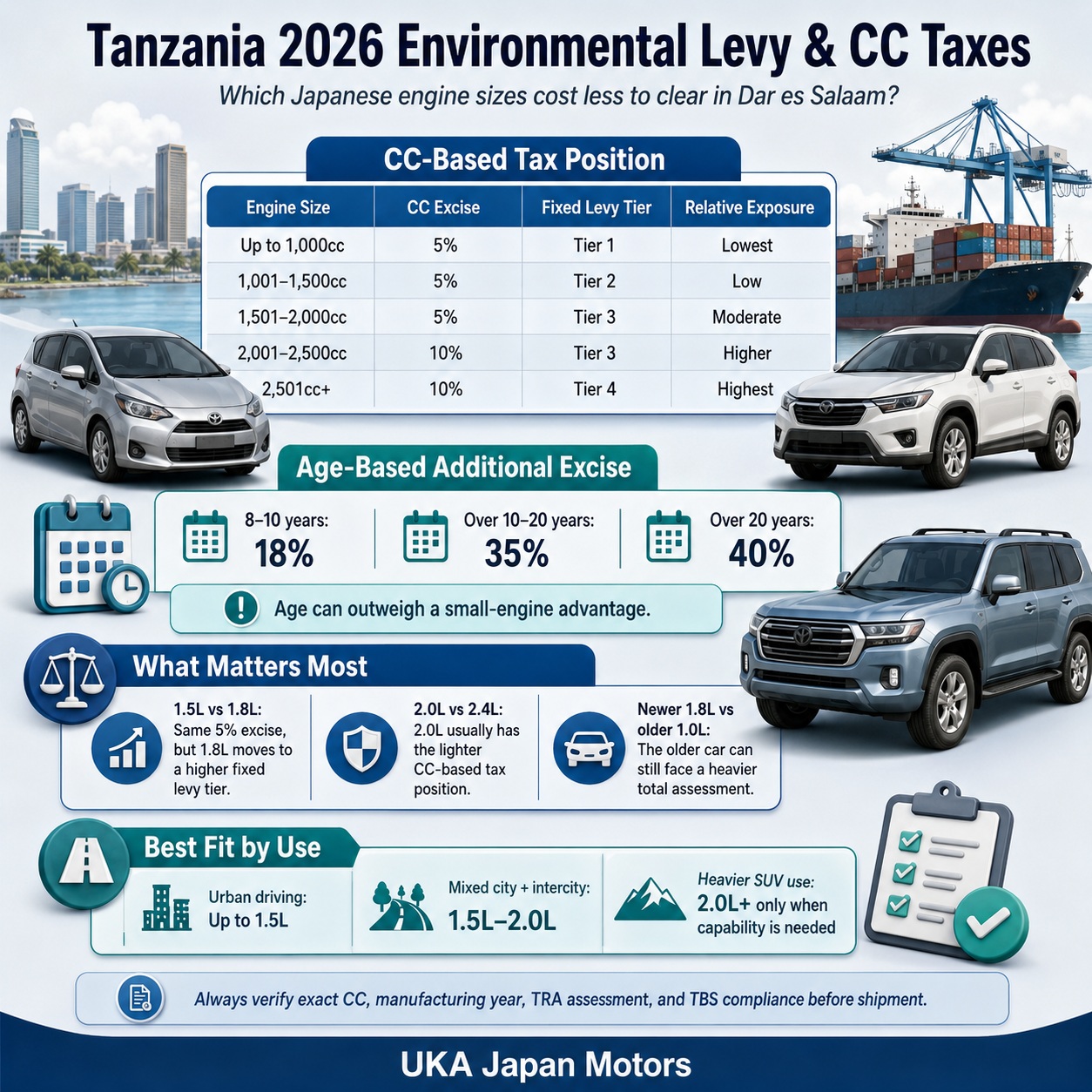
Engine size has always been an important consideration when importing a Japanese vehicle into Tanzania. In 2026, however, buyers must look beyond the familiar assumption that the smallest engine automatically receives the lightest overall clearance assessment.
The Finance Act No. 2 of 2026 took effect on 1 July 2026. Among its vehicle-related changes, cars with engines not exceeding 1,000cc, which previously sat in a nil engine-capacity excise category, became subject to a 5% excise duty. The Act also revised the additional excise rates applied to older imported vehicles.
This means Tanzanian buyers now need to examine at least three separate factors:
- The ordinary excise duty connected to engine capacity.
- The fixed first-registration levy arranged by engine-capacity bands.
- The additional excise duty determined by the vehicle’s age.
These charges do not operate in isolation. A small but significantly older vehicle can face a heavier overall assessment than a newer car with a moderately larger engine. Likewise, two Japanese vehicles marketed as “1.5-litre” models can fall into different statutory bands if their exact cylinder capacities sit on opposite sides of a threshold.
For buyers clearing vehicles through Dar es Salaam, the most useful question is therefore not simply, “Which engine is smallest?” It is:
Which exact combination of engine capacity, manufacturing year, customs classification and vehicle condition is most appropriate for the intended use?
Direct Answer: Which Engine Sizes Have the Lower CC-Based Tax Position?
When only the engine-related parts of the 2026 clearance framework are considered, the general order is:
- Up to 1,000cc: Lowest fixed CC-levy tier, but now subject to 5% engine-capacity excise.
- 1,001cc to 1,500cc: Second fixed levy tier and the 5% engine-capacity excise bracket.
- 1,501cc to 2,000cc: Higher fixed levy tier, although still within the 5% engine-capacity excise bracket.
- 2,001cc to 2,500cc: The ordinary engine-capacity excise rises to 10%, while the vehicle remains in the 1,501cc–2,500cc fixed levy tier.
- 2,501cc and above: The 10% engine-capacity excise applies together with the highest fixed vehicle-levy tier.
The established excise schedule places vehicles above 1,000cc but not exceeding 2,000cc in the 5% bracket and vehicles exceeding 2,000cc in the 10% bracket. The 2026 change brought vehicles not exceeding 1,000cc into a 5% bracket as well.
The fixed first-registration levy introduced under the 2025 fiscal measures uses separate bands: 0–1,000cc, 1,001–1,500cc, 1,501–2,500cc and 2,501cc or more. The levy rises as the vehicle moves into a larger engine category.
Relative 2026 CC-Based Position
| Exact engine capacity | Ordinary CC excise position | Fixed registration-levy tier | Relative combined CC exposure |
|---|---|---|---|
| Up to 1,000cc | 5% | First tier | Lowest |
| 1,001cc–1,500cc | 5% | Second tier | Low |
| 1,501cc–2,000cc | 5% | Third tier | Moderate |
| 2,001cc–2,500cc | 10% | Third tier | Higher |
| 2,501cc and above | 10% | Fourth tier | Highest |
This table compares only the engine-related layers. It does not include the effects of vehicle age, customs valuation, HS classification, inspection results or other clearance requirements.
What Does “Environmental Levy” Actually Mean in Tanzania?
The phrase “environmental levy” is widely used when discussing imported used vehicles, but it can create confusion because not every engine-related charge carries that exact statutory label.
Three different mechanisms are often grouped together in everyday discussion.
Engine-capacity excise duty
This is the percentage-based excise duty applied according to the vehicle’s cylinder capacity and customs classification.
For conventional passenger vehicles, the main dividing point is 2,000cc:
- Engines up to 2,000cc currently fall within the 5% engine-capacity position.
- Engines exceeding 2,000cc move into the 10% position.
Before 1 July 2026, engines not exceeding 1,000cc had a nil rate. The 2026 amendment removed that distinction by applying 5% to the smallest category.
Fixed levy based on engine capacity
A separate levy was introduced for first registration of imported vehicles under the 2025 fiscal changes. It uses four engine-capacity groups, beginning with vehicles up to 1,000cc and ending with those above 2,500cc. It is a fixed statutory levy rather than a percentage calculated from customs value.
This charge should not be confused with ordinary engine-capacity excise duty. A vehicle can be subject to both.
Additional excise duty based on age
The strongest environmental and fleet-renewal element is the additional duty imposed on older used imports. From 1 July 2026, the applicable rates are:
- Eight to ten years old: 18%
- More than ten years and up to twenty years old: 35%
- More than twenty years old: 40%
The final Finance Act moderated the higher rates originally proposed in the Finance Bill, but the enacted percentages still create a major difference between newer and older imports.
Therefore, a buyer should treat “environmental levy” as an informal description of the broader tax treatment that discourages older or larger-engine vehicles, rather than as the name of one single calculation.
The Four Engine Thresholds Buyers Should Check
Rounded engine descriptions can be misleading. Customs assessment is based on the actual cylinder capacity recorded in the vehicle documents and classification, not merely on the model badge used in advertising.
Four thresholds deserve particular attention.
1. The 1,000cc Threshold
A vehicle with an engine not exceeding 1,000cc sits in the first fixed levy tier. A vehicle recorded at 1,001cc enters the second fixed tier.
Under the 2026 ordinary excise rules, however, both sides of this boundary are generally within the 5% engine-capacity position. The difference is therefore created mainly by the fixed first-registration levy rather than the ordinary CC excise percentage.
This changes how buyers should evaluate very small Japanese cars.
Before July 2026, a sub-1,000cc vehicle benefited from a nil ordinary engine-capacity excise rate. That advantage no longer applies. The smallest engines still occupy the lowest fixed levy tier, but they now share the same basic percentage position as engines extending up to 2,000cc.
2. The 1,500cc Threshold
The fixed levy moves to another tier once the engine exceeds 1,500cc.
This makes the exact difference between a 1,496cc engine and a 1,598cc engine relevant. Both remain under the 2,000cc ordinary excise ceiling, but they do not occupy the same fixed levy category.
This is one reason a model name alone is insufficient. A Japanese model may be available with several engines, including variants below and above 1,500cc. The body shape may look almost identical even though the tax classification differs.
3. The 2,000cc Threshold
This is the most important percentage-based CC boundary.
An engine recorded at 1,998cc remains within the 5% ordinary engine-capacity bracket. An engine exceeding 2,000cc moves into the 10% bracket.
The difference between a 2.0-litre and a 2.4-litre vehicle is therefore more significant than the difference between a 1.5-litre and a 1.8-litre vehicle when ordinary engine-capacity excise is considered.
Both a 1.5-litre and a 1.8-litre vehicle generally remain in the 5% category. Once cylinder capacity passes 2,000cc, the applicable percentage changes.
4. The 2,500cc Threshold
A vehicle exceeding 2,500cc enters the highest fixed first-registration levy tier.
The ordinary CC excise has already moved to 10% after 2,000cc, so crossing 2,500cc does not create another ordinary excise percentage change. It does, however, move the vehicle into the upper fixed levy group.
Large Japanese SUVs, MPVs and utility vehicles should therefore be selected because their capability is genuinely required, not simply because a larger engine is assumed to be automatically better.
Engine Sizes Up to 1,000cc
Sub-1,000cc Japanese vehicles occupy the lowest fixed CC-levy category. Typical examples include compact city cars and light hatchbacks with engines around 660cc, 996cc or similar capacities.
Clearance position
These vehicles now attract 5% ordinary engine-capacity excise under the 2026 changes. Their remaining CC-based advantage is that they stay in the first fixed levy tier.
Where they work well
A small engine can suit a driver whose routine is concentrated within Dar es Salaam, particularly where the vehicle normally carries one or two occupants and limited luggage.
Compact dimensions can also be useful in congested urban areas, narrow access roads and restricted parking spaces.
Where limitations may appear
The lowest CC category is not suitable for every Tanzanian use case.
Performance can feel strained when the vehicle is carrying several adults, luggage and operating air conditioning continuously. The limitation becomes more noticeable during overtaking, climbing or longer journeys from Dar es Salaam toward Morogoro, Dodoma, Tanga or other permitted destinations.
A small turbocharged engine may deliver stronger acceleration than its capacity suggests, but it also introduces additional components that require careful inspection. Turbo condition, cooling performance, oil history and correct servicing become especially important.
Who this category suits
It is most appropriate for:
- Primarily urban driving.
- Light passenger loads.
- Drivers comfortable with modest acceleration.
- Buyers prioritising compact dimensions and low CC exposure.
It may not suit regular heavy loading, rough access roads or frequent long-distance travel with several occupants.
Engine Sizes from 1,001cc to 1,500cc
For many Dar es Salaam buyers, this is the most practical low-CC category.
Engines in this group remain within the 5% ordinary engine-capacity bracket and occupy the second fixed levy tier. They therefore carry a lighter CC-based assessment than engines exceeding 1,500cc, while generally providing more usable power than the smallest category.
Why this category is important
Japanese compact cars, hatchbacks, small sedans, station wagons and some crossovers commonly use engines close to 1.2, 1.3 or 1.5 litres.
A naturally aspirated engine around 1.3 or 1.5 litres can be well suited to Dar es Salaam because it provides enough output for air-conditioning use and normal passenger loads without crossing into the higher fixed levy tier.
A 1.5-litre vehicle may also be more relaxed than a sub-1,000cc car on journeys toward Morogoro or Dodoma.
Check the exact capacity
“1.5-litre” is a marketing description, not a customs category.
An engine may be recorded at 1,490cc, 1,496cc or another figure below the threshold. Another vehicle described informally as a 1.5 may have a different technical specification.
The engine code and official cylinder capacity should be checked before shipment. Never rely only on a seller’s shortened description.
Who this category suits
It generally suits:
- Daily urban commuting.
- Small families.
- Mixed Dar es Salaam and occasional intercity use.
- Buyers who do not require a heavy SUV or large MPV.
- Drivers seeking a practical balance between output and lower CC exposure.
For many ordinary passenger-car users, this is the first engine band worth examining.
Engine Sizes from 1,501cc to 2,000cc
This category requires a more careful comparison.
An engine above 1,500cc moves into the third fixed levy tier. However, it remains within the 5% ordinary engine-capacity bracket until it exceeds 2,000cc.
This means a 1.8-litre car does not necessarily face a higher ordinary CC excise percentage than a 1.5-litre car. The distinction comes from the fixed levy category and from any differences in customs valuation.
Practical advantages
Engines between 1.5 and 2.0 litres are common in Japanese sedans, estate cars, compact SUVs and MPVs.
They can offer:
- More confident acceleration with passengers.
- Better performance when air conditioning is running.
- More relaxed intercity driving.
- Greater suitability for luggage and regular family use.
- More flexibility for routes between Dar es Salaam and Morogoro, Dodoma, Arusha, Tanga or Mbeya.
The larger engine may therefore be justified when the vehicle’s role demands it.
The key comparison: 1.5 litres versus 1.8 litres
Both generally remain within the same 5% ordinary engine-capacity excise bracket.
However:
- A vehicle at or below 1,500cc occupies the second fixed levy tier.
- A vehicle exceeding 1,500cc enters the third fixed levy tier.
The 1.5-litre model has the lighter CC-based position, while the 1.8-litre model may provide more suitable performance for regular full-load or intercity use.
The correct choice depends on how the vehicle will actually be used, not just on the tax table.
Engine Sizes from 2,001cc to 2,500cc
Crossing 2,000cc creates the main ordinary excise change.
Vehicles in this range move from the 5% ordinary engine-capacity bracket to the 10% bracket. They also remain within the third fixed levy category until the capacity exceeds 2,500cc.
Typical vehicle types
This group includes certain Japanese:
- Midsize SUVs.
- Larger crossovers.
- Executive sedans.
- MPVs.
- Four-wheel-drive variants.
Their engines may be appropriate for carrying several occupants, travelling long distances or operating heavier bodies.
Why model selection matters
A Japanese vehicle may be available with both a sub-2,000cc engine and a larger option.
For example, two variants can share similar body dimensions and interior space but fall on opposite sides of the 2,000cc excise threshold. Choosing the larger engine should be based on a clear operational reason, such as regular payload, terrain, drivetrain requirements or sustained intercity use.
Where both variants can perform the intended role adequately, the sub-2,000cc version has the lower CC-related tax position.
Inspection priorities
Larger crossovers and SUVs should be inspected for more than engine condition. Important areas include:
- Four-wheel-drive operation.
- Automatic transmission behaviour.
- Cooling-system condition.
- Suspension wear.
- Steering components.
- Underbody condition.
- Tyres of the correct specification.
- Signs of previous collision repair.
A favourable tax band does not compensate for poor mechanical condition, and a larger engine does not guarantee greater durability.
Engine Sizes Above 2,500cc
Engines exceeding 2,500cc sit in the highest fixed levy tier and remain subject to the higher 10% ordinary engine-capacity position.
This category is common among large Japanese SUVs, high-capacity MPVs, utility vehicles and some premium saloons.
When a large engine can be appropriate
A larger engine may be justified for:
- Regular heavy passenger loads.
- Demanding access roads.
- Frequent long-distance use.
- Towing where the vehicle is properly rated.
- Operational requirements that genuinely need higher torque.
- Large four-wheel-drive vehicles whose weight requires additional output.
When it may not be suitable
For a driver whose routine is mainly short trips within Dar es Salaam, a large engine may provide capability that is rarely used.
The vehicle will also have larger supporting systems, including cooling, transmission, tyres, brakes and suspension. Their condition should be assessed as a complete package.
Buyers should avoid choosing this category solely because a large SUV appears stronger. Suitability depends on engineering condition, actual use and correct maintenance.
Why Vehicle Age Can Matter More Than Engine Capacity
The most important 2026 lesson is that engine size cannot be evaluated separately from manufacturing year.
The additional used-vehicle excise rates now reach 18% for vehicles aged eight to ten years, 35% for vehicles over ten and up to twenty years, and 40% for vehicles beyond twenty years.
These percentages are substantial compared with the difference between the 5% and 10% ordinary engine-capacity brackets.
Newer 1.8-litre versus older 1.0-litre
The 1.0-litre vehicle occupies the lowest fixed levy tier. The 1.8-litre car occupies a higher fixed tier.
However, if the smaller car falls into a much older age band while the 1.8-litre car remains below the age-duty threshold, the older vehicle’s age-based assessment can outweigh its CC advantage.
The small engine is therefore not automatically the lighter overall import.
Newer 2.0-litre versus much older 1.5-litre
Both engines generally sit within the 5% ordinary engine-capacity bracket, although their fixed levy categories can differ.
If the 1.5-litre car is significantly older, its additional age excise can create the larger difference. Buyers should compare the manufacturing year before assuming the 1.5-litre model has the better clearance position.
2.0-litre versus 2.4-litre of the same age
When age and customs condition are similar, the engine distinction becomes more direct.
The engine not exceeding 2,000cc remains in the 5% ordinary CC position. The 2.4-litre version moves into the 10% position.
In this comparison, the 2.0-litre model usually has the lighter CC-based assessment, provided both vehicles are classified correctly and have comparable customs valuations.
A separate guide to Tanzania’s 2026 vehicle age surcharge should therefore be read alongside any engine-size comparison.
How TRA Determines the Actual Vehicle Assessment
The Tanzania Trade Portal explains that import duties and taxes depend on the vehicle’s brand, engine size and year of production. It directs importers to the TRA used-motor-vehicle valuation system for the precise assessment.
The exact result is therefore influenced by more than the CC band.
Customs valuation
Percentage-based duties are applied using the customs value accepted for the vehicle. Two cars with the same engine capacity can receive different assessments because of differences in model, specification, manufacturing year and valuation.
HS classification
The customs heading and subheading determine which statutory rates apply.
Petrol, diesel, hybrid and other propulsion systems may be listed under different HS codes. A buyer should not assume that a vehicle receives special treatment merely because it is described as a hybrid.
The exact drivetrain and engine capacity must be declared correctly.
Manufacturing year
The recorded year determines whether the additional age duty applies.
This is why the export certificate and chassis information must be checked before purchase. A registration date should not be casually substituted for the year used under the applicable assessment rules.
Engine capacity
TRA uses the technical cylinder capacity rather than a rounded model description. The engine code should match the export documentation, chassis specification and physical vehicle.
Vehicle identity
Chassis number, model code, engine code and declared specification should agree across the documentation.
Any inconsistency can delay assessment or require further verification.
Dar es Salaam Clearance and Compliance Steps
The official import procedure lists several stages, including appointment of a clearing agent, lodging customs documents, payment of the relevant vehicle levy, obtaining the Tanzania Single Administrative Document, physical vehicle verification, acceptance of the inspection report, issuance of the TBS roadworthiness certificate and TRA release.
A buyer should prepare for the process before the vehicle reaches Dar es Salaam.
Verify the vehicle before shipment
The following should be confirmed:
- Chassis number.
- Model code.
- Engine code.
- Exact cylinder capacity.
- Manufacturing year.
- Fuel type.
- Transmission type.
- Odometer history.
- Structural condition.
- Export documentation.
Complete roadworthiness requirements
TBS roadworthiness compliance is a separate concern from tax assessment.
A vehicle can occupy a favourable CC band and still present compliance or condition problems. Steering, brakes, lights, tyres, emissions-related equipment, structural integrity and identification details should be checked before shipment.
Avoid documentation assumptions
A listing title, auction description or model badge should never be treated as the final customs record.
The documents must support the actual vehicle being imported.
Use the live assessment
Tax rules can be amended, and the customs value differs by vehicle. Buyers should use the current TRA system and qualified clearing documentation rather than relying on an old calculation or a general online estimate.
Our broader Dar es Salaam vehicle import guide provides additional context on TRA, TBS and port-stage documentation.
Choosing an Engine Size for Real Tanzanian Use
The lowest CC band is not always the best ownership decision.
A vehicle that is underpowered for its routine may operate under greater strain, while a larger vehicle selected without a real need can bring unnecessary mechanical complexity.
Primarily Dar es Salaam urban use
For light daily travel, engines up to 1.5 litres can be suitable.
The vehicle should still be tested with the air conditioner operating, because cooling demand affects small-engine performance. Transmission response should also be checked during low-speed driving.
Mixed urban and intercity driving
Engines around 1.3 to 2.0 litres often provide more flexibility for a vehicle that operates in Dar es Salaam but also travels toward Morogoro, Dodoma, Tanga or Arusha.
The correct point within this range depends on vehicle weight, passenger load and transmission design.
A 1.5-litre hatchback and a 1.5-litre seven-seat MPV do not place the same demand on an engine.
Regular family and luggage use
A naturally aspirated engine between 1.5 and 2.0 litres can be more appropriate than a very small engine when the car frequently carries several people and luggage.
The buyer should still compare the exact 1,500cc and 2,000cc boundaries.
SUV requirements
A sub-2,000cc SUV can retain the 5% engine-capacity position, but the vehicle’s performance must be evaluated under realistic load.
A larger SUV may require more than 2,000cc to perform its intended role properly. In that case, the higher CC category may be operationally justified.
Demanding routes and heavy-duty use
Where the vehicle will regularly operate with substantial loads or on difficult access roads, engine size should not be reduced purely to remain in a lower band.
Drivetrain, ground clearance, cooling, suspension, tyres and transmission suitability are equally important.
Long-Term Ownership Considerations by Engine Category
Clearance is only the beginning of vehicle ownership.
Cooling-system condition
Dar es Salaam’s warm coastal environment places importance on a healthy cooling system.
Radiator condition, coolant quality, electric fans, hoses, thermostat operation and signs of previous overheating should be inspected. A small engine working hard with air conditioning can suffer if the cooling system is neglected.
Transmission condition
Many Japanese compact vehicles use continuously variable transmissions.
Correct fluid history and smooth operation are essential. Warning lights, delayed engagement, shuddering and abnormal noise require investigation regardless of engine size.
Larger vehicles may use conventional automatic transmissions or more complex four-wheel-drive systems. These also require proper testing.
Parts identification
Engine code matters after clearance as well as during customs assessment.
Two vehicles with the same model name may use different engines, transmissions and electronic components. Accurate model and engine identification makes future servicing more reliable.
Hybrid systems
A hybrid can be suitable for urban traffic, but its traction battery, inverter cooling, warning history and diagnostic condition should be assessed.
Hybrid status does not remove the need to verify engine capacity, age, customs classification and applicable TRA treatment.
Suspension and underbody
Vehicles intended for regular travel beyond central Dar es Salaam should be inspected for worn bushes, shock absorbers, wheel bearings, steering joints and underbody repairs.
A smaller engine does not make a neglected vehicle a sound ownership choice.
A Practical Selection Method
Before choosing a Japanese import, use the following order.
Step 1: Define the vehicle’s actual job
Decide how many passengers it will carry, where it will travel, how often it will leave Dar es Salaam and whether it needs meaningful cargo or rough-road capability.
Step 2: Select the narrowest suitable engine range
Do not begin with the smallest possible engine. Begin with the smallest range that can perform the intended role without excessive strain.
For many urban users, that may be 1.0–1.5 litres. For mixed use, it may be 1.5–2.0 litres. Larger engines should be connected to a genuine capability requirement.
Step 3: Check the exact CC figure
Pay close attention to the 1,000cc, 1,500cc, 2,000cc and 2,500cc boundaries.
Step 4: Check the manufacturing year
Determine whether the vehicle falls below eight years, within the eight-to-ten-year band, above ten years or beyond twenty years.
Step 5: Compare complete specifications
Compare engine capacity together with:
- Body weight.
- Drivetrain.
- Passenger capacity.
- Transmission.
- Ground clearance.
- Safety equipment.
- Mechanical condition.
Step 6: Verify the live TRA assessment
Use the correct chassis, year, engine capacity and model information.
Step 7: Complete an inspection-led review
Do not allow a favourable tax category to distract from accident history, corrosion, transmission faults, cooling problems or warning lights.
Common Mistakes When Comparing CC Taxes
Treating 1.0 litres as automatically excise-free
That assumption became outdated on 1 July 2026. Vehicles not exceeding 1,000cc now attract 5% ordinary excise.
Assuming all engines below 2,000cc have identical treatment
They share the same ordinary engine-capacity percentage, but the fixed levy changes at 1,000cc and 1,500cc.
Ignoring a difference of a few cubic centimetres
A vehicle just above a threshold can move into another statutory category.
Comparing CC without comparing age
The additional age duty can create a larger difference than engine capacity.
Using the model badge as the engine specification
A model name can cover several engines, drivetrains and production years.
Choosing an engine that is unsuitable for the body
A very small engine in a heavier body may not provide the same experience as the same engine in a compact hatchback.
Assuming hybrid branding determines clearance
Customs treatment depends on the declared HS classification and technical specification, not the badge alone.
Ignoring inspection findings
Tax classification does not indicate mechanical quality.
UKA Japan Motors’ Inspection and Compliance Role
UKA Japan Motors approaches Japanese vehicle selection as an inspection and documentation exercise, not simply a comparison of model names.
Our role is to help buyers understand the information that should be verified before a vehicle is committed for importation, including:
- The correct manufacturing year.
- Chassis and model codes.
- Exact engine capacity.
- Engine and transmission type.
- Auction and condition information.
- Visible structural repairs.
- Warning lights and diagnostic concerns.
- Documentation consistency.
- Likely TBS inspection considerations.
- The appropriate TRA assessment route.
We do not treat a general CC table as a final customs calculation. TRA remains responsible for the official assessment, and the live result should be checked using the exact vehicle information.
This inspection-first approach is especially important in 2026 because a buyer can no longer rely on the old assumption that every sub-1,000cc vehicle occupies a nil ordinary excise category.
Frequently Asked Questions
1. Are Japanese cars below 1,000cc still exempt from ordinary CC excise in Tanzania?
No. From 1 July 2026, vehicles with engines not exceeding 1,000cc became subject to 5% excise duty.
2. Which engine size has the lowest CC-related clearance position?
Vehicles not exceeding 1,000cc remain in the lowest fixed first-registration levy tier. They now share the 5% ordinary engine-capacity position with vehicles up to 2,000cc, but their fixed levy category remains the lowest.
3. Is a 1.5-litre engine treated the same as a 1.8-litre engine?
They generally share the 5% ordinary CC excise position, but they can occupy different fixed levy tiers. A vehicle not exceeding 1,500cc is in the second fixed tier, while one above 1,500cc moves into the third.
4. What happens when an engine exceeds 2,000cc?
The ordinary engine-capacity excise moves from 5% to 10%. This makes the exact difference between an engine at or below 2,000cc and one above it particularly important.
5. Does a vehicle above 2,500cc face another percentage increase?
The ordinary CC excise remains at the above-2,000cc position, but the fixed first-registration levy moves into its highest engine-capacity tier once the vehicle exceeds 2,500cc.
6. Can an older 1.0-litre car face a heavier assessment than a newer 1.8-litre car?
Yes. The 2026 additional age-duty rates can be more influential than the difference between their CC categories. The complete comparison must include manufacturing year and customs valuation.
7. Does the age duty start immediately on every used vehicle?
The additional used-vehicle excise begins when the vehicle reaches the relevant statutory age threshold. The 2026 bands begin at eight years, followed by higher categories above ten and twenty years.
8. Is the engine size written on the boot badge sufficient?
No. Customs assessment should use the exact cylinder capacity supported by the engine code, chassis specification and official vehicle documents.
9. Do hybrid Japanese vehicles avoid CC taxes?
Hybrid status does not automatically remove engine-capacity assessment. The vehicle must be classified under the correct HS code, and its engine size, drivetrain, age and current statutory treatment must be verified through the live TRA process.
10. What engine range is generally suitable for Dar es Salaam?
For light urban use, engines up to 1.5 litres can be suitable. For mixed urban, family and intercity operation, a range between 1.5 and 2.0 litres may provide greater flexibility. The correct choice depends on body weight, passenger load, transmission and vehicle condition.
11. Does a smaller engine always use less fuel?
Not in every situation. Vehicle weight, gearing, traffic, driving style, air-conditioning demand and mechanical condition all influence consumption. A very small engine working continuously under heavy load may not behave as expected.
12. Can the final TRA assessment be calculated from CC alone?
No. The Tanzania Trade Portal states that the duties and taxes depend on factors including brand, engine size and year of production. The current TRA vehicle valuation system should be used for the precise assessment.
Conclusion
Tanzania’s 2026 vehicle tax framework changes the way buyers should compare small Japanese engines.
A vehicle not exceeding 1,000cc still occupies the lowest fixed CC-levy category, but it no longer benefits from a nil ordinary engine-capacity excise rate. Engines from 1,001cc to 1,500cc remain a strong option for buyers who need more practical performance while staying in a relatively low CC category.
Engines from 1,501cc to 2,000cc continue within the 5% ordinary excise position, although they enter a higher fixed levy tier. Once an engine exceeds 2,000cc, the ordinary CC excise rises to 10%, and vehicles above 2,500cc also enter the highest fixed levy category.
The decisive factor, however, may be the vehicle’s age. The additional 2026 age-duty bands can outweigh the advantage of choosing a smaller engine. A newer, well-inspected Japanese vehicle with a suitable moderate engine may therefore present a more rational clearance and ownership profile than a much older small-engine car.
Buyers should verify the exact cylinder capacity, manufacturing year, chassis number, engine code, customs classification and inspection condition before shipment. The most suitable vehicle is not automatically the one with the smallest engine, but the one whose specification, age, condition and intended use align properly with Tanzania’s current clearance framework.
Contact UKA Japan Motors for availability and inspection guidance.