


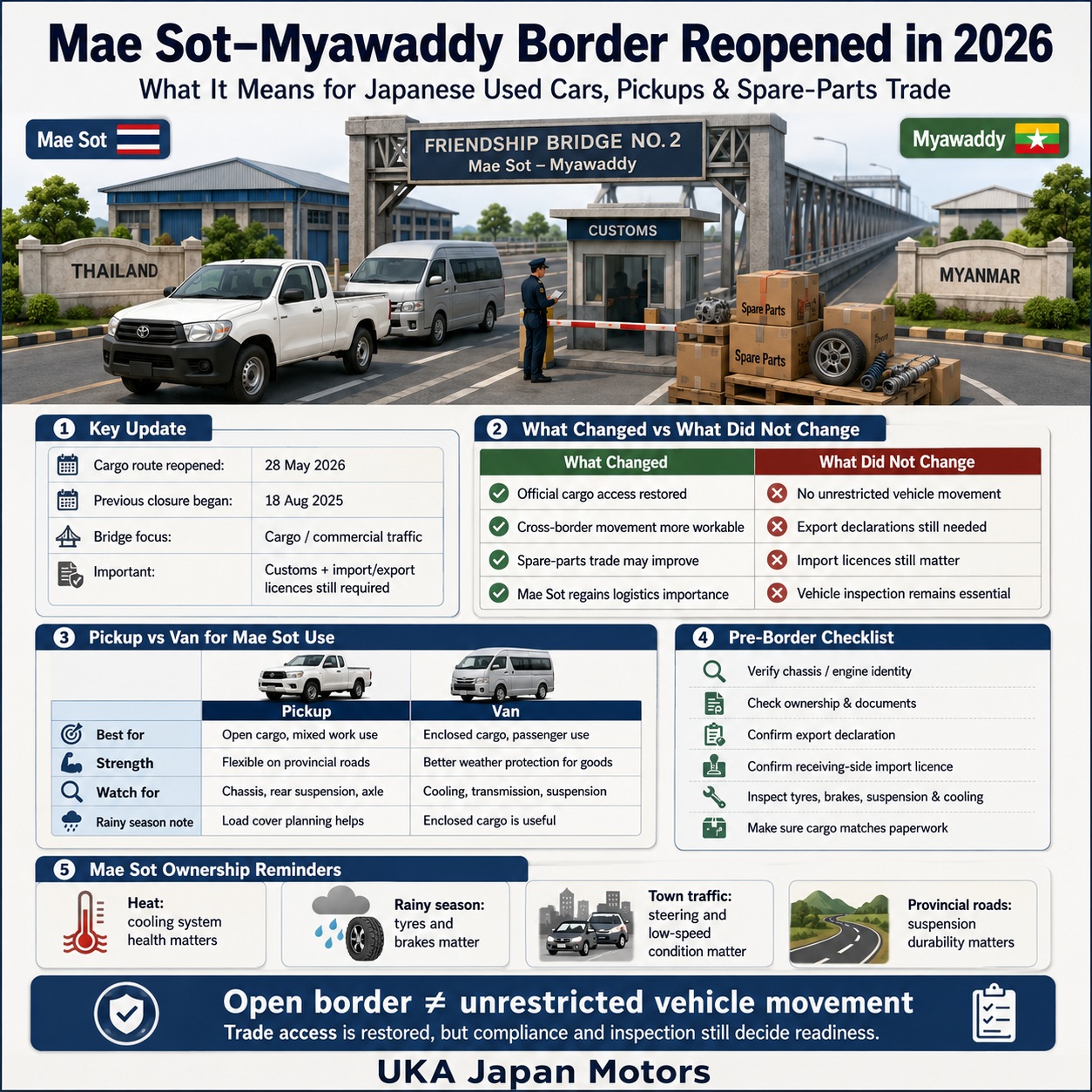
The reopening of the Mae Sot–Myawaddy cargo crossing in 2026 is an important development for businesses and vehicle-related operators in Mae Sot, Tak Province. However, its practical meaning is more specific than simply saying that the “border is open again.”
Myanmar reopened the Myawaddy checkpoint opposite Thailand’s Second Thai–Myanmar Friendship Bridge in Mae Sot on 28 May 2026, after the Myanmar side had kept the cargo checkpoint closed since 18 August 2025. Thailand’s Department of International Trade Promotion subsequently confirmed that cargo vehicles had begun moving through the checkpoint again and that applications for import and export licences on the Myanmar side had resumed.
For Mae Sot’s automotive sector, this matters because the border route has historically supported the movement of commercial goods, vehicles, components and related equipment. Official Thai reporting on the reopening specifically identified vehicles and spare parts among the categories that could benefit from restored trade access.
Yet reopening a bridge does not remove customs controls, vehicle documentation requirements, import permissions or inspection responsibilities. A Japanese used pickup, van, passenger car, engine, transmission or group of used components cannot simply be moved across the border because the physical route is operating.
For owners, traders and businesses in Mae Sot, the more important question is therefore not just “Is the bridge open?”
It is:
“Is this particular vehicle or automotive shipment properly documented, permitted, declared, inspectable and suitable for the intended use?”
That distinction is essential in 2026.
Direct Answer: What Does the 2026 Reopening Mean?
In practical terms, the reopening restores an important formal cargo route between Mae Sot and Myawaddy and makes organised cross-border movement more workable than during the closure.
For the Japanese used-vehicle and spare-parts sector in Mae Sot, it can mean:
- more regular use of an official cargo crossing for permitted automotive goods;
- renewed relevance of Mae Sot as a vehicle and parts logistics point;
- increased importance of correct Thai export declarations;
- renewed need to verify destination-side import licences before dispatch;
- greater attention to chassis numbers, engine numbers and supporting vehicle records;
- stronger reasons to separate legally documented vehicles and components from uncertain stock;
- greater importance of accurate inspection before vehicles enter long transport or commercial-use cycles;
- continued customs scrutiny of used tyres, engines, components and other automotive goods.
It does not mean that every used Japanese vehicle or second-hand automotive component is automatically allowed to cross.
Thai Customs requires formal procedures for goods exported across a land border. For general commercial exports, exporters must submit an electronic export declaration before goods are moved to the customs checkpoint, together with supporting information such as invoices, packing information where applicable, and permits for controlled goods.
The Myanmar-side reopening has likewise been linked to import-licence and export-licence procedures rather than unrestricted trade. Thailand’s DITP advised businesses to obtain the relevant licences before transporting goods through official Myanmar checkpoints.
The border reopening should therefore be understood as restored infrastructure and customs access, not as a removal of regulation.
Why Friendship Bridge No. 2 Matters to Mae Sot
Mae Sot has more than one type of border movement.
Friendship Bridge No. 1 has traditionally been associated mainly with passenger and smaller-vehicle movement, while Friendship Bridge No. 2 is designed around cargo transportation and commercial traffic. Reporting surrounding the May 2026 reopening specifically described Bridge No. 2 as the cargo route.
That distinction matters when discussing used Japanese vehicles.
A privately registered vehicle temporarily driven across a border is not necessarily following the same customs procedure as a vehicle exported as commercial merchandise. Likewise, a truck carrying engines or replacement parts is different from the vehicle carrying that cargo.
Thai Customs provides a separate procedure for temporarily taking a Thai-registered personal vehicle out of Thailand through a land checkpoint. The owner normally needs the vehicle registration record and travel documents, while an authorisation document is required where the driver is not the registered owner. Customs then records the temporary movement through the relevant special declaration procedure.
Commercial vehicle exports are different.
A Japanese pickup being permanently exported as merchandise is fundamentally a customs shipment, not simply a road trip across the bridge.
This is why owners and operators in Mae Sot should avoid treating all cross-border vehicle movements as one category.
What the Reopening Could Mean for Japanese Used Cars in Mae Sot
Mae Sot has long had an automotive environment shaped by several different forms of vehicle use: personal commuting, family transport, business operations, goods movement, provincial-road travel and border-related activity.
Japanese used cars remain relevant within this environment because many familiar Japanese platforms are designed around practical everyday use.
However, the reopening of the cargo route should not change the basic standards by which a vehicle is assessed.
A vehicle that may potentially form part of cross-border commercial activity still needs to be judged first as a machine.
That means examining:
- chassis and structural condition;
- engine operation;
- transmission behaviour;
- cooling-system performance;
- braking condition;
- suspension wear;
- steering condition;
- tyre age and condition;
- signs of accident repair;
- evidence of water exposure;
- electrical reliability;
- mileage consistency;
- identification numbers;
- service and ownership records where available.
Mae Sot’s climate makes several of these checks especially important.
High temperatures place constant demands on cooling systems, air-conditioning systems, batteries, rubber hoses and engine fluids. During the rainy season, water, mud and poor drainage can expose weaknesses in tyres, brakes, suspension joints, wheel bearings and electrical connections.
A visually clean vehicle may therefore still require careful mechanical inspection.
The reopening of a trade route does not reduce those risks.
If anything, a vehicle expected to work around cargo operations, commercial routes or repeated provincial travel needs stronger condition assessment because unreliable cooling, braking or suspension can become more serious during sustained use.
Japanese Pickups May Receive Particular Attention—but Suitability Still Comes First
Pickups are naturally important in Mae Sot because they can support family use, business activity, agricultural work, tools, supplies and general goods movement.
The border reopening may strengthen operational interest in pickups because commercial activity around a functioning cargo route tends to require adaptable transport.
But a pickup should not be selected simply because it is a pickup.
The correct question is whether the individual vehicle suits the work expected of it.
For a Japanese used pickup, inspection should include the normal mechanical systems as well as load-related components.
The rear suspension deserves particular attention. Leaf springs, bushes, shackles and dampers can reveal a history of demanding use.
The chassis should be examined for:
- distortion;
- corrosion;
- poorly repaired accident damage;
- cracks;
- unusual welding;
- mounting-point damage;
- evidence of repeated overloading.
The rear axle, differential and propeller shaft also deserve attention on vehicles used regularly for commercial duties.
A pickup that has spent much of its life lightly used is different from one that has repeatedly carried demanding loads over uneven surfaces.
Both may appear similar from outside.
Their long-term ownership requirements may be very different.
Pickup Versus Van for Mae Sot Border-Related Business Use
The reopening also makes a useful comparison between pickups and vans.
| Consideration | Japanese Pickup | Japanese Van |
|---|---|---|
| Open cargo | Well suited | Usually limited |
| Weather protection for goods | Requires covered load area | Strong |
| Passenger carrying | Depends on cab configuration | Often stronger |
| Loading flexibility | High | High for enclosed cargo |
| Rougher provincial roads | Often suitable when suspension is healthy | Depends strongly on model and condition |
| Heavy commercial history risk | Chassis, rear suspension and drivetrain | Transmission, rear suspension, doors and cooling |
| Mae Sot rainy season | Load protection requires planning | Enclosed cargo can be advantageous |
| Inspection focus | Chassis, axle, suspension, load history | Cooling, transmission, suspension, sliding doors, interior wear |
Neither vehicle type is universally better.
A pickup may suit tools, equipment and mixed road conditions.
A van may suit enclosed cargo or passenger movement.
The correct choice depends on actual use, road conditions, loading requirements and the condition of the individual vehicle.
Spare-Parts Trade May Be One of the Most Important Areas to Watch
The implications of the reopening are not limited to complete vehicles.
Spare parts are particularly relevant because maintaining older Japanese cars, pickups and vans requires a continuing supply of components.
Official reporting following the reopening specifically included spare parts among the goods expected to benefit from restored cross-border trade activity.
That can include a wide variety of automotive items, such as:
- suspension components;
- steering components;
- electrical equipment;
- body components;
- cooling-system parts;
- drivetrain components;
- engines and engine components;
- transmissions;
- wheels;
- tyres;
- interior components.
But “spare parts” is not a single customs category in practical terms.
A new component in manufacturer packaging may be treated differently from a complete used engine.
A clean used body panel is different from a collection of dismantled components.
A mechanical assembly with identification numbers may require different supporting information from small general replacement parts.
Used tyres and certain second-hand components can also attract particular regulatory attention.
Mae Sot Customs has publicly reported enforcement activity involving used vehicle tyres, engines, wheels and other second-hand automotive components. Those enforcement reports reinforce a basic point for anyone involved in border automotive trade: the existence of an active market does not override customs controls or other applicable restrictions.
For legitimate operators, traceability matters.
Complete Vehicle Versus Spare-Parts Shipment
The difference between exporting a complete used vehicle and exporting automotive components should be understood clearly.
Complete Used Vehicle
A complete vehicle has a unique identity.
Important information can include:
- chassis or VIN identification;
- engine number where applicable;
- make and model;
- registration history;
- ownership documentation;
- customs status;
- physical condition;
- intended export status.
Mismatch between the vehicle and its records should be treated seriously.
A chassis number that is difficult to read, appears altered or does not correspond with supporting documents requires investigation before any further movement.
Spare Parts
Individual parts may not carry the same complete registration identity, but proper cargo descriptions are still important.
A shipment described simply as “car parts” may contain components with very different regulatory characteristics.
An engine, used tyre, body panel and small electrical sensor are not practically identical items.
Accurate identification makes customs processing more transparent and reduces the risk of confusion during inspection.
For Mae Sot operators, the safest working principle is straightforward:
The physical cargo should match the description in the documentation.
Border Reopening Does Not Replace Thai Customs Procedure
One of the biggest misunderstandings surrounding border reopening stories is the idea that an open gate means goods can move with minimal paperwork.
Formal commercial exports from Thailand remain subject to customs procedures.
Thai Customs states that exporters moving general goods through a land border must prepare and electronically submit an export declaration before bringing the goods to the customs checkpoint. Supporting information commonly includes an invoice, packing list where applicable and any required permission for controlled products.
Vehicle-related cargo should therefore be prepared before it reaches the bridge.
This is especially important for businesses dealing with multiple vehicles or dismantled components.
Waiting until the shipment reaches the border to establish basic information such as model, chassis identity, engine identity, cargo description or ownership history creates avoidable uncertainty.
A Practical Pre-Border Documentation Check
Before a complete used vehicle or automotive cargo is prepared for formal movement, operators should check:
- Who legally controls the vehicle or goods?
Ownership and authority should be clear.
- Does the physical vehicle match its documents?
Chassis numbers, registration information and other identifiers should correspond.
- Is this a temporary vehicle movement or a commercial export?
The procedures are not the same.
- Are any special permissions required?
Controlled goods need the relevant approvals.
- Does the receiving side have the necessary import permission?
Reopening the Myawaddy checkpoint did not eliminate import licensing requirements.
- Is the cargo accurately described?
Engines, tyres, body parts and mechanical assemblies should not be treated as an unidentified mixed load.
- Has the vehicle been inspected before transport?
A mechanically weak vehicle can create problems before it even reaches its destination.
This is where documentation and mechanical inspection intersect.
Inspection-Ready Vehicle Versus Poorly Documented Vehicle
The border reopening also highlights a broader distinction relevant to Mae Sot’s used-vehicle market.
Consider two visually similar Japanese pickups.
The first has:
- readable chassis identification;
- documentation that matches the vehicle;
- understandable ownership history;
- consistent mechanical condition;
- no obvious structural irregularities;
- tyres and brakes suitable for continued use;
- stable cooling-system operation.
The second has:
- unclear identification;
- incomplete records;
- inconsistent body repairs;
- uncertain engine identity;
- poor tyres;
- neglected suspension;
- cooling-system problems.
The first vehicle is easier to assess objectively.
The second carries several different kinds of uncertainty at once.
That does not automatically determine the legal or mechanical status of either vehicle, but it demonstrates why proper inspection cannot focus only on appearance.
For a buyer who intends to register and use the vehicle in Thailand, clean Thai documentation and inspection readiness are essential.
For a commercial operator considering legitimate export activity, documentation becomes even more important because customs and destination-side procedures are added to the equation.
What the Reopening Means for Mae Sot’s Local Vehicle Owners
Not everyone in Mae Sot is involved in cross-border trade.
Many residents simply need dependable transport for work, family and daily life.
For these owners, the reopening still matters indirectly because Mae Sot’s roads and commercial activity are connected to its role as a border town.
When freight activity increases around key routes, drivers may encounter:
- more heavy vehicles;
- changing traffic patterns;
- queues near logistics areas;
- increased road wear;
- mixed local and commercial traffic.
That makes ordinary roadworthiness particularly important.
Tyres with weak wet-weather performance can become dangerous during the rainy season.
Worn brake components deserve attention in stop-and-go town traffic.
Suspension wear becomes more noticeable on uneven provincial roads.
Cooling weaknesses often emerge in heat, slow-moving traffic and sustained operation.
The correct response is not to seek a particular vehicle type simply because border activity has increased. It is to make sure the vehicle already being used—or being considered for ownership—is suitable for Mae Sot conditions.
Mae Sot Town Driving Versus Provincial and Commercial Road Use
A vehicle’s ideal condition also depends on where it will spend most of its time.
Mae Sot Town Use
Town driving involves frequent braking, intersections, short trips and slower traffic.
Important inspection areas include:
- cooling fan operation;
- air-conditioning;
- battery condition;
- brakes;
- steering;
- tyres;
- engine idle quality;
- automatic transmission behaviour at low speeds.
Repeated short journeys can be demanding in a different way from highway travel.
Provincial Road Use
Longer travel outside town places greater emphasis on:
- tyre integrity;
- wheel alignment;
- suspension stability;
- shock absorbers;
- cooling-system reliability;
- transmission temperature control;
- engine fluid condition;
- braking consistency.
Commercial Use
Vehicles carrying goods regularly need additional scrutiny of:
- load-bearing suspension;
- chassis condition;
- axle components;
- tyres appropriate to the intended load;
- brakes;
- drivetrain;
- cooling system.
A vehicle suited to light daily commuting may not automatically be suitable for repeated commercial loading.
Registration in Thailand Remains a Separate Issue
The reopening of the Mae Sot–Myawaddy cargo checkpoint should not be confused with Thai vehicle registration.
A border trading route and Thailand’s domestic vehicle registration system are separate matters.
If a used vehicle is intended to remain in Thailand and operate on Thai roads, the buyer should focus on whether the vehicle’s Thai registration status, ownership records and transfer documentation are correct.
The fact that a similar model may participate in cross-border trade does not establish the registration status of an individual vehicle.
Buyers should check that key information is internally consistent, including:
- vehicle identity;
- registration record;
- chassis number;
- engine information where recorded;
- ownership information;
- supporting transfer documents.
Any significant discrepancy should be resolved before the vehicle is treated as ready for normal ownership.
Documentation should not be an afterthought after the mechanical inspection.
It is part of the inspection.
Why Mileage Awareness Still Matters
Border activity can also create confusion around mileage because commercial vehicles can accumulate distance differently from privately used vehicles.
Mileage should therefore be interpreted together with physical wear.
Useful comparison points include:
- steering-wheel condition;
- pedal wear;
- seat condition;
- door hinges;
- suspension wear;
- engine condition;
- transmission response;
- load-area condition on pickups;
- cargo-floor wear on vans.
A low odometer reading combined with extensive commercial wear deserves closer examination.
A higher reading accompanied by coherent maintenance and healthy mechanical systems may be easier to understand.
Mileage alone does not describe vehicle condition.
For Mae Sot owners, the objective should be mileage awareness, not simply chasing the lowest number.
Border Trade and the Importance of Cooling-System Inspection
Cooling systems deserve special attention in Mae Sot.
Heat and sustained commercial use can expose cooling weaknesses quickly.
Before long-term ownership or demanding road use, inspect:
- radiator condition;
- coolant level and condition;
- hoses;
- hose connections;
- water pump behaviour;
- cooling fans;
- thermostat operation;
- signs of previous overheating;
- oil and coolant contamination;
- temperature behaviour in slow traffic.
Japanese pickups and vans that have spent years in commercial service may have had cooling components replaced at different times.
Replacement itself is not a problem.
Poor-quality repair work or unresolved overheating is.
A properly maintained cooling system is particularly important when a vehicle may travel beyond Mae Sot town or operate regularly in traffic with cargo.
Rainy-Season Checks Should Not Be Ignored
Mae Sot’s rainy season creates another ownership consideration.
Vehicles exposed to standing water, repeated mud or poorly drained roads may develop problems that are not immediately visible on a dry inspection day.
Areas worth checking include:
- wheel bearings;
- lower suspension joints;
- brake components;
- tyre tread;
- electrical connectors;
- underbody corrosion;
- chassis drain areas;
- cabin water ingress;
- pickup load-bed drainage;
- door and window seals.
For used vehicles, signs of past water exposure need careful interpretation.
A damp smell, unusual corrosion inside electrical connectors, stained carpets or inconsistent interior replacement can justify further examination.
This applies whether a vehicle is intended for family use, business use or cross-border-related activity.
What Could Change After the Reopening?
The most important lesson from the 2025–2026 closure is that border conditions are not permanently fixed.
The Myawaddy cargo checkpoint closed on the Myanmar side in August 2025 amid security problems and reopened on 28 May 2026. Initial reopening reports described limited operations before broader cargo processing resumed.
Security conditions around transport routes in Karen State have also remained changeable, including conflict affecting strategic roads connected with Myawaddy.
For a Mae Sot automotive business, that means planning should never rely only on the statement that the bridge “reopened in 2026.”
Current checkpoint conditions should be verified before dispatch.
Import permissions should be confirmed before loading.
Documentation should be complete before vehicles reach customs.
The condition of the road beyond the formal border should not be assumed from the condition of the bridge itself.
A functioning checkpoint and a predictable complete transport route are related, but they are not identical.
Practical Guidance for Japanese Used-Vehicle Operators in Mae Sot
The reopening can be approached more safely through a disciplined sequence.
1. Start With Vehicle Identity
Confirm the make, model, chassis identification and other relevant details.
Do not begin with assumptions based on appearance.
2. Check Ownership and Documentation
Establish who controls the vehicle and whether records correspond with the physical vehicle.
3. Decide the Intended Use
Is it intended for Thai road ownership?
Commercial export?
Temporary movement?
Parts dismantling?
Those purposes lead to different requirements.
4. Inspect Mechanical Condition
Engine, transmission, cooling, brakes, suspension, tyres and steering should be assessed.
5. Check Structural Condition
Look underneath the vehicle as well as around the exterior.
6. Separate Complete Vehicles From Components
Do not treat an engine shipment, used tyres and a complete pickup as identical customs goods.
7. Confirm Applicable Permissions
Thai export rules and destination-side import requirements should be checked before movement.
8. Use Formal Border Procedures
Restored official cargo access is most useful when the cargo is properly documented and declared.
Long-Term Ownership: What Matters After the Border Story Fades
The reopening is important news in 2026, but a vehicle may remain in service for many years.
That means owners should avoid allowing a short-term trade development to dominate a long-term vehicle decision.
For a Japanese used vehicle in Mae Sot, long-term suitability still depends on factors such as:
- mechanical condition;
- serviceability;
- parts availability;
- cooling performance;
- brake condition;
- suspension durability;
- tyre requirements;
- interior space;
- cargo requirements;
- passenger needs;
- daily driving pattern;
- rainy-season behaviour;
- provincial-road suitability.
A family using a compact car primarily around Mae Sot has different requirements from a business using a pickup with regular loads.
A van carrying passengers needs different inspection priorities from a pickup carrying equipment.
A hybrid operating mostly in town needs attention to its hybrid system and cooling as well as normal mechanical components.
There is no single vehicle type made “correct” by the reopening of the border.
The correct vehicle is the one that is mechanically sound, properly documented and appropriate for its actual work.
Common Misunderstandings About the 2026 Border Reopening
“The border is open, so any car can cross.”
No.
The physical reopening does not cancel customs, licensing or destination-side requirements.
“A vehicle with Thai registration can automatically be permanently exported.”
Thai registration alone does not replace commercial export procedures or destination import approval.
“Driving a vehicle across temporarily is the same as exporting it.”
No.
Thai Customs has a specific procedure for temporary cross-border movement of personal vehicles, while commercial goods exports use separate declarations.
“All spare parts follow the same rules.”
Not necessarily.
Parts differ in condition, classification and regulatory characteristics.
“If the engine starts, the vehicle is suitable for trade or long-term use.”
Starting the engine is only one small part of a proper inspection.
“Documentation can be sorted out after the vehicle reaches the checkpoint.”
That approach creates unnecessary risk.
Core vehicle identity, ownership information, customs documents and relevant permissions should be addressed beforehand.
Frequently Asked Questions
1. When did the Mae Sot–Myawaddy cargo checkpoint reopen in 2026?
The Myawaddy checkpoint opposite Thailand’s Second Thai–Myanmar Friendship Bridge in Mae Sot reopened on 28 May 2026 after being closed by the Myanmar side since 18 August 2025. Cargo movement initially resumed on a limited basis.
2. Is Friendship Bridge No. 2 mainly for cargo?
Yes. The second bridge is principally associated with cargo transportation and commercial border activity, while Bridge No. 1 has commonly served passenger and smaller-vehicle movements.
3. Does the reopening mean Japanese used cars can automatically be exported through Mae Sot?
No. Reopening the checkpoint restores the route but does not remove customs procedures, export declarations, applicable permissions or destination-side import requirements.
4. Are import licences still relevant after the reopening?
Yes. Thai DITP reporting on the reopening specifically stated that Myanmar-side import and export licence applications had resumed and advised businesses to obtain the relevant permissions before shipment.
5. What documents matter when exporting goods by land from Thailand?
Thai Customs requires an export declaration for normal commercial land exports. Supporting documents can include an invoice, packing information where applicable and permits or approvals where goods are controlled.
6. Is temporarily driving a Thai vehicle across the border different from commercially exporting it?
Yes. Thai Customs provides a special procedure for temporarily taking a registered personal vehicle outside Thailand through a land border. Vehicle registration records, travel documents and owner authorisation where necessary form part of that process.
7. What should be inspected on a Japanese used pickup in Mae Sot?
Inspect the engine, transmission, cooling system, brakes, tyres, steering, suspension, chassis, rear axle, differential, load area, accident repairs and identification numbers. For Mae Sot use, cooling performance and rainy-season roadworthiness are especially important.
8. Are used spare parts automatically easier to trade than complete vehicles?
No. A complete vehicle and a spare part have different documentation characteristics, but used automotive goods still require correct classification and lawful customs handling. Mae Sot Customs has reported enforcement involving used tyres, engines and other vehicle components.
9. Does the border reopening affect Thai vehicle registration?
Not directly. Cross-border trade procedures and Thailand’s domestic vehicle registration system are separate. A vehicle intended to remain in Thailand should have clear registration, ownership and transfer documentation regardless of developments at the border.
10. Is a pickup always more suitable than a van for Mae Sot business use?
No. Pickups are flexible for open cargo and mixed road use, while vans can provide enclosed cargo space or passenger capacity. The appropriate choice depends on use, loading pattern, road conditions and individual vehicle condition.
11. Should buyers focus mainly on mileage?
No. Mileage should be considered alongside engine condition, transmission behaviour, suspension wear, interior wear, structural condition and maintenance history. A mileage number without supporting condition evidence gives only part of the picture.
12. Could border operating conditions change again?
Yes. The previous closure and subsequent reopening demonstrate that border operations can respond to security, administrative and infrastructure conditions. Operators should verify current official checkpoint and licensing requirements before arranging a shipment.
UKA Japan Motors Thailand – Mae Sot: Inspection and Documentation Awareness
For UKA Japan Motors Thailand – Mae Sot, the significance of the 2026 border reopening is not simply that more vehicle-related movement may become possible.
The more important issue is whether that movement is supported by clear vehicle information, appropriate inspection and correct documentation.
Japanese used vehicles should be assessed individually.
That means helping owners and operators understand areas such as:
- chassis and body condition;
- engine and transmission behaviour;
- tyres and braking systems;
- suspension condition;
- cooling performance;
- mileage awareness;
- signs of previous repairs;
- registration information;
- vehicle identification;
- ownership documentation;
- inspection readiness;
- suitability for Mae Sot driving conditions.
For vehicles connected with legitimate cross-border activity, documentation awareness becomes even more important because Thai customs requirements and destination-side import procedures must be considered in addition to mechanical condition.
UKA Japan Motors’ role is therefore centred on transparent condition awareness, practical inspection guidance, documentation understanding, compliance awareness and long-term ownership suitability.
A functioning border may create new movement.
Proper inspection and documentation determine whether a particular vehicle is actually ready for that movement.
Expert Conclusion
The reopening of the Myawaddy cargo checkpoint opposite Mae Sot’s Second Thai–Myanmar Friendship Bridge on 28 May 2026 restored an important formal route for Thailand–Myanmar cargo traffic after a lengthy closure. Vehicles and automotive spare parts are among the sectors with a direct connection to renewed border activity.
For Mae Sot’s Japanese used-car, pickup, van and spare-parts sector, however, the most important lesson is not that restrictions have disappeared.
They have not.
The reopening restores access to an official cargo route. Commercial exports from Thailand still require customs declarations and relevant supporting documentation, while destination-side import permissions remain important. Different rules can also apply to complete vehicles, temporary vehicle movements and different categories of used automotive components.
Mechanical condition remains equally important.
Pickups expected to carry loads need careful chassis, suspension and drivetrain inspection. Vans need cooling, transmission, suspension and body-system checks. Passenger cars require the same disciplined attention to tyres, brakes, steering, cooling and documentation.
Mae Sot’s heat, rainy season, town traffic and provincial-road conditions make roadworthiness a long-term ownership issue rather than a border-only issue.
The most dependable approach in 2026 is therefore to separate three questions clearly: Can the route be used? Is the vehicle or cargo legally and properly documented? Is the vehicle mechanically suitable for its intended use?
A reopened border answers only the first question.
Inspection, documentation and compliance awareness answer the others.
Contact UKA Japan Motors for availability and inspection guidance.