


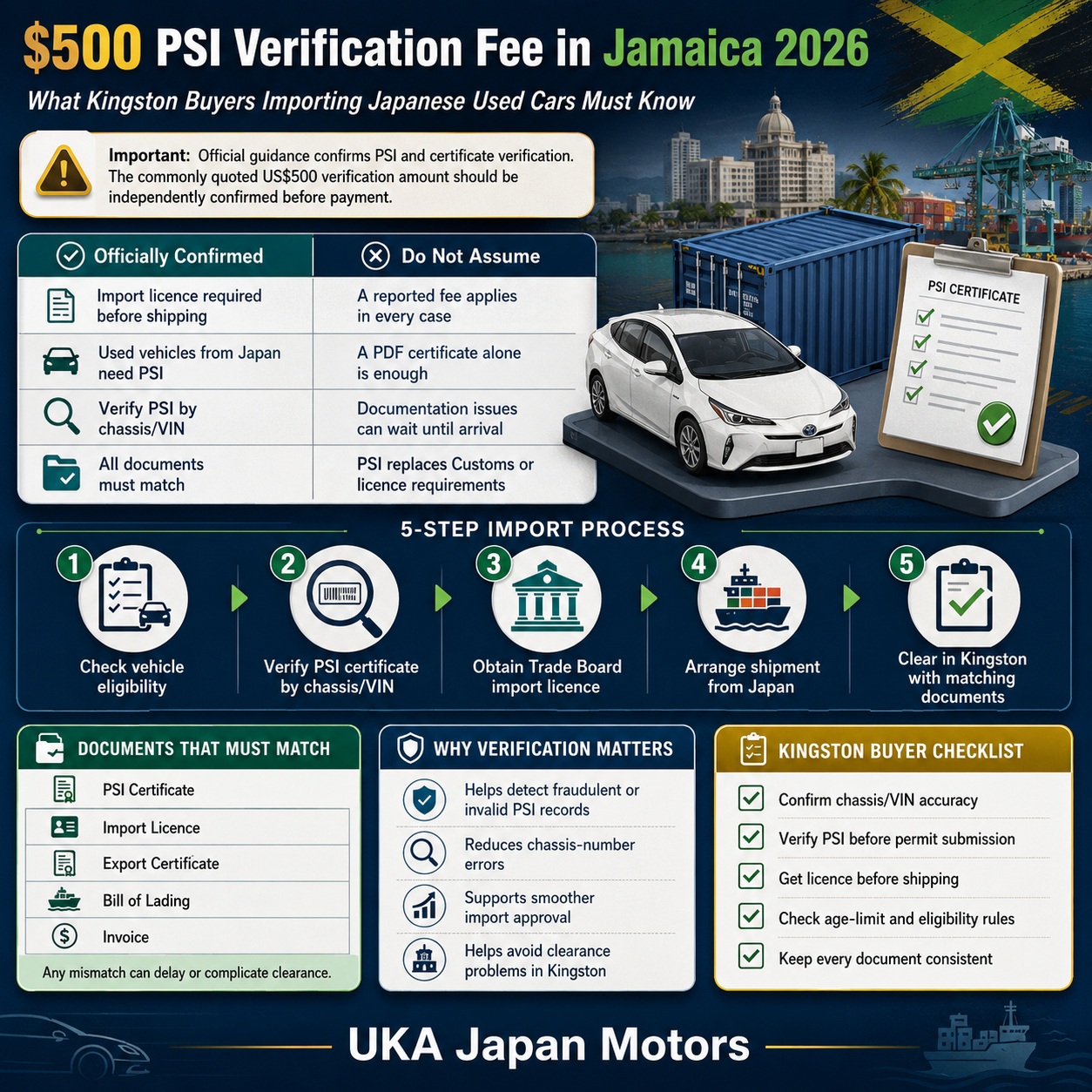
Importing a Japanese used car into Jamaica involves more than selecting a vehicle and arranging shipment. Before the vehicle can move through the Jamaican import process correctly, several regulatory steps have to line up, including the import licence, pre-shipment inspection documentation, vehicle identification information and the paperwork ultimately required for Customs clearance.
For Kingston buyers in 2026, one of the most important parts of this process is the Pre-Shipment Inspection, commonly referred to as PSI.
The subject has attracted additional attention because buyers sometimes encounter references to a separate PSI verification charge or a specific verification amount. However, the current Jamaica Trade Board and Jamaica Customs material reviewed for this guide confirms the PSI requirement and provides a system for verifying inspection certificates, but it does not currently publish the frequently quoted verification amount as a standard government charge. Buyers should therefore avoid treating an informal figure, exporter statement or social-media explanation as an official rule unless it can be confirmed against the current Trade Board or inspection-provider procedure.
What is clear is that PSI itself matters. Jamaica Customs states that a person intending to import a motor vehicle must obtain the appropriate Trade Board import licence before making shipping arrangements and that the vehicle must be inspected and issued with a pre-inspection certificate before importation. For used vehicles coming from Japan, Jamaica Customs identifies Auto Terminal Japan in connection with the inspection process.
For a buyer in Kingston, the safest approach is therefore not to focus on a headline figure. The priority should be ensuring that the inspection is genuine, the chassis number can be verified, the vehicle is eligible to enter Jamaica, the import licence is approved at the correct stage and every document describes the same vehicle.
Direct Answer: What Kingston Buyers Need to Know
A Japanese used car intended for import into Jamaica should have its compliance position checked before shipment is arranged.
The Jamaica Customs Agency states that an import licence must first be obtained from the Trade Board. It also states that used vehicles are required to be inspected and issued with a pre-inspection certificate from the country of export. The Trade Board separately advises importers to verify PSI certificates before submitting import permit applications and provides a chassis-number or VIN verification route for vehicles inspected through the approved system.
In practical terms, a Kingston buyer should make sure that four things agree with one another before allowing the transaction to progress:
- The physical vehicle and its chassis or VIN identity.
- The PSI inspection record.
- The vehicle information used for the Trade Board import application.
- The export, shipping and Customs documentation prepared for the vehicle.
A discrepancy at any one of these points deserves investigation before the vehicle is shipped.
The PSI certificate should therefore be viewed as part of a chain of evidence rather than as a stand-alone piece of paper.
What Is PSI for a Japanese Used Car?
Pre-Shipment Inspection is an inspection performed before an eligible used vehicle is exported to Jamaica.
Its purpose is closely connected with Jamaica’s system of controlling the type and condition of vehicles entering the country. Jamaica Customs states that vehicles must be inspected and issued with a pre-inspection certificate before importation, while the Trade Board identifies Japan as one of the locations where PSI is mandatory.
The important word here is pre-shipment.
PSI is not intended to be something a buyer starts thinking about only after the car has reached Kingston. It belongs on the pre-export side of the process.
This is why ordering a vehicle first and attempting to resolve documentation later creates unnecessary regulatory risk. A vehicle may look suitable from auction photographs or exporter information, yet the Jamaican import process still depends on eligibility, inspection and documentation.
A careful buyer should therefore separate two questions:
Is this vehicle mechanically and physically suitable for my needs in Jamaica?
And:
Is this exact vehicle correctly documented and eligible to complete Jamaica’s import process?
Both questions matter. PSI contributes mainly to the second, although the inspection process also provides useful evidence about the condition and identity of the vehicle before export.
PSI Verification Is Different From Simply Receiving a Certificate
A PDF attachment labelled as a PSI certificate should not automatically be treated as sufficient proof that the inspection record is valid.
The Jamaica Trade Board specifically advises importers to verify pre-shipment inspection certificates before submitting import permit applications. For the approved inspection route covering Japan, the Trade Board says verification can be carried out using the vehicle’s chassis number or VIN.
That distinction is particularly important for people purchasing Japanese used vehicles remotely.
A Kingston buyer may never physically see the car before it leaves the export yard. Much of the transaction therefore depends on documents, digital photographs, chassis details and records supplied electronically.
Verification creates an additional control point.
Instead of asking only, “Do I have a certificate?”, the better question becomes, “Does the approved inspection system recognise this exact chassis number?”
That is a much stronger way to manage the import process.
Why the Chassis Number Matters So Much
For Japanese used cars, the chassis identifier is one of the most important pieces of information in the entire transaction.
It connects the physical vehicle with its export documentation, inspection history, shipping documents and import paperwork.
The Trade Board’s own PSI advisory directs importers to verify certificates using the chassis number or vehicle identification number. Jamaica Customs also requires vehicle-specific documents including the title or export certificate, Bill of Lading and supplier invoice during the import and clearance process.
This means buyers should pay close attention to small differences.
A single incorrect character can matter.
For example, the number recorded on the PSI information should agree with the vehicle identification shown on the Japanese export documentation. That information should then agree with what appears on the shipping paperwork and import application.
A buyer should not accept explanations such as “it is probably a typing mistake” without having the discrepancy formally corrected.
When regulatory documents identify a vehicle, accuracy is more important than convenience.
Import Licence First: The Sequence Matters
One of the clearest rules published by Jamaica Customs is that a person intending to import a vehicle should apply for and receive the Trade Board import licence before making arrangements to ship the vehicle to Jamaica.
This sequencing deserves emphasis because buyers often think primarily about the physical journey of the car: exporter, vessel, Kingston and clearance.
From a compliance perspective, however, the paperwork journey begins earlier.
The vehicle should first be checked for eligibility. Its identity should be established. Its PSI documentation should be valid. The information supporting the import application should be consistent. The required approval should then be in place before shipment proceeds.
The Trade Board also warns that importers can face penalties where licensable goods are imported before an approved permit has been obtained.
The practical lesson is straightforward: shipping should not be used as a deadline for fixing unresolved import paperwork.
PSI Certificate, Import Licence and Customs Clearance Are Not the Same Thing
These parts of the process are related but serve different functions.
| Document or stage | Primary purpose | What the buyer should confirm |
|---|---|---|
| PSI certificate | Records the required pre-shipment inspection | The inspection is genuine and matches the correct chassis/VIN |
| PSI verification | Confirms that the inspection record can be recognised through the appropriate verification route | The chassis/VIN produces the expected vehicle record |
| Trade Board import licence | Authorises importation of the vehicle | Approval exists before shipment and vehicle details are correct |
| Japanese title/export certificate | Identifies the vehicle through official export documentation | Identity and vehicle details agree with the import application |
| Bill of Lading | Records the vehicle’s shipment | Chassis and shipping particulars are correct |
| Customs declaration and supporting documents | Supports clearance after arrival | All documents describe the same eligible vehicle |
Jamaica Customs lists the import licence, title or export certificate, Bill of Lading, invoice, Tax Compliance documentation and the relevant Customs declaration among the documents used in the motor-vehicle import process.
Understanding the distinction prevents a common mistake: assuming that because one part of the process has been completed, every other requirement has automatically been satisfied.
A successful PSI inspection does not replace an import licence.
An import licence does not replace the PSI requirement.
And neither eliminates the Customs clearance documentation required when the vehicle arrives.
The Question Around the Reported PSI Verification Charge
This is where buyers should be especially careful in 2026.
References to a specific PSI verification charge may circulate through exporters, online discussions, agents or informal explanations of the import process. But when dealing with regulatory matters, terminology matters.
A charge imposed by an inspection company is not automatically the same thing as a Jamaica Trade Board fee.
A document-processing charge is not automatically a Customs requirement.
A corrective or exceptional charge is not automatically part of the normal import process.
And a figure quoted for one situation should not automatically be assumed to apply to every Japanese used vehicle entering Jamaica.
The current Trade Board PSI advisory reviewed for this article explains how certificates can be verified and identifies Auto Terminal Japan for the relevant inspection route, but the advisory itself does not publish the commonly circulated verification amount. The general Trade Board import/export licence procedure currently lists the licence fee field as “N/A,” although applicants should always rely on the live process applicable to their specific vehicle rather than assuming every transaction is identical.
For that reason, a Kingston buyer who is presented with a separate PSI-related charge should ask what the charge is actually for, who imposes it, what official document supports it and whether it applies to the normal inspection process or to an exceptional situation requiring correction or additional verification.
That approach is more reliable than arguing about a number without first establishing what the number represents.
Normal Verification Versus a Documentation Problem
The distinction becomes easier to understand by comparing two situations.
In the first situation, a Japanese used car has been properly inspected before shipment. The chassis information is correct, the certificate is genuine, the inspection record can be verified and the data supplied for the Trade Board application agrees with the underlying documents.
This is a normal compliance path.
In the second situation, the buyer receives documentation that cannot be verified, the chassis number differs across records, the certificate comes from an unclear source or the vehicle has already moved forward in the shipping process before the required approval has been secured.
That is no longer simply an inspection question. It has become a documentation and regulatory problem.
The Trade Board expressly warns importers about fraudulent PSI documentation and says importers should ensure that the certificate is valid before attempting to apply for the import permit.
This is why verification should happen early.
The earlier a discrepancy is found, the more opportunity there is to identify what went wrong before the vehicle enters the later stages of the import process.
What Kingston Buyers Should Check Before Shipping
Kingston importers should treat the pre-shipment stage as a document audit.
Start with the vehicle itself. Confirm the model, model code, chassis identifier, year information and vehicle category.
Next, check import eligibility. Jamaica Customs publishes vehicle age limits, and the current JCA age-limit page lists a six-year limit for cars, station wagons and SUVs within the specified categories, with different limits applying to other vehicle classes. Vehicle classification therefore matters; buyers should not assume that the same age rule applies to every vehicle.
Then confirm the inspection record and verify that the correct chassis appears in the approved PSI system.
After that, compare the identification details with the Japanese export certificate and the information being submitted for the Jamaican import licence.
Only when these pieces are consistent should shipping documentation be prepared around the same vehicle identity.
This sequence gives the buyer a much clearer documentary trail.
Be Careful With Outdated Import Information
Motor-vehicle regulations are an area where old web pages, copied guides and screenshots can create confusion.
A useful example appears within official Jamaican information itself. The Jamaica Trade Information Portal’s older motor-vehicle clearing procedure contains age-limit information that differs from the Jamaica Customs Agency’s dedicated current age-limit page. The dedicated JCA page states that its listed age limits became effective November 6, 2019 and shows six years for the specified car, station-wagon and SUV categories.
For buyers, the lesson is not that official information should be ignored. It is that the most specific and current source should take priority when older guidance conflicts with a dedicated current rule page.
The same principle should be used with PSI information.
Do not rely on an old screenshot when the Trade Board has a live verification advisory.
Do not rely on a forwarded message when an official chassis-verification route is available.
Do not rely on a remembered age limit when the current Jamaica Customs page can be checked.
Documentation should be confirmed against the rule currently in force for the particular vehicle.
Damaged and Salvage Vehicles Require Particular Attention
Another important Jamaican import rule is the prohibition on damaged or salvaged vehicles.
The Jamaica Customs Agency states that the importation of motor vehicles considered damaged or salvaged is prohibited.
That makes condition verification particularly important when buying from Japanese used-vehicle sources.
A vehicle may be visually attractive after cosmetic work, but import suitability should not be judged from exterior photographs alone. Buyers should pay attention to the vehicle’s underlying history and documentation.
Auction information, exporter descriptions, inspection findings and export records should be examined together.
Where information is inconsistent, additional checking is appropriate before the vehicle is committed to shipment.
This is especially important for a buyer purchasing remotely from Kingston, because discovering a serious eligibility issue after shipment is fundamentally different from identifying it before export.
Why PSI Matters Beyond the Port
PSI is an import requirement, but careful pre-export inspection can also influence ownership experience in Jamaica.
A Japanese used vehicle that will spend its working life in Kingston may face dense daily traffic, frequent air-conditioning use and substantial periods of low-speed operation. Vehicles travelling into elevated communities around the city may also experience repeated climbing and braking.
Heat and humidity add another ownership consideration. Cooling-system condition, air-conditioning performance, rubber components, electrical connections and battery condition deserve attention. Vehicles frequently exposed to coastal air also benefit from routine underbody and corrosion checks.
PSI should not be treated as a complete substitute for an ownership-focused mechanical assessment. Regulatory inspection and long-term ownership inspection answer different questions.
The first asks whether the vehicle has completed the required pre-export inspection process.
The second asks whether the vehicle’s current mechanical condition is suitable for the buyer’s intended daily use.
A careful Kingston buyer considers both.
Why a Valid PSI Certificate Does Not Mean “No Further Inspection Needed”
This distinction is particularly important with Japanese used cars.
A PSI certificate confirms completion of a required inspection process. It does not mean that every component on the car is new, that future maintenance will not be required or that the vehicle is automatically ideal for every driving environment.
Used vehicles naturally differ according to mileage, maintenance history, storage conditions and previous use.
For Jamaican ownership, buyers should still evaluate areas relevant to local operation: cooling performance, suspension condition, steering components, braking behaviour, tyres, air-conditioning, fluid condition, electrical systems and the condition of the underside.
For hybrid vehicles, the inspection conversation should also include hybrid-system condition and battery-related diagnostics appropriate to the particular model.
This is where regulatory compliance and practical vehicle selection need to work together rather than being confused with one another.
Kingston Arrival and Customs Documentation
Once the vehicle arrives in Jamaica, the transaction moves into the clearance stage.
Jamaica Customs identifies a range of documents required when importing and clearing motor vehicles. These include the Trade Board import licence, title or export certificate, Bill of Lading, supplier invoice, Tax Compliance documentation and the Customs declaration prepared through the appropriate process. The Jamaica Trade Information Portal likewise describes the Customs clearing process and identifies the vehicle-specific information required.
At this stage, consistency established before shipment becomes valuable.
The chassis information on the inspection record should not suddenly disagree with the shipping documentation.
The vehicle shown on the export certificate should be the vehicle authorised under the import licence.
The description used by the exporter should align with the actual vehicle arriving at the port.
Good documentation makes it easier for every party involved to understand exactly what vehicle is being processed.
Why Kingston Buyers Should Avoid “We Will Fix It After Arrival”
The phrase sounds convenient, but it is the wrong mindset for import compliance.
Several important requirements are explicitly pre-import or pre-shipment requirements.
Jamaica Customs says the import licence should be received before shipping arrangements are made. PSI is, by definition and by the published guidance, a pre-shipment requirement. The Trade Board recommends validating the PSI certificate before submitting the import permit application.
That means a buyer should become more cautious—not less cautious—when told that a major document inconsistency can simply be addressed after the car is already travelling to Jamaica.
Some administrative corrections may be possible depending on the circumstances, but buyers should not build an import strategy around assuming that regulators will accept incomplete or conflicting pre-shipment documentation later.
The strongest position is to have the transaction correctly documented from the beginning.
A Better Way to Evaluate a Japanese Used-Car Import
For Kingston buyers, vehicle selection should happen on three levels.
The first is vehicle suitability.
Does the model suit everyday use in Kingston? Is its ground clearance appropriate for the intended roads? Will its cooling and air-conditioning systems cope well with regular city operation? Is the drivetrain appropriate for frequent urban driving or hillside use?
The second is vehicle condition.
What do the available records indicate about previous condition? Is the chassis identity clear? Are there signs that need further investigation? Does the inspection documentation correspond with the vehicle being offered?
The third is import compliance.
Is the vehicle within the applicable Jamaican import rules? Has the correct PSI process been completed? Can the certificate be verified? Is the Trade Board licence in place at the correct point? Do all export and shipping documents match?
A vehicle should ideally pass all three levels.
A model can be excellent for Kingston but poorly documented.
A car can have clean documentation but be a poor fit for the owner’s driving needs.
And a mechanically attractive vehicle can still create problems if it falls outside applicable import rules.
Who Is Most Affected by PSI Verification Issues?
The issue is most relevant to anyone directly arranging the import of a Japanese used vehicle, as well as buyers acquiring a vehicle through an importer where shipment has not yet occurred.
First-time importers should be particularly careful because the process contains several similar-sounding terms: inspection certificate, certificate verification, import licence, Customs declaration and vehicle clearance.
They are not interchangeable.
Experienced importers can also encounter problems where information is accepted too quickly from a supplier without independently checking the chassis and certificate.
The safest approach does not depend on experience level. It depends on verification.
When Importing Directly May Not Suit a Buyer
Direct importation gives the buyer responsibility for following a vehicle through multiple stages of documentation and compliance.
That may not suit someone who does not want to review chassis information, verify inspection records, monitor the import-licence stage, coordinate shipping documents and ensure that Customs paperwork remains consistent.
The important point is not whether direct importing is good or bad.
It is whether the buyer understands the responsibilities involved.
A person who prefers a more straightforward ownership process may be better suited to dealing with a vehicle whose import documentation and inspection position have already been professionally reviewed.
Either way, the buyer should still ask for clear information about the vehicle and its inspection history.
Common PSI Mistakes Kingston Buyers Should Avoid
The most serious mistakes usually begin before the vehicle reaches Jamaica.
One is assuming that an exporter will automatically handle every Jamaican requirement correctly.
Another is approving shipment because photographs look good even though the PSI record has not been verified.
A third is allowing a chassis discrepancy to remain unresolved.
Another is confusing the inspection certificate with the Trade Board import licence.
Buyers can also create problems by relying on old Jamaican import information or informal messages instead of checking current regulator guidance.
Finally, focusing entirely on a reported PSI charge can distract attention from the more important compliance question: is the underlying inspection and documentation valid?
The purpose of verification is not merely to produce another document. It is to establish confidence that the vehicle being imported is the same vehicle that passed through the required inspection and licensing process.
FAQs About PSI Verification for Japanese Used Cars in Jamaica
1. Is PSI mandatory for Japanese used cars imported into Jamaica?
Yes. Jamaica Customs states that used vehicles must be inspected and issued with a pre-inspection certificate before importation, and the Jamaica Trade Board lists Japan among the locations where pre-shipment inspection is mandatory.
2. Who performs PSI for vehicles coming from Japan?
Jamaica Customs identifies Auto Terminal Japan in its guidance for used vehicles from Japan, while the Trade Board’s PSI verification advisory also identifies Auto Terminal Japan for the Japanese inspection route.
3. Can a Kingston buyer verify a PSI certificate?
Yes. The Trade Board advises importers that certificates for vehicles from mandatory PSI locations can be verified by entering the chassis number or VIN through the appropriate verification system.
4. Should the PSI certificate be checked before the import licence application?
The Trade Board specifically advises importers to ensure that the PSI certificate is valid before attempting to apply for the import permit.
5. Can the car be shipped before the Trade Board import licence is approved?
Jamaica Customs states that the importer must first apply for and receive the import licence before making arrangements for shipment of the vehicle to Jamaica.
6. What happens if the chassis number on the PSI record does not match the vehicle documents?
The transaction should be investigated before shipment proceeds. Because the Trade Board uses the chassis or VIN for PSI verification and the Customs process relies on vehicle-specific documentation, conflicting identifiers can undermine the documentary chain connecting the inspection record with the imported vehicle.
7. Does a PSI certificate replace the import licence?
No. They serve different purposes. PSI establishes the required pre-shipment inspection record, while the Trade Board import licence provides authorisation for importation. Jamaica Customs requires both stages within the wider import process.
8. Does passing PSI mean the car will not need maintenance in Jamaica?
No. PSI should not be interpreted as a guarantee of future mechanical condition. A used vehicle should still be assessed according to its age, service history, mileage, drivetrain and suitability for Jamaican operating conditions.
9. Are damaged or salvage vehicles allowed to be imported into Jamaica?
Jamaica Customs states that motor vehicles considered damaged or salvaged are prohibited from importation. Buyers should therefore investigate vehicle condition and documentation carefully before approving shipment.
10. What documents are normally needed when the vehicle reaches the Customs stage?
Jamaica Customs identifies documents including the Trade Board import licence, title or export certificate, Bill of Lading, supplier invoice, Tax Compliance documentation and the relevant Customs declaration among the documentation used for motor-vehicle importation and clearance.
11. Should buyers rely on an online post stating that a new PSI verification charge applies?
Not without checking the current official process. The Trade Board’s live PSI advisory explains certificate verification but does not publish the commonly circulated verification amount. A buyer presented with a separate charge should determine who imposes it and which official procedure supports it before treating it as a universal Jamaican requirement.
12. What should a buyer check immediately before approving shipment from Japan?
Confirm the vehicle’s eligibility, chassis identity, PSI record, PSI verification result, import-licence status and consistency of the export documents. Any unresolved discrepancy should be investigated before the vehicle moves forward.
UKA Japan Motors’ Role in a Documentation-First Import Process
UKA Japan Motors’ role is best understood as helping buyers approach Japanese used vehicles through inspection, documentation and vehicle suitability rather than through assumptions.
For a Kingston buyer, that means establishing the identity of the vehicle first.
The chassis information should be clear.
The export documentation should describe the same vehicle.
The inspection information should be capable of verification through the appropriate system.
The applicable Jamaican import requirements should be checked before shipment.
Vehicle condition should also be considered in the context of how the car will actually be used after arrival—whether that means daily Kingston commuting, regular hillside driving, family use or longer-term ownership in Jamaica’s warm and humid environment.
No inspection document should be treated as a substitute for careful review of the entire vehicle record.
Similarly, no informal explanation of a regulatory charge should replace confirmation through the relevant authority or approved inspection process.
The objective is straightforward: create a clear chain from vehicle identity to inspection, from inspection to import approval, and from import approval to Customs documentation.
That approach gives buyers a more transparent basis for making decisions.
Final Guidance for Kingston Buyers in 2026
PSI verification should be treated as an early compliance step, not something to investigate after a Japanese used car is already approaching Kingston.
The current Jamaican regulatory guidance establishes several important principles.
A motor vehicle requiring an import licence should have that approval secured before shipment arrangements are made. Used vehicles from Japan require the appropriate pre-shipment inspection. The inspection certificate should be verified, with the Trade Board providing a chassis/VIN-based verification route. The vehicle’s identifying information should remain consistent across the PSI record, import licence, Japanese export documentation, Bill of Lading and Customs paperwork.
Buyers should also distinguish confirmed regulatory requirements from informal claims.
Where a particular PSI-related charge is mentioned, ask exactly what the charge represents, which organisation imposes it and which current official procedure supports it. The current government pages reviewed for this article confirm the inspection and verification requirements but do not themselves establish the widely circulated verification amount as a standard Jamaican government charge.
For Kingston buyers importing Japanese used vehicles, good preparation therefore begins with verification rather than shipment.
Check the car.
Check the chassis.
Check the inspection record.
Check the applicable import eligibility.
Check the licence.
And make sure every document continues to identify the same vehicle from Japan through to clearance in Kingston.
That documentation-first approach is one of the most reliable ways to reduce uncertainty during the Jamaican vehicle import process while also giving the buyer a stronger understanding of the vehicle being acquired.
Contact UKA Japan Motors for availability and inspection guidance.