


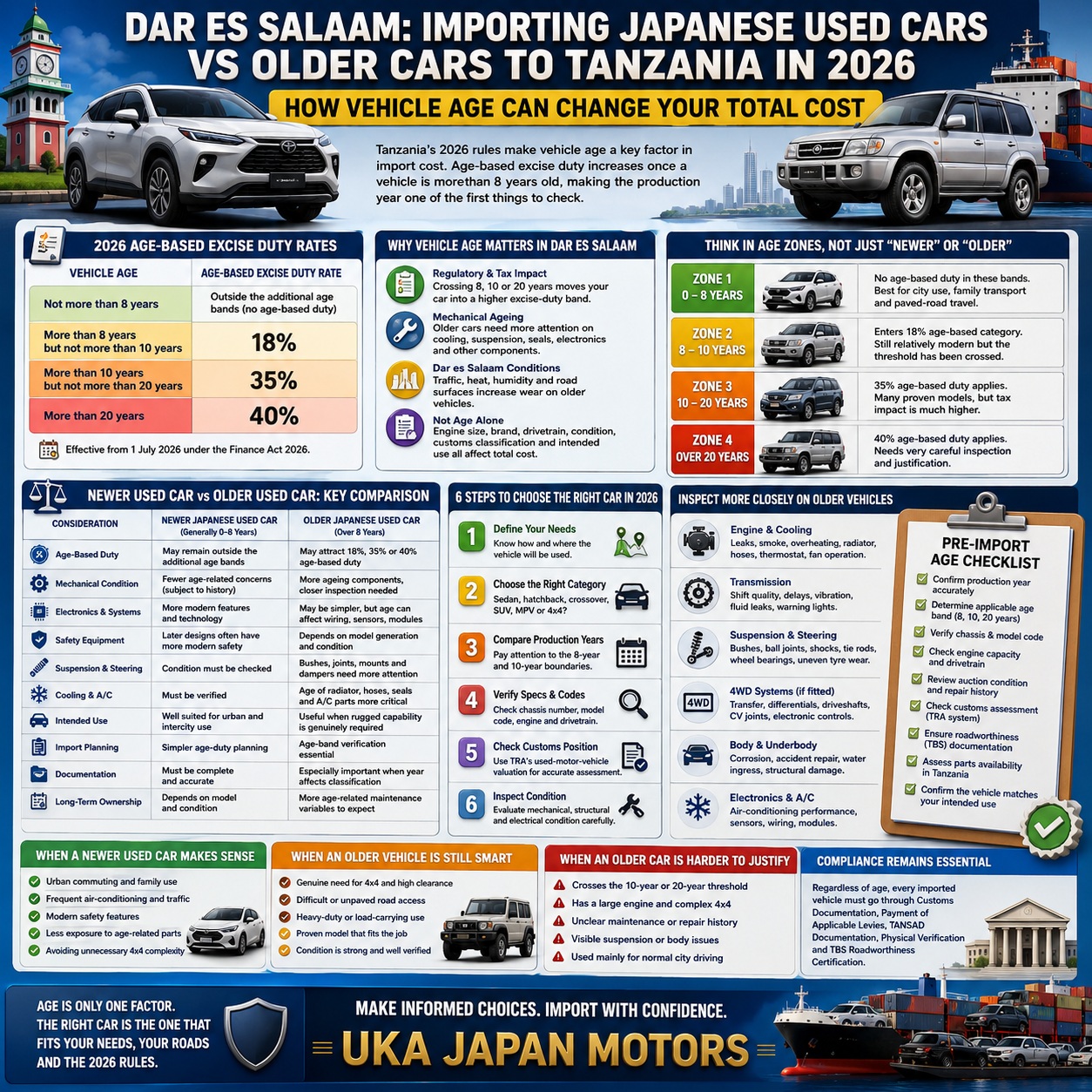
For a buyer importing a Japanese used vehicle into Dar es Salaam in 2026, the production year is no longer a detail to check near the end of the selection process. It should be one of the first specifications examined.
Two vehicles can belong to the same model family, have similar equipment and appear equally suitable for daily driving, yet fall into very different import positions because they were manufactured a few years apart.
Tanzania’s 2026 tax framework makes this distinction particularly important. Imported used vehicles more than eight years old enter age-based excise-duty bands, and the applicable rate increases substantially once a vehicle passes ten years of age.
The rates effective under the 2026 framework are 18% for imported vehicles more than eight years but not more than ten years old, 35% for those more than ten but not more than twenty years old, and 40% for vehicles more than twenty years old.
This does not mean that every newer Japanese vehicle is automatically the right choice or that an older vehicle should automatically be rejected. Vehicle condition, engine capacity, model suitability, road use, maintenance history, customs classification and inspection status remain important.
What has changed is the importance of evaluating age before deciding that an older vehicle is the more sensible import.
For buyers in Dar es Salaam, the practical question in 2026 is therefore not simply:
“Which Japanese used car should I import?”
A more useful question is:
“Which production year gives me the right balance of import treatment, mechanical condition and suitability for how I will actually use the vehicle in Tanzania?”
Direct Answer: How Does Vehicle Age Affect a Japanese Car Import in 2026?
Tanzania applies additional excise duty to imported used vehicles once they cross specified age thresholds.
| Vehicle age | 2026 age-based excise-duty position |
|---|---|
| Not more than 8 years | Outside the three additional age bands discussed here |
| More than 8 years but not more than 10 years | 18% |
| More than 10 years but not more than 20 years | 35% |
| More than 20 years | 40% |
The 2026 changes took effect from 1 July 2026.
The most important point is that these percentages should not be treated as a complete calculation of everything involved in importing a vehicle.
Tanzania’s official Trade Portal states that the duties and taxes applicable to a vehicle depend on factors including its brand, engine size and year of production, and directs importers to the TRA used-motor-vehicle valuation system for a vehicle-specific assessment.
Vehicle age is therefore one layer in a wider customs calculation.
For someone comparing Japanese vehicles for Dar es Salaam, however, it can be a decisive layer.
Think in Age Zones, Not Simply “Newer” and “Older”
A common mistake is to divide Japanese imports into only two groups:
- newer cars; and
- older cars.
The 2026 rules make that distinction too simple.
A better way to evaluate a vehicle is to place it into an age zone before comparing it with alternatives.
Zone 1: Vehicles not more than eight years old
These vehicles remain outside the three additional age-based excise bands introduced above the eight-year threshold.
That does not make them exempt from normal customs requirements or other applicable vehicle taxation. It simply means that the additional age-based duty discussed in this guide has not yet been triggered.
For a Dar es Salaam buyer, this zone deserves particular attention when the intended vehicle is primarily for:
- commuting;
- family transport;
- business travel;
- airport journeys;
- regular urban driving;
- Dar es Salaam-to-Dodoma travel;
- Dar es Salaam-to-Morogoro travel; or
- ordinary paved-road use.
A newer compact car, sedan or crossover may provide all the required functionality without entering an older age category.
Zone 2: More than eight but not more than ten years
Once the vehicle is more than eight years old, the 18% age-based excise duty becomes relevant under the 2026 framework.
This is an important transition.
A vehicle in this category may still be relatively modern mechanically. It may have contemporary safety equipment, efficient engine management, readily identifiable replacement parts and a familiar drivetrain.
But from an import perspective, it is no longer in the same position as an otherwise comparable vehicle that remains within eight years.
That difference needs to be identified before shipment, not after arrival in Dar es Salaam.
Zone 3: More than ten but not more than twenty years
This is where the age question becomes much more significant.
The applicable age-based rate rises to 35%.
For many buyers, this category contains attractive Japanese models with established reputations for durability. It can include older generations of SUVs, crossovers, MPVs, sedans and four-wheel-drive vehicles that are already familiar on Tanzanian roads.
Mechanical reputation, however, should not be confused with import treatment.
A vehicle can be:
- durable;
- easy for local technicians to recognise;
- mechanically straightforward;
- practical on Tanzanian roads;
and still sit in a substantially higher age-duty category.
Those are separate considerations.
Zone 4: More than twenty years
Vehicles beyond twenty years fall into the 40% age-based category.
At this point, the decision becomes about much more than taxation.
A vehicle of this age also deserves much deeper investigation into corrosion, previous repairs, electrical systems, seals, cooling components, suspension wear, drivetrain condition and parts availability.
An older vehicle can remain mechanically sound, but age increases the number of systems that require evidence rather than assumption.
Why Dar es Salaam Buyers Should Care About the Manufacturing Year
Dar es Salaam creates a particular ownership environment.
A vehicle can spend long periods in slow-moving traffic, operate air conditioning for extended periods, encounter heat and humidity, travel over uneven road surfaces and then be expected to handle longer intercity journeys.
These conditions place different stresses on different systems.
Cooling systems matter.
Air-conditioning condition matters.
Automatic-transmission behaviour matters.
Suspension condition matters.
Engine mounts matter.
Rubber bushes, hoses and seals matter.
For this reason, vehicle age in Dar es Salaam has two separate meanings.
The first is regulatory and tax-related.
The second is mechanical.
A good buying decision considers both.
The Eight-Year Boundary Can Change the Comparison Between Similar Cars
Imagine two Japanese crossovers from the same general model family.
One remains within eight years of age.
The other is just beyond eight years.
They may have similar:
- engine capacities;
- seating layouts;
- luggage capacity;
- ground clearance;
- transmissions;
- safety equipment;
- fuel systems; and
- everyday usefulness.
Yet the older example has entered the 18% age-based category while the younger vehicle remains outside these three age bands.
That immediately changes how the two should be compared.
The older vehicle should not be selected merely because its production year seems “close enough.”
A difference of one or two production years can matter when it moves a vehicle across a legal threshold.
This is why Japanese auction and export information should be checked carefully.
The Ten-Year Boundary Deserves Even More Attention
For 2026 import planning, the ten-year boundary can be more consequential than many buyers initially realise.
A vehicle more than eight but not more than ten years old is subject to the 18% rate.
Move beyond ten years and the applicable age-based rate becomes 35%.
That is not a small change in classification.
Consider a buyer looking at two vehicles with broadly similar practical abilities.
Vehicle A
- newer production year;
- 1.8- or 2.0-litre engine;
- crossover body;
- two-wheel drive;
- primarily intended for Dar es Salaam;
- occasional intercity use.
Vehicle B
- more than ten years old;
- larger engine;
- traditional SUV construction;
- four-wheel drive;
- heavier drivetrain;
- substantially more capability than the owner normally requires.
Vehicle B may appear more robust.
But robustness is useful only when the owner actually needs it.
If most journeys involve normal roads around Dar es Salaam and occasional paved intercity routes, the buyer should ask whether the additional capability justifies moving into an older age category and maintaining a more complex vehicle.
That is a usage question rather than a simple model-ranking exercise.
Vehicle Age Does Not Work Alone
Age should never be used as the sole predictor of a vehicle’s total import position.
The official Tanzania Trade Portal specifically notes that vehicle duties and taxes vary according to factors such as brand, engine size and year of production.
That means a proper comparison should consider several characteristics simultaneously.
Engine capacity
Engine capacity can affect vehicle taxation and classification.
This becomes particularly relevant when an older vehicle also has a substantially larger engine than the newer alternative.
The comparison is therefore not simply:
new car versus old car.
It may actually be:
newer + smaller engine + simpler drivetrain
versus
older + larger engine + higher age band + more complex drivetrain.
Those combinations can produce very different import profiles.
Customs valuation
Import calculations cannot reliably be reconstructed from an advertised vehicle figure alone.
TRA’s applicable valuation process and vehicle-specific characteristics must be considered.
A buyer should therefore avoid treating the visible Japanese listing information as a complete indication of the final customs assessment.
Vehicle classification
Different vehicles can fall under different customs classifications.
Body type, passenger configuration, intended function and other characteristics may affect how a vehicle is treated.
The correct chassis and model information should therefore be verified before assumptions are made.
Production year
The year must be established accurately because it determines where the vehicle falls relative to the age thresholds.
This is especially important for vehicles close to eight or ten years old.
A Better Way to Compare Japanese Imports in 2026
Instead of starting with the oldest acceptable vehicle and moving forward, Dar es Salaam buyers can use a more disciplined sequence.
Step 1: Define what the vehicle actually needs to do
Start with usage.
Will the vehicle spend most of its life in Dar es Salaam traffic?
Will it regularly travel to Morogoro?
Will it frequently travel to Dodoma?
Will it operate around Arusha?
Will it encounter rough access roads?
Will it carry a large family?
Does it genuinely need four-wheel drive?
Does it require high ground clearance?
A vehicle should solve an ownership requirement rather than simply offer the largest specification.
Step 2: Identify suitable vehicle categories
A city-focused buyer may find that a compact sedan, hatchback or crossover is sufficient.
A family may require a larger crossover or MPV.
Someone regularly accessing difficult roads may have a legitimate requirement for a more capable SUV.
This distinction should be made before age is considered.
Step 3: Compare production years within the suitable category
Once the vehicle category is clear, compare different production years.
Pay particular attention to examples around:
- the eight-year boundary;
- the ten-year boundary; and
- for unusually old vehicles, the twenty-year boundary.
Step 4: Verify the engine and chassis information
Do not rely only on a model name.
A single Japanese model can be available with several:
- engine sizes;
- engine codes;
- model codes;
- drivetrains;
- transmissions; and
- equipment configurations.
Those differences can affect both suitability and import assessment.
Step 5: Check the customs position
Use vehicle-specific information rather than assumptions.
The official Trade Portal specifically points importers toward TRA’s used-motor-vehicle valuation system for precise vehicle tax calculations.
Step 6: Evaluate mechanical condition
Only after the regulatory and specification checks should the individual vehicle’s physical condition determine whether it remains a good candidate.
Newer Used Car vs Older Used Car: Practical 2026 Comparison
The following comparison avoids monetary assumptions and focuses on the factors that change as vehicle age increases.
| Consideration | Newer Japanese used vehicle | Older Japanese used vehicle |
|---|---|---|
| Age-based excise exposure | May remain outside the additional age bands if not more than 8 years old | Can enter 18%, 35% or 40% age bands |
| Mechanical ageing | Generally fewer age-related concerns, subject to history | Requires closer inspection of ageing components |
| Electronics | Potentially more modern and complex | May be simpler on some models but age can affect wiring, sensors and modules |
| Safety systems | Later designs may have more modern equipment | Depends heavily on model and production generation |
| Suspension | Condition still requires inspection | Bushes, joints, mounts and dampers deserve closer attention |
| Cooling system | Condition must be verified | Age of radiator, hoses, seals and related components becomes more significant |
| Intended use | Often well suited to urban and intercity use | Can remain useful where older rugged models match the required task |
| Import planning | Production year still matters | Age-band verification becomes essential |
| Documentation | Must be complete and accurate | Especially important where production year affects classification |
| Long-term ownership | Depends on model and condition | More age-related maintenance variables should be expected |
Neither column automatically wins.
The correct vehicle is the one whose age, condition and capabilities match the owner’s actual requirements.
Why an Older Car Can Still Be the Right Choice
The 2026 rules should not be interpreted as saying older Japanese vehicles have no place in Tanzania.
There are circumstances where an older model remains sensible.
Consider a vehicle intended for regular travel over demanding access roads.
A newer low-clearance passenger car may sit in a more favourable age category but still be unsuitable for the job.
Likewise, a driver who genuinely requires four-wheel drive, strong ground clearance and a proven drivetrain should not select a less capable vehicle solely because it is younger.
The objective is not to minimise age at any cost.
The objective is to avoid paying the mechanical and regulatory consequences of additional capability that the owner never uses.
That distinction is especially relevant in Dar es Salaam, where SUVs and crossovers may perform similar everyday functions despite very different mechanical designs.
When an Older Vehicle Becomes Harder to Justify
An older vehicle deserves more scrutiny when several disadvantages appear together.
For example:
- it crosses the ten-year age threshold;
- it uses a larger engine than necessary;
- it has a complicated four-wheel-drive system;
- its maintenance history is unclear;
- its auction information shows previous repairs;
- suspension wear is evident;
- its cooling system has not been properly assessed;
- replacement components are difficult to identify; or
- the owner will use it almost entirely for urban driving.
No single item necessarily disqualifies the vehicle.
The problem is accumulation.
A vehicle can look attractive when each issue is considered separately but become less convincing when age duty, mechanical wear and actual use are examined together.
Mechanical Age Matters Even When Mileage Looks Low
Mileage is useful, but it does not replace age.
A Japanese vehicle can show relatively modest recorded mileage and still have age-related deterioration.
Rubber and plastic components age with time.
Seals harden.
Bushes deteriorate.
Hoses age.
Tyres can become unsuitable because of time even when tread remains.
Electrical connectors can suffer deterioration.
Air-conditioning components can develop leaks.
Shock absorbers can weaken.
Engine and transmission mounts can deteriorate.
For Dar es Salaam operation, cooling and air conditioning deserve particular attention because traffic and climate can expose weaknesses quickly.
This is why “old but low mileage” should never be accepted as a complete description of condition.
What to Inspect More Closely on an Older Japanese Vehicle
As vehicle age rises, inspection should become progressively more detailed.
Engine and cooling system
Check for:
- coolant leaks;
- oil leaks;
- abnormal smoke;
- unstable idle;
- cooling-fan operation;
- radiator condition;
- hose deterioration;
- evidence of overheating; and
- previous engine repairs.
Automatic transmission
Assess:
- engagement from park;
- shift quality;
- hesitation;
- abnormal vibration;
- fluid leakage; and
- warning indicators.
For CVT-equipped vehicles, correct operation deserves particularly careful verification.
Suspension and steering
Older vehicles should be checked for:
- control-arm bushes;
- ball joints;
- stabiliser links;
- shock absorbers;
- wheel bearings;
- steering-rack condition;
- tie-rod ends; and
- uneven tyre wear.
Four-wheel-drive systems
Where fitted, inspect:
- transfer systems;
- differentials;
- driveshafts;
- CV joints;
- electronic 4WD controls; and
- warning lights.
Extra drivetrain capability means extra components that need to be healthy.
Body and underbody
Check for:
- corrosion;
- accident repair;
- structural repair;
- poor panel alignment;
- water ingress;
- underbody damage; and
- deteriorated weather seals.
A clean exterior should never substitute for an underbody inspection.
Inspection and Compliance Before Arrival in Dar es Salaam
Vehicle selection cannot be separated from compliance.
Tanzania’s official import procedure includes customs documentation and vehicle roadworthiness requirements. The Trade Portal describes steps involving customs documentation, payment of applicable vehicle levies, TANSAD documentation, physical verification and obtaining the relevant TBS roadworthiness certification.
For the buyer, this means a vehicle should not be chosen simply because its photographs look good.
The documentation must support what the vehicle is claimed to be.
Important information includes:
- chassis number;
- model code;
- engine capacity;
- production details;
- vehicle category;
- export documentation;
- inspection documentation; and
- applicable roadworthiness information.
An error in production-year assumptions is particularly problematic in 2026 because the age bands make that information directly relevant to excise-duty treatment.
Japanese Auction Information Becomes More Valuable as Cars Get Older
Auction information can help buyers distinguish between chronological age and actual condition.
Two twelve-year-old vehicles are not necessarily equivalent.
One may have:
- consistent grading;
- documented minor defects;
- clean structural condition;
- reasonable interior wear; and
- no indication of major repair.
Another vehicle of exactly the same age may show:
- accident repair;
- corrosion;
- interior deterioration;
- mechanical warnings; or
- multiple replacement panels.
Both fall into the same broad age category.
Their ownership prospects can be completely different.
This is why age should be treated as a screening factor, not as a complete condition assessment.
Dar es Salaam Driving Changes the Ownership Calculation
The final decision should extend beyond customs clearance.
A vehicle may remain in service for years after it arrives.
Dar es Salaam’s combination of traffic, heat, humidity and varied road surfaces means long-term ownership deserves attention at the selection stage.
Cooling performance
Stop-and-go traffic reduces the natural airflow that occurs at higher speeds.
A healthy radiator, cooling fan, thermostat and coolant system therefore matter.
Older vehicles with neglected cooling systems can reveal problems quickly under these conditions.
Air-conditioning
Air conditioning is not merely a specification to see on the auction sheet.
Its actual operating condition matters.
Compressors, condensers, evaporators, seals and electronic controls can all be affected by age.
Suspension
Repeated uneven surfaces expose weak bushes, dampers and joints.
A larger older SUV does not automatically have healthier suspension than a smaller newer crossover.
Physical inspection decides that.
Fuel and engine suitability
A large engine may be entirely appropriate where vehicle capability requires it.
Where the vehicle is used mainly for ordinary urban transport, however, buyers should consider whether the engine and drivetrain are more than the task requires.
Four Vehicle Profiles and What Age Changes
Consider four hypothetical imports.
| Vehicle profile | Age position | Main question before importing |
|---|---|---|
| 7-year-old compact crossover | Outside the three older-vehicle age bands | Is condition and specification suitable for intended use? |
| 9-year-old family crossover | 18% age category | Does its condition and suitability justify crossing the 8-year boundary? |
| 13-year-old SUV | 35% age category | Is genuine SUV capability required, and is mechanical condition strong enough? |
| 21-year-old 4WD | 40% age category | Does the specific use case justify both the age position and significantly greater inspection requirements? |
The comparison demonstrates why “older” should not be treated as one category.
A nine-year-old vehicle and a twenty-one-year-old vehicle are both older imports, but their tax positions and likely inspection requirements are very different.
Who Should Consider a Newer Japanese Used Vehicle?
A newer used vehicle may be particularly appropriate for a buyer whose priorities are:
- regular Dar es Salaam commuting;
- family transport;
- frequent air-conditioning use;
- paved intercity travel;
- modern safety equipment;
- reduced exposure to age-related components;
- simpler age-duty planning; and
- avoiding unnecessary heavy-duty capability.
Compact Japanese crossovers are particularly relevant because they can provide useful ground clearance without necessarily requiring the size and drivetrain complexity of a traditional SUV.
Sedans and hatchbacks remain appropriate where ground clearance and cargo requirements allow.
Who May Still Be Better Served by an Older Vehicle?
An older vehicle can remain suitable where function outweighs age.
Examples include owners who genuinely need:
- substantial ground clearance;
- four-wheel drive;
- rugged suspension;
- access to difficult roads;
- particular load-carrying characteristics; or
- a proven vehicle configuration that matches a specialised operating requirement.
The important word is genuinely.
Buying a heavy older 4WD for a job that a crossover can perform creates complexity without necessarily providing practical benefit.
Where the capability is required, the older vehicle may be entirely justified.
It should simply be selected with full awareness of its age band, mechanical condition and compliance requirements.
A 2026 Pre-Import Age Checklist
Before confirming a Japanese used vehicle for Tanzania, verify the following:
- Production year — establish the year accurately rather than relying on a general model-generation description.
- Applicable age band — determine whether the vehicle remains within eight years or enters the 18%, 35% or 40% category.
- Chassis number — verify that the identity matches the documents.
- Model code — confirm the exact variant.
- Engine capacity — do not assume all vehicles with the same model name use the same engine.
- Drivetrain — identify two-wheel drive, four-wheel drive or other configuration correctly.
- Auction condition — review available grading and inspection information.
- Repair history — investigate evidence of structural or significant previous repair.
- Customs assessment — check the vehicle using the appropriate TRA information rather than estimating from age alone.
- Roadworthiness documentation — confirm the applicable TBS requirements and inspection status.
- Parts support — consider whether components for the exact model code and engine are reasonably identifiable in Tanzania.
- Intended use — confirm that the vehicle’s capability actually matches its future work.
This process prevents vehicle age from becoming an unexpected issue after the selection has already been made.
How This Topic Connects With Other Import Decisions
Vehicle age is best understood alongside several closely related subjects.
A buyer investigating age should also understand engine capacity and vehicle taxation in Tanzania, because an older vehicle with a larger engine can present a different customs profile from a newer, smaller-engined alternative.
A detailed Japanese auction sheet guide for Tanzania buyers can then help separate age from actual condition.
Before shipment, buyers should understand TBS inspection and roadworthiness requirements for Japanese imports, while a Tanzania vehicle import documentation guide can help confirm the information required for customs processing.
For SUV buyers, a separate comparison between older traditional SUVs and newer Japanese crossovers for Tanzania roads can help determine whether four-wheel-drive capability is genuinely required.
Together, these subjects create a more reliable decision process than choosing a vehicle based on model name or production year alone.
UKA Japan Motors’ Role: Inspection Before Assumption
UKA Japan Motors’ role is not to treat the newest vehicle as automatically superior or an older vehicle as automatically unsuitable.
The useful approach is evidence-based.
That means helping buyers evaluate information such as:
- production year;
- chassis and model identification;
- engine specification;
- auction information;
- visible mechanical condition;
- structural condition;
- documentation;
- inspection status;
- likely Tanzanian usage; and
- the relevant age category.
An older Japanese vehicle with clear documentation and strong verified condition may be a more appropriate choice for a demanding use case than a newer vehicle that does not meet the owner’s practical requirements.
Equally, a buyer who needs only normal Dar es Salaam transport should know when an older, heavier or mechanically more complicated vehicle introduces obligations that provide little practical benefit.
The objective is transparency.
Vehicle selection should happen with the age band, inspection evidence and intended use understood before shipment.
Frequently Asked Questions
1. Does Tanzania ban Japanese used cars more than eight years old?
No. Crossing the eight-year point does not itself mean the vehicle is prohibited. Under the 2026 framework, it changes the applicable age-based excise-duty treatment. Vehicles must still satisfy the applicable customs, documentation, inspection and roadworthiness requirements.
2. What is the age-based excise duty for an imported vehicle more than eight years old in 2026?
An imported used vehicle more than eight years but not more than ten years old falls into the 18% age-based excise-duty category under the 2026 framework.
3. What happens when an imported used vehicle is more than ten years old?
Vehicles more than ten years but not more than twenty years old fall into the 35% age-based excise-duty category. This makes the ten-year threshold particularly important when comparing different production years of similar Japanese vehicles.
4. What is the 2026 rate for a vehicle more than twenty years old?
Imported vehicles more than twenty years old fall into the 40% age-based excise-duty category. Such vehicles also deserve particularly detailed mechanical and structural inspection because chronological age affects far more than taxation.
5. Is a newer Japanese used car always better than an older one?
No. Age is only one consideration. Intended use, engine, drivetrain, ground clearance, mechanical condition, documentation, roadworthiness and parts support all matter. An older properly inspected 4WD may be appropriate for demanding routes where a newer urban vehicle would not be suitable.
6. Does vehicle age alone determine the complete import assessment?
No. Tanzania’s official Trade Portal states that duties and taxes depend on factors including the vehicle’s brand, engine size and year of production. Buyers should therefore use vehicle-specific customs information rather than attempting to determine the complete assessment from age alone.
7. Why is the eight-year threshold important for Dar es Salaam buyers?
A vehicle that remains within eight years stays outside the three additional older-vehicle age bands discussed in this guide. Once it becomes more than eight years old, the 18% category becomes relevant. That can change a comparison between two otherwise similar Japanese cars.
8. Should I avoid a Japanese SUV that is more than ten years old?
Not automatically. First determine whether SUV capability is genuinely required. Then examine the 35% age category alongside engine capacity, customs classification, mechanical condition, four-wheel-drive condition and intended Tanzanian use. The vehicle should be accepted or rejected on the complete evidence.
9. Does low mileage make an older Japanese vehicle equivalent to a newer one?
No. Mileage and age describe different aspects of a vehicle. Low recorded mileage does not prevent deterioration of rubber bushes, hoses, seals, tyres, cooling components, electrical connections or other age-sensitive parts. Both mileage and chronological age should be investigated.
10. What should be inspected especially carefully on an older import?
Cooling components, suspension, steering, transmission behaviour, oil and coolant leaks, air conditioning, engine mounts, wheel bearings, underbody condition and previous structural repairs deserve attention. Four-wheel-drive vehicles also require checks of their additional drivetrain components.
11. Do TBS and customs procedures still apply regardless of the vehicle’s age?
Yes. Vehicle age does not remove the normal import process. Tanzania’s Trade Portal describes customs-documentation, physical-verification and TBS roadworthiness steps as part of the vehicle-import procedure.
12. When did the 2026 age-duty changes become effective?
The revised 2026 measures took effect from 1 July 2026. The final rates reported following the parliamentary revisions are 18% for vehicles more than eight but not more than ten years old, 35% for those more than ten but not more than twenty years old, and 40% for those over twenty years old.
Conclusion
Importing a Japanese used vehicle into Dar es Salaam in 2026 requires a different way of thinking about age.
The useful distinction is no longer simply between a “newer car” and an “older car.”
There are clear thresholds.
A vehicle not more than eight years old remains outside the three additional age bands discussed here. A vehicle more than eight but not more than ten years old enters the 18% category. Once it is more than ten years old, the applicable rate rises to 35%. Beyond twenty years, it becomes 40%.
Those thresholds make production-year verification an important part of vehicle selection.
But taxation is only half of the age question.
Older vehicles also require greater attention to cooling systems, suspension, steering, transmissions, seals, electronics, air conditioning, structural condition and previous maintenance. Dar es Salaam’s heat, humidity, traffic and varied road surfaces make these checks particularly relevant to long-term ownership.
A newer Japanese vehicle may make sense for a buyer whose driving is primarily urban and who does not need heavy four-wheel-drive capability. An older SUV or other specialised vehicle can still be entirely appropriate when its capabilities are genuinely required and its condition has been properly verified.
The strongest 2026 import decision therefore comes from combining vehicle age, engine specification, customs assessment, inspection evidence, documentation and intended use rather than judging any one factor in isolation.
For Dar es Salaam buyers, the production year should be checked at the beginning of the selection process—not discovered after the vehicle has already been chosen.
Contact UKA Japan Motors for availability and inspection guidance.