


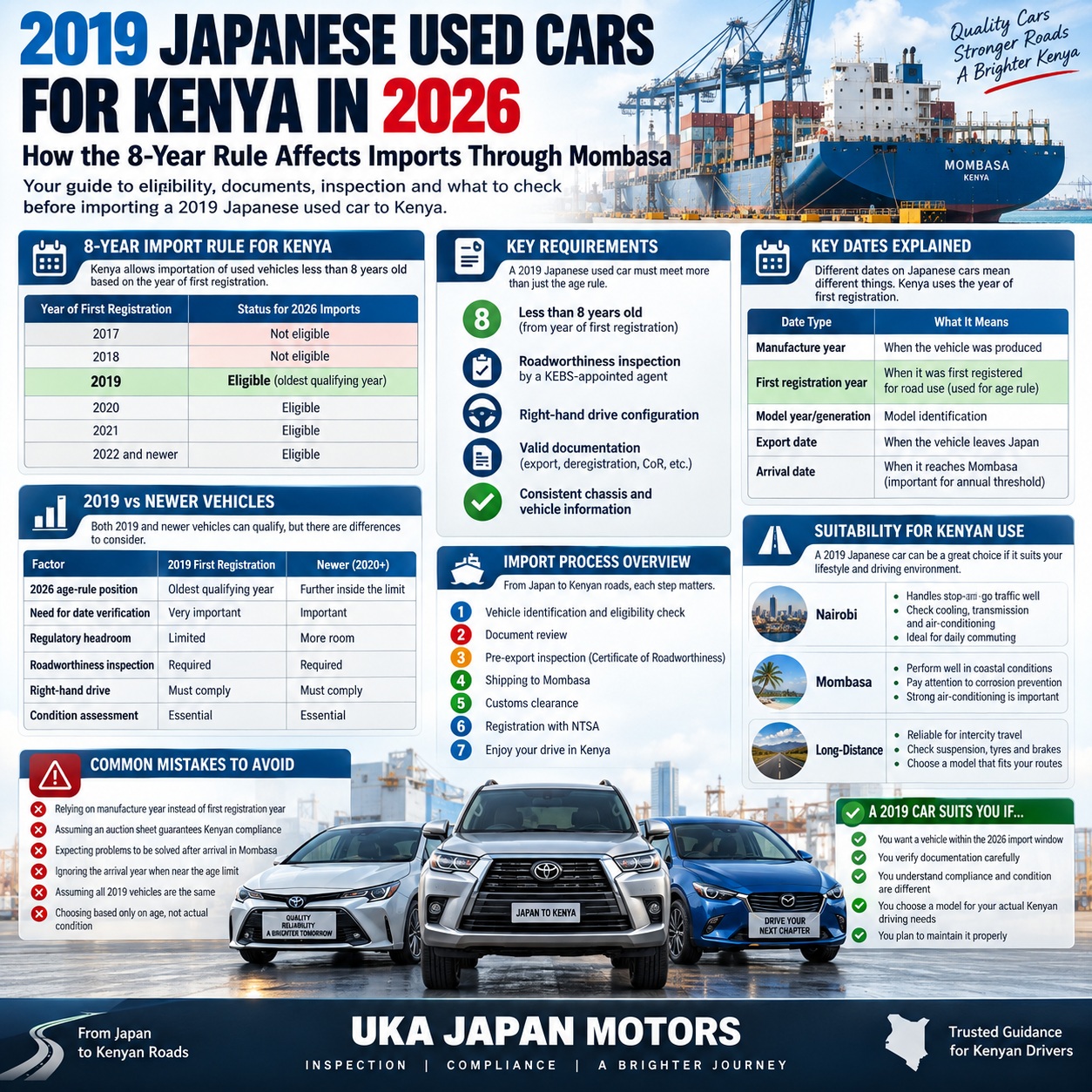
For Kenyan motorists considering a Japanese used vehicle in 2026, the number 2019 has particular importance.
Kenya restricts the importation of older used vehicles under the applicable road-vehicle inspection standard. The central principle is that a used passenger vehicle must not be more than eight years old when assessed according to its year of first registration. Kenya Revenue Authority (KRA) describes imported vehicles as required to be less than eight years old from the year of first registration, while the Kenya Bureau of Standards (KEBS) framework also makes roadworthiness and right-hand-drive compliance important parts of import eligibility.
For vehicles entering Kenya during 2026, this makes 2019 the oldest normal qualifying year of first registration. A vehicle first registered in 2018 falls outside the applicable 2026 threshold, while one first registered in 2019 can fall within it, provided all the other requirements are satisfied.
This distinction matters especially at the Port of Mombasa. By the time a vehicle reaches Mombasa, its age eligibility should already have been established from reliable documentation. Importers should therefore treat the year of first registration as an essential pre-shipment compliance check rather than something to resolve after arrival.
This guide explains what the 2019 threshold means, how the eight-year rule works, why manufacture year and registration year should not be confused, what documents matter, and what Kenyan buyers should examine before a Japanese used vehicle begins its journey to Mombasa.
Direct Answer: Can a 2019 Japanese Used Car Be Imported into Kenya in 2026?
Yes, provided 2019 is the qualifying year of first registration and the vehicle satisfies Kenya’s other applicable import and inspection requirements.
The practical 2026 threshold can be understood as follows:
| Year of First Registration | Position for a 2026 Arrival |
|---|---|
| 2017 | Outside the normal age limit |
| 2018 | Outside the 2026 age limit |
| 2019 | Oldest qualifying year under the 2026 threshold |
| 2020 | Within the age threshold |
| 2021 | Within the age threshold |
| 2022 and newer | Within the age threshold |
Age eligibility alone does not establish full compliance.
A qualifying vehicle must also meet other requirements applying to used vehicle imports. KRA identifies the core requirements as compliance with the relevant KEBS standard, roadworthiness inspection by a KEBS-appointed inspection agent and right-hand-drive configuration.
Another important detail is that Kenya’s rules look to the year of first registration, rather than allowing the buyer to rely simply on a model-year description used in an advertisement or auction listing.
That makes documentation verification particularly important for vehicles close to the age boundary.
Why 2019 Becomes So Important in 2026
Kenya’s age restriction effectively moves forward as the calendar advances.
A vehicle that qualified for import during an earlier year does not automatically remain eligible indefinitely. As another year begins, the oldest qualifying year of first registration advances as well.
For 2025, KEBS stated that right-hand-drive vehicles whose year of first registration was from 1 January 2018 and later would be allowed, and that 2017-registered vehicles arriving after 31 December 2024 would be non-compliant with the age requirement.
Following the same age-limit application, the threshold advances to 2019 for vehicles entering Kenya in 2026.
The important lesson for a Kenyan buyer is therefore not simply:
“Is this a 2019 car?”
The more useful question is:
“What is the documented year of first registration, and will that year comply when the vehicle actually enters Kenya?”
That second question is especially important when sourcing a vehicle late in the calendar year.
The Rule Is Based on First Registration, Not Simply the Advertised Model Year
One of the easiest mistakes to make when evaluating Japanese used cars is treating several different vehicle dates as though they mean the same thing.
They do not.
A Japanese used vehicle can have references to:
- manufacture year;
- manufacture date;
- model generation;
- model code;
- first registration date;
- export or deregistration date; and
- auction listing year.
For Kenya’s age-limit assessment, year of first registration is the critical reference.
KRA has specifically stated that it applies the year of first registration in its treatment of used motor vehicles.
Consider two hypothetical cars.
Vehicle A
Manufactured: 2019
First registered: 2019
For a 2026 arrival, its first-registration year meets the 2019 threshold.
Vehicle B
Manufactured: 2019
First registered: 2020
For age-limit purposes, the relevant first-registration year is 2020.
The opposite situation requires more attention because Kenya’s inspection requirements also address the relationship between manufacture and first registration.
The applicable standard states that the difference between the year of first registration and year of manufacture should not exceed one year.
This is why simply seeing “2019” somewhere on an auction sheet, listing or chassis description should never be treated as enough evidence of Kenyan import eligibility.
Manufacture Year vs First Registration Year
Understanding this distinction is particularly useful when comparing Japanese vehicles.
| Vehicle Information | What It Describes | Importance for Kenya |
|---|---|---|
| Manufacture year | When the vehicle was produced | Relevant to vehicle identity and compliance checks |
| First registration year | When it was first registered for road use | Central to the eight-year age assessment |
| Model year/generation | Commercial or technical model identification | Useful for identifying specifications, but not the main age test |
| Export date | When the vehicle leaves the source market | Does not replace first-registration information |
| Arrival date | When the vehicle reaches Kenya | Important because eligibility applies to the relevant import period |
The safest approach is therefore document-led.
A buyer should not try to establish eligibility from appearance, mileage, trim level or seller terminology.
Why the Arrival Year Matters at Mombasa
The eight-year rule has a practical timing dimension.
A vehicle may begin the sourcing or export process in one calendar year and arrive in Kenya in another. When the vehicle is close to the age boundary, that transition can change its eligibility.
KEBS has previously made this arrival requirement explicit when annual thresholds changed. Its notice for the 2025 threshold stated that certificates for 2017 first-registered vehicles would cease to be valid after 31 December 2024 and that affected vehicles had to arrive at the port of destination or entry by that deadline.
That illustrates an important principle:
The fact that a vehicle was eligible when it was identified, inspected or prepared for shipment does not mean the calendar can be ignored.
For a Kenyan importer handling an older qualifying vehicle, the intended arrival period needs to be considered from the beginning.
The 2019 Situation Is Different in 2026
A first-registered 2019 vehicle sits at the oldest qualifying edge for 2026.
That means there is less room for casual assumptions about dates and documentation than with a substantially newer vehicle.
A 2021 or 2022 first-registered vehicle has more distance from the age boundary.
A 2019 vehicle does not.
The closer a vehicle is to the regulatory limit, the more important precise verification becomes.
What Happens When the Vehicle Reaches Mombasa?
Mombasa is not where an importer should first discover whether a vehicle satisfies Kenya’s age rules.
The important eligibility work begins earlier.
Before shipment, the vehicle’s records should establish its identity, registration history and conformity with applicable requirements. Used vehicles from markets where KEBS has an appointed inspection arrangement are expected to undergo the required inspection process and be supported by the relevant Certificate of Roadworthiness.
KRA states that imported vehicles are subject to roadworthiness inspection by a KEBS-appointed inspection agent in the country of export.
Once the vehicle arrives in Kenya, customs clearance, conformity documentation and subsequent registration processes become relevant.
Kenya’s Trade Information Portal also explains that imported motor vehicles must ultimately be registered with the National Transport and Safety Authority (NTSA), which issues the registration certificate and number plates. It likewise identifies the less-than-eight-year requirement, right-hand-drive requirement and roadworthiness certification among the applicable conditions for used vehicle imports.
The overall journey can therefore be viewed as:
Vehicle identification → eligibility verification → document review → pre-export inspection → shipping → Mombasa arrival → customs clearance → registration → Kenyan road use
Problems identified near the beginning are normally much easier to manage than problems discovered after the vehicle has already reached the port.
The Certificate of Roadworthiness Matters
Age compliance and physical condition are related parts of import compliance, but they are not the same thing.
A vehicle can be young enough and still fail another requirement.
Likewise, a mechanically sound vehicle does not become eligible if its first-registration year falls outside the permitted age limit.
KEBS’ road-vehicle inspection framework provides for compliant vehicles to receive a Certificate of Roadworthiness (CoR) after inspection.
For Japanese used vehicles, this means buyers should think about two separate questions:
Question 1: Is the vehicle legally within the permitted age range?
Question 2: Does the vehicle satisfy the applicable inspection and conformity requirements?
Both matter.
This distinction is especially useful for buyers who assume that a clean auction grade or attractive service history automatically establishes Kenyan import compliance. Such information may help assess the vehicle, but it does not replace the required compliance process.
Right-Hand Drive Is Another Core Requirement
Japanese domestic vehicles are commonly available in right-hand-drive configuration, which aligns naturally with Kenyan road use.
Nevertheless, configuration should still be verified.
KRA lists right-hand drive among the principal requirements applying to imported vehicles.
The road-vehicle inspection standard likewise specifies right-hand-drive requirements for vehicles allowed into the country.
For common Japanese passenger cars, this is usually straightforward. However, unusual specifications, conversions or vehicles originally intended for different markets deserve closer examination.
Age compliance should therefore never be considered in isolation.
Why Document Accuracy Is Especially Important for 2019 Vehicles
When a vehicle is several years newer than the age threshold, a minor misunderstanding about model terminology may not immediately put it outside the age limit.
With a 2019 vehicle in 2026, the situation is different.
The vehicle sits directly on the oldest qualifying year.
This makes documents such as the export or deregistration record particularly important because they help establish the information on which eligibility depends.
Documentation should be consistent across the import process.
Important records can include:
- export or deregistration documentation;
- Certificate of Roadworthiness;
- commercial documentation identifying the vehicle;
- shipping documentation such as the bill of lading;
- customs/import documentation; and
- registration documentation required as the vehicle moves into Kenyan road use.
The chassis number and vehicle description should also remain consistent between documents.
A compliance-focused importer checks those details before the vehicle is committed to shipment.
Destination Inspection Should Not Be Treated as a Shortcut
There can be situations where used vehicles arrive without the normal Certificate of Roadworthiness and become subject to destination procedures.
That should not be confused with a way to bypass the age restriction.
KEBS has required validation of import documentation for used vehicles subject to destination inspection, specifically to verify age information and reduce problems involving forged or unreliable documents. The agency identifies documents such as logbooks, export certificates and deregistration certificates as relevant to this validation.
The broader principle is important:
Destination inspection does not turn an over-age vehicle into an eligible vehicle.
The age requirement remains a fundamental compliance condition.
For buyers considering 2019 vehicles in 2026, reliable pre-shipment verification remains the safer approach.
A Practical Example: Three Japanese Cars Heading for Mombasa
Consider three otherwise similar Japanese used vehicles being considered for import during 2026.
Car One: First Registered in 2018
The vehicle may be mechanically excellent. It may have good maintenance records and a desirable specification.
Those characteristics do not change its first-registration year.
For a 2026 arrival, a 2018 first-registration year falls outside the normal age threshold.
Car Two: First Registered in 2019
This is the boundary-year vehicle.
Its first-registration year meets the 2026 threshold, assuming its documentation confirms that status and all other applicable requirements are satisfied.
This car deserves careful document checking precisely because it sits at the regulatory edge.
Car Three: First Registered in 2021
This vehicle is comfortably within the 2026 age threshold.
It must still satisfy roadworthiness, right-hand-drive and other import requirements, but there is more distance between its first-registration year and the age boundary.
This comparison demonstrates why “used Japanese car” is too broad a description when evaluating Kenyan import eligibility.
The registration history matters.
Does a 2019 Vehicle Make Sense for Kenyan Ownership Beyond Import Eligibility?
Regulatory eligibility answers only whether the vehicle can pass the age requirement.
It does not answer whether the individual vehicle is suitable for its future owner.
A 2019 Japanese vehicle in 2026 has already accumulated several years of real-world use. Its condition can vary considerably according to mileage, maintenance, storage, previous environment and how it was driven.
Kenyan buyers should therefore evaluate the actual vehicle rather than assuming all cars from the same year are equivalent.
Nairobi Use
A vehicle intended primarily for Nairobi may spend substantial time in slow-moving traffic.
That makes cooling-system condition, transmission behaviour, air-conditioning performance, braking response and general engine smoothness particularly relevant.
Hybrid vehicles also deserve system-specific assessment rather than assumptions based solely on mileage.
Mombasa and Coastal Use
Vehicles based in Mombasa operate in a warm coastal environment.
Air-conditioning performance becomes especially important for daily comfort, while long-term owners should pay attention to corrosion prevention and the condition of exposed metal components.
A vehicle arriving through Mombasa is not necessarily going to remain there, but buyers planning coastal ownership should consider the environment in their maintenance routine.
Long-Distance Kenyan Use
Drivers regularly travelling between major towns may place greater emphasis on cooling reliability, tyre condition, suspension condition, braking stability and predictable servicing.
The key point is simple:
Import eligibility and ownership suitability are two different assessments.
A vehicle should pass both.
2019 vs Newer Japanese Used Vehicles in 2026
A useful comparison is not simply between individual models but between their position relative to Kenya’s age threshold.
| Factor | 2019 First Registration | Newer First Registration |
|---|---|---|
| 2026 age-rule position | Oldest qualifying year | Further inside the permitted window |
| Need for date verification | Particularly important | Still important |
| Exposure to next annual threshold | Immediate consideration for future import timing | More regulatory age headroom |
| Roadworthiness inspection | Required as applicable | Required as applicable |
| RHD requirement | Applies | Applies |
| Condition assessment | Essential | Essential |
| Documentation verification | Essential | Essential |
The important difference is therefore regulatory headroom, not an assumption that newer automatically means mechanically better.
A well-maintained 2019 vehicle can be in stronger condition than a poorly maintained newer vehicle.
Condition must be assessed independently.
What Should Buyers Check on a 2019 Japanese Vehicle?
Because 2019 cars occupy the boundary year for 2026 imports, the inspection should have two dimensions.
The first is compliance verification.
Confirm the first-registration year, manufacture information, chassis identity, right-hand-drive configuration and required conformity documentation.
The second is vehicle-condition assessment.
Mechanical areas worth reviewing include engine behaviour, transmission operation, steering, suspension, brakes, tyres, cooling system, electrical equipment and air-conditioning.
For hybrids, the assessment should also consider the hybrid system and its associated components.
For turbocharged vehicles, maintenance history and engine condition deserve particular attention.
For vehicles intended for rougher roads or frequent travel outside major urban centres, ground clearance, tyre profile and suspension suitability may matter more than they would for primarily urban use.
The best vehicle is not determined by age alone.
Why Chassis and Document Matching Matters
Every important record should refer to the same vehicle.
That sounds obvious, but it is fundamental.
The chassis number is effectively the vehicle’s identity throughout the process. A mismatch between auction information, export records, inspection documentation and shipping documentation can create significant complications.
Before shipment, the importer should therefore confirm that the identifying details correspond across the available documents.
For a boundary-year vehicle, this becomes even more important because the documents are also being relied upon to establish age eligibility.
What Kenyan Buyers Should Avoid Assuming
Several assumptions can create unnecessary risk.
“The seller calls it a 2019 model, so it qualifies.”
Not necessarily.
The documented year of first registration matters.
“It passed an auction inspection, so it meets Kenyan requirements.”
An auction condition report and Kenya’s conformity process serve different purposes.
“If there is a problem, it can be corrected when the car reaches Mombasa.”
Some documentation or clearance issues can be addressed through the appropriate procedures, but an over-age vehicle should not be shipped on the assumption that arrival at Mombasa will somehow make it compliant.
“All 2019 vehicles are basically the same.”
They are not.
Mileage, maintenance history, accident repairs, mechanical wear and specification can differ substantially.
“If it qualifies under the eight-year rule, it must be a good vehicle.”
Compliance is not the same as condition.
Both need independent verification.
Timing Matters More Near the End of the Year
The eight-year rule deserves additional attention when an import is being considered toward the end of a calendar year.
The annual threshold moves forward.
This means a vehicle near the oldest permissible year cannot be assessed without considering when it will reach Kenya.
A buyer should therefore avoid making decisions based solely on the date on which the vehicle is selected.
Shipping schedules, documentation readiness, inspection status and the expected Kenyan arrival period all need to fit together.
This is one reason boundary-year vehicles require disciplined import planning.
From Mombasa to Registration
After compliant importation and customs clearance, the vehicle proceeds toward Kenyan registration.
The Trade Information Portal states that imported motor vehicles must be registered with NTSA, which issues the registration certificate and number plates.
For the buyer, this illustrates why the import process should be treated as a connected chain rather than a collection of unrelated steps.
A vehicle identity established in the source documents follows the vehicle through:
inspection → export → shipping → customs → registration.
Accurate records at the beginning support a smoother process later.
Long-Term Ownership of a 2019 Japanese Vehicle in Kenya
Once registered, the fact that a vehicle was the oldest qualifying import year becomes much less important than how it is maintained.
By this stage in a vehicle’s life, preventative maintenance deserves attention.
Owners should establish a clear baseline rather than assuming every consumable or fluid was recently serviced.
Depending on the model and documented history, attention may include:
engine oil and filters;
coolant condition;
brake system condition;
transmission fluid according to manufacturer requirements;
battery health;
tyres;
suspension components;
drive belts where applicable;
air-conditioning;
and model-specific service items.
The correct maintenance programme depends on the vehicle.
Nairobi Driving
Frequent congestion can mean prolonged low-speed operation and substantial air-conditioning use. Maintenance should reflect actual operating conditions rather than kilometres alone.
Mombasa Driving
Coastal conditions make periodic inspection of the underbody, fasteners and exposed metal components sensible for long-term ownership.
Mixed Urban and Highway Driving
Vehicles regularly travelling between cities need dependable cooling, tyres, brakes and suspension.
These practical ownership factors are ultimately more useful than choosing a car purely because its registration year meets the import threshold.
Who Does a 2019 Japanese Used Vehicle Suit in 2026?
A 2019 first-registered vehicle can make sense for a Kenyan buyer who:
wants a vehicle that remains within the applicable 2026 import-age window;
is willing to verify documentation carefully;
understands that age eligibility does not replace a mechanical inspection;
has identified a model suitable for their actual Kenyan driving environment;
and intends to maintain the vehicle according to its condition and usage.
It may be less suitable for someone planning an import whose arrival could move into a later regulatory year without first checking the applicable threshold.
It is also unsuitable when the only evidence of age is an informal model-year description rather than reliable registration documentation.
UKA Japan Motors’ Role in a Compliance-Focused Import
UKA Japan Motors approaches Japanese used vehicle sourcing by separating three questions that buyers sometimes combine:
Is the vehicle eligible?
Is the documentation consistent?
Is the vehicle itself suitable?
For 2019 vehicles entering Kenya in 2026, the first-registration date deserves particular attention because these cars sit at the oldest qualifying edge of the normal age window.
The role of UKA Japan Motors is therefore not simply to identify a Japanese vehicle. It is to help buyers examine the vehicle within the realities of Kenyan inspection, documentation and compliance requirements.
That includes reviewing relevant vehicle information before shipment, paying attention to roadworthiness requirements and ensuring that the buyer understands what the vehicle’s documented history means for importation through Mombasa.
After importation, the same inspection-focused thinking remains useful when assessing whether a particular model suits Nairobi commuting, Mombasa conditions or regular long-distance Kenyan use.
The objective is a transparent process in which vehicle identity, condition and compliance are understood rather than assumed.
Frequently Asked Questions
1. Can I import a 2019 Japanese used car into Kenya in 2026?
Yes, a vehicle whose qualifying year of first registration is 2019 can fall within Kenya’s 2026 eight-year import threshold, provided it satisfies the other applicable requirements.
2. Can a 2018 first-registered vehicle arrive in Mombasa in 2026 under the normal eight-year rule?
No. For the 2026 threshold, 2019 becomes the oldest normal qualifying year of first registration. The age restriction is therefore an important check before shipping.
3. Does Kenya use manufacture year or first registration year?
The year of first registration is central to the age-limit calculation. KRA has specifically stated that it applies the year of first registration when treating imported used vehicles.
Manufacture information still matters because the applicable inspection standard also addresses the permitted difference between manufacture and first registration.
4. What if my car was manufactured in 2018 but first registered in 2019?
This requires checking the exact documentation, but the applicable standard provides that the difference between manufacture year and first-registration year should not exceed one year.
The complete vehicle record should therefore be reviewed rather than relying on one date in isolation.
5. Does passing the age requirement guarantee that the vehicle can be imported?
No.
The age rule is only one part of compliance. Roadworthiness inspection, right-hand-drive configuration, documentation and other applicable import requirements also matter.
6. Why is the Certificate of Roadworthiness important?
It provides evidence that the vehicle has undergone the applicable inspection process and met the relevant inspection requirements. The KEBS framework provides for conforming vehicles to receive a Certificate of Roadworthiness.
7. Can an over-age vehicle simply undergo inspection after reaching Mombasa?
Destination procedures should not be treated as a way around the age limit.
KEBS documentation-validation measures for vehicles subject to destination inspection specifically include verification of age-related import documents.
8. Does a Japanese auction sheet prove that the vehicle complies with Kenyan import rules?
No.
An auction sheet can provide useful information about a vehicle’s condition and history, but Kenyan compliance should be established using the appropriate official vehicle and inspection documentation.
9. Is every Japanese 2019 vehicle right-hand drive?
Right-hand-drive vehicles are common in Japan, but buyers should still verify the individual vehicle’s configuration. Kenya requires right-hand drive for normal qualifying vehicle imports under the applicable rules.
10. Why should I check the expected Mombasa arrival date?
Because the age threshold advances with the calendar year.
A vehicle near the oldest qualifying year should therefore be assessed according to the import period in which it will enter Kenya, not merely when it was selected.
11. Is a 2019 vehicle automatically less reliable than a newer Japanese vehicle?
No.
Registration year alone does not determine reliability. Maintenance history, mileage, previous use, accident history, mechanical condition and the design of the particular model all influence long-term ownership.
12. What should I inspect after a 2019 vehicle arrives in Kenya?
Even when a vehicle has passed the required import inspection, establishing a maintenance baseline is sensible. Engine condition, fluids, brakes, tyres, suspension, cooling, electrical systems and air-conditioning should be considered according to the model and its documented history.
13. Are 2019 hybrids treated differently under the eight-year age rule?
The basic age principle still applies. Hybrid vehicles, however, should also receive appropriate attention to their hybrid system and associated components when assessing condition and long-term suitability.
14. Does clearing the vehicle through Mombasa complete the process?
No.
Following the relevant customs and import processes, the vehicle must proceed through Kenyan registration requirements. NTSA is responsible for vehicle registration and issuance of the registration certificate and number plates.
15. Should I choose a 2019 car simply because it is the oldest year permitted in 2026?
No.
The age threshold establishes regulatory eligibility, not suitability. The better decision depends on the individual vehicle’s documentation, condition, specification and intended use in Kenya.
Conclusion
For Japanese used vehicles entering Kenya during 2026, 2019 is a critical boundary year.
The most important point is that Kenya’s eight-year rule should be understood through the vehicle’s documented year of first registration, not simply an advertised model year or a casual reference to manufacture date. KRA identifies the less-than-eight-year requirement, roadworthiness inspection and right-hand-drive configuration as central import conditions, while the applicable road-vehicle inspection framework also connects eligibility with first registration and manufacture information.
For a 2019 vehicle, this makes careful pre-shipment verification particularly important. By the time the vehicle reaches Mombasa, its age eligibility, identity and conformity documentation should already be understood.
The same disciplined approach should continue after importation. A compliant vehicle still needs to be evaluated according to its actual condition and its intended use, whether that means daily Nairobi congestion, coastal operation around Mombasa or regular long-distance travel.
The eight-year rule determines whether a vehicle falls within the permitted import window. It does not determine whether that individual vehicle is mechanically sound or suitable for its owner.
Those questions require inspection, documentation and informed assessment working together.
Contact UKA Japan Motors for availability and inspection guidance.