


Importing a used vehicle from Japan into Jamaica involves a chain of decisions that must be completed in the correct order. Selecting a vehicle is only one part of that process. The vehicle must also satisfy Jamaica’s import rules, inspection requirements and documentation procedures before it reaches the island.
In 2026, one particular requirement became more important for anyone handling a used vehicle shipment.
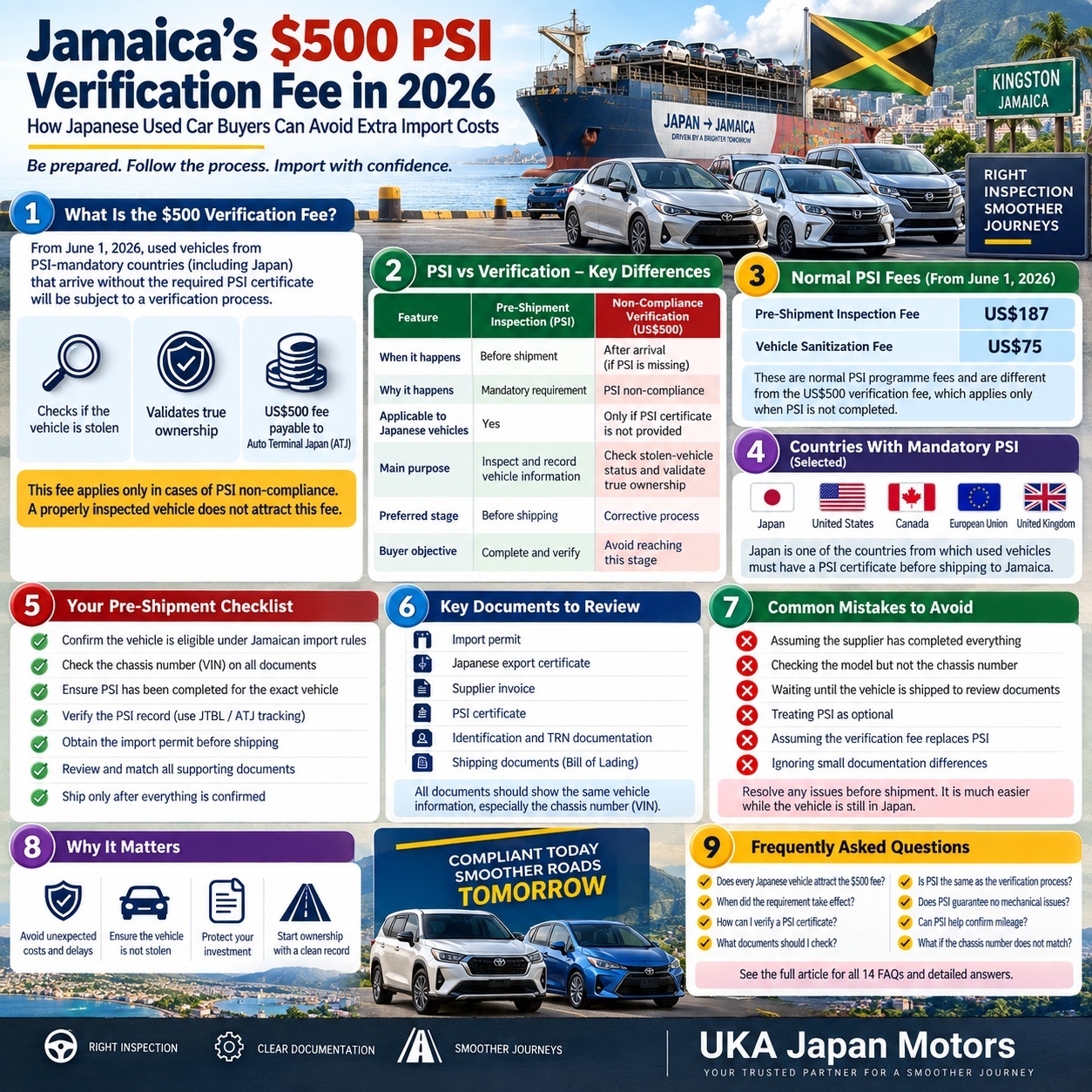
Effective June 1, 2026, the Jamaica Trade Board Limited (JTBL) states that a used vehicle imported from a country where Pre-Shipment Inspection (PSI) is mandatory without the required PSI certificate will be subject to a verification process. That verification carries a US$500 fee payable to Auto Terminal Japan (ATJ).
Japan is one of the countries covered by the mandatory PSI requirement.
The practical point for a buyer in Kingston or elsewhere in Jamaica is that this verification fee should not be treated as a routine part of importing a Japanese used vehicle. It is connected specifically with failure to comply with the mandatory PSI requirement.
That makes preparation before shipment particularly important.
A vehicle may appear suitable based on its model, age, mileage and general condition, but those characteristics alone do not establish that it is ready to be shipped to Jamaica. Inspection and documentation must be treated as part of the vehicle-selection process rather than paperwork to be considered after shipping arrangements have already been made.
This guide explains the 2026 verification requirement from that practical perspective: what buyers should check before shipment, how PSI fits into Jamaica’s vehicle import process, what documentation should correspond, and how buyers can reduce the risk of a vehicle arriving without the required evidence of compliance.
Quick Answer: What Does the US$500 PSI Verification Fee Mean?
The US$500 verification fee is a consequence of PSI non-compliance rather than a standard charge on every used vehicle imported into Jamaica.
From June 1, 2026, JTBL requires verification where a used vehicle arrives from a PSI-mandatory country without the required PSI certificate. The verification is intended to determine whether the vehicle is listed as stolen and to validate its true ownership.
For a Japanese used vehicle buyer, the safest approach is therefore to establish PSI compliance before the vehicle is shipped.
The basic sequence should be:
Vehicle selected → eligibility checked → vehicle details confirmed → PSI completed → PSI certificate verified → supporting documents cross-checked → import permit requirements completed → shipping proceeds.
Problems are more likely when that order is reversed.
A vehicle should not be treated as fully ready for Jamaica merely because it has been purchased or allocated for shipment.
Why PSI Needs to Be Treated as a Pre-Shipment Control
Pre-Shipment Inspection is exactly what its name suggests: a compliance step designed to occur before shipment.
This distinction is important because vehicle import procedures involve information moving between several documents and parties. The chassis or vehicle identification number, model details, year information, ownership records and inspection information all need to relate to the same vehicle.
When inspection is completed at the correct stage, discrepancies can be identified while the vehicle is still in the exporting country.
When the vehicle has already been shipped, resolving missing or inconsistent documentation becomes a different type of problem.
That is the significance of the 2026 verification measure.
The rule creates a clear distinction between completing the required inspection procedure at the proper stage and attempting to resolve non-compliance after the vehicle has already entered the Jamaican import process.
For Jamaican buyers, PSI therefore works best as a checkpoint rather than an administrative formality.
What Jamaica’s PSI Requirement Covers
JTBL identifies several countries from which used vehicles are subject to mandatory PSI requirements. Japan is included among them.
For buyers sourcing Japanese used vehicles, this means the inspection requirement should be considered from the beginning of the transaction.
PSI also contributes to the documentary record surrounding the vehicle.
This matters because used vehicles are identified through information that should remain consistent throughout the import process. A Japanese export certificate, supplier invoice, PSI record and import permit application should not appear to describe different vehicles.
The chassis number is especially important.
A buyer might focus naturally on the visible characteristics of a vehicle—body condition, interior, engine specification, mileage or features—but import authorities depend heavily on documentary identifiers.
One incorrect character in a chassis number can therefore create a much larger problem than its size suggests.
The Difference Between PSI and the 2026 Verification Process
Buyers should not confuse normal Pre-Shipment Inspection with the US$500 verification process.
They are not interchangeable procedures.
| Issue | Pre-Shipment Inspection | Non-Compliance Verification |
|---|---|---|
| Normal timing | Before shipment | Becomes relevant after PSI non-compliance |
| Why it occurs | Part of the required import process | Required PSI certificate was not provided |
| Applicable to Japanese used vehicles | Yes | If mandatory PSI requirements were not met |
| Main role | Establish required inspection compliance and vehicle information | Check stolen-vehicle status and validate true ownership |
| Preferred stage | Before shipping arrangements are completed | A corrective verification stage |
| Buyer objective | Complete and verify properly | Avoid reaching this stage |
The distinction is important because paying for verification does not turn non-compliance into a recommended alternative method of importing.
JTBL describes failure to comply with PSI requirements as a serious breach of the Motor Vehicle Import Policy and warns that non-compliance can lead to delays, additional costs and possible sanctions.
The correct objective is therefore compliance before shipment.
Why the Verification Process Focuses on Ownership and Stolen-Vehicle Status
According to JTBL, the verification process introduced for PSI non-compliance has two specific purposes:
To confirm whether the vehicle is listed as stolen.
To validate the true ownership of the vehicle.
These checks demonstrate why vehicle identity is fundamental to the import process.
A motor vehicle is not simply cargo identified by its make and model. It has a unique identity connected to its chassis or VIN and a documentary history associated with ownership and registration.
For a Japanese used vehicle, that identity should remain traceable across the export documentation, inspection record and Jamaican import paperwork.
A buyer looking at a Toyota, Honda, Nissan, Mazda, Suzuki or another Japanese vehicle should therefore be thinking about more than whether the model is suitable for Kingston traffic or regular driving across Jamaica.
The question before shipment should also be:
Can this exact vehicle be clearly identified through every required document?
That is a more useful import-readiness question than simply asking whether the vehicle has been purchased.
The Most Important Check: Match the Chassis Number Everywhere
One of the most practical ways to reduce documentation risk is to treat the chassis number or VIN as the vehicle’s central reference.
Before shipment, compare it across every available document.
The number shown on the vehicle should correspond with the number recorded on its supporting documentation.
That can include:
- Japanese export documentation
- Supplier invoice
- PSI record or certificate
- Import permit documentation
- Shipping documentation when issued
Do not assume that documents correspond simply because the make, model and colour are correct.
Two vehicles can share those characteristics.
The chassis number identifies the individual vehicle.
This becomes especially relevant when a supplier handles multiple units of the same model. A white compact hatchback of a particular year may look almost identical to another vehicle being processed at the same time, but the two units have different chassis numbers and separate documentary histories.
Checking the identifier before shipment helps prevent one vehicle’s paperwork from being attached to another.
Verify the PSI Record Rather Than Relying Only on a Document Copy
JTBL provides a facility for importers to verify Pre-Shipment Inspection information using the vehicle’s chassis number or VIN.
For vehicles handled through Auto Terminal Japan, JTBL directs importers to ATJ’s inspection report tracking system.
This creates an important additional safeguard.
A buyer does not have to treat a PDF, photograph or forwarded copy of a PSI certificate as the final level of verification. The inspection record can be checked against the vehicle identifier.
That is particularly useful when several parties are involved in a transaction.
For example, a Jamaican buyer may communicate with a vehicle supplier while documentation is processed separately. Instead of assuming that every stage has been completed because shipping preparations are underway, the buyer can independently confirm that the PSI record corresponds with the vehicle.
This approach turns PSI from something the buyer merely receives into something the buyer actively verifies.
PSI Should Be Confirmed Before Shipping Is Treated as Final
The timing of the check matters.
A common weakness in any import process is allowing logistics to move faster than compliance.
Once a vehicle has been selected, there can be a natural desire to move immediately toward shipment. But from a documentation perspective, the important question is not simply whether shipping can be arranged.
It is whether the vehicle is ready to be shipped in accordance with Jamaica’s requirements.
Those are different questions.
A disciplined buyer should regard the PSI certificate as part of the pre-shipment readiness file.
If the inspection status is uncertain, the appropriate response is to resolve that uncertainty before the vehicle leaves the exporting country.
Shipping first and attempting to reconstruct compliance later defeats the purpose of a pre-shipment requirement.
PSI Is Only One Part of Import Readiness
Avoiding the verification process does not mean PSI should be considered in isolation.
Jamaica’s motor vehicle import process involves additional eligibility and documentation requirements.
JTBL states that individuals who qualify to import motor vehicles must obtain the appropriate import permit, and its motor vehicle procedures include checking vehicle age restrictions, purchasing the vehicle, completing PSI where applicable and applying for the permit.
The Jamaica Customs Agency also states that an import licence should be obtained before shipping arrangements are made.
For used vehicles, Jamaica Customs identifies the pre-inspection certificate as part of the import requirements.
This means buyers should think in terms of a complete compliance file rather than one certificate.
A vehicle can have a PSI record but still require other documents to be correct before the import process is complete.
Documents Buyers Should Review Before Shipment
The exact documentation required depends on the import situation, but several documents are central to the process.
Import Permit
The permit authorises the importation of the vehicle under Jamaica’s motor vehicle import framework.
The vehicle information submitted in the application should correspond with the vehicle being shipped.
Japanese Export Certificate
For a used vehicle exported from Japan, this is an important source of vehicle identification information.
Details such as the chassis number, model and other identifying information should be reviewed carefully.
Supplier Invoice
The invoice should identify the vehicle accurately and correspond with the other documentation.
PSI Certificate
For a used vehicle from Japan, the required Pre-Shipment Inspection should be completed and its record confirmed before shipment.
Identification and TRN Documentation
JTBL’s permit procedure requires applicable personal identification and Taxpayer Registration Number information as part of the permit application process.
Shipping Documents
Once shipping is arranged, information on the Bill of Lading or related shipping documentation should again be checked against the vehicle’s established identity.
The principle is straightforward:
Every document should tell the same story about the same vehicle.
A Practical Pre-Shipment Check for Jamaican Buyers
Instead of waiting until the vehicle is approaching Jamaica to assemble documentation, buyers can divide the process into three checkpoints.
Checkpoint One: Is the Vehicle Eligible?
Before treating the vehicle as an import candidate, confirm that it falls within the applicable Jamaican import rules.
Vehicle age restrictions vary by vehicle category.
JTBL currently identifies different limits for motor cars, motorcycles, light commercial vehicles, commercial vehicles, special-purpose vehicles, returning-resident vehicles and heavy-duty commercial equipment.
This should be established early.
A technically attractive vehicle is not automatically an eligible import.
Checkpoint Two: Has the Exact Vehicle Been Inspected?
Once eligibility has been established, verify that PSI has been completed for the correct vehicle.
Use the chassis number rather than relying only on model descriptions.
Check that the inspection record corresponds with the vehicle being purchased.
Checkpoint Three: Do the Documents Agree?
Before shipping, compare the major identifying information across the export certificate, invoice, PSI record and permit documentation.
If something does not match, resolve it while the vehicle is still in Japan.
These three checkpoints create a much stronger process than simply asking whether the vehicle is “ready to ship.”
Why This Matters for Buyers in Kingston
For many Jamaican motorists, the imported vehicle eventually becomes part of everyday transportation through Kingston’s demanding driving environment.
Stop-start traffic, extended periods of low-speed operation, heat and humidity all become practical ownership considerations after the vehicle is registered and in use.
But none of those ownership questions matter until the vehicle successfully completes the import process.
That is why documentation deserves the same attention as mechanical condition during vehicle selection.
A buyer might spend considerable time considering engine size, transmission type, ground clearance, seating capacity or suitability for Kingston commuting. The administrative side can seem less interesting by comparison.
Yet a missing PSI certificate can affect the import process before the vehicle ever becomes part of daily Jamaican driving.
Good vehicle selection therefore has two sides:
Mechanical suitability — Is this the right vehicle for its intended use in Jamaica?
Import suitability — Can this particular vehicle satisfy the inspection, eligibility and documentation requirements for entry into Jamaica?
Both need attention.
PSI Records Can Also Help Buyers Check Odometer Information
PSI has another practical relevance for people purchasing used vehicles.
JTBL has previously advised consumers to compare the odometer reading displayed by a used vehicle with the mileage recorded on its PSI certificate.
Only a minor difference should normally arise from necessary vehicle movement after inspection.
This gives the PSI record value beyond satisfying an import requirement.
When a vehicle reaches Jamaica and is later inspected by its owner or purchaser, the recorded PSI mileage provides a useful reference point.
A significant unexplained discrepancy deserves attention.
This is particularly relevant for used Japanese vehicles because mileage can influence how a buyer approaches future maintenance.
Service planning should be based on reliable information.
An accurate understanding of vehicle history helps an owner make more informed decisions about fluids, filters, transmission servicing, cooling-system checks, suspension inspection and other maintenance after the vehicle begins operating in Jamaica.
What Happens When PSI Is Missing?
From June 1, 2026, JTBL’s stated policy is clear.
A used vehicle imported from a PSI-required country without the required inspection certificate is subject to verification.
The verification is specifically intended to confirm stolen-vehicle status and validate true ownership.
The US$500 verification fee is payable to Auto Terminal Japan.
Importantly, JTBL also states that this fee applies only in cases of PSI non-compliance and does not apply under other circumstances.
That detail prevents a common misunderstanding.
The verification fee is not simply another routine line item attached to every Japanese used vehicle.
A properly compliant shipment does not trigger the fee merely because the vehicle is used or comes from Japan.
Normal PSI Fees and the Verification Fee Are Different
Another distinction is necessary because Jamaica revised the normal PSI programme fees at the same time.
Effective June 1, 2026, JTBL lists the normal Pre-Shipment Inspection fee as US$187 and the vehicle sanitization fee as US$75.
These should not be confused with the US$500 non-compliance verification fee.
The normal PSI fee relates to carrying out the required inspection process.
The verification fee relates to a vehicle imported without satisfying the mandatory PSI certificate requirement.
The existence of both figures does not mean they describe alternative inspection options.
A buyer should follow the normal mandatory pre-shipment procedure rather than viewing post-arrival verification as another way to complete PSI.
Mistakes That Can Create Unnecessary Import Problems
Several practical mistakes deserve attention.
Assuming the Supplier Has Completed Everything
A supplier may handle several parts of the export process, but the Jamaican importer should still verify important compliance documents.
The importer is ultimately affected if the vehicle reaches Jamaica with a missing requirement.
Checking the Model but Not the Chassis Number
“Toyota Aqua 2020” or a similar description is not enough to establish documentary identity.
Always work from the chassis number or VIN.
Waiting Until the Vehicle Is Shipped to Review the Documents
This removes the easiest opportunity to correct discrepancies before export.
Document review belongs before shipment.
Treating PSI as Optional
For used vehicles shipped from Japan to Jamaica, PSI is mandatory under the applicable policy.
It should not be treated as an optional inspection based on buyer preference.
Assuming the Verification Fee Replaces PSI
The 2026 verification process responds to non-compliance. It is not presented as a substitute route for completing the normal PSI requirement.
Ignoring Small Documentation Differences
A spelling difference may sometimes be harmless, but a discrepancy involving chassis numbers, vehicle identity or ownership information requires proper attention.
Never assume an important mismatch will correct itself later.
Inspection Compliance and Mechanical Inspection Are Not the Same Thing
Buyers should also distinguish regulatory inspection from their broader assessment of vehicle condition.
PSI fulfils a specific role within Jamaica’s import framework.
A buyer should still consider the vehicle’s actual mechanical condition and suitability for Jamaican driving.
For example, after importation, important ownership considerations can include:
- cooling-system condition
- air-conditioning performance
- battery condition
- tyres
- brakes
- suspension components
- engine and transmission fluids
- underbody condition
- warning lights and electronic systems
These areas become particularly relevant where vehicles will regularly operate in Kingston traffic, make longer journeys across Jamaica or travel through hilly communities.
A PSI certificate should therefore be understood as an import-compliance document, not a reason to abandon normal mechanical diligence.
Long-Term Ownership Starts With Reliable Vehicle Records
Documentation completed during import can remain useful long after registration.
A clear vehicle identity and reliable mileage reference create a stronger starting point for maintenance records.
Once the vehicle is operating in Jamaica, owners can build their own service history from that foundation.
This is especially useful with Japanese used vehicles that may already have several years of operation before arriving on the island.
Knowing what vehicle was actually imported, its recorded mileage and its identifying information reduces uncertainty when ordering parts or planning maintenance.
Model names alone are sometimes insufficient when identifying compatible components because manufacturers can make mechanical changes within the same generation.
Chassis and model codes can help distinguish those variations.
Good import documentation therefore supports both regulatory compliance and practical ownership.
When a Japanese Used Vehicle Import May Not Be Ready to Ship
A vehicle should not be considered ready for Jamaica if important questions remain unresolved.
Examples include situations where:
- PSI completion cannot be confirmed
- the PSI record cannot be matched confidently to the chassis number
- the export documentation shows inconsistent vehicle information
- the applicable age eligibility has not been confirmed
- the required import permit has not been obtained
- ownership information remains unclear
- key documentation is missing
- vehicle identity differs between documents
In these circumstances, shipment should not be treated as the next automatic step.
The priority is resolving the discrepancy.
Import preparation is much easier when uncertainty is addressed before the vehicle enters the shipping chain.
UKA Japan Motors’ Role in a Documentation-First Import Process
UKA Japan Motors approaches Japanese used vehicle sourcing with inspection and documentation as essential parts of the process.
For Jamaican buyers, that means vehicle selection should not be separated from import-readiness checks.
The aim is not merely to identify a vehicle matching a buyer’s intended use. The specific unit also needs to be considered in relation to Jamaica’s import requirements, its identifying documentation and the inspection process that applies before shipment.
A transparent process should make it possible to establish which vehicle is being handled, verify its identifying information, understand the applicable inspection requirements and keep supporting records organised.
This is particularly important following the introduction of Jamaica’s 2026 PSI non-compliance verification measure.
The best time to identify an inspection or documentation problem is while the vehicle is still in Japan—not after it has entered Jamaica’s clearance process.
UKA Japan Motors therefore treats pre-shipment verification as part of responsible vehicle handling rather than an administrative detail at the end of a transaction.
Frequently Asked Questions
1. Does every Japanese used vehicle imported into Jamaica attract the US$500 verification fee?
No.
JTBL states that the verification fee applies specifically when a used vehicle from a country where PSI is mandatory is imported without the required PSI certificate. Japan is one of the countries covered by mandatory PSI.
2. When did Jamaica’s US$500 PSI verification requirement take effect?
The requirement took effect on June 1, 2026.
From that date, qualifying PSI non-compliance triggers the verification procedure described by JTBL.
3. Who receives the US$500 verification fee?
JTBL states that the fee is payable to Auto Terminal Japan.
4. What does the verification process check?
The verification process is intended to determine whether the vehicle is listed as stolen and to validate its true ownership.
These checks focus on vehicle identity and legitimacy.
5. Is the US$500 verification process the same as normal PSI?
No.
Normal PSI is a mandatory pre-shipment procedure for applicable used vehicles.
The US$500 verification process applies when the required PSI certificate is missing and the shipment is therefore non-compliant with the PSI requirement.
6. How can a Jamaican buyer check whether PSI has been completed?
JTBL provides information for verifying PSI certificates using the vehicle’s chassis number or VIN. For ATJ-inspected vehicles, buyers can use the designated ATJ inspection tracking facility referenced by JTBL.
Checking the record against the chassis number is preferable to relying only on a forwarded document copy.
7. What vehicle information should I compare before shipment?
The chassis number or VIN is the most important identifier to cross-check.
It should correspond across the vehicle, export certificate, supplier invoice, PSI documentation, import permit information and relevant shipping documents.
Other information such as model, year and vehicle description should also be consistent.
8. Does having a PSI certificate mean all Jamaican import requirements have been completed?
No.
PSI is one part of the import process.
Vehicle eligibility, import permit requirements and supporting documentation must also be addressed.
Jamaica Customs and JTBL provide the relevant requirements for vehicle importation.
9. Should I arrange shipping before confirming the import permit and PSI documentation?
Jamaica Customs advises that the import licence should be obtained before shipping arrangements are made.
From a practical risk-control perspective, buyers should also confirm PSI and important vehicle documentation before treating the vehicle as ready for shipment.
10. Can PSI information help confirm a used vehicle’s mileage?
Yes.
JTBL has advised purchasers of used vehicles to compare the vehicle’s displayed odometer reading with the mileage recorded on the PSI certificate.
Only minor movement-related differences would ordinarily be expected after inspection.
11. Does a PSI certificate guarantee that I will never need mechanical repairs in Jamaica?
No.
PSI should not be confused with a guarantee of future mechanical condition.
Once a used vehicle enters service in Jamaica, routine inspection and maintenance remain important, particularly for cooling systems, air conditioning, brakes, tyres, fluids, suspension and other components affected by age and use.
12. What should I do if the chassis number differs between two documents?
Do not ignore the discrepancy.
The vehicle identity should be clarified and the relevant documentation corrected through the appropriate process before shipment wherever possible.
A chassis-number discrepancy is fundamentally different from a minor formatting difference because the chassis number identifies the individual vehicle.
13. Are Japanese used vehicles the only vehicles affected by mandatory PSI?
No.
JTBL identifies Japan alongside several other designated countries under Jamaica’s mandatory PSI framework.
For someone importing from Japan, however, the important point is simply that Japanese used vehicles fall within the requirement.
14. Does paying the verification fee mean PSI compliance no longer matters?
No.
JTBL describes failure to comply with mandatory PSI requirements as a serious breach of the Motor Vehicle Import Policy.
The verification procedure should therefore not be regarded as an alternative route to normal pre-shipment compliance.
Final Pre-Shipment Principle: Verify Before the Vehicle Moves
Jamaica’s 2026 US$500 PSI verification rule reinforces a simple principle for used vehicle importers: documentation should move ahead of the vehicle, not chase it after shipment.
For buyers sourcing used vehicles from Japan, the strongest approach is to establish the vehicle’s eligibility, confirm its chassis information, complete mandatory PSI, verify the inspection record, obtain the required permit and cross-check the supporting documents before shipment.
This approach is particularly important because the US$500 verification fee is not a routine import charge. It is specifically associated with non-compliance with Jamaica’s mandatory PSI requirement.
For a buyer eventually using the vehicle in Kingston or elsewhere across Jamaica, careful pre-shipment preparation provides a clearer starting point for the entire ownership process.
The vehicle begins its Jamaican life with identifiable records, verified inspection documentation and a stronger documentary trail.
That is ultimately what the 2026 requirement makes clear: successful used vehicle importing is not simply about moving a vehicle from Japan to Jamaica.
It is about ensuring that the correct vehicle moves with the correct inspection and the correct documents at the correct time.
Contact UKA Japan Motors for availability and inspection guidance.