


Japanese used cars have been familiar on Tanzanian roads for years, but in 2026 the relationship between the Japanese used-vehicle supply chain and Tanzania has become especially important.
The reasons go beyond the popularity of a few Toyota models.
Dar es Salaam buyers are increasingly making vehicle decisions around a combination of manufacture year, engine capacity, fuel consumption, ground clearance, mechanical simplicity, availability of familiar parts, inspection history and suitability for Tanzanian driving conditions.
At the same time, Tanzania’s 2026 import environment has made vehicle age more important during selection. A car that appears suitable mechanically may occupy a very different import position from a similar model produced only a few years later.
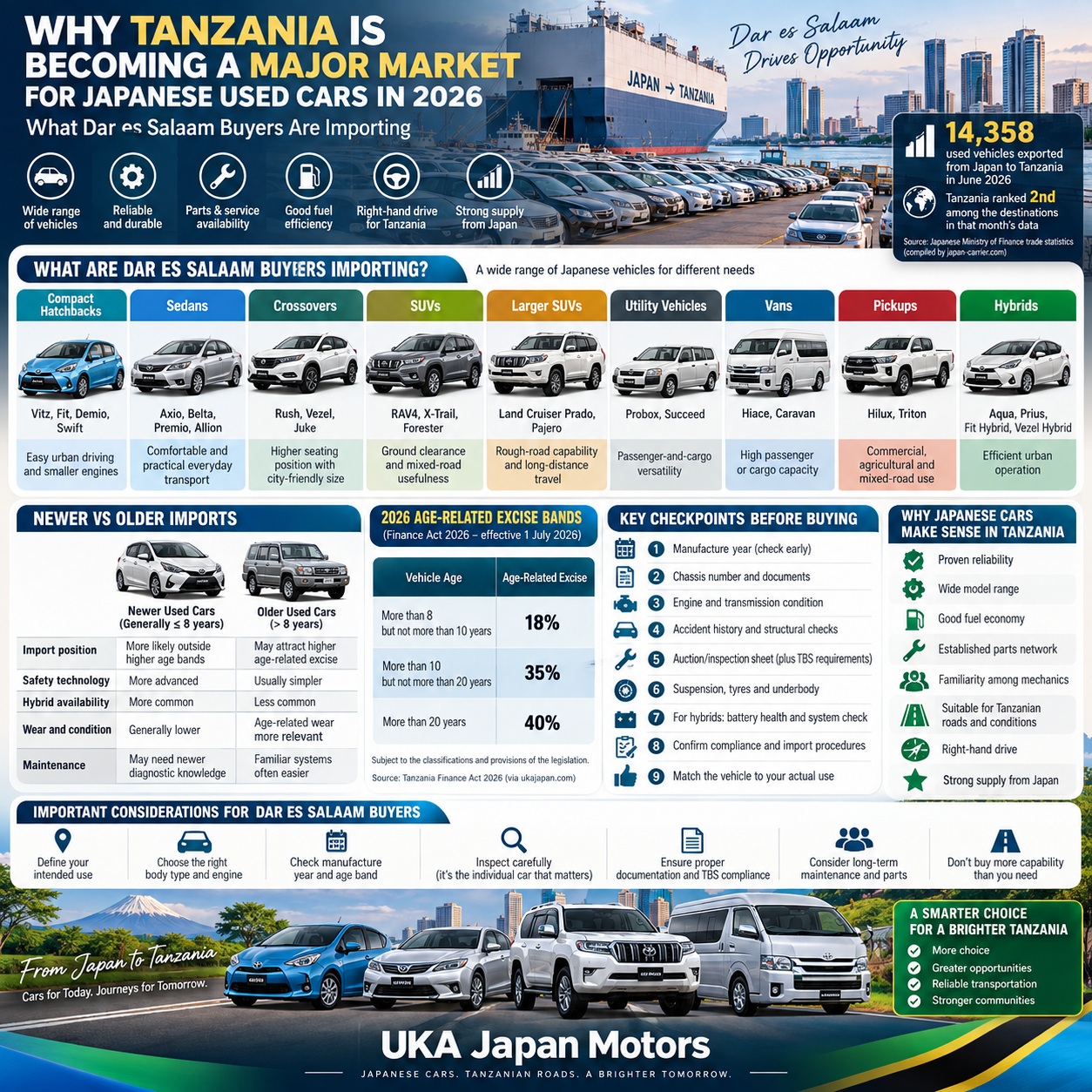
There is also evidence of substantial Japan-to-Tanzania vehicle movement. One industry compilation based on Japanese Ministry of Finance trade statistics reported that Tanzania received 14,358 used vehicles from Japan in June 2026 alone, placing Tanzania second among the destinations covered by that month’s Japanese used-vehicle export data. The figure should be understood as a monthly trade snapshot rather than a measure of Tanzania’s total vehicle fleet, but it demonstrates the scale that the Japan–Tanzania used-car channel can reach.
For a Dar es Salaam buyer, however, the more useful question is not simply why so many Japanese vehicles are entering Tanzania.
It is:
What types of vehicles are Tanzanian buyers choosing, why do those vehicles make sense locally, and what should an individual buyer examine before following the wider market?
This guide looks at those questions from the perspective of real ownership in Tanzania.
Direct Answer: Why Are Japanese Used Cars So Important in Tanzania in 2026?
Japanese used vehicles fit several characteristics of Tanzanian motoring particularly well.
Many are right-hand-drive vehicles suited to Tanzania’s road system. Japan also produces a very broad range of compact hatchbacks, sedans, crossovers, SUVs, vans, pickups and hybrids, giving Tanzanian buyers considerable choice without moving outside familiar vehicle categories.
More importantly, years of Japanese vehicle use in Tanzania have created familiarity around common models.
A Toyota IST, Vitz, RAV4, Harrier, Probox, Land Cruiser Prado or Hiace does not arrive into an unfamiliar ownership environment. Mechanics have experience with many of these vehicles, owners understand their basic characteristics, and parts channels have developed around widely used Japanese platforms.
The same principle extends beyond Toyota. Honda, Nissan, Mazda, Subaru, Suzuki and Mitsubishi vehicles all have established users in Tanzania.
In 2026 another factor has become particularly important: vehicle age.
Tanzania’s import procedures make the brand, engine size and year of production relevant to the assessment of an imported vehicle. The Tanzania Trade Portal specifically directs importers to the TRA used motor vehicle valuation system for vehicle-specific assessment.
The result is a market in which buyers increasingly have reason to look beyond the badge.
Manufacture year, engine specification, condition and intended use need to be considered together.
Dar es Salaam Is at the Centre of the Used-Car Import Cycle
Dar es Salaam has a special role in Tanzania’s Japanese used-car market because it combines three things: a major port, the country’s largest urban driving environment and a substantial concentration of vehicle-related businesses.
For an individual buyer, this means Dar es Salaam is not simply where many imported cars arrive. It is also where buyers experience some of the clearest advantages and disadvantages of different vehicle types.
A vehicle may spend much of its working life dealing with:
- frequent stop-and-go traffic;
- short urban journeys;
- extended idling;
- high ambient temperatures;
- heavy rain and standing water during wet periods;
- uneven access roads;
- speed humps;
- crowded parking areas;
- longer trips towards Morogoro, Dodoma or other parts of Tanzania.
Those conditions help explain why there is no single “best Japanese car” for a Dar es Salaam buyer.
A compact hatchback and a medium SUV can both make sense, but for completely different reasons.
The important trend in 2026 is that buyers have a wide enough Japanese used-vehicle supply to select more precisely according to use.
What Are Dar es Salaam Buyers Importing?
The Japanese used-car market serving Tanzania is broad, but several vehicle categories have particularly strong practical logic.
Rather than looking only at individual model names, it is more useful to understand why each category exists in the market.
| Vehicle category | Common Japanese examples | Why it fits Tanzania |
|---|---|---|
| Compact hatchbacks | Toyota Vitz, Honda Fit, Mazda Demio, Suzuki Swift | Easy urban driving, smaller engines, manageable dimensions |
| Compact sedans | Toyota Axio, Toyota Belta, Honda Grace | Practical everyday transport with conventional saloon layout |
| Medium sedans | Toyota Premio, Toyota Allion, Toyota Mark X | More cabin comfort and stronger long-distance suitability |
| Compact crossovers | Toyota Rush, Nissan Juke, Honda Vezel | Higher seating position with city-friendly dimensions |
| Medium SUVs | Toyota RAV4, Nissan X-Trail, Subaru Forester | Ground clearance, passenger space and mixed-road usefulness |
| Larger SUVs | Toyota Land Cruiser Prado, Mitsubishi Pajero | Rougher-road capability and long-distance use |
| Utility vehicles | Toyota Probox, Toyota Succeed | Passenger-and-cargo versatility |
| Vans | Toyota Hiace, Nissan Caravan | High passenger or cargo capacity |
| Pickups | Toyota Hilux, Mitsubishi Triton | Commercial, agricultural and mixed-road applications |
| Hybrids | Toyota Aqua, Toyota Prius, Honda Fit Hybrid, Honda Vezel Hybrid | Efficient urban operation when condition and battery health are properly assessed |
This diversity is one of the major reasons Japanese vehicles remain so relevant.
The Tanzanian market does not depend on one type of buyer.
An office commuter in Dar es Salaam, a family travelling between Dar es Salaam and Morogoro, a business using a Probox, and an owner regularly travelling on rougher roads may all source vehicles from Japan while selecting completely different specifications.
1. Compact Japanese Cars Remain Highly Relevant to Dar es Salaam
For urban driving, small Japanese hatchbacks make considerable practical sense.
Vehicles such as the Toyota Vitz, Honda Fit, Mazda Demio and Suzuki Swift are compact enough for crowded streets and parking spaces while providing enough cabin capacity for normal everyday use.
Their smaller engines can also suit buyers who do not require the weight or capability of an SUV.
This matters in Dar es Salaam because a vehicle’s physical size affects everyday usability.
A large SUV may provide excellent ground clearance, but that advantage can be unnecessary for someone whose normal routine consists mainly of paved urban roads, office parking and short daily journeys.
A compact hatchback may therefore be the more appropriate tool.
What should buyers inspect?
Small Japanese cars should not automatically be assumed to have had an easy previous life.
Check:
- verified mileage information where available;
- service history;
- cooling-system condition;
- CVT or automatic-transmission behaviour;
- suspension noise;
- wheel alignment;
- underbody condition;
- evidence of accident repair;
- air-conditioning performance;
- tyre condition and age;
- warning lights and diagnostic faults.
For Dar es Salaam, air-conditioning and cooling-system health deserve particular attention because of the combination of heat, traffic and idling.
2. Toyota Axio, Premio and Allion-Type Sedans Still Have a Clear Role
The traditional Japanese sedan remains relevant even as crossovers become more visible.
Cars such as the Toyota Corolla Axio provide straightforward everyday transportation, while larger sedans such as the Premio and Allion provide more interior space and long-distance comfort.
The attraction of these cars in Tanzania is partly familiarity.
Many mechanics understand common Toyota petrol engines and automatic transmissions, and owners have extensive experience with these platforms.
But familiarity should never replace inspection.
Two visually identical Toyota sedans can have very different histories.
One may have been maintained consistently. Another may have accident repairs, neglected fluids, suspension wear or undocumented mileage.
The model name tells you what the vehicle is.
Inspection tells you what that particular vehicle has become.
That distinction is essential when buying used.
3. Crossovers Are Filling the Space Between Hatchbacks and Traditional SUVs
One of the most significant changes in modern vehicle demand is the rise of the crossover.
For Tanzanian drivers, the appeal is understandable.
A crossover can offer a higher seating position and additional ground clearance without necessarily having the dimensions of a traditional body-on-frame SUV.
Vehicles such as the Honda Vezel, Toyota Rush and similar Japanese crossovers can therefore suit buyers who regularly encounter mixed road surfaces but still spend much of their time in Dar es Salaam.
This is a useful contrast:
Compact hatchback: easier urban manoeuvrability and generally simpler everyday city use.
Crossover: greater clearance and a higher driving position, usually with some compromise in weight, complexity or fuel consumption depending on the model.
Traditional SUV: greater capability where road conditions genuinely demand it, but physically larger and often mechanically more substantial.
The correct choice depends on the owner’s actual driving pattern rather than appearance.
4. RAV4, X-Trail and Forester-Type SUVs Match Mixed Tanzanian Use
Medium Japanese SUVs occupy an important position because many Tanzanian owners need one vehicle to perform several roles.
A vehicle may be used in Dar es Salaam during the working week and then travel longer distances on weekends or for business.
Road quality can also change significantly once a journey moves away from major paved routes.
This is where models such as the Toyota RAV4, Nissan X-Trail and Subaru Forester become relevant.
They can offer:
- greater ground clearance than conventional sedans;
- flexible cargo space;
- more comfortable access for passengers;
- better suitability for uneven roads;
- useful long-distance capability.
However, SUV ownership requires more careful specification checking.
A buyer should establish whether a particular vehicle is front-wheel drive or all-wheel drive, understand the transmission fitted, and check the condition of the drivetrain.
Subaru vehicles, for example, should be evaluated with proper attention to their AWD system and maintenance history rather than selected simply because they offer strong road capability.
Likewise, an X-Trail or RAV4 should be inspected as an individual vehicle rather than assumed to be reliable solely because the model has a strong reputation.
5. Larger SUVs Serve a Different Tanzanian Buyer
Vehicles such as the Toyota Land Cruiser Prado are not simply enlarged versions of compact crossovers.
Their purpose is different.
A larger SUV can make sense for an owner who frequently travels outside major urban roads, carries several passengers over long distances, operates in areas where road surfaces are challenging, or requires stronger rough-road capability.
For someone spending almost all their time in central Dar es Salaam, those strengths may be used much less frequently.
This illustrates an important buying principle:
Capability only has value when it matches the job the vehicle actually needs to perform.
Buying considerably more vehicle than necessary can mean living every day with additional size, weight and mechanical complexity without regularly using the capability that justified them.
6. Toyota Probox and Similar Utility Vehicles Remain Important
Few vehicle types demonstrate the practical side of Tanzania’s Japanese-car market as clearly as the Toyota Probox and related utility wagons.
These vehicles are not primarily about luxury.
They are designed around functionality.
A Probox can carry people, goods or a mixture of both. Its straightforward layout and established mechanical familiarity make it useful for a wide range of Tanzanian applications.
This makes the vehicle relevant to businesses as well as private owners who genuinely need cargo flexibility.
However, used utility vehicles require careful inspection precisely because they may have worked hard.
A buyer should pay attention to:
- rear suspension condition;
- cargo-area wear;
- transmission behaviour;
- engine mounts;
- wheel bearings;
- steering components;
- evidence of previous overloading;
- underbody damage;
- seat and interior wear compared with stated mileage.
A clean exterior does not prove light previous use.
7. Hiace and Caravan-Type Vans Support Passenger and Commercial Activity
Japanese vans occupy another distinct part of Tanzania’s vehicle ecosystem.
Toyota Hiace and Nissan Caravan-type vehicles can be configured around passenger movement, cargo use or specialised commercial requirements.
The crucial consideration is previous use.
A van that has spent years carrying heavy loads should not be evaluated in exactly the same way as a lightly used private passenger car.
Chassis condition, suspension, brakes, cooling system, transmission, differential and tyres deserve close attention.
The vehicle’s intended Tanzanian role should also be established before selecting the configuration.
A buyer needs to think about seating layout, roof height, door configuration, engine type and operating environment rather than simply choosing “a Hiace.”
8. Pickups Remain Important Beyond Urban Commuting
Japanese pickups such as the Toyota Hilux and Mitsubishi Triton serve a very different purpose from the compact vehicles common in Dar es Salaam.
Their relevance is strongest where the vehicle genuinely needs to carry loads, travel over rough surfaces or operate in agricultural, construction or commercial environments.
A pickup can still be driven daily in Dar es Salaam, but buyers should distinguish between wanting pickup styling and requiring pickup capability.
Used pickups also need specific inspection.
Look for evidence of:
- heavy towing;
- overloading;
- chassis damage;
- corrosion;
- off-road impacts;
- differential problems;
- worn suspension;
- damaged underbody protection;
- transfer-case problems on four-wheel-drive versions.
The strongest-looking vehicle is not necessarily the healthiest one mechanically.
9. Hybrids Are Becoming Harder for Tanzanian Buyers to Ignore
Japan’s used-vehicle supply increasingly includes hybrid versions of familiar cars and crossovers.
Toyota Aqua, Prius and hybrid variants of other Japanese models have made hybrid technology far more visible.
For Dar es Salaam, the technology has a logical use case.
Hybrid systems can operate effectively in repeated urban stop-and-go conditions because the electric motor, regenerative braking and automatic engine stop-start behaviour are designed around variable-speed driving.
But buying a used hybrid requires an additional layer of inspection.
A conventional petrol-car inspection is not enough.
The buyer should also investigate:
- hybrid battery health;
- battery cooling system;
- hybrid-system fault codes;
- inverter condition;
- warning history;
- correct operation during transition between electric and engine power;
- 12-volt battery condition;
- evidence of previous hybrid-system repairs.
The key issue is not whether hybrid technology is “good” or “bad” for Tanzania.
It is whether the specific hybrid being purchased is healthy and whether the owner has access to appropriate diagnosis and maintenance.
A well-inspected hybrid and a neglected hybrid are two very different ownership propositions.
Why Japan’s Vehicle Supply Matches Tanzania So Well
The relationship between Tanzania and Japanese used vehicles is not accidental.
Japan produces a remarkably broad range of right-hand-drive vehicles, from very small city cars to heavy-duty four-wheel-drive vehicles.
That gives Tanzanian buyers choices across almost every practical vehicle category.
Another advantage is specification diversity.
A single model may be available with:
- different engine capacities;
- two-wheel or four-wheel drive;
- petrol or hybrid power;
- several transmission types;
- different safety packages;
- multiple trim levels.
For a knowledgeable buyer, that means it is possible to select a vehicle around Tanzanian use rather than simply accepting whichever specification happens to be locally available.
But specification diversity creates another responsibility:
The buyer needs to understand exactly what is being imported.
A model name alone is not sufficient.
The 2026 Age Rules Are Changing How Buyers Should Think
Vehicle age has become particularly significant in 2026.
Tanzania’s Finance Act 2026 introduced revised age-related excise treatment for imported used vehicles. Vehicles more than eight years but not more than ten years old fall into an 18% age-related excise band, vehicles more than ten but not more than twenty years old fall into a 35% band, and vehicles more than twenty years old fall into a 40% band, subject to the classifications and provisions of the legislation. The changes took effect from 1 July 2026.
This creates an important change in buyer thinking without implying that every older vehicle should be avoided.
Consider two vehicles from the same model family.
One is relatively recent but has higher mileage.
The other is older but has lower recorded mileage.
Which is the better vehicle?
There is no responsible answer based on those two facts alone.
The buyer needs to consider:
- manufacture year;
- verified mechanical condition;
- mileage credibility;
- engine specification;
- transmission condition;
- previous accident history;
- corrosion;
- maintenance records;
- age-related import treatment;
- suitability for Tanzanian use.
In other words, 2026 makes manufacture year an early selection criterion rather than something to discover after choosing the car.
The Tanzania Trade Portal reinforces the broader point by stating that vehicle import assessment depends on characteristics including brand, engine size and year of production.
Newer Japanese Used Cars vs Much Older Imports
This is one of the most useful comparisons for a Dar es Salaam buyer in 2026.
| Factor | Relatively newer used vehicle | Much older used vehicle |
|---|---|---|
| Age-related import position | More likely to remain outside older age bands | More likely to enter additional age bands |
| Safety technology | More likely to include newer systems | Usually simpler or earlier-generation systems |
| Electronics | Potentially more advanced | Often mechanically simpler |
| Hybrid availability | More common | Less common in earlier generations |
| Wear | Age-related deterioration potentially lower | Rubber, seals, suspension and interior ageing more relevant |
| Maintenance | May require newer diagnostic knowledge | Familiar mechanical systems may be easier for workshops |
| Selection priority | Condition + specification + manufacture year | Condition + age + parts + previous maintenance become especially important |
Neither column automatically describes a good or bad car.
A poorly maintained newer vehicle can be a worse ownership choice than a carefully maintained older one.
The point is that age now affects more than appearance and mechanical wear. It also forms part of the import assessment environment.
Inspection Is the Filter Between a Popular Model and a Good Vehicle
A recurring mistake in used-car buying is to confuse model reputation with individual vehicle condition.
Suppose a buyer finds a Toyota RAV4 from a generation widely regarded as durable.
That reputation tells the buyer something about the engineering platform.
It does not reveal:
- whether that particular engine overheated;
- whether the transmission has been serviced correctly;
- whether the vehicle suffered structural accident damage;
- whether the odometer reading is credible;
- whether the suspension is worn;
- whether warning lights have been concealed;
- whether the vehicle has corrosion or flood-related damage.
That is why inspection must sit at the centre of Japanese used-car selection.
Tanzania Bureau of Standards procedures also make conformity inspection part of the formal import process. TBS documentation describes a pre-shipment verification process in which vehicle details are submitted to an inspection contractor, compliance is evaluated, an inspection certificate or Certificate of Roadworthiness is issued when requirements are met, and the documentation is subsequently authenticated for clearance.
TBS continues to publish information on PVoC procedures and contracted service providers for imported used vehicles.
A Japanese auction inspection sheet can provide useful information, but it should not be treated as a substitute for Tanzania’s required conformity process or for careful buyer due diligence.
Documentation Matters as Much as Mechanical Condition
A mechanically excellent car can still create problems if the documentation is incomplete or inconsistent.
Before shipment, buyers should verify key identifying information such as:
Chassis number: It should correspond correctly across the vehicle and documentation.
Manufacture year: Particularly important in 2026 because age affects the vehicle’s import position.
Engine specification: Engine capacity can affect customs treatment and ownership characteristics.
Export documentation: Details should correspond with the actual vehicle.
Inspection documentation: Required conformity and roadworthiness procedures should be completed correctly.
Bill of lading information: Vehicle and consignee details need to be accurate.
The official Tanzania Trade Portal describes a multi-stage vehicle import procedure covering a clearing agent, customs documentation, TBS roadworthiness processes, TRA release, delivery documentation, port clearance and vehicle registration.
This is why buying a Japanese used vehicle should never be reduced to selecting photographs from an online listing.
The car and its paperwork form one package.
What Should Dar es Salaam Buyers Prioritise in 2026?
The strongest buying process begins with intended use rather than a model name.
A buyer can work through the decision in this order:
- Define where the vehicle will operate.
Mostly Dar es Salaam? Frequent travel to Morogoro or Dodoma? Regular rough roads? Urban business deliveries? - Decide what body type genuinely fits.
Hatchback, sedan, crossover, SUV, wagon, van or pickup. - Choose an appropriate engine and drivetrain.
Do not select more engine capacity or four-wheel-drive complexity unless it serves a real purpose. - Check manufacture year before becoming committed to the vehicle.
The 2026 age bands make this an important early-stage filter. - Verify the exact specification.
Model code, chassis number, engine, transmission and drivetrain matter. - Review history and condition.
Mileage should be considered alongside maintenance and physical wear. - Inspect structurally and mechanically.
Accident repair, corrosion, suspension, drivetrain, cooling and electronics deserve proper attention. - Confirm compliance requirements before shipment.
Do not assume that a vehicle being exportable from Japan automatically means every Tanzanian requirement has been satisfied. - Review ownership suitability.
Parts familiarity, diagnostic capability and the owner’s normal driving environment matter after registration.
This sequence protects the buyer from choosing emotionally first and investigating technically afterwards.
How Dar es Salaam Use Differs From Upcountry Use
Tanzania cannot be treated as one uniform driving environment.
A Dar es Salaam commuter may prioritise compact dimensions, automatic transmission, air-conditioning and efficient stop-start operation.
A driver travelling regularly between Dar es Salaam and Dodoma may place more emphasis on highway stability, seating comfort, luggage capacity and cooling-system health.
A vehicle operating around Arusha may face a different mix of urban roads, longer journeys and tourism-related use.
In Mwanza, Mbeya, Morogoro and Tanga, local terrain, road surfaces and the balance between urban and longer-distance driving can again change the ideal specification.
This is why popularity should be treated as information, not instruction.
A vehicle can be extremely common in Tanzania and still be unsuitable for one particular owner.
Petrol, Diesel or Hybrid?
Powertrain selection is becoming a more interesting question as the Japanese supply available to Tanzania changes.
Petrol
Petrol remains familiar across a broad range of Japanese passenger cars.
For normal private use in Dar es Salaam, a naturally aspirated petrol engine paired with a proven automatic transmission can provide a straightforward ownership experience.
Diesel
Diesel engines remain important in pickups, vans and larger SUVs where torque and heavy-duty use matter.
However, modern diesel systems can include increasingly sophisticated emissions and fuel-delivery components. Buyers should understand the exact engine generation rather than assuming every diesel is mechanically simple.
Hybrid
Hybrid systems are particularly relevant to stop-start urban driving but require hybrid-specific condition assessment.
The best choice therefore depends on use.
A compact petrol hatchback may suit one Dar es Salaam commuter.
A hybrid may suit another.
A diesel pickup may be appropriate for a business operating on demanding roads.
The powertrain should follow the job.
Ownership Begins After the Vehicle Leaves the Port
Importing successfully is only the beginning.
Long-term reliability depends heavily on what happens after the car enters regular Tanzanian use.
A sensible post-import ownership routine should include checking:
- engine oil and filter condition;
- transmission fluid requirements;
- coolant condition;
- brake fluid;
- brake pads and discs;
- suspension components;
- tyres and tyre age;
- wheel alignment;
- battery health;
- air-conditioning;
- engine air filter;
- cabin filter;
- belts and hoses where applicable;
- diagnostic fault codes.
For hybrids, add battery-system diagnosis and cooling-path inspection.
For four-wheel-drive vehicles, include differential and transfer-system checks where applicable.
For diesel vehicles, understand the maintenance needs of the exact injection and emissions systems fitted.
The objective is to establish a known maintenance baseline.
Why Parts Familiarity Matters in Tanzania
One reason established Japanese models remain attractive is the ownership ecosystem surrounding them.
When many examples of a model or engine family are already operating in Tanzania, workshops have more opportunities to become familiar with recurring maintenance requirements.
Parts suppliers also have a reason to stock components for vehicles that appear frequently on Tanzanian roads.
This creates a practical advantage for mainstream models.
But buyers should be careful with unusual specifications.
A vehicle can carry a familiar badge while using an uncommon engine, transmission, hybrid system or electronic package.
For example, knowing that Toyota parts are widely understood does not mean every component for every Toyota specification will be equally familiar.
Always evaluate the exact model code and drivetrain.
The Market Is Moving From “Which Car?” to “Which Specification?”
This may be the most important shift for Tanzanian buyers.
Older buying conversations often begin with broad questions:
“Is a Toyota RAV4 good?”
“Should I buy a Harrier?”
“Is a Honda Fit reliable?”
Those questions are becoming less useful.
A better conversation in 2026 is:
Which RAV4 generation, manufacture year, engine, drivetrain and condition fits my use?
Or:
Which Honda Fit powertrain am I considering, and what does its inspection history show?
That is a much more mature way to buy a used vehicle.
As Tanzania’s Japanese used-car market grows and vehicle technology becomes more diverse, specification literacy becomes increasingly valuable.
Common Mistakes Dar es Salaam Buyers Should Avoid
The first is choosing entirely by appearance. Clean paint and a detailed interior can hide mechanical or structural problems.
The second is treating mileage as the only condition indicator. Mileage matters, but maintenance quality, age and operating history matter as well.
The third is ignoring manufacture year until late in the process. In 2026, age should be checked early because of Tanzania’s revised age-based import treatment.
The fourth is assuming every example of a reliable model is reliable. Reliability reputation applies to the design; inspection determines the state of the individual vehicle.
The fifth is buying unnecessary capability. A four-wheel-drive SUV is useful when the driving environment requires it. It is not automatically the correct choice for every Dar es Salaam owner.
The sixth is ignoring hybrid battery condition when considering a hybrid.
The seventh is assuming an auction sheet replaces Tanzanian compliance procedures. TBS roadworthiness and conformity requirements remain separate formal considerations.
The eighth is failing to verify documents against the actual chassis.
What Tanzania’s Growing Japanese Used-Car Market Means for Buyers
A large and active import market creates more choice, but more choice also requires better filtering.
The ideal outcome is not simply access to more vehicles.
It is access to the right vehicles with enough information to select responsibly.
For Tanzanian buyers in 2026, that means combining four layers of information:
Vehicle suitability — Does this body type, engine and drivetrain match the owner’s real use?
Vehicle condition — What does inspection reveal about this particular unit?
Import compliance — Are age, documentation, inspection and customs requirements understood before shipment?
Ownership suitability — Can the vehicle be properly serviced and maintained during its life in Tanzania?
When all four are considered together, importing from Japan becomes a much more disciplined process.
UKA Japan Motors’ Role: Inspection and Compliance Before Selection
UKA Japan Motors’ role is to help Tanzanian buyers evaluate Japanese used vehicles through inspection, specification verification and compliance awareness rather than treating every available vehicle as equally suitable.
The focus should begin before shipment.
That includes checking the vehicle’s manufacture year, chassis details, engine specification, drivetrain, mileage information where verifiable, physical condition and available inspection documentation.
For a Dar es Salaam buyer, this approach is particularly important in 2026 because the age of an imported vehicle can affect its treatment under Tanzania’s current import framework.
UKA Japan Motors also considers the intended Tanzanian use of the vehicle.
A buyer primarily driving within Dar es Salaam may need a very different specification from an owner regularly travelling between cities or operating on rough roads.
The purpose of this guidance is not to push buyers toward a particular model.
It is to help ensure that the Japanese used vehicle being considered is understood properly before it begins its working life in Tanzania.
Frequently Asked Questions
1. Why are Japanese used cars so common in Tanzania?
Japanese vehicles match several characteristics of the Tanzanian market. Japan has a large supply of right-hand-drive vehicles across many body styles, while Tanzania already has substantial workshop and ownership familiarity with Japanese brands. Models range from small urban hatchbacks to commercial vans, pickups and large SUVs.
2. What Japanese cars are Dar es Salaam buyers importing in 2026?
Demand covers several categories rather than one model. Commonly relevant vehicles include Toyota Vitz, Axio, Premio, Allion, Probox, RAV4, Harrier, Land Cruiser Prado and Hiace, together with vehicles such as the Honda Fit and Vezel, Nissan X-Trail, Mazda Demio, Subaru Forester, Suzuki Swift and Mitsubishi pickups and SUVs.
3. Are compact cars suitable for Dar es Salaam?
Yes, when the owner’s driving is primarily urban. Compact cars can be easier to manoeuvre and park and do not carry the size of an SUV. Buyers should still inspect cooling, transmission, suspension, air-conditioning and previous accident history carefully.
4. Why is vehicle age especially important in Tanzania in 2026?
The Finance Act 2026 revised the age-related excise treatment of imported used vehicles. The applicable age bands mean that manufacture year can materially change the import position of otherwise similar vehicles. Buyers should therefore establish manufacture year early in the selection process.
5. Does Tanzania require Japanese used cars to be inspected?
Imported used motor vehicles are subject to TBS conformity and roadworthiness procedures. TBS documentation describes pre-shipment verification steps and the issuing and authentication of inspection documentation for compliant vehicles. Buyers should confirm the current procedure applicable to the specific shipment before export.
6. Is a Toyota automatically a safe used-car choice because Toyotas are common in Tanzania?
No. A model’s reputation cannot confirm the condition of an individual vehicle. Previous maintenance, accidents, mileage, corrosion, overheating, transmission condition and repairs all need to be investigated.
7. Are Japanese hybrid cars suitable for Dar es Salaam?
They can be well suited to urban stop-start driving, but used hybrids require battery and hybrid-system inspection in addition to conventional mechanical checks. The buyer should also consider access to technicians capable of proper hybrid diagnosis.
8. Should I choose an SUV because Tanzanian roads can be rough?
Only when your normal driving conditions justify one. A buyer mainly travelling on paved roads within Dar es Salaam may find a hatchback, sedan or crossover more appropriate. Regular rough-road or upcountry driving can make additional ground clearance and stronger suspension more relevant.
9. Is low mileage more important than manufacture year?
Neither should be considered alone. A lower-mileage older vehicle may have age-related deterioration, while a newer high-mileage vehicle may have accumulated substantial mechanical wear. Manufacture year, mileage credibility, maintenance history and inspection condition should be assessed together.
10. What documents should be checked before importing from Japan?
Important information includes the chassis number, manufacture year, engine specification, export documentation, inspection documentation and shipping details. These should correspond accurately with the actual vehicle. Tanzania’s official import procedure also involves customs, TBS roadworthiness, TRA release, port clearance and registration stages.
11. Is a Japanese auction sheet enough to prove that a car is suitable for Tanzania?
No. An auction sheet can be useful evidence about the vehicle’s condition at the time of auction, but it does not replace Tanzania’s required conformity and roadworthiness processes. Buyers should treat auction information, independent vehicle assessment and Tanzanian compliance as separate checks.
12. What should I check immediately after receiving an imported Japanese vehicle?
Establish a maintenance baseline. Check fluids, filters, brakes, tyres, suspension, battery, cooling system, air-conditioning and diagnostic fault codes. Hybrids, four-wheel-drive vehicles and modern diesels require additional system-specific checks.
13. Why are vehicles such as the Toyota Probox popular in Tanzania?
The Probox combines passenger capacity with a useful cargo area and relatively straightforward mechanical design. It can therefore serve private, commercial and mixed-use roles. Because used utility vehicles may have experienced demanding previous use, suspension, drivetrain and cargo-area condition should be inspected carefully.
14. What matters most when selecting a Japanese used car for Tanzania in 2026?
Start with intended use. Then examine body type, engine, drivetrain, manufacture year, mechanical condition, mileage history, inspection results, documentation, compliance requirements and long-term maintenance suitability. The model badge should be only one part of that decision.
Conclusion
Tanzania’s importance in the Japanese used-car trade in 2026 reflects something deeper than simple brand popularity.
Japanese vehicles cover an unusually broad range of Tanzanian transport needs.
Compact hatchbacks work naturally in crowded Dar es Salaam traffic. Sedans remain useful for everyday and longer-distance travel. Crossovers combine urban usability with additional clearance. SUVs serve mixed-road and upcountry driving. Probox-type wagons, Hiace-type vans and pickups support commercial and practical transport requirements. Hybrids add another increasingly relevant option for urban users.
At the same time, buying intelligently in 2026 requires more knowledge than simply recognising a trusted model name.
Vehicle age now deserves early attention because of Tanzania’s revised age-related import treatment. Engine and drivetrain specifications need to match actual use. Inspection should establish the condition of the individual vehicle, while TBS conformity procedures and the broader customs and registration process need to be understood before shipment. Tanzania’s official Trade Portal confirms that vehicle import procedures involve customs documentation, roadworthiness processes, release, port clearance and registration, while vehicle characteristics such as brand, engine size and production year influence assessment.
The most useful lesson from Tanzania’s growing Japanese used-car market is therefore not that buyers should simply follow the most popular models.
It is that the depth of Japan’s used-vehicle supply allows Tanzanian buyers to be more selective.
For a Dar es Salaam buyer, the strongest vehicle is the one whose age, specification, mechanical condition, inspection status and long-term ownership requirements fit the work it will actually perform on Tanzanian roads.
Contact UKA Japan Motors for availability and inspection guidance.