


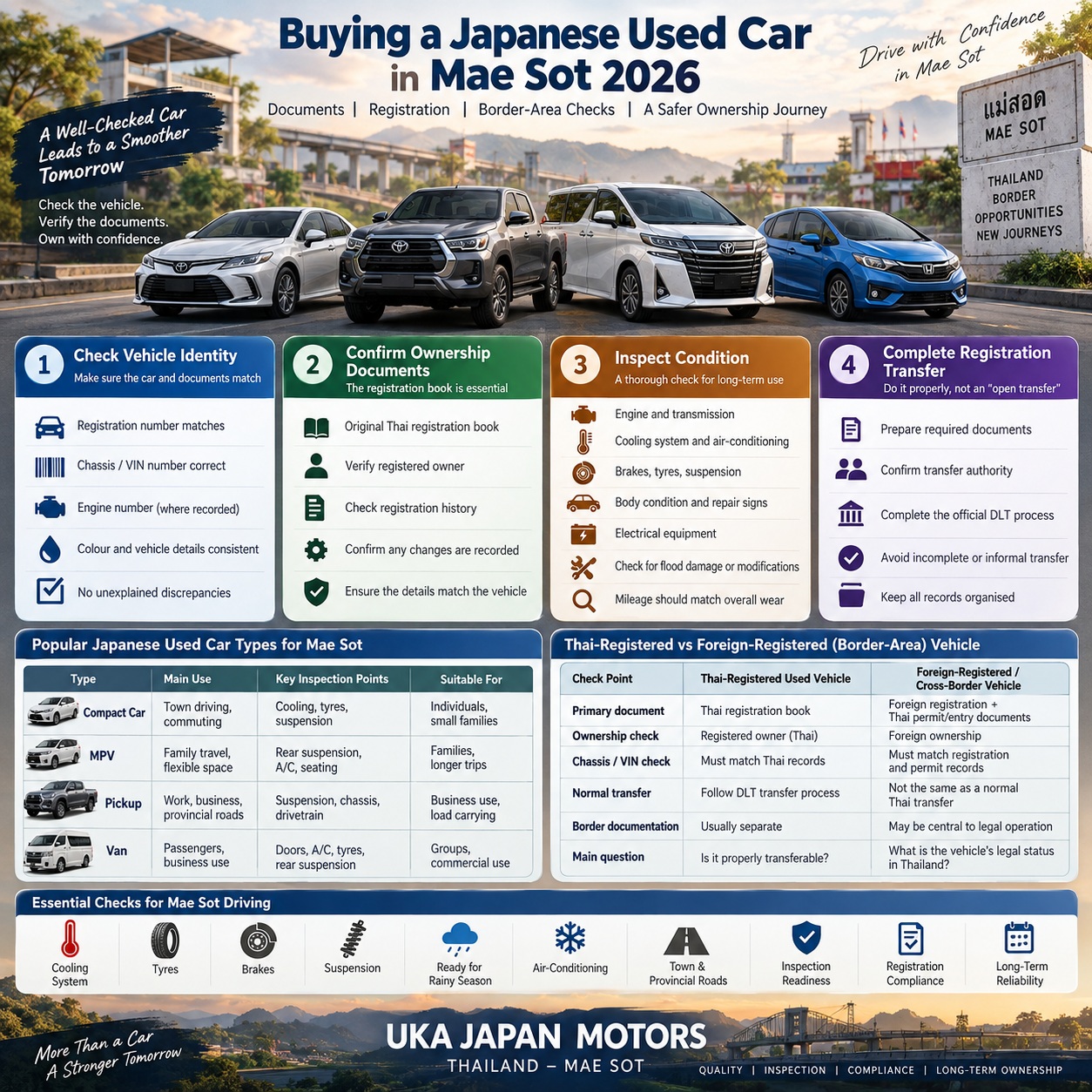
Buying a Japanese used car in Mae Sot requires more than checking how the engine sounds or whether the body looks clean. Vehicle condition matters, but legal identity, ownership records, registration details and transfer readiness are equally important.
This is particularly relevant in Mae Sot because the town is both an everyday driving environment and an important border-area transport centre. Vehicles may be used for commuting within town, family travel, business operations, provincial-road journeys or regular movement around commercial and border-related areas.
A vehicle that appears mechanically suitable can still create difficulties if its documentation does not correspond with the actual vehicle. Likewise, complete-looking paperwork does not replace a physical inspection. The safest approach is to treat the vehicle and its documents as two parts of the same inspection.
Thailand’s Department of Land Transport (DLT) advises buyers and sellers of used vehicles to verify the vehicle’s origin and registration evidence. In particular, the original registration book should correspond with the vehicle’s owner information, chassis number, engine number and colour. The DLT also advises completing the formal registration transfer rather than relying on an informal or incomplete transfer arrangement.
For a buyer in Mae Sot, the practical question should therefore not simply be:
“Is this a good car?”
A more complete question is:
“Does the physical vehicle, its legal identity, its documentation, its mechanical condition and its intended use in Thailand all make sense together?”
This guide explains how to approach that question in 2026.
Direct Answer: What Should You Check Before Buying?
Before taking ownership of a Japanese used car in Mae Sot, examine four areas together:
Vehicle identity: Confirm that identifying details on the physical vehicle correspond with the registration records. Chassis/VIN information, engine details, registration number and vehicle characteristics should make sense as one consistent record.
Ownership and registration documentation: Examine the original vehicle registration book and confirm that the registered information corresponds with the vehicle and the person or entity involved in the transfer.
Physical condition: Inspect the engine, transmission, cooling system, brakes, tyres, steering, suspension, body structure, electrical equipment and signs of previous repairs or modifications.
Transfer and compliance readiness: Establish that the vehicle can proceed through the appropriate Thai registration and ownership-transfer process without unresolved discrepancies.
The DLT specifically recommends checking the original registration book, owner, chassis number, engine number, colour and annual vehicle-tax status, as well as taking the vehicle through the appropriate inspection and registration-transfer process.
For Mae Sot buyers, there is another important distinction: a Thai-registered used vehicle intended for normal ownership in Thailand should not be confused with a foreign-registered vehicle temporarily operating in Thailand or a vehicle involved in cross-border transport procedures. Those situations can involve different documents and permissions.
1. Start With Legal Identity, Not Appearance
Japanese vehicles have a strong presence across many categories used in Thailand, including compact cars, sedans, MPVs, pickups and vans. However, the manufacturer’s badge tells you very little about the legal status of an individual used vehicle.
Two vehicles of the same model and year can have very different histories.
One may have consistent registration information, identifiable service history, straightforward ownership records and condition appropriate for continued use.
Another may look equally presentable while having inconsistencies between physical identifiers and documentation.
That is why vehicle identity should be established early in the inspection.
Registration number
Check that the registration plate corresponds with the registration documentation.
A plate by itself is not proof of the vehicle’s identity. It is one piece of information that should fit into the wider record.
Chassis or VIN information
The chassis number or Vehicle Identification Number is one of the most important identity references.
Locate the identifying number on the vehicle and compare it carefully with the registration records. Characters should correspond exactly.
Do not treat a nearly matching number as sufficient.
A difference involving even one character requires clarification before proceeding.
Engine number
Where an engine number is recorded for the vehicle, compare the physical engine identification with the registration information.
Engine replacement is not automatically evidence of a problem. Engines can be changed for legitimate mechanical reasons. The important question is whether a change that requires registration action has been properly documented.
Vehicle colour and basic description
The colour and other recorded characteristics should also correspond with the physical vehicle.
A repaint for cosmetic reasons is different from a significant colour change or modification that creates a mismatch with official records.
This is why document inspection should happen alongside physical inspection rather than afterwards.
2. The Original Registration Book Is Central to the Check
The vehicle registration book is one of the most important documents in a Thai used-car transaction.
The DLT has specifically advised buyers to check the original registration book and ensure that details such as the owner’s name, chassis number, engine number and colour correspond with the actual vehicle.
A buyer should therefore inspect the document carefully rather than simply confirming that a registration book exists.
Look for consistency across:
- registered owner information;
- registration number;
- make and model information;
- chassis identification;
- engine information where recorded;
- vehicle colour;
- registration history and relevant entries;
- other changes recorded in the book.
The objective is not merely to collect paperwork. It is to build a consistent chain between vehicle → registration record → registered owner → transfer process.
When those elements correspond clearly, the vehicle is easier to understand.
When they do not, investigate before taking ownership.
3. Confirm Who Actually Has Authority to Transfer the Vehicle
The person presenting a vehicle is not automatically the person legally entitled to transfer it.
Check the registered ownership information and determine how the person or organisation handling the transaction relates to that record.
The DLT’s guidance for used-vehicle transfers identifies documents including the original registration book, identification documentation, transaction evidence and the appropriate transfer/application documentation signed by the parties. Different documentation applies when a juristic person is involved.
The exact requirements can depend on the circumstances, so current requirements should be confirmed with the relevant DLT office before completing a transaction.
The practical principle is straightforward:
Do not separate the purchase decision from the registration-transfer decision.
A buyer should understand how ownership will actually be transferred before treating the vehicle as ready for purchase.
4. Why an Informal “Open Transfer” Creates Unnecessary Risk
One issue specifically highlighted by the DLT is the practice commonly described as an incomplete or “open” transfer arrangement, where documents may be signed but the registration is not promptly and properly transferred.
The DLT has warned against this approach because the official ownership record can remain inconsistent with who actually possesses or uses the vehicle. It also reduces the opportunity for the authorities and parties to identify registration irregularities during a formal transfer process.
For a buyer, completing the transfer correctly creates a clearer ownership record.
For the previous registered owner, it also reduces the possibility of the vehicle continuing to be associated with that person’s name after possession has changed.
In practical terms, a completed transfer is much stronger than a folder of signed papers waiting for somebody to deal with later.
5. Physical Inspection and Document Inspection Should Happen Together
Consider two hypothetical vehicles.
Vehicle A: mechanically attractive, documentation unclear
The engine starts smoothly.
The interior is tidy.
The tyres look usable.
The body appears presentable.
But the chassis information is difficult to reconcile with the documentation, or the registered owner and transfer arrangement are unclear.
Vehicle B: mechanically sound, documentation consistent
The vehicle shows normal evidence of use.
Its engine, transmission, brakes and suspension are inspected.
The registration book corresponds with the physical identifiers.
The ownership position is understandable.
The vehicle is ready to follow the appropriate transfer procedure.
These examples show why appearance alone is an incomplete basis for judging a used vehicle.
The more useful standard is mechanical condition plus documentary consistency plus transfer readiness.
6. Mechanical Checks for Mae Sot Driving
Once the vehicle’s identity and documentation are understandable, attention should turn to condition.
Mae Sot presents a combination of driving environments. A vehicle might spend weekdays in relatively short urban journeys and then be used on provincial roads, longer journeys or for business activities.
Heat, humidity and heavy seasonal rain also make certain systems particularly important.
Engine
Check cold starting where possible.
Listen for abnormal knocking, tapping or irregular operation. Look for visible leaks and excessive smoke, and inspect the general condition of hoses, seals and surrounding components.
A clean engine compartment should not automatically be interpreted as evidence of excellent mechanical condition. Recent cleaning can make leakage patterns harder to identify.
Transmission
For an automatic transmission, check engagement and shifting behaviour.
For a manual vehicle, assess clutch operation, gear engagement and abnormal noise.
For continuously variable transmissions or hybrid drivetrains, inspection should consider the characteristics of the specific system rather than applying assumptions from a conventional automatic transmission.
Cooling system
Cooling-system condition is particularly important for long-term vehicle use in Thailand.
Inspect:
- radiator condition;
- coolant level and visible condition;
- hoses;
- expansion tank;
- cooling fans;
- visible leakage;
- evidence of previous overheating.
A vehicle that performs acceptably during a short inspection can still develop problems during longer journeys if its cooling system is marginal.
Brakes
Inspect brake components and assess braking behaviour.
Watch for vibration, pulling, abnormal noises or inconsistent pedal feel.
Rainy-season driving increases the importance of predictable braking and good tyre condition.
Tyres
Do not judge tyres by tread depth alone.
Check:
- manufacturing age;
- cracking;
- uneven wear;
- sidewall damage;
- matching specifications;
- evidence of alignment or suspension problems.
Uneven wear can sometimes reveal problems elsewhere in the vehicle.
Steering and suspension
Mae Sot and surrounding provincial routes can expose suspension weaknesses that are less obvious during a short, smooth-road inspection.
Check for:
- knocking noises;
- worn bushings;
- leaking dampers;
- loose steering response;
- wheel-bearing noise;
- irregular tyre wear;
- poor alignment behaviour.
For pickups and vans that may have experienced business or load-carrying use, suspension inspection deserves particular attention.
7. Look Beyond Cosmetic Body Condition
Paint quality can make a used vehicle visually attractive, but appearance does not necessarily reveal structural history.
Inspect panel alignment, door openings, bonnet and tailgate fit, weld areas, underbody sections and structural points.
A previous repair is not automatically unacceptable.
The important questions are:
What was repaired?
How extensive was the damage?
Was the repair performed appropriately?
Has structural integrity been affected?
Does the documented and physical history make sense?
Cosmetic repainting and structural accident repair are very different matters.
A practical inspection tries to distinguish between them.
8. Check for Flood and Water Exposure
Rainy-season conditions make water exposure another useful consideration in Thailand.
Inspect low areas of the cabin, seat mounting points, carpet edges, electrical connectors and areas where sediment or corrosion might remain.
Look for unusual combinations such as a heavily aged vehicle with unexpectedly new carpet sections or recently replaced interior components concentrated in low areas.
No single sign proves flood exposure.
Instead, evaluate patterns.
Persistent musty odours, corrosion in unusual interior locations, sediment, electrical irregularities and inconsistent interior replacement can justify deeper investigation.
9. Mileage Should Be Evaluated as Evidence, Not a Single Number
Mileage matters, but it should not be interpreted in isolation.
Compare the displayed reading with overall wear.
Look at:
- steering-wheel wear;
- pedal surfaces;
- driver’s seat condition;
- switches;
- door handles;
- suspension condition;
- service records where available;
- engine-bay condition.
A vehicle with substantial mileage but consistent maintenance can be easier to assess than one displaying unusually low mileage that does not correspond with physical wear.
The objective is not to search for the lowest number.
It is to determine whether the mileage appears credible in the context of the vehicle’s overall history.
10. Modifications Require Extra Attention
Japanese pickups, vans and passenger vehicles in Thailand are sometimes modified for practical or personal reasons.
Examples can involve wheels, tyres, suspension, lighting, body equipment, seating configuration or mechanical components.
Modifications should be evaluated from three perspectives:
Safety: Does the modification affect braking, steering, visibility, stability or structural integrity?
Mechanical suitability: Does it place additional stress on suspension, driveline or other components?
Registration and compliance: Is the modification consistent with the vehicle’s registered details and applicable requirements?
The DLT maintains rules concerning vehicles that have been altered or modified, so significant modifications should not simply be assumed to be acceptable because the vehicle is already being driven.
For a buyer seeking straightforward long-term ownership, a vehicle whose physical configuration corresponds clearly with its records is generally easier to understand and manage.
11. Mae Sot’s Border Location Creates an Important Documentation Distinction
Mae Sot’s location near the Thailand–Myanmar border makes vehicle-document terminology particularly important.
A Thai-registered vehicle being purchased for normal ownership in Thailand is not the same legal situation as a foreign-registered vehicle temporarily entering or operating in Thailand.
Thailand’s DLT maintains a Foreign Vehicle Permit framework for certain foreign-registered private vehicles. Its published requirements include vehicle-registration evidence, roadworthiness/inspection evidence, insurance information and other supporting documents. The DLT also identifies particular arrangements and exemptions associated with border use.
Separately, DLT regulations concerning international vehicle documents specifically reference implementation connected with cross-border movement at Myawaddy and Mae Sot.
This matters because the presence of a vehicle in Mae Sot does not, by itself, establish that it is a normal Thai-registered vehicle available for ordinary domestic ownership transfer.
A buyer should establish exactly which situation applies.
12. Border-Area Questions to Resolve Before Taking Ownership
When a vehicle has any cross-border history or unclear registration background, the documentation check should become more detailed.
Ask:
Where is the vehicle currently registered?
What registration document establishes that status?
Does the registration number correspond with the physical vehicle?
Do chassis and engine identifiers correspond with the records?
Who is the registered owner?
Can ownership be transferred through the appropriate Thai procedure?
Is the vehicle’s presence in Thailand based on normal Thai registration or another permission?
Are there unresolved alterations or identity discrepancies?
The purpose is not to assume that a border-area vehicle has a problem.
It is to avoid assuming that every vehicle physically present in Mae Sot has the same registration status.
13. Thai-Registered Vehicle vs Foreign-Registered Border Vehicle
This distinction can be summarised clearly.
| Check | Thai-Registered Used Vehicle | Foreign-Registered / Cross-Border Vehicle |
|---|---|---|
| Primary identity record | Thai registration documentation | Foreign registration plus applicable Thai entry/permit documentation |
| Ownership check | Registered owner and Thai transfer procedure | Foreign ownership and applicable permission/entry conditions |
| Chassis/VIN check | Must correspond with Thai records | Must correspond with registration and permit records |
| Normal ownership transfer | Follow applicable DLT transfer process | Do not assume ordinary Thai transfer applies |
| Border documentation | Usually separate from ordinary domestic ownership | May be central to lawful operation |
| Inspection focus | Mechanical condition + registration consistency | Mechanical condition + registration + permission/status |
| Main buyer question | Is the vehicle properly transferable? | What exactly is the vehicle’s legal status in Thailand? |
The DLT’s Foreign Vehicle Permit system itself requests detailed vehicle information including registration, make, model, colour, VIN, engine number and supporting registration documentation, illustrating how closely vehicle identity and documentary status are connected in cross-border vehicle administration.
14. Registration Transfer Should Be Part of the Buying Process
Do not think of ownership transfer as an administrative job to deal with long after selecting the vehicle.
It should be considered part of the inspection process.
The DLT has advised buyers and sellers to bring the vehicle through the relevant inspection and registration-transfer procedure and has specifically cautioned against leaving ownership transfer incomplete.
A sensible sequence is:
First: identify the vehicle physically.
Second: inspect the original registration information.
Third: establish the registered owner and authority to transfer.
Fourth: inspect mechanical and structural condition.
Fifth: investigate inconsistencies before proceeding.
Sixth: prepare the appropriate transfer documentation.
Seventh: complete the formal registration procedure.
This sequence reduces the chance that an attractive vehicle becomes an administrative problem later.
15. Inspection Readiness Matters
Thailand maintains formal vehicle-inspection rules and roadworthiness requirements. DLT inspection regulations set criteria for evaluating vehicle condition, and official inspection certification confirms that a vehicle examined under the applicable process has passed the required inspection as roadworthy under Thai vehicle law.
A used-car buyer should therefore consider not only how the vehicle behaves today but whether its condition is consistent with ongoing compliant use.
Items deserving attention include lighting, braking, steering, tyres, suspension, emissions-related equipment where applicable and significant modifications.
An inspection-ready vehicle is different from a vehicle that merely starts and moves.
16. Compact Car, MPV, Pickup or Van for Mae Sot?
Documentation standards should remain rigorous regardless of body type, but the mechanical inspection should reflect intended use.
Compact car
A compact car can suit town commuting, personal use and smaller-family needs.
Pay attention to cooling performance, tyre condition, suspension wear and evidence of repeated short-distance operation.
MPV
An MPV may suit families or users requiring flexible passenger and luggage space.
Inspect rear suspension, air-conditioning performance throughout the cabin, seating mechanisms and signs of intensive passenger use.
Pickup
A pickup can suit provincial-road travel, practical work and business-related use.
Look carefully at rear suspension, load-bed condition, chassis areas, drivetrain components and evidence of repeated heavy-duty use.
Four-wheel-drive models require additional attention to transfer-case and driveline operation where applicable.
Van
A van can serve passenger or business needs but may accumulate a different pattern of wear.
Inspect doors, seating, rear suspension, cooling performance, air-conditioning, tyres and signs of prolonged commercial operation.
There is no single body type that suits every Mae Sot owner.
The correct choice depends on actual use, passenger requirements, cargo needs, road conditions and maintenance expectations.
17. Family Use and Business Use Create Different Inspection Priorities
A family vehicle may place greater importance on cabin condition, restraint systems, air-conditioning, predictable handling, luggage space and comfortable daily operation.
A business-use vehicle may require greater attention to load-related suspension wear, cargo areas, door mechanisms, drivetrain condition and operating durability.
Neither use is inherently more demanding in every respect.
They simply produce different wear patterns.
A buyer should inspect the vehicle according to what it has probably done in the past and what it will be expected to do in the future.
18. Urban Mae Sot Use vs Provincial-Road Use
Short-distance town use can involve frequent starting, braking, low-speed operation and prolonged air-conditioning use.
Provincial-road operation creates different demands: sustained engine temperatures, higher speeds, longer braking cycles and more prolonged suspension movement.
A vehicle intended for both should be inspected accordingly.
Cooling-system health, tyres, brakes and suspension become particularly important when the vehicle must transition reliably between daily town driving and longer journeys.
19. Hybrid Vehicles Need a Different Inspection Approach
Japanese hybrid vehicles require the same document and registration checks as other used vehicles, but their mechanical inspection should account for the hybrid system.
Evaluate:
- hybrid warning indicators;
- battery-system behaviour;
- cooling arrangements associated with the hybrid system;
- conventional engine condition;
- braking behaviour;
- electrical systems;
- maintenance history where available.
A hybrid should not be assessed purely by applying conventional petrol-car inspection assumptions.
At the same time, the presence of hybrid technology does not replace ordinary checks of tyres, suspension, cooling, body condition and registration identity.
20. Warning Signs That Deserve Further Investigation
No single warning sign automatically determines whether a vehicle should or should not be purchased.
However, certain inconsistencies justify stopping and investigating.
Examples include:
- chassis information that does not correspond with the registration record;
- engine information that differs without understandable documentation;
- uncertainty about the registered owner;
- an original registration book that cannot be examined;
- unexplained major modifications;
- physical vehicle characteristics inconsistent with records;
- evidence of significant structural repair without a clear explanation;
- irregular mileage evidence;
- unusual interior corrosion or signs of water exposure;
- serious cooling-system problems;
- abnormal transmission behaviour;
- unresolved registration-transfer questions.
The correct response to an inconsistency is not speculation.
It is verification.
21. Think About the Next Five Years, Not Only the First Week
Used-car inspection should consider long-term ownership.
A vehicle that feels acceptable during a short initial examination may still be poorly suited to the owner’s actual routine.
Consider likely annual use, passenger requirements, road environment, seasonal conditions and maintenance needs.
Heat management
Cooling-system maintenance and air-conditioning performance matter throughout Thailand.
Radiator condition, coolant, hoses, fans and associated components deserve continued attention after purchase.
Rainy-season preparation
Tyres, wipers, lights, brakes and drainage areas should receive seasonal checks.
Suspension
Vehicles regularly driven on uneven roads or carrying loads require periodic suspension inspection.
Tyres
Age and physical condition matter alongside tread depth.
Documentation
Keep registration and ownership documentation organised. When changes are made to the vehicle, determine whether they have registration or compliance implications rather than assuming they are purely mechanical matters.
22. Documentation Quality Is Part of Vehicle Quality
Used vehicles are often judged almost entirely through mechanical characteristics.
That is incomplete.
For long-term ownership in Thailand, documentary clarity has practical value of its own.
A vehicle with an understandable registration history, consistent identifiers and properly completed ownership transfer is easier to manage administratively.
This does not mean paperwork proves mechanical quality.
It means that mechanical quality and documentary quality answer different questions.
Mechanical inspection asks:
“Is the vehicle physically suitable?”
Documentation asks:
“Is this legally and administratively the vehicle it claims to be?”
A careful buyer needs both answers.
23. A Practical Pre-Purchase Sequence for Mae Sot Buyers
Rather than examining a vehicle randomly, use a consistent process.
Begin with the registration book and basic vehicle identity.
Then physically locate and verify identifying numbers.
Confirm who owns the vehicle and how the transfer will be completed.
After that, conduct the mechanical and structural inspection.
Review the engine, transmission, cooling system, brakes, tyres, steering, suspension, electrical equipment, air-conditioning and body.
Look for evidence of collision repairs, water exposure or significant modification.
Consider mileage in relation to overall wear.
Assess whether the vehicle suits its intended Mae Sot use.
Finally, make sure registration-transfer requirements and any relevant inspection issues are understood before taking ownership.
That sequence connects the paperwork with the physical vehicle instead of treating them as unrelated tasks.
24. UKA Japan Motors Thailand – Mae Sot: Inspection and Ownership Guidance
UKA Japan Motors Thailand – Mae Sot approaches Japanese used vehicles from an inspection, documentation and long-term ownership perspective.
For buyers, understanding a vehicle means looking beyond make, model and outward appearance.
The process should include awareness of mechanical condition, vehicle identity, documentation consistency, registration status and suitability for continued use in Thailand.
Particular attention can be given to chassis and engine identification, body condition, signs of previous repairs, mileage consistency, tyres, brakes, suspension, cooling systems and other components relevant to Mae Sot’s climate and road conditions.
Documentation guidance is equally important.
Buyers should understand what the registration records show, whether those details correspond with the physical vehicle, how ownership transfer applies and whether any unusual registration or border-related circumstances require further verification.
The purpose of this approach is transparency.
A buyer should understand what is known about the vehicle, what has been physically checked, what documents support its identity and what points may require continued attention during ownership.
That creates a stronger basis for practical, responsible vehicle use in Mae Sot and elsewhere in Thailand.
Frequently Asked Questions
1. What is the most important document to check when buying a used car in Mae Sot?
The original Thai vehicle registration book is a central document for a Thai-registered vehicle. The information in it should be compared with the physical vehicle, including ownership information and identifying details such as chassis and engine information where recorded. The DLT specifically advises buyers to verify these details.
2. Should I check the chassis number myself?
Yes. The physical chassis or VIN information should be located and compared carefully with the registration documentation. Do not rely only on the registration plate or information supplied verbally.
3. What if the engine number is different from the registration record?
Do not immediately assume why it differs. Establish whether the engine was legitimately changed and whether the relevant registration requirements were completed. An unexplained mismatch should be resolved before ownership transfer.
4. Is signed transfer paperwork enough?
A properly completed registration transfer is preferable to leaving the transaction in an incomplete or open-transfer state. The DLT has specifically warned about problems associated with transactions where the official registration transfer is not completed.
5. Does every vehicle in Mae Sot follow the same registration process?
No. A normal Thai-registered vehicle and a foreign-registered vehicle operating under cross-border or temporary-entry arrangements can have different legal and documentary situations. The DLT maintains separate provisions for foreign-registered vehicles entering Thailand.
6. What mechanical systems are especially important in Mae Sot?
Cooling systems, air-conditioning, tyres, brakes and suspension deserve close attention because vehicles may encounter high temperatures, humidity, heavy seasonal rain, town traffic and provincial-road use.
7. Should a pickup used for business be inspected differently?
The basic inspection remains the same, but extra attention should be given to evidence of load-related wear, including rear suspension, chassis areas, tyres, brakes, load bed and drivetrain. Four-wheel-drive systems should also be checked where fitted.
8. Is low mileage always preferable?
Mileage should be considered together with maintenance evidence and physical wear. Steering wheels, pedals, seats, switches, suspension and mechanical condition can help determine whether the displayed mileage appears consistent with the rest of the vehicle.
9. Are modifications a problem when buying a used Japanese vehicle?
Not necessarily, but significant modifications require careful assessment. They can affect safety, mechanical reliability and registration compliance. Thailand has specific DLT rules concerning altered or modified vehicles.
10. Should I inspect a vehicle even if its documentation appears complete?
Yes. Documentation establishes identity and administrative status; it does not prove mechanical condition. Engine, transmission, cooling system, tyres, brakes, suspension, body and electrical equipment should still be inspected.
11. Should I accept a vehicle if the seller says documentation can be sorted out later?
Unresolved registration or ownership questions should be clarified before completing the transaction. A straightforward physical vehicle accompanied by unclear legal identity can create unnecessary complications.
12. Why are border-area checks especially relevant in Mae Sot?
Mae Sot is associated with cross-border vehicle movement, and DLT rules specifically address international vehicle documentation and cross-border arrangements involving Mae Sot and Myawaddy. Buyers therefore benefit from establishing whether a vehicle is normally Thai-registered or operating under another legal arrangement rather than making assumptions based on its physical presence in Mae Sot.
Neutral Expert Conclusion
Buying a Japanese used car in Mae Sot in 2026 should be approached as both a vehicle inspection and a documentation verification process.
Mechanical condition remains fundamental. The engine, transmission, cooling system, tyres, brakes, steering, suspension, electrical equipment and body should be examined in the context of Thailand’s climate and the vehicle’s intended use.
But physical condition is only half of the picture.
The registration book, registered ownership, chassis identity, engine information and other recorded details should correspond with the vehicle. Any significant inconsistency deserves verification before ownership changes hands.
Mae Sot’s border setting adds another reason to be precise. Thai-registered vehicles intended for normal domestic ownership should be distinguished from foreign-registered or cross-border vehicles operating under different documentation or permit arrangements.
For long-term ownership, the strongest approach is therefore not to focus on one attractive characteristic. Look for consistency across the entire vehicle: identity, documentation, physical condition, compliance, intended use and transfer readiness.
A Japanese used car that is understood clearly in all of these areas gives its next owner a better foundation for responsible daily use, seasonal maintenance and continued ownership in Mae Sot and Thailand.
Contact UKA Japan Motors for availability and inspection guidance.