


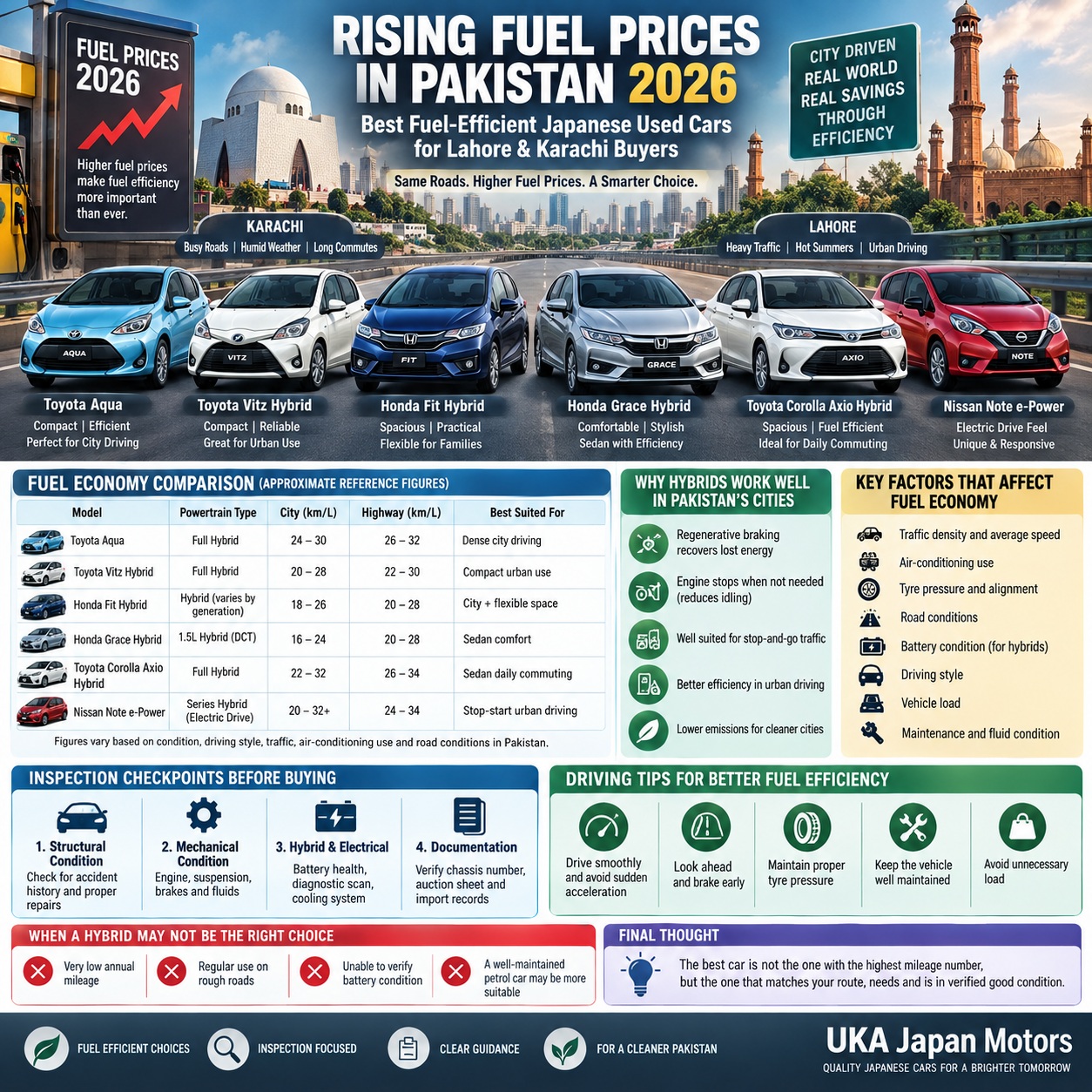
Fuel efficiency has become a much more important part of everyday vehicle ownership in Pakistan during 2026.
Petroleum rates have changed repeatedly, and official fuel-price publications during September alone show multiple revisions. For drivers in Lahore and Karachi, this volatility matters because urban driving often combines long commuting distances with congestion, idling, air-conditioning use and repeated acceleration and braking.
The result is that choosing a fuel-efficient car is no longer simply about finding the vehicle with the highest advertised kilometre-per-litre figure.
A car that performs well in a controlled test may behave differently in Lahore traffic during a hot afternoon or in Karachi when congestion, humidity and continuous air-conditioning place additional demands on the powertrain. For a Japanese used car, age, hybrid-battery condition, tyres, maintenance history and previous accident repairs can change the real-world result even further.
For that reason, buyers should consider fuel efficiency, vehicle condition, hybrid-system health and suitability for their normal route together.
Among Japanese used vehicles commonly encountered in Pakistan, models such as the Toyota Aqua, Toyota Vitz Hybrid, Honda Fit Hybrid, Honda Grace Hybrid, Toyota Corolla Axio Hybrid and Nissan Note e-Power deserve particular attention.
They do not all achieve efficiency in the same way, however, and they do not suit every driver equally.
Direct Answer: Which Japanese Used Cars Make Sense for Fuel-Conscious Drivers?
For predominantly urban driving in Lahore or Karachi, a healthy Toyota Aqua is one of the most practical conventional-hybrid choices because its powertrain is particularly well suited to stop-and-go operation.
The Toyota Vitz Hybrid provides similar hybrid logic in a compact hatchback format. Honda Fit Hybrid offers useful cabin flexibility, while Honda Grace Hybrid gives buyers a sedan body with a 1.5-litre hybrid system. Toyota Corolla Axio Hybrid is another sedan-oriented option.
Nissan Note e-Power deserves separate consideration because its operating principle differs from a conventional Toyota or Honda hybrid: its petrol engine primarily generates electricity while the electric motor drives the wheels.
Published Pakistan-market fuel-economy figures vary substantially by model and variant. Toyota Aqua figures, for example, are commonly shown in the mid-20s to around 30 km/L range, while hybrid versions of the Vitz and Corolla Axio are listed considerably above their conventional petrol counterparts under favourable conditions. These figures should be treated as references rather than promises because actual consumption depends heavily on condition and use.
The more important question is therefore not:
“Which car has the highest mileage number?”
It is:
“Which properly inspected car will remain efficient on the routes I actually drive?”
That distinction is especially important with used Japanese hybrids.
Why Fuel Efficiency Matters Differently in Lahore and Karachi
Lahore and Karachi both involve demanding urban driving, but the conditions are not identical.
Lahore
A Lahore commuter may encounter prolonged congestion around major commercial and residential corridors, frequent signal-to-signal acceleration, longer cross-city journeys and intense summer temperatures.
Air-conditioning can remain active for much of the journey. During congested periods, a conventional petrol engine may spend significant time operating while the vehicle covers relatively little distance.
Hybrid systems can reduce some of this inefficiency because they are designed to recover braking energy and reduce unnecessary engine operation under suitable low-speed conditions.
Karachi
Karachi adds its own combination of long commuting routes, dense traffic, warm weather, humidity, dust and variable road surfaces.
A vehicle that spends much of its life moving between slow traffic and short open stretches needs a powertrain capable of handling repeated changes in speed efficiently.
Road condition is relevant as well. Poor alignment, incorrect tyre pressure, damaged suspension components and unsuitable tyres increase rolling resistance and can reduce the efficiency of an otherwise healthy hybrid.
Neither city therefore rewards buyers who judge a vehicle from its badge alone.
Condition matters.
Why Hybrids Often Work Well in Heavy Urban Traffic
A conventional petrol vehicle normally loses energy every time the driver brakes. The kinetic energy used to move the vehicle is converted mainly into heat through the braking system.
A hybrid can recover part of that energy through regenerative braking.
The electric motor works as a generator during deceleration and sends recovered energy back to the hybrid battery. That stored energy can later assist the petrol engine or, depending on the system and operating conditions, move the vehicle electrically for short periods.
This is particularly useful in stop-start traffic.
Hybrids may also switch off the petrol engine when it is unnecessary. Instead of continuously idling at a signal, the vehicle can use its electrical system and restart the engine when required.
This explains an important characteristic of hybrid ownership:
Some hybrids can be more impressive in controlled city driving than drivers expect from conventional petrol cars.
Highway driving changes the equation because regenerative braking opportunities decrease and the petrol engine may operate for longer periods.
That is why buyers should not assume that the car with the strongest urban hybrid performance will necessarily show the same advantage on every uninterrupted journey.
1. Toyota Aqua — Strong Match for Dense City Driving
The Toyota Aqua has become one of the most recognisable Japanese hybrid hatchbacks on Pakistani roads.
Its compact dimensions are useful in congested urban environments, while Toyota’s hybrid arrangement combines a petrol engine, electric motor, hybrid battery and regenerative braking system.
Pakistan-market reference figures commonly place Aqua fuel consumption somewhere around 24–30 km/L in city use depending on generation and variant, although actual results can move noticeably outside published figures depending on vehicle condition and driving environment.
Where the Aqua works particularly well
The Aqua makes sense for drivers whose routine consists mainly of:
- Dense Lahore or Karachi traffic
- Frequent signals
- Regular stop-and-go commuting
- Moderate passenger requirements
- Mostly urban rather than rough-road operation
Its compact footprint also makes parking and narrow urban roads easier to manage.
Where the Aqua requires caution
Ground clearance and road conditions deserve attention.
Speed breakers, damaged surfaces and steep ramps can be less comfortable in a low hatchback than in a taller vehicle. Drivers regularly travelling over broken roads should inspect the underbody and suspension carefully.
Battery condition is equally important.
A neglected Aqua with a weak hybrid battery should not be judged by the fuel-economy reputation of a healthy Aqua.
The battery cooling path should be inspected for obstruction, warning lights should be investigated properly and diagnostic scanning should form part of a serious pre-purchase inspection.
Auction history and import documentation should also be verified rather than relying on exterior appearance alone.
2. Toyota Vitz Hybrid — Compact Size with Hybrid Efficiency
The hybrid Toyota Vitz combines a familiar compact hatchback format with a 1.5-litre hybrid powertrain.
Pakistan-market reference data lists significantly stronger consumption figures for hybrid variants than conventional Vitz versions, illustrating how important it is to distinguish the exact powertrain when comparing two cars carrying the same model name.
Why it suits urban Pakistan
Its compact dimensions make it appropriate for Lahore and Karachi traffic.
Drivers moving through busy commercial areas may appreciate a smaller turning and parking footprint, while the hybrid system benefits from repeated braking and low-speed operation.
What buyers should inspect
A Vitz Hybrid should be checked for:
Hybrid battery condition
Cooling-system performance
Diagnostic fault codes
Correct operation of regenerative braking
Suspension wear
Underbody damage
Tyre condition and matching tyre specifications
Previous structural repair
Verified auction and import documentation
The important point is that a Vitz Hybrid and a conventional Vitz are not interchangeable from an efficiency perspective.
A buyer comparing listings should first identify the exact variant and powertrain.
3. Honda Fit Hybrid — Efficiency with Practical Cabin Packaging
Honda Fit Hybrid appeals to a slightly different type of driver.
The Fit is known for making good use of its compact external dimensions, so it can suit households that want a relatively small urban car without giving up as much interior flexibility.
For Lahore and Karachi drivers carrying passengers, bags or everyday household items, that packaging can be useful.
But used Honda hybrids require careful mechanical inspection.
Different Fit generations use different hybrid technologies, and buyers should not assume that every Fit Hybrid has the same drivetrain.
Why generation identification matters
Earlier and later Honda hybrid systems can differ in their transmission arrangement, battery technology and operating behaviour.
That means maintenance requirements and inspection priorities can also differ.
Before purchasing a used Fit Hybrid, the chassis number and exact variant should be established. The inspector should then assess the drivetrain according to that specific generation rather than applying a generic “hybrid check.”
Best use pattern
The Fit Hybrid can be well suited to:
Urban commuting
Family use
Drivers needing flexible interior space
Regular mixed-speed journeys
Buyers who want hatchback dimensions without an extremely small cabin
A poorly maintained transmission or hybrid system, however, can outweigh the theoretical advantage of good fuel economy.
4. Honda Grace Hybrid — Sedan Comfort with Hybrid Operation
Not every fuel-conscious buyer wants a hatchback.
The Honda Grace Hybrid provides a sedan body while retaining a 1.5-litre hybrid drivetrain.
Pakistan reference data lists the Grace Hybrid at approximately 16 km/L city and 20 km/L highway as general figures, while owner experiences can vary and sometimes report higher results. The difference itself is a useful reminder that online mileage figures should not be treated as guaranteed performance.
Why consider the Grace?
It can suit buyers who need:
A separate boot
Sedan seating position
Regular family use
Longer cross-city commuting
A balance between urban efficiency and conventional sedan practicality
Transmission inspection is particularly important
Certain Grace Hybrid generations use Honda’s dual-clutch hybrid transmission technology.
Smooth operation should therefore be checked carefully.
Jerking, warning messages, abnormal engagement behaviour or unexplained transmission work should not simply be dismissed as normal characteristics of an imported hybrid.
A diagnostic scan and a road test under both low-speed and normal operating conditions are important.
5. Toyota Corolla Axio Hybrid — A Fuel-Efficient Sedan Alternative
The Corolla Axio Hybrid offers another route for drivers who want sedan practicality.
The hybrid 1.5-litre Axio is listed with substantially stronger fuel-economy figures than non-hybrid versions in Pakistan-market reference data, with published figures reaching the high-20s and above under favourable conditions.
That does not mean every used Axio Hybrid will reproduce those figures in Lahore or Karachi.
A car’s efficiency can deteriorate because of:
Weak hybrid battery performance
Incorrect tyres
Low tyre pressure
Poor wheel alignment
Dirty filters
Engine-maintenance issues
Cooling-system problems
Dragging brakes
Excessive load
Aggressive acceleration
Long periods of stationary air-conditioning use
Who should consider an Axio Hybrid?
It can suit someone who prefers a sedan and regularly covers meaningful urban distances.
The boot and conventional three-box body also make it different in everyday practicality from Aqua or Fit.
As with the Aqua, Toyota’s hybrid system should be inspected using proper diagnostic equipment rather than judged from whether the dashboard currently shows a warning light.
6. Nissan Note e-Power — A Different Type of Hybrid Experience
The Nissan Note e-Power needs a separate explanation because it does not operate exactly like a Toyota Aqua.
In an e-Power system, the electric motor provides the wheel-driving force while the petrol engine is used primarily to generate electricity.
This creates an electric-motor driving character without requiring the driver to plug the vehicle into an external charger.
Pakistan reference data shows substantial variation between Note variants, with some e-Power versions listed at more than 30 km/L in city conditions and others significantly lower.
That variation is another reason buyers must identify the precise variant.
Why it can work in Lahore and Karachi
Electric-motor propulsion is well suited to repeated acceleration because electric motors provide torque immediately.
The system can therefore feel responsive even in slow urban traffic.
Regenerative deceleration can also recover energy that would otherwise be lost.
What needs checking
Because e-Power depends heavily on its electrical propulsion system, inspection should include:
Traction battery condition
Generator operation
Electric drive system
Cooling systems
Diagnostic codes
Regenerative braking behaviour
12-volt electrical system
Accident or flood-related electrical damage
Buyers should understand the technology before purchasing rather than assuming every vehicle described as a “hybrid” works identically.
Comparing the Main Options
| Japanese used model | Powertrain type | Strongest use case | Main inspection priority |
|---|---|---|---|
| Toyota Aqua | Conventional full hybrid | Dense city commuting | Hybrid battery and accident history |
| Toyota Vitz Hybrid | Conventional full hybrid | Compact urban use | Battery, underbody and variant verification |
| Honda Fit Hybrid | Honda hybrid system varies by generation | City use with flexible cabin needs | Transmission and hybrid system |
| Honda Grace Hybrid | 1.5L hybrid sedan | Longer urban family commuting | DCT operation and battery condition |
| Toyota Corolla Axio Hybrid | Full-hybrid sedan | Sedan-oriented daily commuting | Battery health and documented condition |
| Nissan Note e-Power | Series-hybrid/electric-motor drive | Stop-start urban driving | Battery, generator and electric drive system |
This comparison is more useful than simply arranging the cars by an advertised mileage figure.
A driver travelling mostly through dense central Lahore has a different operating pattern from someone covering longer, relatively open stretches of Karachi every day.
The vehicle needs to fit the route.
Hybrid vs Conventional Petrol Cars in City Traffic
Consider two vehicles of similar size: one conventional petrol and one hybrid.
In flowing traffic, both can operate efficiently when driven smoothly.
In repeated congestion, however, their behaviour changes.
The conventional petrol car must repeatedly accelerate using its engine and then discard much of that kinetic energy through friction braking.
A hybrid can recover part of the braking energy and use it during the next acceleration cycle.
This is why hybrids are particularly relevant to stop-and-go city driving.
However, the advantage becomes less meaningful if the hybrid battery is badly degraded.
A weak battery may accept or provide less useful energy, causing the petrol engine to operate more frequently.
So a buyer comparing a healthy petrol car with a neglected hybrid should not automatically assume the hybrid is the better ownership choice.
Mechanical condition comes first.
Why Published Fuel-Average Figures Need Context
Mileage numbers attract attention, but they are easy to misunderstand.
A claim of 25 or 30 km/L does not mean the car will deliver that result every day.
Fuel consumption changes with:
Traffic density
Average speed
Air-conditioning load
Outside temperature
Trip length
Driving technique
Tyre pressure
Wheel alignment
Vehicle load
Battery state of health
Engine condition
Fuel quality
Road gradient
Regenerative-braking opportunities
Very short trips can be especially inefficient because the engine and hybrid system may not spend enough time at their ideal operating temperatures.
Similarly, aggressive acceleration followed by heavy braking can reduce the benefit of an efficient drivetrain.
The sensible approach is to use published figures as a comparison reference, not as a guarantee.
The Hybrid Battery Question
For a used Japanese hybrid, the battery is one of the most important inspection areas.
Hybrid batteries are designed to operate through many charge and discharge cycles, but they still age.
Heat, age, accumulated use, cooling-system condition and individual battery-cell deterioration can all affect performance.
Pakistan’s hot climate makes proper battery cooling particularly important.
Warning signs that deserve investigation
A buyer should pay attention to:
Rapid changes in the battery charge display
Petrol engine running unusually frequently
Reduced fuel economy
Hybrid-system warnings
Cooling fan operating abnormally
Diagnostic imbalance between battery modules
Previous battery repairs without clear documentation
None of these should be assessed by guesswork.
A diagnostic scan can provide information that a visual inspection cannot.
Air-Conditioning and Fuel Economy in Lahore and Karachi
Air-conditioning is not an optional consideration in Pakistan’s major cities for much of the year.
In intense summer conditions, the cabin may start extremely hot after the car has been parked outdoors.
Cooling that cabin places additional demand on the vehicle.
A hybrid can manage this demand differently from a conventional petrol car depending on its air-conditioning system, battery state and operating conditions.
Drivers should therefore be cautious about comparing an online mileage figure recorded in mild weather with their own consumption during peak summer.
A more realistic test is a proper road drive with the air-conditioning operating as it normally would during everyday ownership.
Road Conditions Matter More Than Many Buyers Realise
Fuel efficiency is partly a powertrain issue and partly a rolling-resistance issue.
If wheel alignment is incorrect, the tyres effectively fight against the vehicle’s forward motion.
Underinflated tyres do the same.
Worn suspension can contribute to poor alignment and uneven tyre wear.
In Lahore and Karachi, where road surfaces can vary significantly between routes, these factors deserve attention.
A fuel-efficient Japanese import running on incorrect tyre specifications or damaged suspension may not behave like the same model in healthy condition.
Inspection Before Buying: What Should Actually Be Checked?
A proper inspection should go beyond paint thickness and exterior condition.
For a Japanese hybrid, the inspection should cover four areas.
1. Structural condition
Check chassis members, pillars, floor structure, suspension mounting areas and evidence of significant collision repair.
2. Mechanical condition
Check engine operation, cooling system, fluid condition, leaks, suspension, steering, brakes and transmission behaviour.
3. Hybrid and electrical condition
Perform diagnostic scanning and inspect battery data, warning history, charging behaviour, cooling arrangements and relevant electrical systems.
4. Documentation
Verify the chassis number against the available documents and confirm that the paperwork corresponds to the physical vehicle.
Where an auction sheet is represented as part of the vehicle’s history, its authenticity should be verified rather than accepted from a printed sheet alone.
Import Documentation Still Matters After the Car Reaches Pakistan
A Japanese used vehicle should have a clear documentary trail.
The buyer should inspect the import-related documentation, customs records where applicable, registration details and chassis identification.
Pakistan’s Federal Board of Revenue explains that imported vehicles are subject to defined import conditions and duty-and-tax structures, with specific rules applying to old and used vehicles. FBR also identifies separate treatment for hybrid electric vehicles within qualifying engine-capacity categories.
Import procedures have also continued to change. Ministry of Commerce records show amendments concerning vehicle-import procedures and pre-shipment inspection, reinforcing why buyers should verify documentation according to the rules applicable to the vehicle’s particular import route and date.
A mechanically attractive vehicle with questionable documentation is not a substitute for a properly documented example.
How to Drive a Hybrid Efficiently in Pakistan
Buying a hybrid is only part of the equation.
Driving technique still matters.
Smooth acceleration is generally preferable to repeatedly demanding maximum power. Looking ahead and slowing progressively gives regenerative braking more opportunity to recover energy.
Maintaining a safe distance also reduces unnecessary acceleration and braking cycles.
Tyre pressure should be checked regularly, especially when temperatures change.
Unnecessary weight should not be carried permanently.
Cooling systems, engine oil, filters and recommended fluids should be maintained according to the correct specifications.
Most importantly, drivers should not become obsessed with forcing the car into electric mode.
A hybrid’s control system is designed to decide when engine operation, electric assistance or combined operation is appropriate. Artificially altering driving simply to keep the EV indicator active does not always produce the best overall result.
Which Car Suits Which Type of Driver?
For a predominantly city-based driver who wants compact dimensions, Toyota Aqua and Toyota Vitz Hybrid are particularly logical vehicles to investigate.
For someone who needs a more flexible hatchback cabin, Honda Fit Hybrid deserves consideration.
Drivers who prefer a traditional sedan can examine Honda Grace Hybrid and Toyota Corolla Axio Hybrid.
For someone interested in electric-motor driving behaviour without external charging, Nissan Note e-Power provides a technically different alternative.
But none should be selected solely from the model name.
The best individual vehicle is the one whose condition, documentation, battery health and drivetrain behaviour withstand inspection while also matching the owner’s normal usage.
When a Hybrid May Not Be the Right Choice
A hybrid is not automatically appropriate for every driver.
Someone who covers very little distance may place less importance on maximising fuel efficiency.
A driver regularly using badly broken roads may need to give greater priority to ground clearance, tyre sidewall and suspension durability.
Likewise, a buyer who cannot establish the battery and drivetrain condition of a particular used hybrid should not rely on the model’s general reputation.
There are also cases where a well-maintained conventional petrol car is easier to evaluate than a neglected hybrid with unclear repair history.
Technology should never substitute for condition.
Long-Term Ownership Considerations
Efficient ownership depends on preventive maintenance.
For Japanese hybrids in Pakistan, owners should pay particular attention to:
Hybrid battery cooling
Engine cooling
Correct lubricants and fluids
Brake condition
Tyre pressure and alignment
12-volt battery health
Diagnostic warning codes
Air-conditioning performance
Transmission maintenance where applicable
Regenerative braking can change normal brake usage, but conventional brake components still require inspection.
Battery cooling vents should remain unobstructed.
Engine coolant and hybrid-system cooling circuits, where separately fitted, should receive appropriate attention.
Repairs should also be diagnosed before components are replaced.
Hybrid systems are interconnected. A warning light does not automatically mean that the complete traction battery has failed.
Frequently Asked Questions
1. Which Japanese used hybrid is suitable for Lahore traffic?
Toyota Aqua, Toyota Vitz Hybrid, Honda Fit Hybrid, Honda Grace Hybrid, Corolla Axio Hybrid and Nissan Note e-Power can all suit Lahore depending on passenger requirements and route conditions. Compact full hybrids such as Aqua are particularly well matched to repeated stop-and-go operation, provided the vehicle is mechanically healthy.
2. Which Japanese used car works well in Karachi traffic?
Compact hybrids can work effectively in Karachi because congestion provides frequent opportunities for regenerative braking. Aqua, Vitz Hybrid, Fit Hybrid and Note e-Power are worth considering for urban use, while Grace and Axio suit buyers wanting a sedan. Road condition and daily route should influence the final choice.
3. Does a hybrid always use less fuel than a petrol car?
Not in every situation. Vehicle condition, driving style, trip length, traffic and battery health affect consumption. A neglected hybrid can perform worse than expected, while a properly maintained petrol car driven efficiently can perform consistently.
4. Is Toyota Aqua good for long daily commuting?
It can be. Its hybrid system is particularly effective where a commute includes congestion and repeated slowing. Buyers should still consider seating needs, ground clearance, road conditions and battery health.
5. How do I check a used hybrid battery before buying?
Use diagnostic equipment capable of reading relevant hybrid-system data. The inspection should examine battery behaviour, module or block data where available, stored fault codes, cooling operation and charging/discharging behaviour. A short visual inspection is insufficient.
6. Does air-conditioning reduce hybrid fuel economy?
Air-conditioning requires energy, so heavy use can affect consumption. The effect varies by vehicle and operating condition. In Lahore and Karachi summers, mileage expectations should therefore include realistic air-conditioning use.
7. Is Nissan Note e-Power the same as Toyota Aqua Hybrid?
No. Aqua is a conventional full hybrid in which the petrol engine and electric motor can participate in propulsion through Toyota’s hybrid drivetrain. Note e-Power uses its petrol engine primarily to generate electricity while an electric motor drives the wheels.
8. Should I trust the mileage shown on a Japanese used car’s dashboard?
It can provide useful information, but it should not be treated as independent proof of condition. Trip data can depend on recent driving history and resets. Mechanical inspection and diagnostic data are more meaningful when evaluating the vehicle.
9. Is auction-sheet verification important for a fuel-efficient Japanese import?
Yes. An auction sheet can help establish the vehicle’s condition before export when authentic records are available. It should be verified rather than accepted solely because a seller provides a printed copy.
10. Can accident repairs affect fuel economy?
They can. Poor structural repairs may cause alignment problems, increased tyre wear or other mechanical issues. Accident history also matters independently of fuel economy because structural integrity and correct repair quality are important ownership considerations.
11. Are older Japanese hybrids still suitable for daily use?
Age alone does not determine suitability. Battery condition, maintenance, accident history, transmission condition and previous repairs become increasingly important as a vehicle gets older. Each car should therefore be evaluated individually.
12. What matters more: advertised fuel economy or inspection condition?
For a used vehicle, inspection condition should carry greater weight. Advertised or published mileage describes what a model may achieve under particular conditions. It cannot confirm what a specific used example will deliver.
UKA Japan Motors’ Role: Inspection and Documentation Before Assumptions
UKA Japan Motors approaches Japanese used vehicles from an inspection and documentation perspective.
Fuel efficiency should not be presented as a promise based simply on a model badge, dashboard reading or published specification.
For a Japanese hybrid, meaningful evaluation involves understanding the vehicle’s chassis identity, import documentation, auction history where available, structural condition, mechanical condition and hybrid-system health.
This is especially important with models such as Toyota Aqua, Honda Fit Hybrid, Honda Grace Hybrid, Corolla Axio Hybrid and Nissan Note e-Power because two apparently similar cars can have very different histories.
A documented, properly inspected vehicle gives the buyer a clearer basis for understanding what they are purchasing.
The objective is not to claim that one technology is suitable for everyone. It is to establish whether the particular vehicle being considered is consistent with its documented history and expected mechanical condition.
Conclusion
Fuel-price volatility in Pakistan during 2026 has made fuel consumption a more significant consideration for drivers covering long distances in Lahore and Karachi. Official petroleum publications throughout the year also demonstrate why buyers should think about efficiency as a long-term ownership characteristic rather than reacting to a single fuel-price revision.
Japanese used hybrids provide several useful options.
Toyota Aqua and Vitz Hybrid are particularly relevant to compact urban driving. Honda Fit Hybrid adds interior flexibility. Honda Grace Hybrid and Toyota Corolla Axio Hybrid serve drivers who prefer sedans, while Nissan Note e-Power offers a different approach based on electric-motor propulsion.
Yet the badge is only the beginning.
Hybrid-battery condition, transmission behaviour, tyres, cooling systems, previous repairs, auction history and import documentation can all influence whether a supposedly fuel-efficient vehicle actually performs as expected in Pakistan.
For Lahore and Karachi buyers, the sensible approach is therefore to compare vehicles according to daily route, traffic pattern, passenger requirements, road conditions and verified vehicle condition rather than chasing the highest advertised kilometre-per-litre number.
A properly inspected Japanese used car that suits the driver’s actual usage is more meaningful than an impressive specification attached to an uncertain vehicle.
Contact UKA Japan Motors for availability and inspection guidance.