


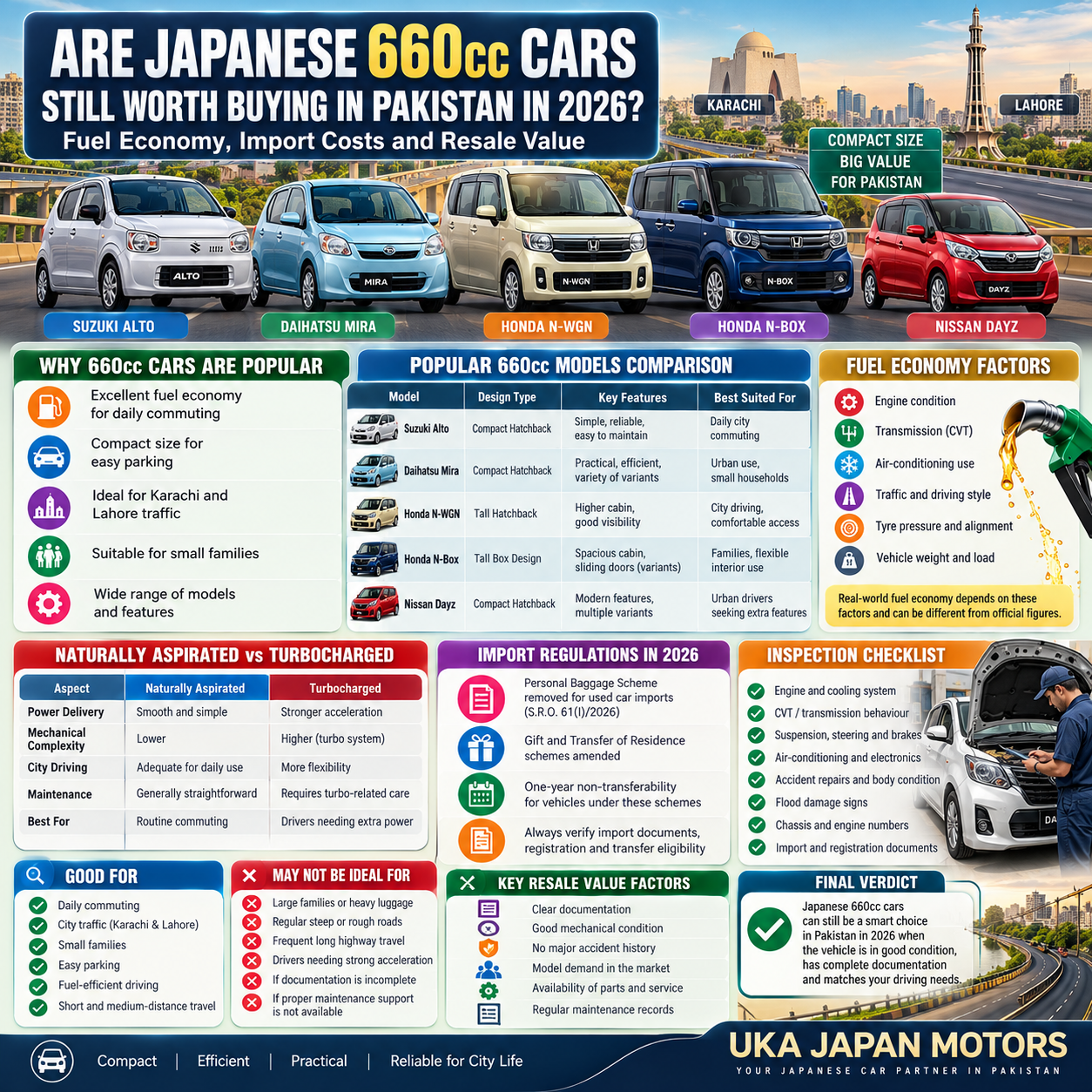
Japanese 660cc cars remain a practical consideration for drivers in Pakistan who need a compact vehicle for daily commuting, household use and navigating congested urban roads. Their small engines, compact dimensions and efficient use of cabin space make them particularly relevant in cities such as Karachi and Lahore, where traffic congestion, limited parking and frequent stop-and-go driving shape everyday ownership.
However, choosing a Japanese 660cc car in 2026 requires more than looking at engine capacity or a seller’s claims about fuel economy. Import regulations, vehicle condition, maintenance history, transmission health, registration documentation and the availability of compatible replacement parts can significantly influence the ownership experience.
A vehicle that performs well during a short inspection may still have hidden mechanical problems. Similarly, a well-maintained car with a straightforward ownership history may be a more sensible choice than a newer-looking example with incomplete documentation or signs of previous repairs.
The important question is therefore not simply whether Japanese 660cc cars are worth buying. It is whether a particular vehicle suits the driver’s daily requirements, the condition of the roads they use, their maintenance expectations and their intended ownership period.
This guide examines these considerations in the context of Pakistan in 2026, with particular attention to Karachi and Lahore.
The Short Answer: When Is a Japanese 660cc Car Worth Buying?
A Japanese 660cc car can be a sensible choice when the buyer prioritises compact dimensions, manageable urban driving and fuel-efficient everyday transportation.
It is particularly suitable for:
- Daily commuting through congested streets.
- Small households with moderate luggage requirements.
- Drivers who frequently use narrow streets and crowded parking areas.
- Urban journeys involving regular stops and relatively short distances.
- Owners who are comfortable maintaining a Japanese imported vehicle according to its specifications.
It may be less suitable for drivers who frequently travel with a full passenger load, carry substantial luggage, drive on steep or severely damaged roads, or regularly undertake long journeys at sustained motorway speeds.
The vehicle’s individual condition is equally important. A well-maintained 660cc car can offer dependable daily service, while an abused or poorly repaired example can develop recurring problems regardless of its reputation.
The central principle is simple: assess the complete vehicle, not just its engine capacity, model name or claimed fuel economy.
What Exactly Is a Japanese 660cc Car?
Japanese 660cc cars belong to a compact vehicle category commonly associated with the Japanese kei-car classification. These vehicles are designed around small engine capacity and compact exterior dimensions.
Popular examples encountered in Pakistan include:
- Suzuki Alto.
- Daihatsu Mira.
- Honda N-WGN.
- Honda N-Box.
- Daihatsu Move.
- Nissan Dayz.
- Mitsubishi eK Wagon.
These models do not all have identical engineering, equipment or driving characteristics. Some prioritise straightforward urban transportation, while others offer taller cabins, sliding doors, additional equipment or turbocharged engine options.
Many Japanese 660cc cars are equipped with continuously variable transmissions (CVTs), although the exact transmission depends on the model, generation and variant. Some versions also feature turbocharging, hybrid assistance or four-wheel-drive systems.
These differences matter because two vehicles with the same engine capacity can behave differently in traffic, consume different amounts of fuel and require different maintenance procedures.
A buyer should identify the exact model code, production year, drivetrain, transmission type and equipment specification before comparing vehicles.
Why 660cc Cars Remain Relevant in Karachi and Lahore
Karachi: Congestion, Heat and Long Daily Journeys
Karachi presents several practical challenges for compact-car owners. Heavy traffic, extended commuting distances, road construction, dust and high summer temperatures can place considerable demands on a vehicle.
A small car is easier to position in congested lanes and may be simpler to park in crowded residential and commercial areas. Its compact dimensions can also make everyday manoeuvring less stressful.
Nevertheless, frequent stop-and-go driving affects fuel consumption. Air-conditioning use adds an engine load, while extended idling consumes fuel without covering any distance.
Cooling-system condition is particularly important in Karachi. A radiator with restricted airflow, an ageing coolant hose, a weak radiator fan or a malfunctioning thermostat can create problems during prolonged traffic congestion.
Buyers should also examine the underbody, suspension and tyres because repeated travel over damaged road surfaces can accelerate wear.
Lahore: Urban Traffic, Dust and Seasonal Rain
Lahore’s daily driving conditions create a different combination of challenges. Congested urban routes, dusty roads, seasonal rainfall and occasional standing water can affect the vehicle’s mechanical and electrical systems.
Compact dimensions help when navigating busy markets, residential streets and crowded parking areas. However, a low-clearance vehicle may be less comfortable on damaged roads, uneven speed breakers and sections with deep surface depressions.
During heavy rainfall, water exposure deserves particular attention. A car with signs of cabin dampness, corroded electrical connections or water contamination may develop problems that are not immediately obvious during a brief inspection.
Suspension condition, tyre quality, brake performance and ground clearance should therefore be evaluated against the routes the owner expects to use.
Fuel Economy: What Should Buyers Realistically Expect?
Fuel economy is one of the principal reasons drivers consider Japanese 660cc cars. However, engine capacity alone does not determine actual consumption.
A vehicle’s fuel use depends on several interacting factors:
- Engine design and condition.
- Naturally aspirated or turbocharged configuration.
- Transmission condition and calibration.
- Vehicle weight and aerodynamic characteristics.
- Air-conditioning use.
- Traffic congestion and average journey speed.
- Tyre pressure and wheel alignment.
- Passenger load and driving behaviour.
- Maintenance quality.
A light, naturally aspirated hatchback driven smoothly may use fuel differently from a taller, heavier turbocharged vehicle covering the same route.
Official laboratory figures, dashboard readings and real-world fuel consumption should not be treated as interchangeable measurements.
Why Advertised Fuel Economy Can Be Misleading
Fuel-consumption figures may be obtained under controlled testing conditions that do not reproduce every aspect of driving in Karachi or Lahore.
Consider a commuter who spends considerable time moving a few metres at a time in congested traffic. The engine may remain running while the vehicle covers very little distance. The resulting average will differ from that of a driver travelling at a steady speed on an unobstructed road.
Likewise, a car with an ageing engine, dirty air filter, incorrect tyre pressure or transmission fault may consume more fuel than an otherwise similar vehicle in good condition.
Buyers should therefore treat claimed mileage as an indication rather than a guarantee.
How to Assess Real-World Fuel Consumption
For a meaningful assessment, establish a consistent measurement method after the vehicle has been inspected and confirmed mechanically sound.
- Fill the fuel tank using a consistent method.
- Reset the trip meter.
- Drive the vehicle through the routes normally used.
- Refill the tank using the same measurement approach.
- Divide the distance travelled by the litres consumed.
For kilometres per litre, use:
Fuel economy = Distance travelled in kilometres ÷ Fuel consumed in litres
Repeat the measurement over several refuelling cycles where practical. A single journey can be distorted by traffic, weather, route selection or unusually heavy air-conditioning use.
If the dashboard displays average fuel economy, compare it with measured consumption rather than relying on the display alone.
Naturally Aspirated Versus Turbocharged 660cc Cars
The choice between naturally aspirated and turbocharged engines is important for buyers who want predictable everyday performance.
| Consideration | Naturally aspirated engine | Turbocharged engine |
|---|---|---|
| Power delivery | Generally progressive and straightforward | Can provide stronger acceleration under boost |
| Mechanical complexity | Usually fewer turbo-specific components | Includes additional turbocharging hardware |
| City driving | Often adequate for routine commuting | Can offer additional flexibility when accelerating |
| Maintenance priorities | Engine, cooling and transmission condition remain essential | Requires attention to turbocharger condition, lubrication and cooling |
| Heavy passenger loads | Performance can feel limited | May provide more acceleration, depending on the model |
| Inspection | Check engine health and transmission operation | Also examine boost behaviour, unusual noises and related systems |
Neither configuration is automatically the better choice. The correct decision depends on the vehicle’s engineering, condition and intended use.
A turbocharged car with poor maintenance history may present more concerns than a carefully maintained naturally aspirated model. Conversely, a naturally aspirated engine may feel underpowered when carrying several passengers or climbing an incline.
The inspection should establish whether the engine performs normally under the conditions for which it was designed.
Import Regulations in Pakistan: What Has Changed?
Import eligibility is a major consideration when evaluating Japanese used cars in 2026. A vehicle’s presence in the local market does not, by itself, establish that its import documentation is complete or that a particular import route remains available.
Pakistan’s import framework has undergone changes affecting used-vehicle import schemes. The Ministry of Commerce issued S.R.O. 61(I)/2026 on 15 January 2026, which removed the Personal Baggage Scheme for used-car imports and amended provisions governing the remaining Gift and Transfer of Residence schemes.
The amended rules also introduced a one-year non-transferability requirement for vehicles imported under the Gift and Transfer of Residence schemes and changed the relevant interval governing another import under the applicable entitlement.
These provisions are important when examining a vehicle’s import history and subsequent ownership documentation.
The Federal Board of Revenue publishes vehicle-import guidance, while the Ministry of Commerce publishes the applicable Import Policy Order amendments. Buyers should consult the latest official requirements rather than relying on an older article or an informal summary.
Official references:
- Federal Board of Revenue: https://fbr.gov.pk/vehicles/51149/131187
- Ministry of Commerce, S.R.O. 61(I)/2026: https://www.commerce.gov.pk/wp-content/uploads/2026/01/SRO-No.-61.pdf
Why Import Route Matters to the Buyer
The route under which a vehicle entered Pakistan can affect eligibility, documentation and subsequent transfer requirements.
A buyer should establish:
- Which import scheme or commercial route applied.
- Whether the vehicle met the eligibility requirements at the time of import.
- Whether the customs documentation corresponds to the vehicle.
- Whether any transfer restrictions remain applicable.
- Whether the vehicle’s registration details match its identification numbers.
The applicable rules can differ according to import route and vehicle circumstances. A general statement that a vehicle is Japanese imported is not a substitute for reviewing the relevant documents.
For vehicles imported under the Gift or Transfer of Residence schemes, the applicable non-transferability requirement is particularly important. The buyer should verify that the intended transaction is legally permissible before proceeding.
Import Duties and Regulatory Changes
Import duties and related regulatory requirements influence the import process, but the applicable treatment depends on the vehicle’s characteristics, import route and rules in force at the relevant time.
Engine capacity alone does not establish complete import eligibility or determine every applicable requirement.
Commercial imports and imports under schemes available to eligible overseas Pakistanis should not be treated as identical processes. Their eligibility conditions, documentation and regulatory obligations can differ.
The government has also issued amendments affecting the regulatory treatment of commercial used-vehicle imports. Because notifications can supersede earlier rules, buyers and importers should confirm the operative requirements with the relevant authorities before relying on an earlier interpretation.
For an already imported vehicle, the practical priority is to establish that the vehicle was imported through an applicable route and that the documentation supports its current legal status.
Which Japanese 660cc Models Should You Consider?
Different models suit different ownership requirements. The following comparisons are intended to clarify practical differences rather than establish a universal ranking.
Suzuki Alto: A Compact Everyday Hatchback
The Japanese Suzuki Alto is worth considering for drivers who prioritise a small exterior footprint and straightforward urban usability.
Its compact dimensions are useful in narrow streets and crowded parking areas. Depending on the generation and variant, equipment, transmission and interior features can differ considerably.
Before selecting one, check the precise model code, service history, transmission operation, engine condition and availability of compatible replacement parts.
The Alto may be less suitable for drivers who require a particularly spacious cabin or frequently carry several adults and substantial luggage.
Daihatsu Mira: Practical Urban Transportation
The Daihatsu Mira is another compact option commonly considered for everyday city driving.
Different generations and variants can have different equipment levels, drivetrain configurations and transmission specifications. The exact vehicle therefore matters more than the model name alone.
Buyers should examine engine behaviour, CVT performance where fitted, cooling-system condition, suspension wear and the availability of parts for the particular generation.
A Mira may suit an individual commuter or a small household, especially when the vehicle’s dimensions and cabin layout match the intended use.
Honda N-WGN: A Taller Cabin Layout
The Honda N-WGN uses a taller body design than many conventional small hatchbacks. Its cabin layout may appeal to drivers who prefer a more upright seating position and convenient access.
The additional cabin height does not mean every version offers the same space, equipment or safety features. These depend on the generation and specification.
Because it is a different vehicle design from a conventional low hatchback, buyers should pay attention to visibility, tyre condition, suspension behaviour and the exact dimensions when assessing parking and road use.
Honda N-Box: Space-Oriented Compact Design
The Honda N-Box is designed around a tall, space-efficient body. Sliding-door arrangements on applicable versions can make access convenient in tight parking spaces.
Its cabin arrangement can be useful for small families, but a tall body and different vehicle weight may produce a different driving experience from a smaller hatchback.
Inspection should include the operation of the doors, electrical equipment, engine and transmission, along with any model-specific systems fitted to the vehicle.
Nissan Dayz and Mitsubishi eK Wagon
The Nissan Dayz and Mitsubishi eK Wagon are compact alternatives whose specifications vary by generation and variant.
Some versions include additional driver-assistance or convenience equipment. Such features should be checked individually rather than assumed to be present on every vehicle carrying the model name.
For either model, examine the transmission, warning lights, diagnostic information, air-conditioning performance and availability of compatible components.
Choosing Between These Models
| Driver requirement | Models worth evaluating | Main consideration |
|---|---|---|
| Compact urban commuting | Suzuki Alto, Daihatsu Mira | Dimensions, condition and ease of maintenance |
| Taller cabin and upright seating | Honda N-WGN | Visibility, cabin layout and suspension |
| Flexible access for a small household | Honda N-Box | Door operation, cabin condition and equipment |
| Alternative compact hatchback | Nissan Dayz, Mitsubishi eK Wagon | Variant-specific systems and parts support |
These are starting points for a shortlist, not guarantees that a particular example will suit every driver. A well-maintained car with verifiable documentation should generally receive more consideration than a poorly maintained example of a preferred model.
Inspection: What Should You Check Before Buying?
A Japanese 660cc car should be assessed as a complete vehicle, including its mechanical systems, structural condition, identification details and paperwork.
1. Engine and Cooling System
Start the engine from cold when possible. Listen for unusual knocking, persistent rattling or irregular operation.
Check for abnormal exhaust smoke, fluid leaks, overheating symptoms and warning lights. The coolant reservoir, radiator area, hoses and cooling fan should be examined for signs of leakage or previous overheating.
In Pakistan’s hot weather, cooling-system condition is especially relevant for vehicles that spend extended periods in traffic with the air-conditioning operating.
A brief idle test is not sufficient to establish the condition of every cooling component.
2. CVT and Transmission Behaviour
Many Japanese 660cc vehicles use a CVT. These transmissions should be assessed according to the manufacturer’s specifications and the particular model.
During a road test, check for delayed engagement, abnormal vibration, unexpected changes in engine response or warning indicators.
A buyer should not assume that every unusual sensation is a transmission failure, but neither should persistent symptoms be dismissed as normal behaviour without diagnosis.
Where concerns arise, a qualified technician familiar with the specific transmission should carry out further checks.
3. Suspension, Steering and Brakes
Listen for knocking over uneven surfaces and check whether the vehicle tracks straight during normal driving.
Inspect tyres for uneven wear, steering components for excessive play and the suspension for damaged or leaking components.
Braking should feel consistent, without abnormal vibration, pulling to one side or unusual noises.
These checks are important in both Karachi and Lahore, where potholes, uneven surfaces and repeated speed breakers can affect suspension components.
4. Air-Conditioning and Electrical Equipment
Operate the air-conditioning long enough to assess its performance. Check that the cooling remains consistent and that the engine continues to operate normally when the compressor engages.
Test power windows, mirrors, locks, lights, wipers, instrument displays and other fitted equipment.
If the car has a keyless entry system, electric sliding doors, driver-assistance functions or other electronic features, verify their operation individually.
Electrical faults may be difficult to identify from a quick exterior inspection, particularly if previous repairs were incomplete.
5. Accident Repairs and Structural Condition
Inspect panel alignment, paint consistency, door gaps and the condition of the boot and engine-bay areas.
Differences in paint finish do not automatically prove serious accident damage, but they justify closer examination.
A professional inspection should look for structural repairs, distorted panels, signs of poor welding and damage around important mounting points.
Where available, diagnostic equipment and appropriate measuring tools can help establish whether further examination is necessary.
6. Flood Exposure and Corrosion
Water exposure deserves special attention in a country where seasonal rainfall can leave roads submerged.
Look for damp carpets, unusual cabin odours, corrosion on exposed metal, deposits around electrical connectors and inconsistencies in the condition of interior components.
Inspect accessible areas beneath the seats and carpets where appropriate. A clean cabin alone does not establish that the vehicle has never been exposed to water.
Potential flood damage should be investigated professionally before a purchase decision is made.
Registration and Documentation: Do Not Leave This Until the End
Mechanical condition is only one part of a sound purchase. The paperwork must also establish the vehicle’s identity and legal status.
Important checks include:
- Original registration documents and applicable provincial records.
- Vehicle identification number and chassis-number consistency.
- Engine number, where recorded and applicable.
- Customs clearance and import documents, as relevant to the vehicle.
- Verification of the current registered owner.
- Confirmation of any restrictions affecting ownership transfer.
- Completion of the applicable transfer process through the relevant authority.
The precise requirements depend on the vehicle’s history and the jurisdiction in which it is registered.
In Karachi, buyers should verify the applicable Sindh registration and transfer requirements. In Lahore, they should check the relevant Punjab procedures.
Do not rely exclusively on photographs of documents or a seller’s verbal assurances. Where verification services are available, use the relevant official records and resolve discrepancies before proceeding.
If a chassis number appears altered, a document does not match the vehicle, or the import route cannot be established, pause the transaction until the issue is clarified.
Resale Value: What Determines Future Demand?
Resale value is not determined by engine capacity alone. The condition, documentation and market demand for the specific vehicle can matter considerably.
A Japanese 660cc car with a recognised model name may attract interest, but its eventual resale prospects depend on several factors.
Documentation and Ownership History
Clear registration records, consistent identification numbers and a verifiable ownership history make a vehicle easier for a prospective buyer to assess.
Missing import records, unresolved transfer restrictions or discrepancies in identification details can complicate a future transaction.
Mechanical Condition
A healthy engine, properly functioning transmission, sound suspension and effective air-conditioning help demonstrate that the vehicle has been maintained.
Conversely, recurring warning lights, abnormal transmission behaviour, overheating or extensive repair requirements can discourage prospective buyers.
Accident History and Originality
Evidence of major structural repairs can affect buyer confidence. A vehicle with a documented repair history is easier to assess than one with unexplained panel replacement or signs of concealed damage.
Originality should be considered alongside structural safety and repair quality. A repaired panel is not automatically proof of an unsafe vehicle, but the nature and quality of the repair matter.
Model-Specific Demand
Some models attract more interest because of their cabin layout, equipment, familiarity or suitability for urban use.
However, demand can change with regulatory developments, the availability of comparable vehicles and shifts in buyer preferences.
No model should be assumed to retain strong resale demand indefinitely.
Maintenance and Parts Support
A vehicle that uses specialised components or model-specific electronics may require more careful maintenance planning.
Before selecting an uncommon variant, establish whether a competent workshop can diagnose it and whether compatible replacement components can be sourced.
The best preparation for resale is responsible ownership: maintain the vehicle, preserve its records and resolve mechanical or documentation issues promptly.
Long-Term Ownership: What Should Drivers Plan For?
The ownership experience of a Japanese 660cc car extends beyond the initial inspection.
Routine maintenance should follow the manufacturer’s requirements for the exact model and engine. This includes appropriate engine oil, filters, coolant, transmission servicing where prescribed, brake components and tyre maintenance.
Owners should not assume that every imported vehicle uses identical service intervals or fluid specifications.
Air filters deserve attention in dusty conditions. Tyre pressure should be checked regularly, and wheel alignment should be assessed when uneven wear or steering symptoms appear.
Cooling-system inspections are particularly relevant before periods of sustained hot weather. Drivers should also respond promptly to overheating, unusual transmission behaviour and dashboard warnings rather than continuing to drive until the problem becomes more severe.
A maintenance record helps the owner track completed work and provides useful evidence of care when the vehicle is eventually sold.
For imported models with unfamiliar equipment, retaining the exact model code and specification can make future diagnosis more straightforward.
Are Japanese 660cc Cars Suitable for Highway Driving?
These vehicles can undertake longer journeys when the particular model is mechanically sound and the journey falls within its intended operating capabilities.
However, a small engine does not provide the same acceleration reserve as a larger engine in every situation. Passing slower traffic, climbing inclines and carrying several passengers may require more planning.
A naturally aspirated version can feel less responsive under heavy load, while a turbocharged version may offer stronger acceleration but requires its own maintenance considerations.
Before a long trip, check tyre condition, brakes, engine oil, coolant, lights and the spare tyre or puncture equipment.
The driver should also consider cabin comfort, luggage capacity, road clearance and the availability of assistance if a mechanical problem occurs.
For frequent highway travel with a full family and substantial luggage, a larger vehicle may be more appropriate. For occasional intercity journeys with a light load, a well-maintained 660cc car may be adequate when driven within its capabilities.
When Is a Japanese 660cc Car Not the Right Choice?
Despite their practical advantages, these cars do not meet every driver’s requirements.
A different vehicle category may be more suitable if the owner:
- Frequently travels with five occupants and substantial luggage.
- Regularly drives on rough roads where ground clearance is a major concern.
- Needs strong acceleration under heavy loads.
- Requires a larger cabin for family or professional use.
- Cannot obtain suitable maintenance support for a particular imported model.
- Encounters unresolved documentation or ownership-transfer restrictions.
- Finds that a specific vehicle’s mechanical condition cannot be established reliably.
The correct decision should be based on actual usage rather than the general reputation of the 660cc category.
How UKA Japan Motors Approaches Vehicle Assessment
UKA Japan Motors approaches vehicle evaluation through practical inspection and documentation considerations. For Japanese imported vehicles, the aim is to establish what can be verified about the vehicle and identify matters that may require further attention.
A responsible assessment considers the model and variant, visible mechanical condition, transmission behaviour, structural condition, available documentation and the requirements of the intended registration or transfer process.
Where a particular issue cannot be confirmed through an initial inspection, it should be identified as requiring additional verification rather than presented as a certainty.
This distinction matters because an exterior examination cannot establish every aspect of a vehicle’s history, and a road test alone cannot rule out all mechanical or electronic faults.
Buyers should ask for clarification about the vehicle’s documentation and inspection findings, verify the applicable requirements with the relevant authorities and arrange specialist assessment where needed.
The purpose of this approach is to help buyers make informed decisions based on verifiable information rather than assumptions about engine capacity, claimed fuel economy or resale demand.
Frequently Asked Questions
1. Are Japanese 660cc cars still worth buying in Pakistan in 2026?
They can be suitable for compact urban transportation, particularly where manoeuvrability and fuel efficiency are priorities. The decision should depend on the vehicle’s condition, import documentation, maintenance requirements and suitability for the driver’s regular journeys.
2. Which Japanese 660cc car is best for city driving?
The Suzuki Alto and Daihatsu Mira are worth considering for conventional compact-hatchback use. The Honda N-WGN and Honda N-Box may appeal to drivers who prefer taller cabin layouts. The best option depends on the exact variant, condition and intended use.
3. Do Japanese 660cc cars always deliver excellent fuel economy?
No. Actual fuel consumption depends on traffic, engine condition, transmission health, air-conditioning use, vehicle weight, driving style and maintenance. Official or advertised figures should not be treated as a guaranteed result on congested Pakistani roads.
4. Is a turbocharged 660cc car better than a naturally aspirated model?
Not necessarily. Turbocharged models may provide stronger acceleration, while naturally aspirated versions can offer a more straightforward mechanical configuration. The appropriate choice depends on performance needs, vehicle condition and the maintenance support available for the specific model.
5. Can Japanese 660cc cars handle Karachi traffic?
A well-maintained example can be suitable for Karachi’s congested streets. However, cooling-system performance, air-conditioning, transmission condition and suspension health deserve particular attention because of prolonged traffic, hot weather and uneven road surfaces.
6. Are Japanese 660cc cars suitable for Lahore’s roads?
They can work well on suitable urban routes, but ground clearance, suspension condition and tyre quality matter on uneven surfaces and speed breakers. Drivers who regularly encounter damaged roads should assess these factors before choosing a specific model.
7. What should I check before buying an imported 660cc car?
Inspect the engine, cooling system, transmission, suspension, brakes, tyres, air-conditioning, electrical equipment and body structure. Verify the chassis and engine identification details where applicable, and establish that the registration and import documents support the vehicle’s legal status.
8. Can a Japanese 660cc car be imported under the Personal Baggage Scheme in 2026?
The Ministry of Commerce’s S.R.O. 61(I)/2026 removed the Personal Baggage Scheme for used-car imports and amended the applicable import-policy provisions. Buyers should consult the current official rules concerning the Gift and Transfer of Residence schemes and any applicable commercial import route.
9. Are imported cars under the Gift and Transfer of Residence schemes immediately transferable?
The 2026 amendments introduced a one-year non-transferability requirement for vehicles imported under these schemes. The buyer should verify the vehicle’s import route, import date and applicable legal requirements before agreeing to a transfer.
10. Does a lower engine capacity guarantee better resale value?
No. Resale demand depends on the specific model, condition, documentation, maintenance history, equipment and market preferences. Engine capacity alone cannot establish a vehicle’s future resale prospects.
11. How can I identify possible flood damage in a Japanese imported car?
Look for persistent damp smells, water marks, corrosion, deposits around electrical connections and inconsistencies in the condition of carpets or interior components. These signs are not conclusive individually, so suspected water exposure should be investigated by a qualified inspector.
12. Should I buy a Japanese 660cc car with incomplete import documents?
Not until the discrepancies have been resolved. Confirm the vehicle’s identity, applicable import requirements, registration records and legal transfer status with the relevant authorities. Unverified documentation can create substantial ownership and transfer difficulties.
13. Is a Japanese 660cc car suitable for a small family?
It can suit a small household when the cabin, passenger capacity and luggage space meet the family’s requirements. Taller models may provide a different seating arrangement, but the actual configuration and safety equipment should be checked on the specific vehicle.
14. Can a Japanese 660cc car be used for intercity travel?
Yes, when the particular vehicle is suitable for the journey and is mechanically sound. Check tyres, brakes, fluids, cooling-system condition and luggage requirements before departure. Drivers should also account for the vehicle’s acceleration and performance when carrying passengers or travelling on inclines.
15. How important is the transmission inspection on a Japanese 660cc car?
It is essential, particularly on models equipped with a CVT. Delayed engagement, abnormal vibration, unusual noises and warning lights warrant further investigation. A qualified technician should assess persistent symptoms before the purchase is finalised.
Conclusion: Make the Decision Based on the Complete Vehicle
Japanese 660cc cars remain relevant to Pakistan’s urban driving environment in 2026, particularly for commuters who value compact dimensions, practical cabin layouts and efficient everyday transportation.
Their suitability, however, depends on more than engine size. Karachi’s heat and congestion, Lahore’s uneven roads and seasonal rainfall, model-specific maintenance requirements, transmission condition and the vehicle’s legal documentation all influence the ownership experience.
Buyers should compare naturally aspirated and turbocharged variants according to their actual driving needs, assess fuel consumption under realistic conditions and inspect the vehicle before making a commitment. Import eligibility and ownership-transfer requirements should be verified through the applicable official records rather than assumed from the vehicle’s appearance or the seller’s description.
A carefully selected and properly maintained Japanese 660cc car can be a practical urban vehicle. A poorly inspected example with mechanical defects or unresolved paperwork can create avoidable difficulties.
The most reliable decision is one based on verified documents, a thorough inspection and a realistic understanding of how the vehicle will be used over the long term.
Contact UKA Japan Motors for availability and inspection guidance.