


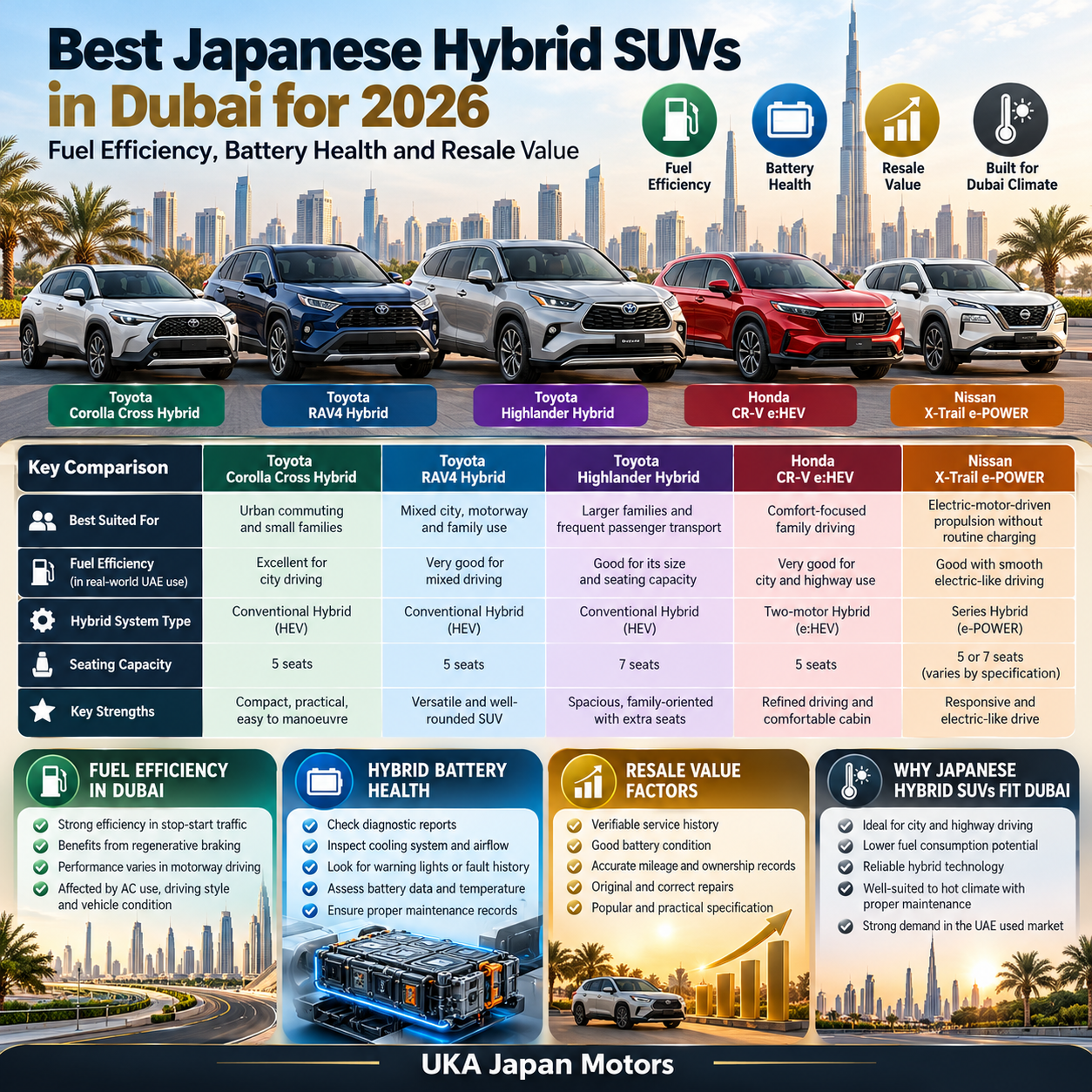
Japanese hybrid SUVs have become an important option for drivers in Dubai who want the practicality of an SUV with the potential for lower fuel consumption during everyday driving. Combining a petrol engine with an electric motor, these vehicles can recover energy during deceleration, assist the engine during acceleration and, depending on their design, travel short distances using electric power alone.
However, selecting a hybrid SUV in the UAE requires more than comparing advertised fuel-efficiency figures or choosing a familiar manufacturer. Dubai’s combination of high ambient temperatures, prolonged air-conditioning use, congested urban roads, motorway journeys and extended periods of vehicle ownership makes battery condition, cooling-system performance and maintenance history particularly important.
The most suitable vehicle also depends on how it will be used. A compact hybrid crossover may suit someone commuting daily between residential communities and business districts. A larger family SUV may be more appropriate for frequent journeys between Dubai, Abu Dhabi and the Northern Emirates. Buyers considering a Japanese import must additionally establish the vehicle’s exact specification, previous usage, service records and compatibility with local registration requirements.
In 2026, the Toyota RAV4 Hybrid, Toyota Corolla Cross Hybrid, Toyota Highlander Hybrid and Honda CR-V e are useful models to investigate, subject to the specific vehicle’s availability and specification. Nissan’s X-Trail e-POWER is another option to assess where the relevant configuration is available. These vehicles do not all use identical hybrid technology, and their suitability depends on more than their badges.
This guide explains how to compare these SUVs, understand hybrid battery health, assess fuel efficiency under UAE driving conditions and protect long-term resale potential.
Quick Answer: Which Japanese Hybrid SUV Should You Consider?
The best choice depends on your priorities rather than a single overall ranking.
- Toyota RAV4 Hybrid: A practical starting point for drivers seeking a versatile five-seat SUV for commuting, family duties and longer journeys.
- Toyota Corolla Cross Hybrid: Worth considering for predominantly urban use, manageable dimensions and everyday family transport.
- Toyota Highlander Hybrid: More suitable for households requiring additional seating capacity and a larger family-oriented vehicle.
- Honda CR-V e:HEV: A strong candidate for drivers who prioritise cabin comfort, usable passenger space and a refined hybrid driving experience.
- Nissan X-Trail e-POWER: Worth investigating for buyers interested in a system in which an electric motor drives the wheels while the petrol engine generates electricity.
These are suitability-based recommendations, not a definitive ranking of fuel consumption or resale performance. Actual results depend on model year, drivetrain, specification, battery condition, route, driving behaviour and maintenance.
For any used example, a documented maintenance history and a credible hybrid-system inspection should carry more weight than a seller’s general assurance that the vehicle is in excellent condition.
Why Hybrid SUVs Make Sense for Some Dubai Drivers
Dubai presents several distinct driving conditions, and a hybrid powertrain responds differently to each.
Frequent acceleration and deceleration
During congested traffic, a conventional petrol vehicle repeatedly converts fuel energy into movement and loses some kinetic energy as heat when braking. A conventional hybrid can recover a portion of that energy through regenerative braking and store it in its traction battery.
The recovered electricity can subsequently assist acceleration or power certain vehicle functions. This can improve efficiency in suitable driving conditions, particularly when journeys involve repeated changes in speed.
Regenerative braking does not recover all the energy used to accelerate. The amount recovered depends on factors including battery charge, temperature, braking intensity and the vehicle’s control system.
Air-conditioning demand
Air-conditioning is essential during much of the year in Dubai. It adds an energy demand that can influence overall fuel consumption, especially during stationary periods and short trips.
Depending on the hybrid design, the air-conditioning compressor may operate electrically rather than being driven directly by the petrol engine. This can allow cooling to continue when the engine temporarily stops, although the energy still has to come from the battery and, ultimately, the vehicle’s energy sources.
The system’s condition matters. Weak cooling, unusual compressor noise or inconsistent cabin temperatures should not be dismissed as ordinary characteristics of a hybrid.
Motorway driving
Journeys along Sheikh Zayed Road, Emirates Road and other major routes involve sustained cruising at higher speeds. At these speeds, aerodynamic resistance becomes more significant, and the petrol engine may operate for extended periods.
A hybrid can still benefit from its electric motor and energy management system, but its advantage over a conventional petrol SUV may be less pronounced than during suitable stop-start driving.
Buyers who regularly travel between Dubai, Sharjah, Ajman and Abu Dhabi should assess the vehicle against their actual journey patterns rather than relying exclusively on urban fuel-efficiency claims.
Heat exposure and vehicle storage
High ambient temperatures increase the importance of battery thermal management, air-conditioning performance and general cooling-system maintenance.
Parking in direct sunlight also heats the cabin and can increase the initial demand placed on the climate-control system. Shaded parking and maintaining clear air intakes can help reduce unnecessary thermal stress, although they cannot compensate for defective components.
A hybrid SUV should therefore be evaluated as a complete vehicle, not simply as a petrol engine accompanied by a battery.
Understanding the Main Types of Japanese Hybrid SUV
Before comparing individual models, it is useful to distinguish the main hybrid architectures.
Conventional hybrid: HEV
A conventional hybrid combines a petrol engine, electric motor or motors, a traction battery and electronic control systems.
The battery normally charges through regenerative braking and energy produced by the engine under controlled operating conditions. External charging is not normally required.
The vehicle can automatically alternate between electric assistance, engine power and combined operation. Some models can move on electric power alone under suitable conditions, but the distance and circumstances are limited by the battery’s capacity and operating requirements.
Toyota’s RAV4 Hybrid and Corolla Cross Hybrid are examples to investigate in this category.
Two-motor hybrid systems
Some hybrids use separate electric machines for driving and generating electricity, with the petrol engine participating according to the system’s design.
Honda’s e system uses a multi-mode arrangement in which electric drive is prominent under many conditions, while the petrol engine can contribute mechanically in appropriate operating modes.
This can produce a different driving feel from a Toyota hybrid, even though both systems combine petrol and electric power.
Series-oriented hybrid: e-POWER
Nissan’s e-POWER architecture uses an electric motor to drive the wheels, with the petrol engine generating electricity. The engine is not used in the same way as a conventional hybrid’s engine mechanically driving the wheels.
The result can feel closer to electric-motor propulsion, but the vehicle remains dependent on petrol and does not become a plug-in electric vehicle simply because its wheels are driven electrically.
Important distinction: A conventional hybrid, a plug-in hybrid and an e-POWER vehicle should not be treated as interchangeable. Verify the exact powertrain before making assumptions about charging, maintenance, driving behaviour or battery requirements.
Comparing the Best Japanese Hybrid SUVs for Dubai in 2026
| Model | Best suited to | Main consideration |
|---|---|---|
| Toyota Corolla Cross Hybrid | Urban commuting and small families | Confirm rear-seat space, luggage requirements and exact hybrid specification |
| Toyota RAV4 Hybrid | Mixed city, motorway and family use | Inspect hybrid cooling, drivetrain operation and service history |
| Toyota Highlander Hybrid | Larger families and frequent passenger transport | Assess seating configuration, vehicle dimensions and full-system condition |
| Honda CR-V e | Families prioritising cabin usability and refined driving | Confirm local specification and inspect the complete e system |
| Nissan X-Trail e-POWER | Drivers interested in electric-motor-driven propulsion without routine external charging | Verify the precise e-POWER configuration and its diagnostic history |
Model availability, equipment and powertrain specifications can differ between vehicles supplied through local channels and those imported independently. The comparison above describes general suitability, not a guarantee that every model or configuration is available through every UAE seller.
Toyota Corolla Cross Hybrid: An Urban-Focused Option
The Corolla Cross Hybrid is worth considering when the vehicle’s primary role is commuting, school transport, shopping and ordinary family journeys.
Its crossover format offers an elevated seating position without the footprint of a larger seven-seat SUV. That can be useful in residential parking areas, busy commercial districts and multi-storey parking facilities.
For Dubai driving, the key question is whether the vehicle provides enough passenger space, luggage capacity and motorway comfort for the household’s regular needs.
During an inspection, examine the petrol engine’s operation, hybrid-system warning history, cooling-air intake, suspension, tyres and air-conditioning performance. If the vehicle has been used extensively for short trips, establish whether servicing was performed according to the correct schedule.
Imported examples require particular care because the model name alone does not establish the exact specification, equipment or maintenance requirements.
Best fit: Drivers who primarily travel around Dubai and want a compact, practical hybrid crossover.
Toyota RAV4 Hybrid: A Versatile All-Rounder
The RAV4 Hybrid is a useful candidate for buyers who need one vehicle to perform several roles. Depending on its specification, it can suit commuting, family duties, inter-emirate journeys and occasional trips to destinations outside the main urban areas.
Toyota’s UAE model range includes a 2026 RAV4 Hybrid. The exact equipment and drivetrain should nevertheless be confirmed against the vehicle being considered.
Its suitability comes from the balance of SUV practicality and hybrid operation rather than any guarantee of class-leading efficiency.
Buyers should pay close attention to the traction-battery cooling system, engine and transmission-related operation, electronic warning history and condition of the suspension and tyres. Vehicles used frequently on fast roads may have accumulated substantial mileage without obvious cosmetic deterioration.
For a used RAV4 Hybrid, examine service records against the manufacturer’s schedule and investigate any unexplained gaps. A clean interior or smooth test drive is useful but cannot establish the battery’s remaining capacity.
Best fit: Drivers who want a versatile family SUV for mixed city and motorway use.
Toyota Highlander Hybrid: A Larger Family Vehicle
The Highlander Hybrid is relevant to households that need greater passenger capacity than a compact or medium-sized crossover can provide.
Its larger body and family-oriented layout may suit frequent journeys with several passengers, although the usefulness of the third row and remaining luggage space should be checked in person.
A larger vehicle also brings different practical considerations. Buyers should assess parking access, visibility, tyre condition, suspension behaviour under load and whether the vehicle’s dimensions suit their regular routes.
The hybrid system requires the same attention to battery health, thermal management and diagnostic history as a smaller model. A vehicle intended for regular family use should also be inspected for evidence of heavy passenger transport, repeated loading or neglected interior and mechanical maintenance.
When evaluating an imported Highlander, confirm the seating arrangement, safety equipment, drivetrain and parts compatibility for the exact vehicle identification number.
Best fit: Families who need additional seating and regularly transport several occupants.
Honda CR-V e:HEV: Comfort and Everyday Usability
The Honda CR-V e deserves consideration for drivers who value passenger comfort, a practical cabin and a hybrid powertrain designed to manage different driving conditions automatically.
Honda’s regional technical information identifies the e system as a two-motor hybrid arrangement. Actual specifications vary by model year and configuration, so the applicable documentation should be checked before comparing individual vehicles.
For UAE use, evaluate cabin cooling performance, engine behaviour during acceleration, transitions between operating modes and any warning messages relating to the hybrid system.
Inspect the vehicle’s service history carefully, including evidence of scheduled maintenance and any work performed on electrical or cooling components. A hybrid-specific diagnostic assessment should accompany a conventional mechanical inspection.
The CR-V’s practical appeal depends on the household’s requirements, including passenger space, luggage capacity and the character of its regular journeys.
Best fit: Families looking for a practical SUV with a comfort-focused cabin and a sophisticated hybrid system.
Nissan X-Trail e-POWER: Electric-Motor-Driven Propulsion
The X-Trail e-POWER provides a different approach to hybrid driving. Its electric motor drives the wheels, while the petrol engine generates electricity rather than functioning as the primary mechanical source of wheel propulsion.
This arrangement can deliver responsive acceleration and a driving experience that differs from conventional petrol-engine SUVs. It remains a petrol-powered vehicle, however, and the engine, generator, traction battery, inverter, cooling systems and associated electronics all require appropriate maintenance.
Buyers should establish which e-POWER version is being considered, whether the vehicle’s specification matches its documentation and whether the available service support is appropriate.
Do not assume that all X-Trail vehicles use e-POWER. Conventional petrol variants and different equipment configurations may exist, and the model badge alone is insufficient to establish the powertrain.
Best fit: Drivers interested in electric-motor-driven response who do not want routine external charging.
Fuel Efficiency: What UAE Drivers Should Actually Measure
Fuel efficiency should be assessed against the routes and conditions in which the SUV will be used.
A laboratory figure provides a controlled comparison, but it cannot fully represent every Dubai journey. Ambient temperature, traffic density, average speed, air-conditioning demand, passenger load, tyre pressure and driving style all affect real-world performance.
Why short trips can change the result
Repeated short journeys may involve a cold engine, cabin cooling demand and limited opportunities for the hybrid system to reach its most efficient operating conditions.
A hybrid can still recover energy during deceleration, but the energy required to accelerate the vehicle must first be supplied. Repeatedly covering very short distances does not guarantee exceptional fuel efficiency.
Why motorway journeys behave differently
At a steady cruising speed, regenerative braking opportunities are limited. The petrol engine may supply most of the sustained propulsion demand, depending on the powertrain and road conditions.
A vehicle that performs particularly well in urban traffic may therefore produce a different result on a long motorway journey.
A practical comparison method
When assessing two SUVs, use the same approach for each:
- Confirm the exact model year, powertrain and drivetrain.
- Record the published fuel-consumption test method, if available.
- Establish whether the vehicle’s existing consumption data represents city driving, motorway driving or mixed use.
- Check tyre pressure, alignment, maintenance condition and air-conditioning operation.
- Compare fuel consumption across representative journeys rather than one isolated trip.
- Investigate unexplained deterioration rather than assuming it is simply a characteristic of hybrid technology.
Fuel consumption should be expressed consistently, such as litres per 100 kilometres. Figures from different testing methods should not be treated as directly equivalent without understanding the test conditions.
For a used vehicle, unusually high fuel consumption can have several causes, including tyre problems, mechanical drag, poor maintenance, engine-management faults or a hybrid system that is not operating correctly. Battery degradation is one possibility, not the automatic explanation.
Hybrid Battery Health in Dubai’s Climate
The traction battery is one of the most important components to evaluate when buying a used hybrid SUV.
Unlike the conventional 12-volt battery, which supports low-voltage electrical systems and vehicle startup functions, the traction battery stores energy used by the hybrid powertrain. Depending on the model, it may use nickel-metal hydride or lithium-ion chemistry.
The battery’s design, usable capacity, thermal-management system and diagnostic procedures differ between manufacturers and model generations.
What affects battery condition?
Several factors influence battery performance over time.
Temperature exposure: Sustained high temperatures can increase battery ageing. A correctly functioning thermal-management system helps control operating temperature, but it cannot eliminate the effects of ageing or prolonged heat exposure.
Mileage and usage: Mileage is relevant, but it is not a complete measure of battery condition. A high-mileage vehicle with consistent servicing may have a healthier battery than a lower-mileage vehicle that has been neglected or stored under unsuitable conditions.
Charging and discharging behaviour: Hybrid control systems normally manage the battery within a defined operating window. Repeated abnormal operating conditions or underlying electrical faults can affect system performance.
Airflow and cooling maintenance: Depending on the design, the traction battery may use a dedicated air intake and fan. Dust, obstructions or fan problems can interfere with cooling.
Previous repairs: Incorrect repairs, non-approved components or incomplete fault diagnosis can create additional risks. Any previous battery or inverter work should be documented.
Signs that deserve investigation
Potential warning signs include:
- Hybrid-system warning lights or stored fault codes.
- Unusual changes in the battery charge display under similar driving conditions.
- Cooling-fan noise that is abnormal for the vehicle.
- Reduced performance or unexpected engine operation.
- Unexplained changes in fuel consumption.
- Evidence of previous electrical repairs without supporting documentation.
None of these signs alone proves that a traction battery has failed. A warning may relate to a sensor, cooling component, wiring issue, inverter or another part of the system.
Equally, the absence of warning lights does not prove that the battery is healthy.
How a proper battery assessment works
A credible assessment should be specific to the manufacturer’s system and the vehicle’s exact model year.
The inspection may include a scan of relevant control modules, stored and pending diagnostic trouble codes, available battery data, temperature readings, voltage measurements and an assessment of battery cooling operation.
Where supported by the manufacturer’s procedures, the technician may examine the consistency of battery block or cell-group readings, charging and discharging behaviour and evidence of imbalance.
A suitable load or performance test may provide further information, but the method must be appropriate for the battery architecture. A simple voltage reading or dashboard charge display cannot establish the battery’s remaining useful life.
The report should explain what was tested, identify any abnormal findings and state the limits of the assessment. If the available data cannot support a reliable conclusion, that uncertainty should be disclosed.
A Hybrid SUV Inspection Checklist Before You Buy
A used hybrid requires both a conventional mechanical inspection and a hybrid-specific evaluation.
1. Confirm the vehicle’s identity
Match the vehicle identification number, registration documents and available import documentation. Verify the model year, powertrain, drivetrain and equipment against the manufacturer’s information.
Do not rely solely on an advertisement, trim badge or verbal description.
2. Review service and repair records
Check for evidence of scheduled maintenance, cooling-system work, electrical repairs and any hybrid-system warnings previously reported.
Look for unexplained gaps, inconsistent mileage entries and descriptions of repairs that cannot be supported by documentation.
3. Inspect the traction-battery cooling system
Check the relevant air intake, ducts and fan where accessible and appropriate. Look for obstructions, damage or signs of unsuitable repairs.
The precise inspection procedure depends on the vehicle. Battery components should not be opened or handled by an unqualified person.
4. Scan the hybrid system
Use suitable diagnostic equipment to review the relevant control modules. Record current, pending and historical faults where supported.
Cleared fault codes do not necessarily establish that the underlying issue has been repaired. Ask whether the vehicle has completed the appropriate diagnostic and verification procedures.
5. Check the engine and cooling systems
Inspect for leaks, abnormal noises, warning messages and evidence of overheating. Verify that the engine cooling system and any model-specific hybrid cooling components operate as intended.
The petrol engine remains an important part of the vehicle even if electric assistance is frequently available.
6. Test air-conditioning performance
Check how quickly the cabin cools, whether temperatures remain consistent and whether unusual noises occur.
Because climate control can be closely integrated with hybrid operation, faults should be assessed by a technician familiar with the specific system.
7. Examine tyres, brakes and suspension
Inspect tyre condition, wear patterns, pressure and alignment. Assess brake operation, suspension noises and steering behaviour.
Regenerative braking can alter how conventional friction brakes are used, but it does not remove the need to inspect brake discs, pads, hydraulic components and related systems.
8. Conduct a controlled road test
Where legally and practically possible, assess the vehicle under different operating conditions. Observe acceleration, braking, steering, cabin cooling and the transitions between engine and electric operation.
A short drive cannot establish the remaining lifespan of a traction battery. It should be combined with diagnostic findings and documented maintenance history.
9. Check for accident or water damage
Inspect body panels, structural areas, underbody components, electrical connectors and the cabin for signs of previous repairs or water intrusion.
Electrical and hybrid components may be affected by damage that is not immediately obvious from the exterior.
10. Obtain a written assessment
A useful inspection report should distinguish confirmed faults from observations requiring further investigation. It should identify the inspection scope, limitations and recommended next steps.
For a hybrid vehicle, a general roadworthiness check and a dedicated battery assessment answer different questions. Both may be necessary before a purchase decision.
UAE Registration, Compliance and Imported Japanese Hybrids
Hybrid technology does not automatically exempt an SUV from the UAE’s applicable vehicle registration, safety or technical inspection requirements.
The relevant procedures depend on the emirate, the vehicle’s registration status, its origin and the type of transaction.
In Dubai, the Roads and Transport Authority provides vehicle technical inspection services for applicable registration, renewal and other vehicle transactions. Requirements and appointment procedures should be checked directly with the relevant authority before completing a transaction.
A successful technical inspection is not equivalent to a comprehensive mechanical condition report. It does not necessarily establish the traction battery’s remaining capacity, verify every electronic module or reveal every previous accident or repair.
Additional checks for imported vehicles
For a Japanese hybrid imported into the UAE, establish the following:
- The vehicle’s identification and import documentation are consistent.
- The exact model year and powertrain are correctly identified.
- Available maintenance records correspond to the vehicle.
- Previous accident, repair and ownership information has been investigated where available.
- The vehicle’s equipment and components are suitable for its intended use.
- Any outstanding registration or compliance requirements have been confirmed.
- Appropriate technical support is available for its specific hybrid system.
Where applicable, ask the relevant authority about the documentation and inspection steps required for registration.
A Dubai vehicle-history or technical status report may provide useful information when eligible and available. However, official guidance explains that such reports can have limitations and may not contain every accident, maintenance or other historical record. They should complement, rather than replace, an independent inspection.
Imported vehicles also require careful attention to regional specification differences. Air-conditioning calibration, electronic equipment, safety features, infotainment, software and component compatibility may differ between versions of the same model.
Resale Value: What Helps a Japanese Hybrid SUV Retain Buyer Confidence?
Resale value is influenced by the vehicle’s condition, specification, service history, buyer demand and the quality of its supporting documentation. No manufacturer badge or hybrid designation guarantees a particular resale outcome.
For Japanese hybrid SUVs in Dubai, the following factors can help establish confidence in a future buyer.
A verifiable maintenance history
Documented servicing provides evidence that the vehicle has received appropriate attention. Records should identify the work performed and, where available, the date and mileage.
A consistent history is generally more informative than a seller’s statement that the vehicle has been regularly maintained.
Evidence of battery condition
A recent, properly documented hybrid-system assessment can help a prospective buyer understand the traction battery’s observed condition.
The report should identify the test method and findings rather than making an unsupported promise about how many years the battery will last.
Battery condition changes over time, so an older report may not represent its current state.
Originality and correct repairs
Vehicles with documented repairs and correctly functioning safety and electronic systems are easier to assess than those with unexplained modifications or incomplete repair records.
Where a hybrid component has been replaced, retain the available documentation identifying the part and the work completed.
Accurate mileage and ownership information
Consistent mileage records, maintenance entries and ownership documentation support a clearer picture of the vehicle’s history.
Any discrepancy should be investigated before the vehicle is represented as having a fully verified history.
A specification that suits local buyers
Practical seating, usable luggage space, effective air-conditioning and appropriate safety equipment can influence a vehicle’s appeal.
The relevance of particular features varies between buyers. A larger SUV may suit a family needing additional seats, while a compact crossover may better suit a household that prioritises easier manoeuvrability.
Continued maintenance after purchase
A well-maintained hybrid remains dependent on appropriate servicing, correct tyres, functioning cooling systems and timely diagnosis of faults.
Resale preparation should focus on genuine condition, accurate records and transparent disclosure rather than cosmetic presentation alone.
Common Mistakes When Choosing a Used Hybrid SUV
Assuming all hybrids are the same: Different architectures have different operating characteristics and diagnostic requirements. Identify the actual powertrain first.
Treating a dashboard display as a battery test: The displayed charge level indicates the system’s current operating state, not a definitive measure of battery health.
Choosing solely on advertised fuel consumption: Test figures do not guarantee the same results on every Dubai route.
Ignoring air-conditioning faults: Cabin cooling is a major practical requirement in the UAE and should be assessed properly.
Confusing roadworthiness with mechanical condition: A vehicle that passes a required inspection may still need further investigation of its hybrid system or maintenance history.
Assuming low mileage guarantees a healthy battery: Age, storage conditions, thermal exposure and previous maintenance also matter.
Overlooking imported specification differences: Confirm the actual vehicle specification and parts compatibility rather than relying on the model name.
Accepting unexplained warning-light history: Ask for diagnostic evidence and confirmation that any identified fault has been correctly resolved.
Frequently Asked Questions
1. Which Japanese hybrid SUV is best for Dubai in 2026?
There is no single best choice for every driver. The Toyota Corolla Cross Hybrid suits buyers seeking a compact crossover, the RAV4 Hybrid offers versatile family use, and the Highlander Hybrid is worth considering when additional seating is required. The Honda CR-V e and Nissan X-Trail e-POWER provide alternative hybrid driving characteristics. Choose according to your space requirements, route patterns, vehicle condition and service support.
2. Are Japanese hybrid SUVs suitable for Dubai’s hot climate?
They can be suitable when correctly specified, maintained and operated. The important considerations are battery thermal management, effective air-conditioning, engine cooling and appropriate servicing. High temperatures make it especially important to inspect these systems rather than assuming that a vehicle’s hybrid technology automatically protects it from heat-related problems.
3. Does a hybrid SUV need to be plugged in?
A conventional HEV generally does not require external charging. It recovers energy through regenerative braking and manages electrical energy through its hybrid system. Nissan e-POWER also operates using petrol and onboard electricity generation rather than requiring routine external charging. A plug-in hybrid is a different category and must be assessed according to its specific design.
4. How can I check a hybrid battery before buying a used SUV?
Arrange a hybrid-specific inspection using diagnostic equipment and procedures appropriate for the exact vehicle. The assessment should review relevant fault codes, available battery data, temperature information and cooling-system operation. Where appropriate, additional performance testing may be required. A dashboard display, short road test or verbal assurance is not a substitute for a documented assessment.
5. How long does a hybrid battery last in the UAE?
There is no universal lifespan that applies to every Japanese hybrid SUV. Battery chemistry, design, age, usage, thermal exposure, maintenance and individual operating conditions all influence its condition. Manufacturer coverage terms also vary by vehicle and specification. A qualified assessment can establish observed condition, but it cannot guarantee the battery’s remaining lifespan.
6. Is a high-mileage Japanese hybrid SUV a poor choice?
Not necessarily. Mileage should be considered alongside maintenance history, battery condition, accident history and overall mechanical health. A well-documented vehicle with higher mileage may be more straightforward to evaluate than one with lower mileage and unexplained maintenance gaps. The decision should be based on evidence from the individual vehicle.
7. Can a hybrid battery problem cause higher fuel consumption?
Yes, certain battery or hybrid-system faults can affect fuel consumption and operating behaviour. However, increased consumption can also result from tyre pressure, alignment, engine condition, air-conditioning demand, driving conditions or other mechanical issues. Proper diagnosis is needed to identify the actual cause rather than automatically attributing it to battery degradation.
8. Is a Japanese-import hybrid different from a UAE-specification vehicle?
It can be. Equipment, software, safety features, air-conditioning calibration, powertrain configuration and component compatibility may vary. Buyers should verify the exact specification and available documentation for the vehicle identification number. Import origin alone does not establish whether a vehicle is suitable for local registration or whether its condition is satisfactory.
9. Does passing a UAE vehicle inspection prove that the hybrid battery is healthy?
No. A technical inspection addresses the applicable roadworthiness and regulatory requirements. It is not necessarily a comprehensive traction-battery health assessment. Buyers should confirm the relevant registration requirements with the responsible authority and arrange a separate hybrid-system inspection where appropriate.
10. What most influences the resale value of a Japanese hybrid SUV?
Condition, maintenance documentation, accurate mileage, accident history, specification and evidence of hybrid-system health can all influence buyer confidence. Practical features and ongoing support for the vehicle also matter. No single factor guarantees a particular resale outcome, and battery health should be assessed using credible evidence rather than assumptions based on age or mileage alone.
How UKA Japan Motors Approaches Japanese Hybrid SUV Selection
Choosing a Japanese hybrid SUV should begin with understanding the vehicle, its intended use and the evidence available about its condition.
UKA Japan Motors’ role is to support a more informed selection process by emphasising vehicle identification, inspection requirements, maintenance documentation and the practical considerations associated with hybrid ownership in the UAE.
For buyers evaluating imported Japanese hybrid SUVs, the important questions include whether the exact powertrain has been verified, whether relevant service records are available, whether previous repairs can be understood and whether the vehicle is suitable for the intended registration and usage requirements.
Hybrid-specific checks deserve particular attention. A conventional mechanical inspection can identify many important issues, but battery condition, electronic control faults and thermal-management performance may require additional expertise and diagnostic procedures.
Transparency also means distinguishing confirmed findings from unresolved questions. If records are incomplete or a component’s condition cannot be established confidently, that limitation should be made clear before the buyer reaches a decision.
The objective is not to recommend a particular SUV regardless of circumstances. It is to help buyers understand the differences between available models and make decisions based on practical requirements, technical evidence and long-term ownership considerations.
Conclusion: Choose the Hybrid System, Not Just the Badge
The best Japanese hybrid SUV for Dubai in 2026 is the one that matches your daily journeys, passenger requirements and expectations for long-term ownership while demonstrating sound mechanical and hybrid-system condition.
The Corolla Cross Hybrid is worth investigating for urban use, the RAV4 Hybrid for versatile family driving, and the Highlander Hybrid for households requiring additional seating. The Honda CR-V e offers a different two-motor hybrid approach, while Nissan’s X-Trail e-POWER provides electric-motor-driven propulsion without routine external charging.
Regardless of model, battery condition, cooling-system performance, service history, specification and registration suitability deserve careful attention. Fuel-efficiency figures should be interpreted in the context of Dubai’s climate and the routes the vehicle will actually travel.
A thorough inspection and a clear understanding of the vehicle’s history provide a more reliable foundation for ownership than assumptions based on reputation, mileage or dashboard displays alone.
Contact UKA Japan Motors for availability and inspection guidance.