


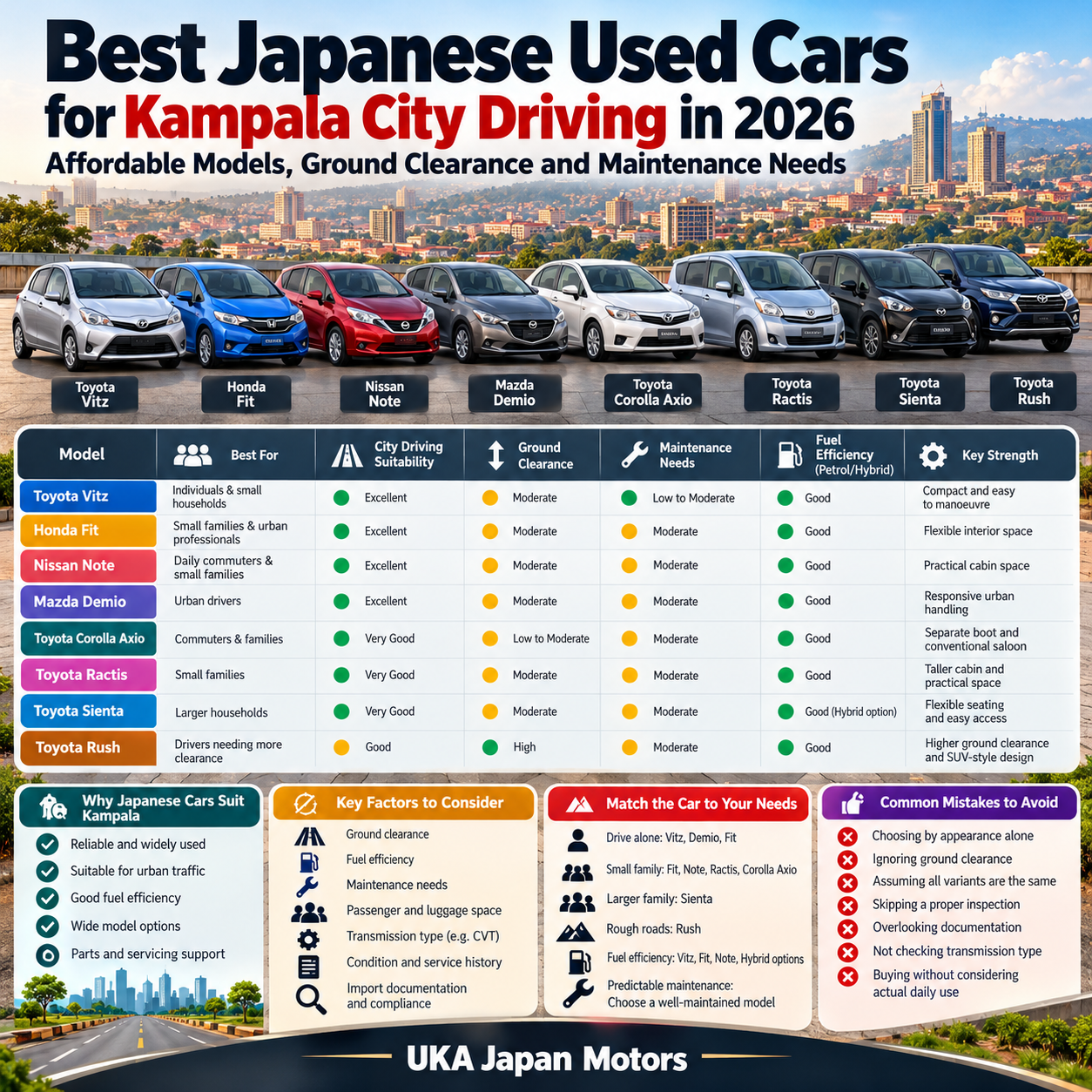
Choosing a Japanese used car for driving in Kampala requires more than comparing vehicle models or looking at exterior appearance. A suitable vehicle must cope with congested roads, frequent stopping, uneven road surfaces, speed humps, occasional flooding, changing traffic conditions and the demands of everyday ownership.
For many drivers, a car will serve several purposes. It may carry family members to school, support a daily commute, travel between residential areas and workplaces, or make occasional journeys outside Kampala. These different responsibilities influence which vehicle is most appropriate.
Japanese used cars are worth considering because the market includes compact hatchbacks, small sedans, family saloons, crossovers and larger multipurpose vehicles. However, two vehicles from the same manufacturer can have very different ground clearance, engine characteristics, maintenance requirements and suitability for local roads.
The most appropriate choice is therefore not necessarily the newest-looking vehicle or the model with the smallest engine. It is the vehicle whose design, condition and maintenance history match the driver’s real circumstances.
This guide compares several Japanese used cars commonly considered by Ugandan buyers, explains the practical differences between them and outlines the checks that should take place before a vehicle is purchased or imported.
The Short Answer: Which Japanese Used Cars Suit Kampala Best?
The best option depends on the driver’s priorities.
- Toyota Vitz: Worth considering for individual drivers and small households that prioritise compact dimensions and straightforward city manoeuvring.
- Honda Fit: A practical option for drivers who need a small exterior footprint with a flexible passenger and luggage area.
- Nissan Note: Suitable for drivers who want a compact hatchback with a more upright cabin and useful everyday practicality.
- Mazda Demio: An option for drivers who want a compact hatchback with responsive urban handling.
- Toyota Corolla Axio: Worth considering for drivers who prefer a conventional saloon and a separate luggage compartment.
- Toyota Ractis: A practical alternative for households that want a taller cabin and flexible interior space.
- Toyota Sienta: Suitable for families needing additional seating flexibility and easier access to rear seating.
- Toyota Rush: Worth evaluating when greater ground clearance and a more upright vehicle layout are important.
These are starting points rather than unconditional recommendations. The exact model year, engine, transmission, drivetrain, tyre specification and mechanical condition can change the ownership experience substantially.
A well-maintained compact car may serve a Kampala commuter better than a larger vehicle with neglected suspension or transmission components. Equally, a low-clearance hatchback may be unsuitable for a household whose daily route includes rough access roads or poorly drained sections.
1. Toyota Vitz: A Compact Choice for Everyday Urban Driving
The Toyota Vitz is a small hatchback that can suit drivers who spend much of their time navigating Kampala’s busy streets.
Its compact body helps when entering narrow residential roads, manoeuvring in crowded parking areas and turning around in confined spaces. These characteristics are particularly useful around commercial centres, office areas and residential neighbourhoods where available parking space can be limited.
What makes it suitable?
A small hatchback is generally easier to position in traffic than a larger vehicle. The Vitz’s relatively compact footprint can also make short urban journeys less demanding for drivers who regularly stop, park and restart throughout the day.
Depending on the version, its engine and transmission configuration may also suit drivers who prioritise everyday urban usability.
Ground clearance considerations
Ground clearance varies by generation, specification, tyre size and suspension condition. Buyers should not assume that every Vitz has identical clearance simply because the vehicles share a model name.
Pay particular attention to the lowest points underneath the vehicle, including the exhaust system and other components that could contact raised road surfaces.
If the car regularly carries several passengers, assess its loaded ride height as well. A vehicle that clears a speed hump when empty may have less clearance when fully occupied.
Maintenance and inspection priorities
Inspect the suspension, steering, engine cooling system, transmission behaviour and engine condition. Listen for knocks over uneven surfaces and check for excessive vibration during acceleration.
For versions equipped with a continuously variable transmission (CVT), confirm the precise transmission type and review the applicable maintenance history. A smooth test drive alone cannot establish that the transmission is healthy.
Best suited to: Individual commuters, couples and small households whose usual routes are predominantly paved and reasonably maintained.
Consider another type of vehicle if: Your regular journeys involve deep ruts, rough access roads, substantial ground-clearance demands or frequent travel with a heavily loaded cabin.
2. Honda Fit: Small Exterior Dimensions, Flexible Interior Space
The Honda Fit is a useful option for buyers who want a compact vehicle without sacrificing everyday cabin flexibility.
Its interior layout is one of its main practical attractions. Depending on the generation and seating configuration, the rear seats can be folded or rearranged to accommodate different combinations of passengers and luggage.
This can be helpful for households that sometimes carry shopping, work equipment, school items or other bulky belongings.
Why it works in Kampala
The Fit’s compact dimensions can help with parking and urban manoeuvring. Its interior flexibility also makes it more adaptable than some small hatchbacks whose rear seating and luggage arrangements are less versatile.
However, a spacious cabin does not automatically mean that the vehicle has sufficient ground clearance. Interior room and underbody height are separate characteristics and must be assessed independently.
Ground clearance and road suitability
Check the exact generation and specification rather than relying on a general model description. Inspect the underside for scraping, damaged protective covers and signs of previous impacts.
Consider the access roads you use regularly. If you frequently cross pronounced speed humps or drive through uneven sections, assess the actual vehicle in relation to those conditions before making a decision.
The importance of transmission identification
Some Honda Fit versions use different transmission arrangements across generations. Certain models use CVTs, while others may have different systems depending on the year and specification.
This distinction matters because servicing procedures, diagnostic requirements and possible failure symptoms differ between transmission types.
Before purchasing, obtain the chassis or frame identification details and confirm the fitted powertrain. Check for warning lights, delayed engagement, abnormal noises, shuddering and inconsistent acceleration. Have a qualified technician assess the transmission when its condition or history is uncertain.
Best suited to: Small households, urban professionals and drivers who value flexible passenger and luggage arrangements.
Consider another type of vehicle if: Your routes consistently demand greater ground clearance or you require a larger passenger cabin.
3. Nissan Note: Practical Cabin Space in a Compact Package
The Nissan Note is another hatchback worth considering for Kampala city use.
Its relatively upright cabin design can make the interior feel practical for passengers, while the compact body remains manageable in busy urban traffic. Exact interior space, seating arrangements and equipment vary by generation.
Everyday advantages
A car used in Kampala may spend considerable time moving slowly, waiting in queues and making short journeys. For this type of use, a compact vehicle that is easy to manoeuvre and provides comfortable passenger access can be a sensible choice.
The Note can suit drivers who need more cabin practicality than a very small hatchback but do not want the dimensions of a large family vehicle.
Ground clearance and suspension condition
Do not select a Note based solely on its body shape or seating height. Compare the actual clearance of the particular vehicle with the roads you use.
Inspect the suspension for worn bushes, damaged shock absorbers, leaking components and uneven tyre wear. These problems can affect ride quality, steering stability and tyre life.
If the vehicle has been driven over rough surfaces, also inspect the underside for impact damage.
Transmission and mechanical checks
Nissan Note versions differ by engine, generation and transmission. Some use CVT systems, so it is important to identify the precise configuration before assessing maintenance requirements.
Check service documentation, transmission fluid servicing where applicable, cooling performance and engine operation. A diagnostic scan may help identify stored faults that are not obvious during a short drive.
Best suited to: Drivers seeking a compact hatchback with useful cabin space for daily commuting and small-family duties.
Consider another type of vehicle if: Your regular route involves severe road damage or your household requires more luggage capacity than the vehicle provides.
4. Mazda Demio: A Compact Hatchback for Urban Manoeuvring
The Mazda Demio, known as the Mazda2 in some markets, is another option for drivers who want a small vehicle suited to urban traffic.
Its compact proportions can make it convenient for navigating busy streets and entering limited parking spaces. Depending on the generation and engine, it may also provide a responsive driving experience.
What buyers should consider
A vehicle’s suitability is not determined by steering response alone. Kampala drivers must also consider ride comfort, suspension condition, visibility, braking performance and the ability to handle the roads they use most frequently.
The Demio’s ground clearance should be checked on the actual vehicle, especially if the driver regularly travels over raised junctions, rough neighbourhood roads or damaged road edges.
Maintenance priorities
Inspect the engine, cooling system, suspension, steering and transmission. Pay attention to the vehicle’s service records and any evidence of previous overheating, accident repairs or neglected maintenance.
Some versions use different engine and transmission configurations, so do not assume that servicing requirements are identical across all Demio models.
Where the vehicle is fitted with a direct-injection petrol engine, establish the specific engine type and follow the appropriate maintenance schedule. A qualified technician can help assess the engine’s condition and identify any model-specific concerns.
Best suited to: Drivers who prioritise compact dimensions, urban handling and a straightforward daily-driving layout.
Consider another type of vehicle if: The car’s actual clearance, cabin space or condition does not match your intended use.
5. Toyota Corolla Axio: A Conventional Saloon for Commuting and Family Use
Not every Kampala driver prefers a hatchback. The Toyota Corolla Axio is a saloon option for buyers who want a separate boot and a more conventional passenger-car layout.
The enclosed luggage compartment can be useful for carrying bags and personal belongings out of direct view from outside the vehicle.
Why a saloon may be appropriate
A Corolla Axio can suit drivers who commute regularly, carry family members and occasionally travel beyond the city.
Its overall suitability depends on the particular generation, engine and transmission, as well as the vehicle’s condition. Buyers should assess rear-seat space and boot capacity against their actual needs rather than assuming that every saloon provides the same amount of room.
Ground clearance limitations
A conventional saloon may have a lower stance than a crossover or SUV, although specifications vary. This makes it especially important to examine the underside and compare the vehicle’s clearance with the driver’s usual routes.
A saloon that performs well on paved urban roads may require more care when crossing steep entrances, deep potholes or pronounced speed humps.
What to inspect
Check the engine, transmission, suspension, steering, brakes, cooling system and air conditioning. Inspect the boot floor and surrounding bodywork for signs of accident repairs or water entry.
For hybrid variants, if applicable, the inspection should also include the hybrid system and traction battery. Do not assume that every Corolla Axio uses the same powertrain.
Best suited to: Commuters, small families and drivers who prefer a saloon’s separate boot and conventional layout.
Consider another type of vehicle if: Your daily route contains frequent severe road irregularities or you need a taller body for access and loading.
6. Toyota Ractis: A Taller Alternative for Daily Practicality
The Toyota Ractis offers a different approach to compact urban transport. Its taller body and practical cabin layout can appeal to buyers who want a small vehicle with a more upright seating position.
Everyday use
The Ractis can be useful for households that need accessible passenger seating and flexible interior space without moving to a substantially larger vehicle.
However, its advantages should be assessed in context. A taller cabin does not automatically guarantee greater ground clearance, better handling on rough roads or more room for every type of luggage.
What about maintenance?
As with other used vehicles, maintenance requirements depend on the exact powertrain, transmission, age, condition and previous servicing.
Inspect the suspension, steering, tyres, engine cooling system and transmission. Confirm that warning lights function correctly and that no unresolved diagnostic faults are present.
Pay attention to door operation, seat mechanisms and interior fittings, particularly if the vehicle will be used frequently by family members.
Best suited to: Small families and drivers seeking a practical cabin in a compact vehicle.
Consider another type of vehicle if: You need substantial ground clearance or regularly transport several passengers with large amounts of luggage.
7. Toyota Sienta: A Flexible Option for Larger Households
The Toyota Sienta is worth considering when passenger access and seating flexibility are more important than having the smallest possible vehicle.
Depending on the generation and configuration, it can provide additional seating and sliding rear doors that make passenger entry easier in confined parking spaces.
Why families may prefer it
School journeys, family errands and shared commuting often involve several passengers entering and leaving the vehicle throughout the day.
Sliding doors can be useful where conventional doors would open into neighbouring vehicles, walls or pedestrian areas. The cabin layout can also offer flexibility for different passenger and luggage combinations.
Ground clearance and load considerations
A vehicle carrying more passengers places additional load on its suspension. This can reduce the available clearance beneath the body.
Inspect the suspension and tyres carefully, and assess the vehicle in a representative loading condition. Also check whether the seats, sliding doors and associated mechanisms operate correctly.
Inspection requirements
Review the engine and transmission configuration, cooling performance, brakes and suspension. Confirm that all seat belts and seating mechanisms function correctly.
For hybrid versions, obtain an assessment of the hybrid system and traction battery. A routine engine inspection alone is not sufficient for a hybrid vehicle.
Best suited to: Families and drivers who regularly carry multiple passengers and value flexible access.
Consider another type of vehicle if: Most journeys involve only one person and your priorities are minimum vehicle dimensions or the simplest possible layout.
8. Toyota Rush: When Ground Clearance Becomes a Priority
For drivers who frequently encounter uneven access roads, pronounced road humps or rougher surfaces around Kampala, a compact SUV such as the Toyota Rush may be worth evaluating.
Its taller body and SUV-style design can provide a different combination of road clearance, seating position and passenger space compared with a small hatchback.
What greater ground clearance changes
Ground clearance is the vertical distance between the road surface and the lowest relevant part of the vehicle under specified conditions.
More clearance can reduce the likelihood of the underside contacting raised or uneven surfaces. It does not make a vehicle immune to potholes, flooding, poor driving technique or damage caused by excessive speed.
Tyre size, suspension condition, passenger load and underbody components all influence the vehicle’s practical ability to negotiate obstacles.
Maintenance considerations
A taller vehicle still requires careful inspection of the engine, cooling system, transmission, steering, suspension and braking components.
Inspect the underside for impact damage and examine the tyres for uneven wear. If the vehicle has a four-wheel-drive system, where fitted, ensure that its operation and servicing requirements are understood.
A higher body may also affect handling and visibility compared with a small hatchback. The driver should become familiar with the vehicle’s dimensions and turning characteristics.
Best suited to: Drivers whose regular routes justify additional ground clearance and who need a more upright vehicle.
Consider another type of vehicle if: Your driving is almost entirely on well-maintained paved roads and a compact hatchback would meet your passenger and luggage requirements.
Comparing the Models: Which One Fits Your Daily Routine?
The following comparison focuses on intended use rather than treating one model as universally superior.
| Model | Main practical strength | Ground-clearance consideration | Maintenance focus |
|---|---|---|---|
| Toyota Vitz | Compact urban manoeuvring | Verify clearance and underside condition | Engine, suspension and transmission |
| Honda Fit | Flexible interior layout | Check actual specification and loaded ride height | Transmission type and engine condition |
| Nissan Note | Practical compact cabin | Inspect underside and suspension | CVT condition where fitted |
| Mazda Demio | Compact urban handling | Assess clearance against regular routes | Engine, cooling and transmission |
| Toyota Corolla Axio | Separate boot and saloon layout | Lower bodywork may need care on rough surfaces | Engine, transmission and suspension |
| Toyota Ractis | Taller, practical cabin | Do not confuse cabin height with underbody clearance | Suspension, steering and transmission |
| Toyota Sienta | Passenger access and seating flexibility | Consider clearance when carrying a full load | Sliding doors, seating and powertrain |
| Toyota Rush | SUV-style body and greater-clearance potential | Confirm actual clearance and underbody condition | Suspension, drivetrain and cooling |
This table is a preliminary selection guide. It is not a ranking of mechanical reliability. Vehicle condition, maintenance history and exact specifications can matter more than the model name.
Understanding Ground Clearance on Kampala Roads
Ground clearance deserves special attention because a vehicle can appear suitable while struggling with particular sections of a driver’s daily route.
Why road conditions matter
Kampala driving may involve several different surfaces within one journey. A driver could travel on a paved main road, enter a residential area with uneven surfaces, cross speed humps and then park on a sloping entrance.
A car that clears one obstacle may contact another because the approach angle, departure angle, wheelbase, suspension travel and location of the lowest underbody component differ.
Ground clearance is not the only measurement
Three factors are particularly useful when assessing an obstacle:
- Ground clearance: Helps indicate whether the underside can pass over a raised surface without contact.
- Approach and departure angles: Influence how easily the front or rear of the vehicle can pass over a change in road level.
- Wheelbase and body overhang: Affect the likelihood of the underside contacting a crest or dip as the wheels move over it.
Tyre condition and suspension wear also influence the practical result.
How to assess a vehicle before choosing it
First, identify the difficult parts of your regular route. Consider the height and shape of speed humps, the depth of potholes and whether the road has steep transitions.
Next, inspect the vehicle on level ground. Ask a qualified technician to check its ride height, tyres, suspension and underbody.
Finally, consider how often you will carry passengers or luggage. Additional load can reduce clearance and change handling.
Do not rely solely on a specification quoted in a listing. Different variants can have different dimensions, and a used vehicle’s current condition may differ from its original factory configuration.
Fuel Efficiency: Why Your Driving Pattern Matters
Fuel efficiency is important for daily ownership, but the result depends on more than engine size.
In Kampala, frequent acceleration, prolonged idling, stop-start traffic, air-conditioning use, passenger load and tyre condition can all influence fuel consumption.
A small petrol hatchback may be suitable for a driver who travels short urban distances, but its real-world consumption can differ substantially from published laboratory figures.
Petrol, hybrid and engine-size considerations
A conventional petrol vehicle may suit drivers who prefer a familiar powertrain and whose servicing arrangements match the specific engine.
A hybrid can be worth considering when the vehicle’s system condition, maintenance history and intended driving pattern are appropriate. Hybrid ownership requires attention to the traction battery, electrical systems and specialist diagnostic requirements.
Engine displacement alone cannot establish which vehicle will consume less fuel. Transmission design, vehicle weight, engine condition, driving style and traffic conditions all play a role.
Before choosing a model, assess its actual condition and consider the type of journeys you undertake most frequently.
Maintenance Needs: Looking Beyond the Model Name
Maintenance requirements are influenced by age, mileage, powertrain design, driving conditions and previous care.
A vehicle used primarily for short urban journeys may experience repeated cold starts and extended periods of slow driving. Rough surfaces can also increase stress on tyres, suspension components and steering systems.
The maintenance areas every buyer should review
Engine and cooling system
Look for coolant leaks, overheating evidence, abnormal noises, smoke and signs of poor servicing. Check whether the cooling system has been maintained according to the manufacturer’s requirements.
Transmission
Identify the exact transmission type. Check for abnormal engagement, hesitation, vibration, unusual noises and warning lights. Obtain specialist assessment if the history is incomplete or the behaviour is uncertain.
Suspension and steering
Listen for knocks over uneven surfaces and check for excessive play, leaking shock absorbers and uneven tyre wear. Worn components can affect control and ride comfort.
Brakes and tyres
Inspect brake pads, discs or drums as applicable, tyre condition and tread wear. Confirm that the tyres are appropriate for the vehicle and fitted in compatible specifications.
Electrical systems and air conditioning
Test the lights, windows, locks, instruments, charging system and air conditioning. Electrical faults can be difficult to identify through a visual inspection alone.
Hybrid systems where applicable
Arrange an assessment of the high-voltage system, traction battery and associated electronics by a suitably qualified technician.
Why maintenance history matters
Two vehicles of the same model and age may have very different mechanical conditions. One may have received regular servicing, while another may have been driven with overdue maintenance or unresolved faults.
Service records help establish what work has been completed and what may be due. They should be checked against the vehicle’s identity and, where possible, supporting workshop documentation.
A clean interior or polished exterior cannot establish mechanical condition.
Buying an Imported Japanese Used Car in Uganda: Inspection and Documentation
Selecting a suitable model is only one part of the process. Buyers should also establish that the vehicle’s identity, import documentation and applicable compliance requirements are in order.
Requirements can change, so confirm the current process with the relevant Ugandan authorities and authorised inspection or registration service providers before committing to an import or registration procedure.
Vehicle identity and documentation
Check that the chassis or frame number matches the available documentation and the vehicle itself. Where applicable, verify the engine number and other identifying details.
Review the import and ownership documents relevant to the vehicle’s status. Confirm that the records are consistent, legible and appropriate for the stage of the transaction.
Do not assume that documents are valid simply because they have been provided. Questions about discrepancies should be resolved before proceeding.
Import age and compliance requirements
Before arranging an import, establish which age-related rules, inspection requirements, standards and registration procedures currently apply to the specific vehicle.
Confirm the model year using reliable documentation rather than relying exclusively on a seller’s description. Where manufacturing date, first registration date and model year differ, establish which date is relevant to the applicable requirement.
Do not assume that every Japanese used vehicle is eligible for import simply because it is available for export.
Independent mechanical inspection
A pre-purchase inspection should examine more than the engine. It should cover the transmission, suspension, steering, braking system, tyres, electrical equipment, cooling system, underbody and body structure.
The inspection should also look for accident repairs, corrosion, flood-related damage and evidence of poorly completed repairs.
For a hybrid, the inspection should include the hybrid system. For a vehicle with a CVT or another specialised transmission, assessment should reflect the exact system fitted.
Why documentation and condition must be checked separately
A vehicle may have apparently complete documentation while still having mechanical problems. Equally, a mechanically sound vehicle may have unresolved identity or compliance questions.
These are separate issues. Both need to be addressed before a buyer can make an informed decision.
Which Car Should You Choose for Your Specific Use?
Your normal routine is often a better guide than a general model ranking.
If you drive alone most days
Consider the Toyota Vitz or Mazda Demio if compact dimensions and urban manoeuvring are your main priorities. The Honda Fit may also suit you if interior flexibility is important.
If you regularly carry family members
Compare the Honda Fit, Nissan Note, Toyota Ractis and Toyota Corolla Axio. Assess actual rear-seat comfort, luggage capacity, access and safety equipment in the specific vehicle.
If you frequently carry several passengers
The Toyota Sienta may be worth evaluating for its seating flexibility and passenger access. Confirm that its configuration meets your needs and that all seating and restraint systems are functional.
If your route includes rough access roads
Investigate vehicles with suitable ground clearance, including the Toyota Rush, but verify the actual vehicle’s dimensions and condition. Do not select an SUV merely because it looks taller.
If you prioritise fuel efficiency
Compare the precise engine and transmission versions you are considering. Examine maintenance history and consider how much of your driving takes place in stop-start traffic.
A smaller engine does not automatically guarantee the best result under every driving condition.
If you want predictable maintenance
Prioritise a vehicle with a clear service history, accessible technical information and a powertrain that can be properly inspected and serviced. Avoid assuming that a model is maintenance-free because it has a familiar name.
Common Mistakes to Avoid When Choosing a Used Car
Several avoidable mistakes can lead to a poor match between a vehicle and its owner’s needs.
Choosing by appearance alone: Exterior condition cannot establish the health of the engine, transmission, suspension or structural components.
Assuming every variant is identical: Different generations and specifications may use different engines, transmissions, safety features and suspension arrangements.
Ignoring ground clearance: A car may be convenient in traffic but unsuitable for the last section of the journey to your home or workplace.
Treating a short test drive as a complete inspection: Some faults only become apparent after specialist diagnostics or a more thorough mechanical assessment.
Overlooking passenger load: Clearance and handling can change when the vehicle carries a full cabin or substantial luggage.
Assuming a hybrid requires no specialist attention: Hybrid systems need appropriate inspection and maintenance, including assessment of the traction battery and electrical components.
Neglecting paperwork: Vehicle identity, import documentation and compliance must be reviewed independently of mechanical condition.
Using the model name as a reliability guarantee: A well-maintained vehicle and a neglected example of the same model can offer very different ownership experiences.
Frequently Asked Questions
1. Which Japanese used car is best for Kampala city driving in 2026?
There is no single best vehicle for every driver. The Toyota Vitz, Honda Fit, Nissan Note and Mazda Demio are worth considering for compact urban use. Drivers who need a saloon, flexible family seating or greater ground clearance may prefer a different model. The final choice should reflect route conditions, passenger requirements, specification and mechanical condition.
2. Which Japanese used cars have good ground clearance for Kampala roads?
The answer depends on the exact model year, variant, tyres and suspension condition. An SUV-style vehicle such as the Toyota Rush may offer a useful starting point for buyers who need greater clearance. However, actual underbody height should be verified rather than assumed from the vehicle’s appearance.
3. Is a hatchback or a saloon better for Kampala?
A hatchback can offer a compact footprint and flexible luggage access, while a saloon provides a separate boot and may suit drivers who prefer a conventional passenger-car layout. Neither body style is automatically superior. Ground clearance, cabin space, road conditions and the specific vehicle’s condition are more important than body style alone.
4. Are Toyota Vitz and Honda Fit suitable for daily commuting?
Both can suit daily commuting when their specifications and condition match the driver’s needs. They are compact vehicles that can be convenient in urban traffic. Buyers should still inspect the engine, transmission, suspension, brakes and underbody, and consider whether the available cabin space and ground clearance are sufficient for their regular routes.
5. Is a Nissan Note suitable for family use?
The Nissan Note can suit small households that want a compact vehicle with a practical cabin. Its suitability depends on the generation, seating arrangement, luggage needs and condition. Families should check rear-seat comfort, child-seat compatibility where relevant, safety equipment and the vehicle’s mechanical history before deciding.
6. Which used Japanese car is easiest to maintain in Uganda?
Maintenance depends on the exact engine and transmission, service history, component condition and availability of suitable technical support. A familiar model is not automatically easy to maintain if it has been neglected or uses a system that has not been properly identified. Obtain a vehicle-specific inspection and confirm an appropriate servicing plan.
7. Are hybrid Japanese used cars suitable for Kampala traffic?
A hybrid can be suitable for urban driving when its system is in good condition and its operating characteristics match the owner’s needs. Buyers should verify the hybrid system, traction battery, electrical components and service history. The inspection should be carried out by a technician qualified to assess the particular hybrid system.
8. What should I inspect before buying an imported Japanese used car?
Check the vehicle’s identity and documentation, engine, transmission, cooling system, suspension, steering, brakes, tyres, electrical equipment and body structure. Look for evidence of accident repairs, corrosion, flood damage and unresolved faults. Confirm applicable import, inspection and registration requirements before proceeding.
9. How can I know whether a used car has enough ground clearance?
Identify the difficult parts of your normal route and compare them with the actual vehicle. Have a technician inspect the underbody and measure relevant clearance where appropriate. Consider passenger and luggage loads, tyre condition and suspension wear. A general model description or advertised specification should not replace checking the particular car.
10. Does a smaller engine always use less fuel in Kampala?
No. Fuel consumption also depends on engine design, transmission, vehicle weight, maintenance, traffic congestion, idling, air-conditioning use and driving habits. Compare the precise vehicle versions and consider how they will be used in practice rather than relying on engine displacement alone.
11. Should I buy a car based on its mileage reading?
Mileage is useful, but it should not be assessed in isolation. Review service records, vehicle identity, interior and mechanical condition, diagnostic results and evidence of wear. Where possible, seek supporting documentation for the mileage history. An odometer reading alone cannot establish the vehicle’s overall condition.
12. What is the role of a vehicle inspection before purchase?
An inspection helps identify mechanical defects, structural damage, wear, diagnostic faults and maintenance concerns before a decision is made. It also helps establish which areas need further investigation. An inspection does not eliminate every risk, but it provides a stronger basis for evaluating the vehicle than appearance or a brief drive alone.
How UKA Japan Motors Approaches Vehicle Selection
UKA Japan Motors recognises that choosing a Japanese used car requires more than matching a buyer with a familiar model name.
The useful starting point is understanding how the vehicle will be used. A commuter who drives alone through central Kampala may need different characteristics from a family that carries several passengers or a driver whose route includes uneven residential roads.
Vehicle selection should therefore consider ground clearance, cabin layout, engine and transmission configuration, maintenance history, safety equipment and the condition of the individual vehicle.
Inspection and documentation are equally important. Buyers should be encouraged to verify vehicle identity, review available records, establish the applicable import and registration requirements, and obtain an appropriate mechanical assessment.
Where the vehicle has a CVT, hybrid system or another specialised powertrain, the inspection should reflect that configuration rather than relying on a generic checklist.
UKA Japan Motors’ role is to support informed vehicle selection through practical guidance on vehicle suitability, inspection considerations and compliance awareness. The objective is to help buyers understand the strengths and limitations of the vehicles they are considering, so that their decisions reflect real ownership requirements.
Final Thoughts: Choose the Vehicle That Matches Your Roads and Routine
The best Japanese used car for Kampala city driving in 2026 is the one that meets your everyday requirements without overlooking mechanical condition, ground clearance or documentation.
The Toyota Vitz, Honda Fit, Nissan Note and Mazda Demio are useful options for buyers prioritising compact urban driving. The Toyota Corolla Axio offers a conventional saloon layout, while the Toyota Ractis and Sienta provide alternative approaches to passenger and cabin flexibility. The Toyota Rush deserves consideration when greater ground clearance is a priority.
No model should be selected solely because it is popular or appears suitable on paper. The exact specification, service history, condition of the suspension and transmission, road conditions and intended passenger load all influence the final decision.
Before proceeding, identify your regular routes, establish your passenger and luggage needs, confirm the vehicle’s powertrain and inspect its mechanical condition. Review the documentation and verify the applicable Ugandan import and registration requirements as well.
A careful selection process helps reduce uncertainty and supports more responsible long-term vehicle ownership.
Contact UKA Japan Motors for availability and inspection guidance.