


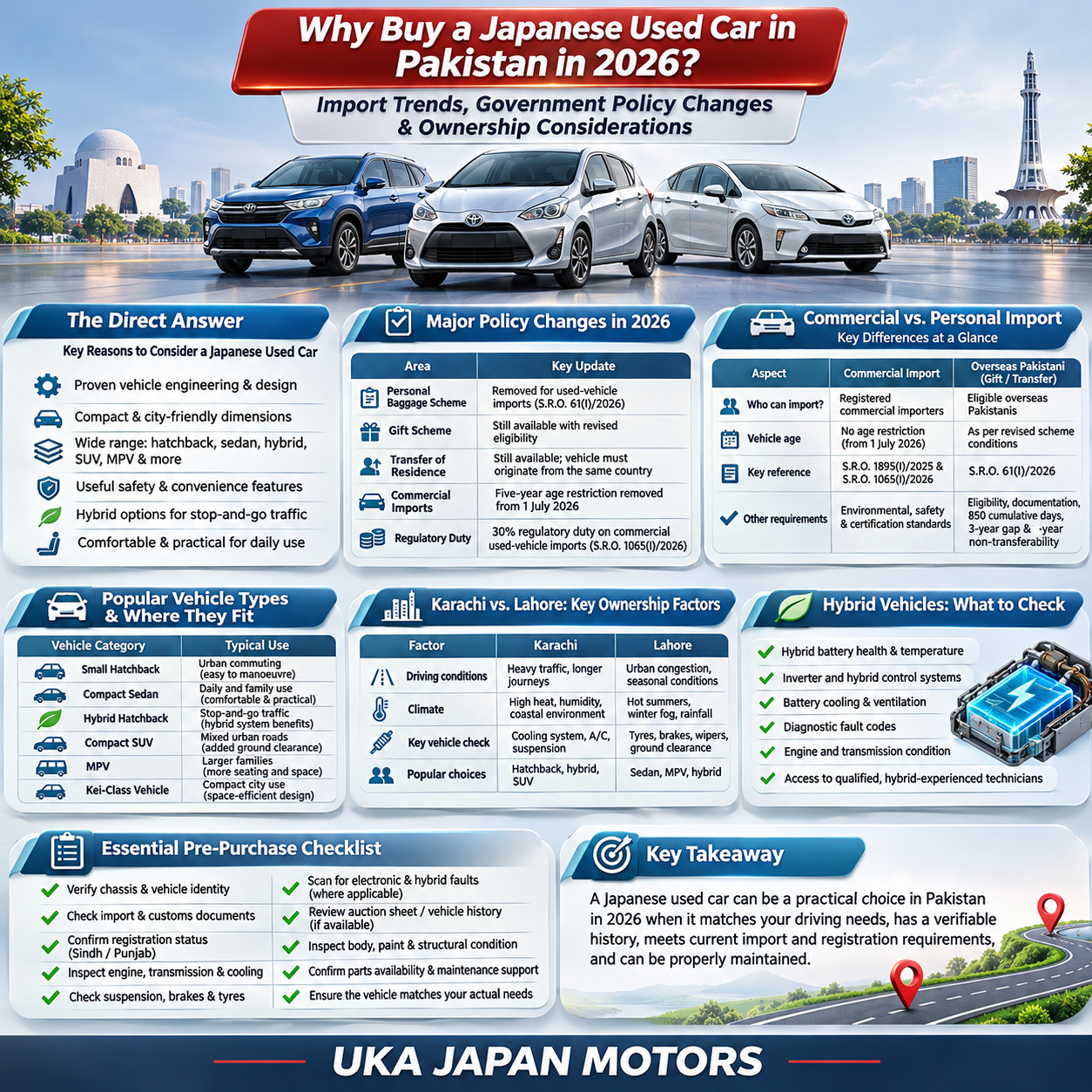
Japanese used cars continue to occupy an important position in Pakistan’s automotive market. Their popularity is not based on a single feature or one particular vehicle category. Instead, it comes from a combination of vehicle engineering, practical dimensions, equipment, driving characteristics and the availability of different body styles.
In 2026, the discussion around Japanese imported vehicles has become particularly important because Pakistan’s government has introduced significant changes to the used-vehicle import framework. These changes have affected the way vehicles can enter the country, the conditions governing commercial imports and the eligibility requirements for overseas Pakistanis importing vehicles under designated schemes.
For buyers in Karachi and Lahore, understanding these developments is essential. Choosing an imported vehicle is no longer simply a matter of selecting a familiar manufacturer or a particular model. Buyers must also consider the vehicle’s import route, customs documentation, manufacturing history, physical condition and registration eligibility.
Japanese vehicles are commonly considered for different purposes. A small hatchback may suit someone travelling through congested urban streets, while a compact hybrid may appeal to someone covering long daily distances. Families may require a practical MPV, and drivers needing additional ground clearance may consider a compact SUV.
However, the Japanese origin of a vehicle does not automatically establish that it is suitable for every Pakistani driver.
A responsible decision requires an understanding of both the vehicle and the conditions under which it was imported.
This guide explains the reasons behind Japanese used-car demand in Pakistan during 2026, the latest relevant government policy changes, the distinction between commercial and personal import arrangements, and the practical considerations that should guide ownership.
The Direct Answer: Why Consider a Japanese Used Car in 2026?
Japanese used cars can be a practical choice for Pakistani motorists when the selected vehicle matches their driving requirements and has a verifiable history.
The main considerations include:
- Vehicle engineering: Many Japanese models have established mechanical designs and well-documented maintenance requirements.
- Compact dimensions: Smaller hatchbacks and compact vehicles can be easier to manoeuvre through congested Karachi and Lahore streets.
- Different vehicle categories: Buyers can consider hatchbacks, sedans, hybrids, SUVs, MPVs and commercial vehicles.
- Equipment and safety features: Depending on the model, manufacturing year and specification, imported vehicles may have different safety and convenience equipment.
- Hybrid technology: Selected models offer hybrid powertrains that can be useful in frequent stop-and-go urban traffic.
- Driving comfort: Certain models provide comfortable seating, practical cabin layouts and useful storage arrangements.
- Vehicle selection: The imported market offers different configurations, engine capacities and body styles.
These advantages must be considered alongside important limitations.
Parts availability, specialised electronic components, hybrid battery condition, accident history, import documentation and local registration requirements can all affect the ownership experience.
The most suitable vehicle is therefore not necessarily the newest-looking or most highly equipped model. It is the vehicle whose mechanical condition, documentation and intended usage can be properly established.
1. Understanding the Appeal of Japanese Used Cars
Japanese vehicles are frequently considered by Pakistani buyers because their engineering and vehicle configurations cover a wide range of everyday requirements.
Consistent engineering and mechanical design
Many Japanese manufacturers develop vehicles around clearly defined mechanical platforms and established engineering systems.
This can make it easier for experienced technicians to understand their maintenance requirements, particularly for models that have an established presence in Pakistan.
However, the maintenance history of an individual vehicle remains more important than the manufacturer’s reputation.
A poorly maintained Japanese vehicle can develop serious mechanical problems, while a properly serviced vehicle can provide dependable everyday transportation.
Buyers should pay attention to:
- Engine operating condition.
- Transmission response.
- Cooling-system performance.
- Suspension and steering components.
- Electrical connections.
- Brake operation.
- Evidence of previous repairs.
- Maintenance records where available.
These checks are particularly important in Karachi, where prolonged traffic congestion and high ambient temperatures can place additional demands on cooling systems and engine components.
Practical vehicle dimensions
Compact Japanese hatchbacks are often suitable for urban driving.
In Karachi, drivers regularly encounter narrow residential streets, crowded commercial areas, roadside parking and slow-moving traffic. Lahore presents similar challenges in busy commercial districts and older residential neighbourhoods.
A vehicle with manageable dimensions can make everyday manoeuvring easier.
Nevertheless, buyers should also consider:
- Door opening space.
- Rear passenger access.
- Boot capacity.
- Ground clearance.
- Seating position.
- Visibility.
- Turning radius.
A compact vehicle may be convenient for daily commuting but may not provide the passenger space required by a larger family.
Different body styles and configurations
The Japanese used-car market includes several vehicle categories.
| Vehicle category | Typical purpose | Important consideration |
|---|---|---|
| Small hatchback | Urban commuting | Cabin and luggage space |
| Compact sedan | Daily and family use | Rear-seat comfort |
| Hybrid hatchback | Stop-and-go driving | Battery and electrical health |
| Compact SUV | Mixed urban driving | Ground clearance and suspension |
| MPV | Family transportation | Seating and transmission condition |
| Kei-class vehicle | Compact city use | Engine specification and load requirements |
The correct category depends on the driver’s actual requirements rather than general market popularity.
2. What Makes 2026 an Important Year for Japanese Car Imports?
Pakistan’s used-vehicle import framework underwent important changes during 2025 and 2026.
These changes are significant because they affect two different areas of the market:
- Commercial imports of used vehicles.
- Imports by eligible overseas Pakistanis under designated schemes.
The distinction is important because the two routes do not operate under identical eligibility conditions.
A buyer considering an already-cleared imported vehicle in Karachi or Lahore should understand which import route was used and whether the vehicle has completed the required customs and registration procedures.
Commercial import policy changes
The Ministry of Commerce introduced an amendment through S.R.O. 1895(I)/2025, dated 30 September 2025.
The amendment allowed commercial imports of used vehicles falling under specified Pakistan Customs Tariff headings, initially subject to a maximum vehicle age of less than five years until 30 June 2026.
The permission was also subject to environmental, safety and quality standards, including testing and certification requirements prescribed through the relevant government authorities.
An important subsequent development occurred in 2026.
The Commerce Ministry clarified that the five-year age restriction on commercial imports had ceased to apply from 1 July 2026.
The clarification was reported in November 2026 following an Office Memorandum issued on 30 October 2026.
The removal of the age restriction does not mean that every used vehicle can enter Pakistan without restrictions. Applicable import-policy provisions, customs requirements, environmental standards, safety requirements and certification obligations continue to matter.
Regulatory duty changes
Another important development concerns regulatory duty on commercial imports.
Under S.R.O. 1065(I)/2026, issued on 30 June 2026, the government imposed a 30% regulatory duty on commercial imports of used vehicles falling under the specified tariff headings.
This duty operates in addition to the regulatory duty imposed under the applicable separate notification.
Consequently, the removal of the five-year age restriction should not be interpreted as the removal of customs or regulatory obligations.
Commercial importers must consider the applicable rules and notifications when arranging a shipment.
Why these developments matter to buyers
The policy changes influence the structure of the imported-vehicle market.
They affect:
- Which vehicles may be commercially imported.
- The age conditions applicable to commercial shipments.
- The documentation required for customs clearance.
- The standards that imported vehicles must satisfy.
- The regulatory treatment of imported vehicles.
- The distinction between commercial and overseas Pakistani import schemes.
For buyers, this makes verification of the import route increasingly important.
A vehicle’s registration history and customs clearance documentation should be examined rather than relying entirely on a seller’s description.
3. Personal Import Schemes: Important Changes for Overseas Pakistanis
The government also changed the rules governing vehicle imports by overseas Pakistanis.
A major development was the removal of the Personal Baggage Scheme for used vehicles through S.R.O. 61(I)/2026, dated 15 January 2026.
The Gift Scheme and Transfer of Residence Scheme remained available under revised conditions.
The changes were intended to restrict misuse of personal import facilities and strengthen the requirements governing eligible imports.
Personal Baggage Scheme
The Personal Baggage Scheme is no longer an available route for importing used vehicles under the revised framework.
Buyers should be cautious when relying on older explanations, online discussions or advertisements that describe the previous arrangements as though they remain unchanged.
Gift Scheme
The Gift Scheme remains subject to eligibility and documentation requirements.
The scheme is intended for eligible overseas Pakistanis gifting a vehicle to a qualifying family member in Pakistan.
The relationship between the overseas Pakistani and the recipient, the eligibility of the sender and the required supporting documents must be established before the import process begins.
Transfer of Residence Scheme
The Transfer of Residence Scheme is intended for eligible overseas Pakistanis returning to Pakistan.
The applicable requirements must be checked before shipment.
One important condition introduced through the revised framework is that a vehicle imported under Transfer of Residence must originate from the same country in which the overseas Pakistani resides.
Important changes under S.R.O. 61(I)/2026
The January 2026 notification introduced several significant amendments.
| Subject | Revised position |
|---|---|
| Personal Baggage | Removed for used-vehicle imports |
| Gift Scheme | Retained subject to revised eligibility |
| Transfer of Residence | Retained subject to revised eligibility |
| Intervening import period | Increased to three years |
| Overseas stay requirement | Revised framework refers to 850 cumulative days |
| Vehicle transfer | One-year non-transferability requirement |
| Vehicle origin | Same-country requirement applies to Transfer of Residence |
| Standards | Applicable commercial safety and environmental requirements also apply |
The revised rules should be read with the actual notification and applicable Customs procedures. Buyers should not assume that eligibility under an older arrangement automatically establishes eligibility under the current framework.
Why this matters when purchasing an imported vehicle
A vehicle imported through an overseas Pakistani scheme may have different documentation from one brought through commercial import.
The buyer should establish:
- The applicable import scheme.
- The identity and eligibility of the importer.
- The vehicle’s customs clearance status.
- The date of importation.
- Whether the non-transferability restriction has expired.
- Whether the required registration documents are available.
These checks are particularly important when a vehicle is being offered for resale.
A vehicle may appear physically ready for use but still require clarification of its legal transfer position.
4. Why Japanese Vehicle Demand Remains Relevant in Karachi and Lahore
Government policy changes influence the supply of imported vehicles, but everyday driving requirements continue to influence buyer decisions.
Karachi and Lahore have different road environments, traffic patterns and commuting requirements. Nevertheless, both cities create practical reasons for considering compact and versatile vehicles.
Karachi: Traffic, heat and longer daily journeys
Karachi motorists frequently encounter:
- Heavy traffic on major roads.
- Congestion around commercial centres.
- Uneven road surfaces.
- Dust and coastal humidity.
- High summer temperatures.
- Long journeys between residential and commercial areas.
For these conditions, vehicle cooling-system health becomes particularly important.
A buyer should inspect the radiator, cooling fans, coolant condition, hoses and evidence of overheating.
Air-conditioning performance also deserves attention.
In a city where vehicles may spend extended periods moving slowly in traffic, a properly functioning cooling and air-conditioning system is essential for comfortable operation.
Suspension condition should also be assessed because uneven surfaces, road repairs and damaged sections can gradually affect bushes, shock absorbers and related components.
Lahore: Congestion, seasonal conditions and family transportation
Lahore presents its own ownership considerations.
Drivers encounter crowded urban roads, extended commuting distances, seasonal rainfall, winter fog and summer heat.
The condition of tyres, brakes, wipers, lights and air-conditioning should therefore be examined carefully.
Ground clearance is another relevant factor.
A vehicle with a low underbody may require greater care when passing over damaged road surfaces, uneven speed breakers and poorly maintained streets.
For family use, rear passenger comfort and luggage space can be equally important.
A compact hatchback may suit an individual commuter, while a sedan or MPV may be more appropriate for regular family transportation.
Matching vehicle type to local usage
| Driving requirement | Vehicle type to consider | What to inspect |
|---|---|---|
| Busy city commuting | Compact hatchback | Transmission and cooling |
| Frequent stop-and-go traffic | Hybrid vehicle | Battery and electrical systems |
| Regular family journeys | Sedan | Rear seating and suspension |
| Larger family requirements | MPV | Transmission and seating mechanism |
| Mixed urban roads | Compact SUV | Suspension and underbody |
| Short residential journeys | Small vehicle | Visibility and manoeuvrability |
The table identifies general vehicle suitability rather than guaranteeing the performance of a particular model.
5. Japanese Hybrid Vehicles: A Continuing Part of the Imported Market
Hybrid vehicles remain an important category within Pakistan’s imported Japanese vehicle market.
A hybrid combines an internal combustion engine with an electric motor and battery system.
Depending on the vehicle design, the system can use electric assistance during acceleration, recover energy during braking and manage engine operation according to driving conditions.
This technology can be particularly relevant in urban traffic.
In Karachi and Lahore, frequent acceleration and deceleration are common. A functioning hybrid system may manage these driving conditions differently from a conventional petrol-only vehicle.
However, hybrid technology introduces additional inspection requirements.
Hybrid battery condition
The high-voltage battery is one of the most important components to assess.
A buyer should not rely solely on dashboard warnings or a short demonstration of vehicle operation.
A proper assessment should consider:
- Battery health information.
- Individual battery block behaviour where applicable.
- Temperature readings.
- Cooling fan condition.
- Battery ventilation.
- Warning codes.
- Charging and discharging behaviour.
Battery performance can deteriorate over time.
Heat, poor maintenance, blocked ventilation and previous electrical repairs may affect system operation.
Hybrid system inspection
The inspection should also include:
- Inverter operation.
- Hybrid control systems.
- Electrical connectors.
- Cooling arrangements.
- Engine condition.
- Transmission or power-split system operation.
- Stored diagnostic trouble codes.
A hybrid vehicle may operate normally during a brief journey while still having stored faults.
Diagnostic inspection is therefore an important part of the buying process.
Who should consider a Japanese hybrid?
A hybrid may be suitable for someone whose driving pattern involves regular urban commuting and who has access to technicians familiar with the relevant system.
It may be less suitable when specialised diagnostic support is unavailable or the vehicle’s battery and electronic condition cannot be established.
The decision should be based on actual mechanical evidence rather than the hybrid badge alone.
6. Vehicle Condition Matters More Than Model Popularity
One of the most common mistakes in the used-car market is assuming that a popular model is automatically a safe purchase.
Popularity cannot establish the condition of an individual vehicle.
Two vehicles of the same model and manufacturing year may have very different ownership histories.
One may have received regular servicing and careful treatment, while another may have experienced accident damage, flood exposure, overheating or neglected maintenance.
For this reason, buyers should evaluate the individual vehicle rather than relying exclusively on model reputation.
Exterior and body inspection
The exterior should be examined for:
- Uneven panel gaps.
- Differences in paint finish.
- Repaired body sections.
- Rust formation.
- Damaged mounting points.
- Signs of previous structural repairs.
- Windscreen replacement.
- Evidence of water entry.
Paint thickness measurements, where appropriate, can help identify areas requiring further investigation.
However, these readings should be interpreted by an experienced inspector.
Engine and transmission
The engine should be inspected under suitable operating conditions.
Important areas include:
- Cold-start behaviour.
- Unusual engine noise.
- Exhaust smoke.
- Oil leakage.
- Coolant leakage.
- Engine mounting condition.
- Cooling-system operation.
- Idle stability.
The transmission should also be checked for delayed engagement, abnormal noises, slipping, harsh operation and warning indicators.
For vehicles using continuously variable transmissions, correct inspection procedures are especially important.
Suspension and steering
Pakistani road conditions make suspension inspection particularly relevant.
An inspection should include:
- Shock absorbers.
- Suspension bushes.
- Ball joints.
- Steering rack.
- Wheel bearings.
- Tie-rod ends.
- Underbody damage.
- Tyre condition.
A vehicle may look clean externally while having significant wear underneath.
7. Understanding Japanese Auction and Vehicle History Documentation
Imported Japanese vehicles may be accompanied by auction-related documentation.
Such records can help establish information about the vehicle’s condition at an earlier point in its history.
However, buyers should understand what these documents can and cannot prove.
An auction sheet is not a guarantee of the vehicle’s present condition.
It records information associated with a particular inspection and sale process. Subsequent transportation, storage, repairs or usage can change the vehicle’s condition.
What should buyers examine?
Where an auction sheet is available, buyers should check:
- Chassis identification.
- Vehicle model and grade.
- Manufacturing information.
- Recorded mileage.
- Inspection date.
- Accident or repair markings.
- Interior condition.
- Exterior condition.
- Inspection comments.
- Consistency with the actual vehicle.
The authenticity of the document should also be checked.
A reproduced document without reliable verification should not be treated as conclusive evidence.
Chassis number verification
The chassis number is a fundamental identification detail.
It should be compared across:
- The vehicle itself.
- Import documentation.
- Customs records.
- Registration documents.
- Available auction or export records.
Any inconsistency requires clarification before the purchase is completed.
Buyers should not accept explanations that dismiss differences in identification details as ordinary paperwork issues.
8. Import Documentation and Registration in Pakistan
Import documentation is a central part of purchasing a Japanese used car.
A vehicle that has physically arrived in Pakistan is not necessarily ready for lawful road use.
The applicable customs and registration requirements must be completed.
Important import documents
Depending on the import route and applicable procedure, relevant records may include:
- Bill of Lading.
- Commercial invoice or applicable export documentation.
- Goods Declaration.
- Customs assessment and clearance records.
- Vehicle identification details.
- Relevant import permission and supporting documents.
- Required inspection or certification records.
- Supporting documents for the applicable import scheme.
The exact document set can differ according to the vehicle category and import arrangement.
Karachi registration considerations
Vehicles registered in Sindh must meet the applicable provincial registration and transfer requirements.
Buyers should verify the vehicle’s customs clearance, registration status, ownership records and identification details through the relevant authorities.
For an imported vehicle that has not yet been registered, the required customs documentation should be checked before assuming registration can proceed.
Lahore registration considerations
Vehicles registered in Punjab must comply with the applicable Excise and Taxation Department requirements.
The buyer should establish whether the vehicle has completed the relevant registration process and whether the available records match its physical identity.
Where a vehicle is being transferred between owners or provinces, the relevant transfer and verification procedures should also be confirmed.
Why documentation should be checked before payment
Documentation problems can create delays and complications even when a vehicle appears mechanically sound.
A responsible purchase process should establish legal eligibility and ownership status before the transaction is finalised.
The vehicle’s appearance should never take priority over its identity and documentation.
9. Japanese Used Cars Compared With Locally Assembled Vehicles
A useful comparison should consider the differences in vehicle selection, specifications, servicing and documentation rather than assuming that one category is always better.
| Consideration | Japanese imported used vehicle | Locally assembled vehicle |
|---|---|---|
| Vehicle history | Requires import and previous-use verification | Requires domestic ownership and service-history checks |
| Specification | May have different grades and equipment | Depends on local variant |
| Parts | Availability varies by model | Depends on local distribution and model support |
| Documentation | Customs and import records are important | Domestic sales and registration records are important |
| Inspection | Import history, chassis and mechanical condition | Accident, service and mechanical condition |
| Technical support | Depends on model familiarity and specialist availability | Depends on local model support |
| Selection | Different imported body styles and configurations | Depends on locally available models |
Neither category should be selected purely on its origin.
The correct decision depends on the specific vehicle, the availability of technical support, the buyer’s intended use and the quality of its documentation.
A well-maintained vehicle with complete records is generally a more sensible consideration than a vehicle selected only because of its manufacturer or country of origin.
10. The Importance of Spare Parts and Maintenance Support
Long-term ownership depends on more than the condition observed on the day of purchase.
The buyer must also consider how the vehicle will be maintained over the coming years.
Japanese vehicles may use model-specific components, particularly where the vehicle has a different engine, transmission, electronic system or equipment configuration.
Some parts may be familiar to local workshops, while others may require specialist sourcing or diagnostic knowledge.
Mechanical parts
Common service requirements include:
- Engine oil and filters.
- Air filters.
- Spark plugs.
- Brake pads.
- Brake discs.
- Suspension components.
- Cooling-system parts.
- Belts and hoses.
Availability should be established for the particular model rather than assumed across all Japanese vehicles.
Electronic components
Modern imported vehicles may include electronic control modules, advanced safety systems, infotainment equipment and specialised sensors.
These components require appropriate diagnostic equipment and technical knowledge.
Replacing an electronic component without understanding the underlying fault may not solve the problem.
Hybrid-specific maintenance
Hybrid vehicles require technicians who understand high-voltage safety procedures.
The battery, inverter and electrical control systems should not be handled by untrained personnel.
Buyers should identify suitable maintenance support before selecting a hybrid vehicle.
11. How Government Policy Changes May Influence Future Imported Vehicle Demand
The 2026 policy changes are likely to influence the composition of the used imported vehicle market.
However, it is important to distinguish between a change in import permission and an immediate change in buyer demand.
The removal of the commercial age restriction creates a different regulatory environment for importers.
At the same time, safety and environmental requirements remain relevant, and commercial imports continue to be subject to applicable regulatory duties.
The removal of the Personal Baggage Scheme also changes the available routes for eligible overseas Pakistanis.
These developments may influence which vehicle categories are imported, how vehicles are sourced and the documentation buyers encounter.
Greater importance of compliance
Importers must understand the relevant customs tariff classification and applicable standards.
Buyers should pay attention to the import route rather than relying on a general statement that a vehicle is legally imported.
Greater importance of vehicle condition
A broader range of permissible vehicle ages does not make age irrelevant to ownership.
Older vehicles may require closer attention to corrosion, rubber components, suspension wear, cooling-system condition and electronic reliability.
The actual condition should determine whether a vehicle is appropriate.
Greater importance of technical inspection
As the market adjusts to regulatory changes, buyers should continue to insist on independent inspection.
The ability to identify accident damage, mechanical faults, odometer inconsistencies and undocumented repairs remains essential.
No automatic guarantee of demand
Government policy can influence the availability of imported vehicles, but it cannot guarantee that a particular model will remain popular or that its future resale demand will remain unchanged.
Demand is influenced by several factors, including vehicle condition, specification, maintenance support, registration status and changing buyer requirements.
12. Common Mistakes When Buying Japanese Used Cars
Buyers can avoid many ownership problems by recognising common mistakes before completing a purchase.
Mistake 1: Selecting a vehicle based only on appearance
A clean exterior does not establish mechanical reliability.
A proper inspection should include the engine, transmission, suspension, underbody and electrical systems.
Mistake 2: Ignoring auction documentation
Where auction records are available, their authenticity and consistency should be checked.
Buyers should not rely on an unverified document as proof of mileage or accident history.
Mistake 3: Ignoring chassis identification
The chassis number should match the vehicle and its supporting documentation.
Any discrepancy requires investigation.
Mistake 4: Buying without a diagnostic scan
Modern vehicles contain electronic systems that may store faults even when no warning light is currently displayed.
A suitable diagnostic assessment can identify issues that are not immediately apparent.
Mistake 5: Assuming every imported vehicle has the same specification
The same model name can cover different grades, engines, transmissions and equipment.
The exact variant should be established.
Mistake 6: Overlooking local road suitability
Ground clearance, suspension condition, tyre profile and underbody protection should be considered in relation to the roads on which the vehicle will operate.
Mistake 7: Ignoring future maintenance requirements
A buyer should understand the vehicle’s maintenance schedule and technical support requirements before ownership begins.
Mistake 8: Treating customs clearance as proof of mechanical quality
Customs clearance and vehicle inspection serve different purposes.
Legal import status does not establish that an engine, transmission, battery or suspension is mechanically sound.
13. Who Should Consider Buying a Japanese Used Car?
Japanese used vehicles can suit several categories of Pakistani motorists.
Daily urban commuters
Drivers who regularly travel through busy urban roads may find compact hatchbacks practical.
Manoeuvrability, visibility, transmission response and air-conditioning performance should be considered.
Small families
A compact sedan or hatchback may suit families requiring regular city transportation.
Rear-seat space, child-seat compatibility, luggage capacity and passenger access should be checked.
Larger families
MPVs may be more appropriate where additional seating and passenger access are required.
Buyers should inspect sliding doors, rear air-conditioning, seating mechanisms and suspension condition.
Drivers considering hybrid technology
Hybrid vehicles may suit drivers with regular stop-and-go journeys.
However, battery condition and access to specialist maintenance support should be established first.
Buyers requiring additional ground clearance
A compact SUV may be worth considering for mixed urban driving.
The vehicle’s actual ground clearance, underbody condition and suspension design should be evaluated.
14. When a Japanese Used Car May Not Be the Right Choice
An imported Japanese vehicle is not automatically suitable for every buyer.
There are situations where a different vehicle category or a locally supported model may be more appropriate.
For example:
- The required spare parts are difficult to source.
- Specialist diagnostic support is unavailable.
- The vehicle has unresolved customs documentation.
- Its registration eligibility cannot be established.
- The hybrid battery condition is uncertain.
- The vehicle has evidence of serious structural damage.
- The model’s cabin dimensions do not meet family requirements.
- Its ground clearance is unsuitable for the intended roads.
- Its previous maintenance history is unreliable.
A responsible buying decision includes recognising when a particular vehicle should be rejected.
Walking away from an unsuitable vehicle is preferable to accepting unresolved mechanical or legal concerns.
15. A Practical Inspection Checklist Before Purchasing
Before completing a purchase, buyers should organise a systematic inspection.
| Inspection area | What needs verification |
|---|---|
| Vehicle identity | Chassis and identification details |
| Import documentation | Goods Declaration and customs clearance |
| Registration | Provincial registration and ownership status |
| Exterior | Paint, panels and structural repairs |
| Engine | Starting, leakage, noise and cooling |
| Transmission | Engagement, response and abnormal operation |
| Suspension | Shock absorbers, bushes and steering |
| Brakes | Pads, discs and braking response |
| Tyres | Condition, wear and suitability |
| Electronics | Diagnostic faults and electrical operation |
| Hybrid system | Battery, inverter and cooling where applicable |
| Interior | Seats, controls, air-conditioning and water damage |
| Vehicle history | Available auction and maintenance records |
An inspection should be carried out under appropriate conditions by someone familiar with the specific vehicle category.
A short road journey alone is not an adequate substitute for a complete mechanical and diagnostic assessment.
Frequently Asked Questions (FAQs)
1. Are Japanese used cars a suitable choice in Pakistan in 2026?
They can be suitable when the selected model matches the buyer’s requirements and has a verifiable import history, sound mechanical condition and complete documentation. Suitability depends on the individual vehicle rather than its origin alone.
2. What changed in Pakistan’s used-car import policy in 2026?
Important changes included the removal of the Personal Baggage Scheme for used-vehicle imports, revised conditions for Gift and Transfer of Residence schemes, and the removal of the five-year commercial import age restriction from 1 July 2026. Commercial imports remain subject to applicable regulatory and technical requirements.
3. Can used Japanese cars be commercially imported into Pakistan in 2026?
Commercial imports are permitted under the applicable Import Policy Order and related notifications. The five-year age restriction was removed from 1 July 2026. However, environmental, safety, certification and customs requirements continue to apply.
4. Is the Personal Baggage Scheme still available for used-car imports?
No. S.R.O. 61(I)/2026 removed the Personal Baggage Scheme for used-vehicle imports. The Gift and Transfer of Residence schemes remain subject to revised eligibility conditions.
5. What is the difference between the Gift Scheme and Transfer of Residence Scheme?
The Gift Scheme allows an eligible overseas Pakistani to gift a qualifying vehicle to an eligible recipient in Pakistan. Transfer of Residence is intended for eligible overseas Pakistanis returning to Pakistan. Each scheme has specific eligibility and documentation requirements.
6. Why is Japanese vehicle inspection important?
Inspection helps identify mechanical faults, accident damage, electrical problems, suspension wear, previous repairs and inconsistencies in vehicle identification. It also helps buyers understand the vehicle’s actual condition before ownership.
7. Should I check the auction sheet before buying a Japanese imported car?
Yes, where an auction sheet is available. Its authenticity, inspection details, chassis identification and consistency with the actual vehicle should be checked. An auction sheet is historical evidence, not a guarantee of the vehicle’s present condition.
8. Are Japanese hybrid cars suitable for Karachi and Lahore traffic?
They may be suitable for frequent stop-and-go driving, depending on the model and its condition. Buyers should pay particular attention to the hybrid battery, inverter, cooling system and electronic controls.
9. What documents should I check before purchasing an imported Japanese vehicle?
Relevant documents may include the Goods Declaration, customs clearance records, Bill of Lading, applicable import documents, vehicle identification records and provincial registration documents. The exact requirements depend on the import route and registration status.
10. Can a Japanese imported vehicle be registered in Karachi or Lahore?
Registration is subject to the applicable provincial requirements and verification procedures. Vehicles registered in Sindh or Punjab must satisfy the relevant Excise and Taxation Department requirements, including appropriate customs and ownership documentation.
11. Does removal of the commercial vehicle age restriction mean older vehicles can be imported without conditions?
No. Removal of the age restriction does not remove other import-policy provisions, environmental standards, safety requirements, customs procedures or applicable regulatory duties.
12. What should I inspect when buying an imported hybrid?
The inspection should include battery condition, battery cooling, inverter operation, diagnostic trouble codes, electrical connections, engine operation and the relevant transmission system. A technician familiar with the particular hybrid model should perform the assessment.
13. Are all Japanese imported vehicles equipped with the same safety features?
No. Safety equipment varies according to model, grade, manufacturing year and specification. Buyers should verify the actual equipment installed in the individual vehicle rather than relying on the model name.
14. Is a newer imported vehicle always a better purchase?
Not necessarily. Manufacturing year is only one consideration. Mechanical condition, accident history, maintenance, identification records and import documentation are equally important.
15. Why should buyers verify the import route?
The import route determines the applicable legal framework and documentation requirements. Commercial imports and vehicles brought under the Gift or Transfer of Residence schemes do not follow identical procedures. Verification helps establish the vehicle’s customs and ownership status.
16. The Role of UKA Japan Motors in Responsible Vehicle Selection
UKA Japan Motors recognises that purchasing an imported vehicle requires more than identifying a manufacturer or selecting a model.
The process involves understanding vehicle specifications, import documentation, physical condition and the requirements associated with ownership in Pakistan.
For buyers considering Japanese vehicles in Karachi and Lahore, reliable information about the vehicle’s identity, import status and inspection requirements is particularly important.
The role of UKA Japan Motors is centred on professional automotive knowledge, vehicle information and inspection-oriented guidance.
This includes helping buyers understand:
- The differences between Japanese vehicle models and grades.
- The importance of checking chassis identification.
- The relevance of available auction and vehicle-history documentation.
- Mechanical and electrical inspection requirements.
- Hybrid battery and system assessment considerations.
- Import documentation and customs clearance.
- The importance of provincial registration procedures.
- Practical vehicle suitability for local driving conditions.
Import rules can change through government notifications, and the requirements applicable to a particular vehicle may depend on its import date, classification and import route.
For this reason, information should always be checked against the relevant official documentation.
UKA Japan Motors considers transparency and proper verification important elements of the vehicle selection process.
The objective is to help buyers understand what they are considering, identify matters requiring further inspection and make decisions based on accurate vehicle information.
Conclusion: Making an Informed Japanese Used-Car Purchase in 2026
Japanese used cars continue to have an important place in Pakistan’s automotive market because they offer different vehicle categories, specifications and driving characteristics that can meet a wide range of requirements.
However, 2026 has brought significant changes to the import environment.
The removal of the Personal Baggage Scheme, revised conditions for overseas Pakistani imports, the removal of the five-year commercial import age restriction and continuing regulatory and technical requirements have changed the framework in which imported vehicles enter Pakistan.
For buyers in Karachi and Lahore, these developments make vehicle verification especially important.
A sensible purchase should begin with a clear understanding of intended usage. The buyer should then examine the vehicle’s mechanical condition, chassis identity, import documentation, registration status and future maintenance requirements.
Hybrid vehicles require additional attention to their electrical systems and battery condition, while conventional vehicles still need thorough engine, transmission, cooling and suspension inspections.
Ultimately, the best Japanese used car is not simply the vehicle with the most popular model name or the most attractive appearance. It is the vehicle that meets the owner’s actual requirements, has a verifiable history, satisfies applicable legal requirements and can be properly maintained throughout its ownership.
An informed approach to inspection and documentation remains essential for responsible vehicle ownership in Pakistan.
Contact UKA Japan Motors for availability and inspection guidance.