


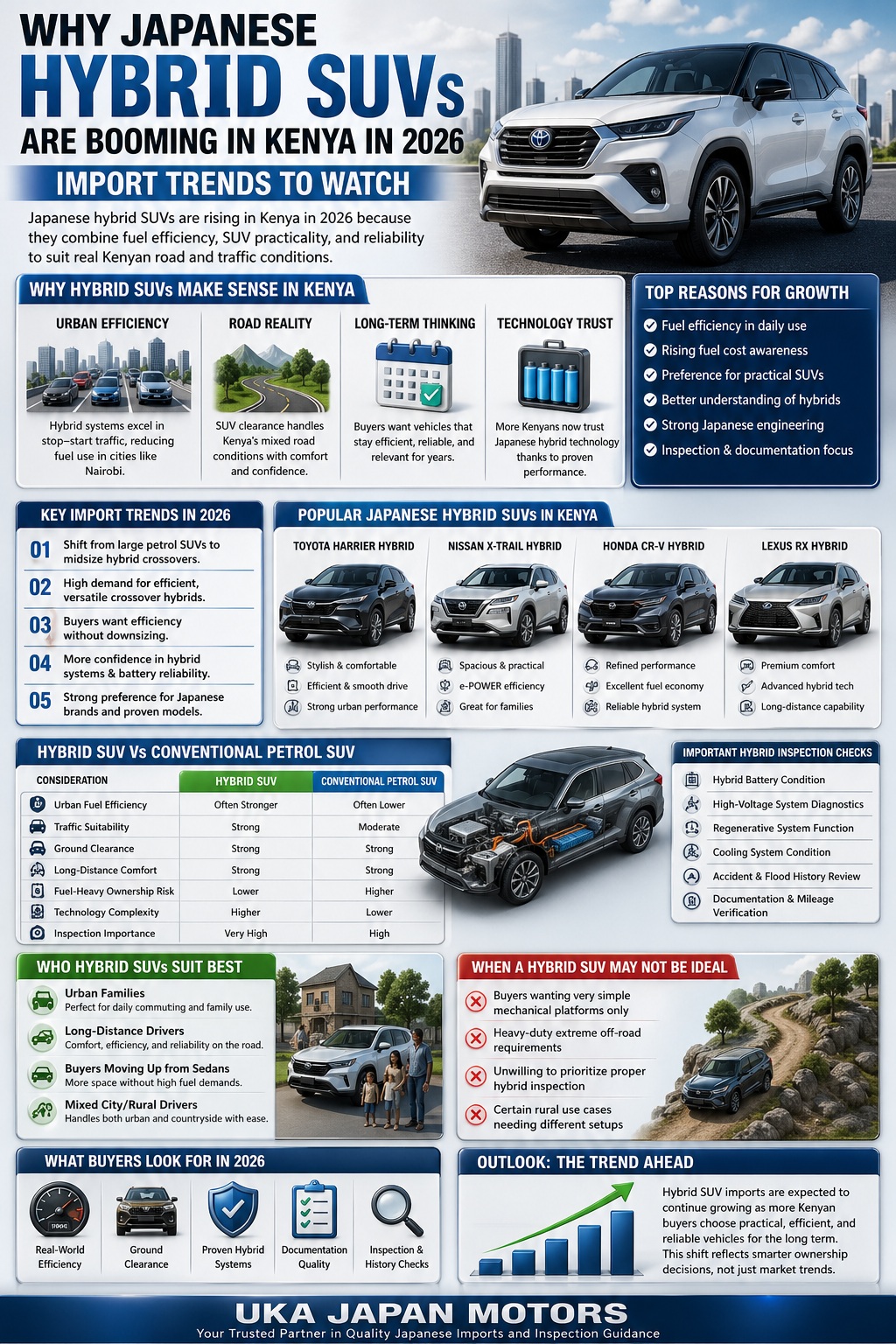
Introduction
Japanese hybrid SUVs are becoming a defining part of Kenya’s import market in 2026. What was once a niche category largely associated with early adopters has moved steadily into mainstream buyer consideration. More import buyers are now specifically asking about hybrid SUVs rather than simply considering them as alternatives to conventional petrol models.
This growth is not happening by accident.
It reflects broader changes in how Kenyan motorists are thinking about fuel use, urban driving, road suitability, long-term ownership, and vehicle technology. Buyers in Nairobi facing heavy traffic and rising demand for fuel-efficient daily transport are increasingly looking at hybrid SUVs as practical solutions. In Mombasa, where long highway driving often combines with coastal climate considerations, many import buyers are also turning toward Japanese hybrid SUVs for balanced performance and efficiency.
The trend is significant because it sits at the intersection of several long-running Kenyan vehicle preferences:
- Continued trust in Japanese imports
- Ongoing preference for SUVs and crossovers
- Growing attention to fuel efficiency
- Stronger interest in proven automotive technology
- Greater focus on long-term ownership decisions
Hybrid SUVs now bring these together in one category.
This article explores why they are booming, what import patterns show, what buyers should watch, and why this trend may continue shaping Kenya’s vehicle market.
Direct Answer: Why Are Japanese Hybrid SUVs Booming?
Japanese hybrid SUVs are growing in Kenya because they offer a practical balance of:
- Fuel efficiency
- SUV versatility
- Urban and long-distance usability
- Proven Japanese hybrid technology
- Strong fit for local road and traffic realities
For many buyers, they address a challenge conventional SUVs often struggle with:
How to keep SUV practicality while improving efficiency.
That is one of the main reasons this category is expanding.
Why Hybrid SUVs Are Rising Instead of Just Hybrid Cars
Earlier hybrid interest often focused on compact passenger cars.
Today, the momentum is shifting toward SUVs.
That matters.
It suggests Kenyan buyers are not simply chasing hybrid technology for its own sake. They are choosing hybrid systems within body styles they already prefer.
That is a different market signal.
Rather than abandoning SUVs, buyers are choosing more efficient SUVs.
This distinction explains much of the boom.
Kenya’s SUV Preference Is Driving the Trend
SUV demand in Kenya has remained strong for practical reasons.
Road Conditions Matter
Many buyers still prioritize:
- Higher ride height
- Better visibility
- Ground clearance
- Versatility beyond urban roads
Whether navigating Nairobi’s mixed road conditions or traveling outside major towns, this remains relevant.
Hybrid SUVs preserve these advantages.
Family and Multi-Purpose Use
SUVs often serve several roles at once:
- Family transport
- Business mobility
- Highway travel
- Mixed urban and upcountry driving
Hybrid versions keep this flexibility while addressing efficiency concerns.
That combination has become attractive.
Fuel Efficiency Is Reshaping Import Choices
Fuel economy discussions have become central to buyer decisions in 2026.
Not as a secondary feature—
As a primary selection factor.
That shift is influencing import demand.
Why This Matters
Many buyers who once considered traditional petrol SUVs are increasingly comparing them against hybrids.
Not just on:
- Performance
- Comfort
- Size
But also on long-term fuel use.
This is changing import priorities.
Urban Traffic Is Favoring Hybrid Technology
Nairobi Driving Conditions Support Hybrid Use
Stop-start traffic can favor hybrid systems.
In heavy commuting conditions, many buyers see practical value in vehicles designed to manage urban efficiency more effectively.
That is a real local factor.
Hybrid SUVs increasingly appeal to:
- Daily commuters
- Urban families
- Professionals with frequent city movement
- Drivers balancing comfort and fuel awareness
Traffic realities are influencing vehicle trends.
Import Trend 1: Growth of Hybrid Crossovers
One of the strongest trends is rising demand for crossover-style hybrid SUVs.
These often appeal because they offer:
- SUV practicality
- Easier city maneuvering
- Efficiency-focused design
- Comfortable long-distance use
This category is attracting both first-time SUV buyers and those moving from conventional SUVs.
Import Trend 2: Shift Away From Fuel-Heavy SUVs
Another visible trend is movement away from some larger conventional petrol SUVs.
This does not mean they are disappearing.
But more buyers are questioning whether they still suit changing ownership priorities.
Hybrid SUVs increasingly fill that gap.
Import Trend 3: More Demand for Proven Hybrid Systems
Buyers are often showing stronger preference for established hybrid platforms.
That matters in imports.
Trust in proven systems affects demand.
Interest often centers around vehicles such as:
- Toyota Harrier Hybrid
- Honda CR-V Hybrid
- Nissan X-Trail Hybrid
- Lexus RX Hybrid
These models often attract attention because buyers value mature hybrid systems.
Why Japanese Hybrid SUVs Fit Kenyan Ownership Needs
1. Efficiency Without Giving Up SUV Benefits
This is perhaps the biggest reason behind growth.
Buyers no longer want efficiency only through smaller vehicles.
They want:
SUV capability + efficiency.
Hybrid SUVs offer that.
2. Strong Urban and Highway Versatility
Some vehicles suit city use but compromise long-distance practicality.
Others suit highways but can feel costly in daily urban driving.
Hybrid SUVs often attract attention because they aim to balance both.
That suits Kenyan usage patterns.
3. Long-Term Ownership Thinking
Many buyers now think beyond immediate purchase decisions.
They ask:
- Will this still suit my needs years from now?
- How practical is it daily?
- How efficient is it over time?
- Is the technology proven?
This long-term thinking supports hybrid demand.
Comparison: Hybrid SUV vs Conventional Petrol SUV
| Ownership Factor | Hybrid SUV | Conventional Petrol SUV |
|---|---|---|
| Urban Efficiency | Strong | Moderate |
| Traffic Suitability | Strong | Moderate |
| Ground Clearance | Strong | Strong |
| Family Practicality | Strong | Strong |
| Long-Distance Comfort | Strong | Strong |
| Fuel Demand | Often Lower | Often Higher |
| System Complexity | Higher | Lower |
| Inspection Priority | Very High | High |
This is not about one category being universally better.
It is about fit.
Why Buyers Are More Comfortable With Hybrids Now
Confidence has changed.
Years ago buyers often worried about:
- Hybrid batteries
- System complexity
- Maintenance uncertainty
Those concerns have not disappeared, but understanding has improved.
That matters.
Growing familiarity often drives adoption.
The Role of Inspections in This Trend
Inspection confidence is a major reason hybrid SUV imports are growing.
Without proper inspection, buyers may hesitate.
With strong inspection standards, confidence improves.
This is especially important with hybrids.
Important Areas Buyers Often Review
Hybrid Battery Condition
Battery condition should never be assumed.
It should be verified.
High-Voltage System Checks
Critical in hybrid evaluation.
Cooling System Inspection
Important for long-term hybrid performance.
Accident History Verification
Especially relevant with imports.
Mileage and Documentation Review
Documentation quality matters heavily.
Why Compliance Awareness Matters
Hybrid imports still require the same seriousness around:
- Documentation
- Inspection standards
- Compliance procedures
- Vehicle condition verification
Technology does not reduce import due diligence.
It often increases the need for it.
That is why compliance awareness remains part of this growth story.
Why Mombasa Buyers Are Also Watching This Trend
This is not only a Nairobi trend.
In Mombasa, hybrid SUV interest also reflects practical considerations:
- Highway use
- Mixed urban travel
- Coastal climate concerns
- Family utility needs
Condition inspection can be especially important in coastal contexts.
That is why buyers often pay attention not only to the model, but to inspection quality.
Who Hybrid SUVs Often Suit
Urban Families
Strong balance of space and efficiency.
Long-Distance Drivers
Comfort with efficiency focus.
Drivers Upgrading From Sedans
Natural step into SUV ownership without moving into traditionally fuel-heavy categories.
Mixed City and Rural Users
A very Kenyan use case.
When a Hybrid SUV May Not Be Ideal
Balanced advice matters.
Hybrid SUVs may not suit everyone.
They may be less ideal where buyers prioritize:
- Very simple conventional mechanical setups
- Certain highly specialized off-road needs
- Use cases where other drivetrains may suit better
Trends should never replace suitability.
Import Trends to Watch Going Forward
Several indicators suggest continued growth:
More Hybrid SUV Variety
Choice is expanding.
That usually supports stronger adoption.
Greater Buyer Familiarity
As more owners use hybrids, confidence often spreads.
That can reinforce demand.
Efficiency Likely Staying Central
Current buyer priorities suggest efficiency will remain important.
That supports hybrid interest.
Stronger Shift Toward Practical Imports
The trend is not about novelty.
It is about practical ownership decisions.
That often has staying power.
How UKA Japan Motors Supports Buyers
Hybrid SUVs require more than choosing a popular model.
Buyers often need guidance around:
- Inspection quality
- Hybrid condition review
- Documentation checks
- Compliance considerations
- Model suitability for Kenyan use
Because hybrid imports combine conventional SUV evaluation with hybrid-specific considerations, inspection-focused guidance matters.
That is especially important in a growing category where popularity can sometimes outpace buyer understanding.
Frequently Asked Questions
1. Why are hybrid SUVs growing faster in Kenya?
Because they combine efficiency and SUV practicality in ways many buyers now prioritize.
2. Are Japanese hybrid SUVs suitable for long-distance travel?
Yes, many are designed for mixed city and highway use.
3. Why are Japanese models popular in this category?
Many buyers trust established Japanese hybrid engineering and proven systems.
4. Are hybrid SUVs mainly for Nairobi drivers?
No. They are increasingly considered for both urban and regional use.
5. Is inspection more important with hybrid imports?
Yes. Battery condition, diagnostics, and documentation checks are especially important.
6. Are buyers replacing conventional SUVs entirely?
No, but hybrid SUVs are becoming a major alternative.
7. What makes crossovers popular among hybrid buyers?
They often balance efficiency, space, and urban practicality.
8. Do coastal buyers need special considerations?
Inspection quality can be especially important in coastal conditions.
9. Are hybrid SUVs suitable for families?
Many are chosen specifically for family practicality.
10. Is this hybrid SUV boom likely temporary?
Current import trends suggest it reflects broader changes in buyer preferences.
Conclusion
Japanese hybrid SUVs are booming in Kenya in 2026 because they align with where the market is moving.
They answer multiple needs at once:
- Fuel efficiency
- SUV versatility
- Practical ownership concerns
- Proven technology
- Long-term relevance
That is why this is more than a passing trend.
It reflects changing import priorities.
For many Kenyan buyers, hybrid SUVs are not replacing what they value in traditional SUVs—
They are redefining it.
Contact UKA Japan Motors for availability and inspection guidance.