


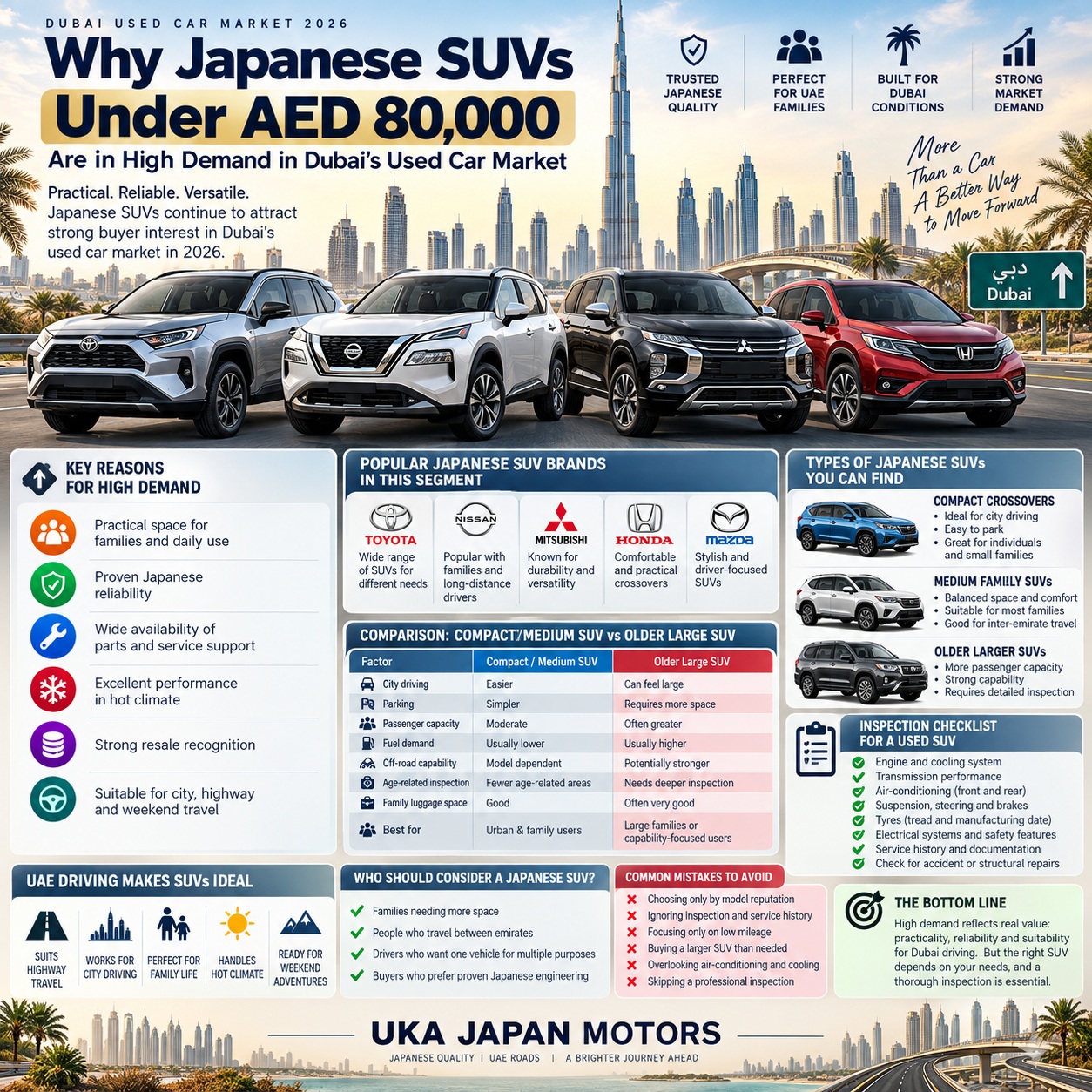
Dubai’s used-car market in 2026 is increasingly shaped by buyers who want practical vehicles rather than simply the newest model or the most impressive specification sheet. One of the clearest examples is the strong interest surrounding Japanese SUVs within the under-AED-80,000 search bracket.
This part of the market brings together several characteristics that Dubai drivers regularly look for: useful cabin space, familiar mechanical systems, established maintenance networks, strong air-conditioning requirements, highway comfort and vehicle types suited to family life.
Toyota, Nissan, Mitsubishi, Honda, Mazda and Subaru all have SUVs or crossovers that can appear within this part of the used market depending on model, age, mileage, specification and condition.
However, the demand is not simply a matter of buyers wanting an SUV carrying a Japanese badge.
The more important development in 2026 is that used-car buyers are becoming increasingly selective about what they receive within a defined buying bracket. They are comparing vehicle condition, maintenance history, specification, fuel consumption, seating capacity, registration readiness and likely long-term usability.
Recent UAE marketplace data supports the broader shift. SUVs remained the preferred vehicle type during the first half of 2026, while Toyota generated more than 10.4 million SUV searches and Nissan attracted about 8.6 million. Separate marketplace reporting also found especially strong consumer interest in vehicles below the AED 100,000 level.
That combination helps explain why Japanese SUVs around and below the AED 80,000 threshold have become such an active part of Dubai’s used-car market.
Direct Answer: Why Are Japanese SUVs Under AED 80,000 So Popular in Dubai?
Japanese SUVs in this segment are attracting demand because they can combine SUV practicality with brands and mechanical platforms that UAE drivers already know well.
For many buyers, the attraction comes from five factors working together:
- Practical cabin and luggage capacity for everyday Dubai life
- Established reputations for durability among major Japanese manufacturers
- Familiarity among UAE workshops and parts suppliers
- A wide selection of compact, medium and older larger SUVs
- Strong buyer recognition when the vehicle eventually returns to the used market
Market observations during 2026 also show particular interest in used crossovers and compact SUVs below AED 80,000, with models such as the Toyota RAV4, Nissan X-Trail and Mitsubishi Outlander appearing among vehicles receiving buyer attention.
Yet there is an important qualification.
A popular Japanese model is not automatically a good used SUV.
At this stage of the market, condition becomes critical. A vehicle with incomplete maintenance records, previous structural damage, overheating history, neglected transmission servicing or questionable mileage can be a weaker ownership proposition than a less fashionable model with transparent history and strong inspection results.
The correct question is therefore not simply:
“Which Japanese SUV can I find under AED 80,000?”
It is:
“Which properly inspected Japanese SUV within my search bracket best matches the way I will actually drive in Dubai?”
That distinction matters.
Why the AED 80,000 Search Bracket Has Become Important in 2026
The under-AED-80,000 category contains an unusually broad mixture of vehicles.
A buyer may encounter relatively recent compact crossovers, older medium SUVs, seven-seat family vehicles and previous-generation four-wheel drives within the same search.
That creates choice, but it also creates complexity.
Two vehicles appearing within the same search filter can have completely different ownership profiles.
One could be a smaller four-cylinder crossover designed mainly for commuting and family transport. Another could be an older body-on-frame SUV designed to tolerate more demanding terrain and heavier use.
Their age, fuel requirements, tyre specifications, cooling loads, suspension designs and maintenance histories may differ considerably.
This is why buyers should treat AED 80,000 as a filter, not as a vehicle category.
The objective should be to find the strongest vehicle inside the filter rather than choosing the largest SUV that happens to appear within it.
That approach is particularly relevant in 2026 because buyers have more information available before visiting a vehicle. Listings can be compared across Dubai, Sharjah, Abu Dhabi and the wider UAE, making differences in mileage, trim, condition and documentation easier to identify.
Recent market tracking also indicates that SUVs represent a particularly large proportion of UAE used-car listings, while Toyota remains one of the most visible brands in available stock.
Greater selection makes inspection more important, not less.
Dubai Driving Makes the SUV Format Particularly Useful
The popularity of SUVs in Dubai makes more sense when viewed through actual ownership patterns.
A single family vehicle may need to handle a school run in the morning, an office commute through Sheikh Zayed Road traffic, supermarket parking in the evening and an inter-emirate journey at the weekend.
The same vehicle may carry adults, children, luggage, shopping or airport baggage.
SUVs and crossovers can accommodate those changing requirements particularly well.
Higher Seating Position
Many drivers prefer the elevated seating position of an SUV when navigating busy multi-lane roads and mixed urban traffic.
This does not automatically make an SUV safer, but the driving position can improve the driver’s view of surrounding traffic depending on vehicle design.
Flexible Cargo Space
Foldable rear seats allow a crossover to move between passenger and luggage duties relatively easily.
For Dubai households that rely on one primary vehicle, flexibility can matter more than maximum vehicle size.
Highway Comfort
Regular travel between Dubai, Abu Dhabi, Sharjah and other emirates means sustained highway driving is normal for many UAE residents.
Wheelbase, seat comfort, cabin insulation, air-conditioning effectiveness and high-speed stability therefore matter alongside city manoeuvrability.
Family Practicality
Rear-seat ventilation, easy child-seat access, door opening angles, luggage space and second-row comfort can matter far more in daily ownership than cosmetic equipment.
This helps medium Japanese SUVs and crossovers maintain strong relevance.
Why Japanese Manufacturers Fit This Demand
Japanese manufacturers have spent decades producing SUVs across very different formats.
That matters because “Japanese SUV” does not describe one engineering philosophy.
Toyota alone has produced everything from compact crossovers to substantial four-wheel drives. Nissan similarly spans city-oriented crossovers, family SUVs and larger off-road-focused vehicles. Mitsubishi has long experience with both family crossovers and traditional 4WD engineering, while Honda and Mazda concentrate heavily on road-oriented crossover usability.
For Dubai buyers, familiarity is another advantage.
Independent garages, specialist workshops, parts suppliers and used-car inspectors regularly encounter popular Japanese models. That does not guarantee straightforward maintenance for every model, but established vehicle populations generally make it easier to find technicians familiar with common systems and known inspection points.
Japanese SUVs also benefit from buyer recognition.
When someone searches for a used RAV4, X-Trail, Outlander, CR-V or similar vehicle, they usually have a reasonable idea of the type of vehicle they are investigating.
That recognition contributes to market liquidity.
In 2026, marketplace data has continued to show particularly strong search activity around Toyota and Nissan SUVs in the UAE.
Which Types of Japanese SUV Appear in This Part of the Market?
Instead of treating every Japanese SUV as interchangeable, buyers should separate them by purpose.
Compact Crossovers
Compact Japanese crossovers suit drivers whose usage is predominantly urban.
Their strengths normally include manageable exterior dimensions, straightforward parking, useful luggage space and comparatively modest mechanical demands.
They make sense for:
- Daily commuting
- Couples and smaller families
- School and nursery runs
- Shopping and urban driving
- Occasional inter-emirate travel
They may be less suitable when a buyer genuinely requires seven seats, substantial luggage capacity or frequent rough-terrain capability.
Medium Family SUVs
This is arguably one of the most relevant categories for Dubai households.
Vehicles such as the Toyota RAV4, Nissan X-Trail, Mitsubishi Outlander, Honda CR-V and Mazda CX-5 illustrate the general format, although actual availability within a particular search bracket depends on age, mileage and condition.
These vehicles usually balance cabin space with dimensions that remain manageable in Dubai parking environments.
The Nissan X-Trail and Mitsubishi Outlander can also attract buyers looking for more family-oriented configurations, depending on model generation and specification.
Older Traditional SUVs
The under-AED-80,000 search can also expose buyers to older examples of larger, more traditional Japanese SUVs.
This is where careful judgement becomes essential.
A larger SUV can initially look more capable because of its size, four-wheel-drive hardware or reputation. But age changes the inspection equation.
Suspension components, cooling systems, driveline seals, rubber components, engine mounts, electronics, air-conditioning systems and previous off-road use all deserve attention.
The better decision is not necessarily the larger vehicle.
It is the vehicle whose condition and engineering match the intended use.
Compact Crossover vs Older Large SUV
This is one of the most useful comparisons a Dubai buyer can make.
| Consideration | Newer Compact/Medium Japanese SUV | Older Larger Japanese SUV |
|---|---|---|
| Dubai commuting | Usually easier | Can feel unnecessarily large |
| Parking | Generally simpler | Requires more space |
| Passenger capacity | Moderate | Often greater |
| Fuel demand | Usually lower | Usually higher |
| Off-road capability | Model dependent | Potentially stronger |
| Age-related inspection | Usually fewer age-related areas | Requires deeper inspection |
| Tyres and suspension | Generally lighter-duty | Larger components may face heavier loads |
| Family luggage | Good | Often very good |
| City manoeuvrability | Strong | More dependent on driver and location |
| Intended buyer | Urban/family user | Large-family or capability-focused user |
Neither side is universally better.
A driver living in an apartment, commuting daily through congested areas and occasionally travelling between emirates may find a medium crossover much more suitable.
A household needing additional seating, substantial cargo capacity or genuine four-wheel-drive ability may reasonably prefer a larger SUV.
The important point is to avoid buying capability that will rarely be used while overlooking the additional inspection demands that can accompany an older vehicle.
Why Condition Matters More Than Model Year
Model year is one of the easiest specifications to compare online.
It is also one of the easiest to overvalue.
A newer SUV with a questionable history can be a much weaker prospect than an older vehicle that has been properly maintained.
Dubai conditions make this particularly important.
Vehicles experience prolonged heat exposure, extensive air-conditioning use and, in some cases, substantial highway mileage. Some SUVs may also have been used in desert environments or on rough tracks.
The buyer therefore needs evidence of how the vehicle has lived.
Service history can reveal regular maintenance patterns.
Inspection can reveal its current mechanical state.
The VIN and supporting documentation can help establish identity and history.
Physical examination can identify evidence that a listing description may not disclose.
Age matters, but verified condition matters more.
The UAE Climate Changes What Buyers Should Inspect
A used SUV should never be assessed only during a short visual walk-around.
Dubai heat places sustained demands on several vehicle systems.
Cooling System
Radiator condition, coolant quality, hoses, fans, expansion tank condition, water-pump evidence and temperature stability all deserve attention.
An SUV that has previously suffered serious overheating can develop problems that are not immediately obvious during a brief inspection.
A proper test should therefore examine operating temperature rather than merely confirming that the engine starts.
Air-Conditioning
Air-conditioning is fundamental to UAE vehicle use.
Check cooling performance at idle as well as while driving.
In multi-row SUVs, rear ventilation performance should also be examined.
Weak cooling can result from several causes, so simply adding refrigerant should not be treated as a diagnosis.
Battery and Charging System
Heat can accelerate battery deterioration.
Battery condition and charging voltage should be checked rather than assuming that a vehicle starting normally means the electrical system is healthy.
Rubber Components
Engine mounts, suspension bushes, hoses, seals, weather strips and other rubber components can deteriorate with age and heat exposure.
Older SUVs deserve particularly careful inspection in these areas.
Tyres
Tyre tread depth is only one consideration.
Manufacturing age, sidewall cracking, uneven wear and mismatched tyres can reveal maintenance or alignment concerns.
Four-wheel-drive vehicles can also be sensitive to significant differences between tyre sizes or rolling circumference.
Imported SUV or GCC-Spec Vehicle?
Dubai’s position as an international vehicle trading centre means buyers may encounter SUVs built for different specifications.
Specification alone should not be treated as proof of quality.
A GCC-specification SUV can still have poor maintenance or accident history.
An imported Japanese SUV can still be mechanically strong and properly documented.
The correct approach is to establish exactly what the vehicle is and inspect accordingly.
Important questions include:
- What specification was the vehicle originally manufactured for?
- Is its VIN clearly identifiable?
- Are import documents available where applicable?
- Does the vehicle meet UAE registration requirements?
- Has it previously been registered locally?
- Are warning lights functioning normally?
- Have any safety systems been altered?
- Is the odometer history consistent with available documentation?
- Are structural repairs visible underneath the vehicle?
Documentation and physical condition should support each other.
If the paperwork tells one story and the vehicle tells another, further investigation is required.
Inspection Should Go Beyond a Basic Road Test
A road test is useful, but it cannot replace a structured inspection.
A Japanese SUV under AED 80,000 may have accumulated years of family use, highway kilometres, commercial use or occasional off-road activity.
Inspection should therefore cover multiple layers.
Body and Structure
Look for inconsistent panel gaps, overspray, unusual welding, altered seam sealer and evidence of structural repair.
Cosmetic paintwork is not automatically a serious problem. Structural damage is different and should be evaluated carefully.
Engine
Check cold-start behaviour where possible.
Listen for abnormal noises and inspect for fluid leaks, cooling-system concerns, smoke and irregular idle.
Transmission
Automatic and continuously variable transmissions should engage correctly and operate smoothly.
Different Japanese SUVs use different transmission designs, so inspection should be model-specific rather than generic.
Suspension and Steering
Bushes, dampers, ball joints, wheel bearings and steering components should be checked.
Uneven tyre wear can provide clues about alignment or suspension condition.
Four-Wheel-Drive System
If the SUV has AWD or 4WD hardware, confirm that the system operates correctly.
Dashboard graphics or badges are not enough.
Where appropriate, inspect differentials, transfer components, driveshafts and related fluids for signs of leakage or neglect.
Electronics
Test cameras, parking sensors, powered seats, windows, mirrors, infotainment, climate controls and driver-assistance systems fitted to the particular vehicle.
Modern SUVs can contain a substantial number of electronic modules.
Why Service History Has Become More Important
Japanese reliability is sometimes misunderstood.
A reliable vehicle is not a maintenance-free vehicle.
Engines still require correct lubricants and service intervals. Transmissions require appropriate maintenance. Cooling systems age. Suspension components wear. Brake fluid deteriorates. Batteries fail. Air-conditioning systems require proper diagnosis.
The reputation of a Toyota, Nissan, Mitsubishi, Honda or Mazda cannot compensate for years of neglected maintenance.
This becomes increasingly important as buyers examine older vehicles within a defined search bracket.
A documented service history provides context.
It can help answer questions such as:
Was the engine maintained consistently?
Were major services performed?
Were recurring problems addressed?
Does recorded mileage progress logically?
Has transmission maintenance been documented where applicable?
A folder of records does not automatically prove perfect condition, but it gives an inspector considerably more information than an unsupported verbal history.
The Fuel-Efficiency Factor Is Changing SUV Demand
Dubai drivers are not abandoning large SUVs, but the SUV market has become more diverse.
Many buyers now realise that they can retain an SUV seating position and flexible cabin without moving into the largest available vehicle.
That has strengthened the appeal of four-cylinder crossovers.
Recent 2026 UAE market analysis has similarly identified movement toward more fuel-efficient crossovers within the broader SUV segment.
The choice should still depend on usage.
A smaller-engine crossover may make excellent sense for a driver spending most of the week commuting within Dubai.
A heavily loaded seven-seat vehicle regularly travelling long distances has different requirements.
Likewise, someone intending to use the vehicle in more demanding terrain should assess drivetrain capability separately from fuel consumption.
Efficiency should be matched to function rather than pursued in isolation.
Why Toyota, Nissan and Mitsubishi Receive So Much Attention
Toyota, Nissan and Mitsubishi have particularly deep SUV histories in the UAE.
That familiarity affects buyer behaviour.
Toyota attracts interest across multiple SUV formats, from road-oriented crossovers to traditional four-wheel drives.
Nissan has a similarly established UAE presence and offers both crossover and larger SUV formats.
Mitsubishi remains relevant because models such as the Outlander and older Pajero have given the manufacturer strong recognition among used-SUV buyers.
Honda and Mazda add alternatives for drivers whose priorities are more road-oriented.
The CR-V and CX-5, for example, represent the crossover approach particularly well: useful ground clearance and cargo flexibility without attempting to behave like traditional heavy-duty off-road vehicles.
The key is not to rank these manufacturers universally.
Each model should be evaluated according to generation, engine, transmission, drivetrain, specification, service history and actual condition.
Why Resale Recognition Still Influences Today’s Purchase
Even buyers planning to keep an SUV for several years often think about future market acceptance.
Dubai is a highly active used-vehicle market. Ownership needs can change because of family requirements, commuting patterns, relocation within the UAE or simply the need for a different vehicle type.
A widely recognised model can therefore be easier for future buyers to understand.
Japanese SUVs benefit from this familiarity.
But resale recognition should never become an excuse to overlook condition.
An SUV with structural repairs, poor maintenance or inconsistent documentation may lose much of the advantage associated with a recognised badge.
The strongest long-term ownership proposition combines:
recognisable model + appropriate specification + transparent history + verified mechanical condition.
Who Should Consider a Japanese SUV in This Segment?
This part of Dubai’s used market can suit several types of driver.
Families who need more luggage room than a sedan may find medium SUVs particularly practical.
Drivers who regularly travel between emirates may appreciate the seating position and highway comfort of a well-designed crossover.
Residents who want one vehicle capable of handling commuting, shopping, family duties and weekend travel may also benefit from the flexibility.
It can additionally suit buyers who deliberately prefer an established mechanical platform rather than selecting a vehicle primarily because it has newer technology.
However, not everybody needs an SUV.
A driver travelling alone almost exclusively in central Dubai may find a sedan or smaller vehicle more convenient.
Likewise, someone purchasing an older large SUV purely for its appearance may discover that its size and maintenance requirements do not correspond to everyday use.
Choose the vehicle around the driving pattern, not the body style around the image.
Common Mistakes When Shopping for a Used Japanese SUV
One mistake is assuming Japanese manufacture guarantees reliability regardless of history.
It does not.
Another is choosing the largest vehicle available inside the search bracket.
Vehicle size should correspond to genuine requirements.
Buyers can also focus too heavily on odometer mileage without examining how that mileage was accumulated or whether it can be verified.
Low displayed mileage with weak documentation deserves scrutiny.
Another mistake is conducting the road test only after the vehicle has already reached operating temperature. A cold start can reveal behaviours that disappear once the engine warms.
Finally, buyers sometimes inspect the engine and body carefully while overlooking air-conditioning, electronics, tyres, suspension and drivetrain systems.
An SUV is a collection of systems. Its condition must be assessed as a whole.
A Better Way to Shortlist Japanese SUVs in Dubai
Begin with use case rather than brand.
Decide whether you need five seats or seven.
Consider how much luggage is normally carried.
Determine whether your driving is predominantly city-based, highway-based or includes genuine off-road use.
Then choose the appropriate SUV category.
After that, shortlist models with suitable engineering and specifications.
Only then should individual vehicles be compared.
For each candidate, examine:
- VIN and vehicle identity
- Specification and registration status
- Service documentation
- Accident and repair evidence
- Engine and cooling condition
- Transmission operation
- Steering and suspension
- Air-conditioning
- Tyres and brakes
- AWD or 4WD operation where fitted
- Electronics and safety systems
- Final inspection findings
This sequence reduces the risk of becoming attached to a particular vehicle before its history has been properly established.
What 2026 Demand Tells Buyers
Strong demand does not mean buyers should rush.
In fact, the opposite lesson is more useful.
When a category becomes popular, vehicles of widely varying quality can enter the market under the same search terms.
The Japanese SUV segment includes carefully maintained family vehicles, high-mileage highway vehicles, older four-wheel drives, imported vehicles and SUVs with very different repair histories.
Marketplace evidence during 2026 shows strong SUV demand, significant Toyota and Nissan search activity and considerable attention around practical used vehicles.
Those trends explain buyer interest.
They do not validate any individual vehicle.
Inspection still decides whether a specific SUV deserves consideration.
How UKA Japan Motors Approaches Japanese Used SUVs
UKA Japan Motors approaches Japanese used SUVs from an inspection and compliance perspective rather than assuming that a vehicle is suitable because of its manufacturer or model reputation.
The objective is to help establish what a vehicle actually is, how its condition compares with its documentation and whether its specification is appropriate for use and registration in the UAE.
For Japanese SUVs, this means paying attention to vehicle identity, import documentation where applicable, visible repair history, mechanical condition, cooling performance, drivetrain operation and other factors that can affect long-term ownership.
This approach is particularly important in the under-AED-80,000 search segment because buyers may be comparing vehicles from different years, specifications and SUV categories.
A younger compact crossover and an older traditional 4WD cannot be evaluated by the same assumptions.
Transparent inspection helps separate model reputation from the condition of the individual vehicle.
Frequently Asked Questions
1. Why are Japanese SUVs under AED 80,000 popular in Dubai in 2026?
They occupy a highly practical part of the used market. Buyers can find crossovers, family SUVs and older traditional SUVs from manufacturers with strong UAE recognition. Their appeal comes from cabin versatility, established mechanical reputations, workshop familiarity and suitability for common Dubai driving patterns.
2. Which Japanese SUV brands are commonly considered by Dubai buyers?
Toyota, Nissan, Mitsubishi, Honda, Mazda and Subaru are among the Japanese manufacturers buyers may encounter. The correct choice depends on the particular model, generation, drivetrain, condition and intended use rather than brand nationality alone.
3. Is a Toyota automatically a better used SUV because of its reliability reputation?
No. Toyota has a strong reputation, but an individual vehicle can still have poor maintenance, accident repairs, overheating history or other problems. Inspection and documentation should determine whether a specific vehicle is suitable.
4. Is a newer compact SUV better than an older large SUV?
Not universally. A newer compact SUV may be more convenient for commuting and parking, while an older large SUV may provide greater passenger capacity or more substantial off-road capability. Condition and actual use requirements should determine the decision.
5. Are imported Japanese SUVs suitable for Dubai?
They can be, provided the vehicle’s specification, condition, documentation and UAE compliance are properly established. Buyers should not assume that either imported or GCC-specification status alone proves vehicle quality.
6. What should I inspect first on a used SUV in Dubai?
Cooling-system condition, air-conditioning performance, structural integrity, engine and transmission behaviour, tyres, suspension and service history deserve particular attention. AWD or 4WD systems should also be tested where fitted.
7. Does low mileage mean a used Japanese SUV is in good condition?
No. Mileage is only one indicator. Maintenance history, accident history, heat exposure, storage, driving environment and mechanical condition can be equally important. Displayed mileage should also be checked against available documentation.
8. Are Japanese crossovers suitable for inter-emirate driving?
Many are. Medium crossovers can provide comfortable highway cruising, practical luggage space and useful family accommodation. Buyers should assess seat comfort, tyre condition, stability, cooling performance and engine suitability for their expected driving pattern.
9. Do I need four-wheel drive for normal Dubai driving?
Usually not simply because the vehicle is an SUV. Drivers whose usage is predominantly paved-road commuting may not require a dedicated four-wheel-drive system. Buyers intending to travel in more demanding terrain should evaluate appropriate drivetrain capability separately.
10. Why is air-conditioning inspection so important?
Dubai’s climate means air-conditioning operates under demanding conditions for much of the year. Weak cooling can indicate faults involving refrigerant charge, compressors, condensers, fans, sensors or other components. Performance should be tested properly rather than judged only by whether cool air initially reaches the cabin.
11. Should I choose an SUV based mainly on resale popularity?
No. Resale recognition is useful, but condition should come first. A popular model with poor history may be a weaker choice than a well-maintained alternative with transparent documentation.
12. What documents should be checked before proceeding with a used SUV?
Vehicle identity and VIN information, available service records, registration documents and relevant import documentation should be reviewed as applicable. The paperwork should correspond with the physical vehicle and its observed condition.
Conclusion
The high demand for Japanese SUVs under AED 80,000 in Dubai during 2026 reflects a broader change in used-car buying behaviour.
SUVs remain highly relevant to UAE driving because they can accommodate family transport, commuting, luggage and inter-emirate travel within one vehicle. Japanese manufacturers strengthen that appeal through established model recognition, familiar engineering and a long presence in the UAE used-car environment.
Current market evidence supports the trend: SUVs continue to dominate buyer attention, Toyota and Nissan are recording substantial search activity, and practical used vehicles are receiving particularly strong consumer interest.
But demand should not be confused with quality.
The AED 80,000 threshold is simply a search boundary. Within it can sit very different vehicles: newer compact crossovers, family-focused medium SUVs and older traditional four-wheel drives. Their suitability depends on what the buyer actually needs.
For predominantly urban use, a well-maintained crossover may make considerably more sense than an older large SUV. For a larger household or a driver requiring genuine capability, the calculation can be different.
In either case, the badge should be the beginning of the assessment rather than the conclusion.
Cooling performance, structural condition, transmission operation, service records, tyre condition, drivetrain health, vehicle specification and UAE compliance all need to support the reputation attached to the model.
That is ultimately why inspection becomes more important as this segment becomes more popular. The objective is not merely to locate a Japanese SUV within a particular search bracket. It is to identify one whose history, engineering and present condition make sense for long-term use in Dubai.
Contact UKA Japan Motors for availability and inspection guidance.