


Understanding Why Interest Has Grown
ULEZ-compliant Japanese used cars have become a major topic of interest across Birmingham in 2026, and the reasons go far beyond emissions regulations alone.
Drivers searching for practical vehicles suited to urban restrictions are increasingly focusing on Japanese imports because many models naturally align with modern compliance requirements while also fitting the realities of city driving.
This interest is not driven by trend alone. It reflects changing ownership priorities.
In Birmingham, where congestion zones, stop-start traffic, motorway commuting, environmental scrutiny, and long-term running suitability all influence buying decisions, many motorists are asking a similar question:
Which vehicles meet clean air expectations without compromising reliability, practicality, or everyday use?
That question has pushed ULEZ-compliant Japanese vehicles into much broader search demand.
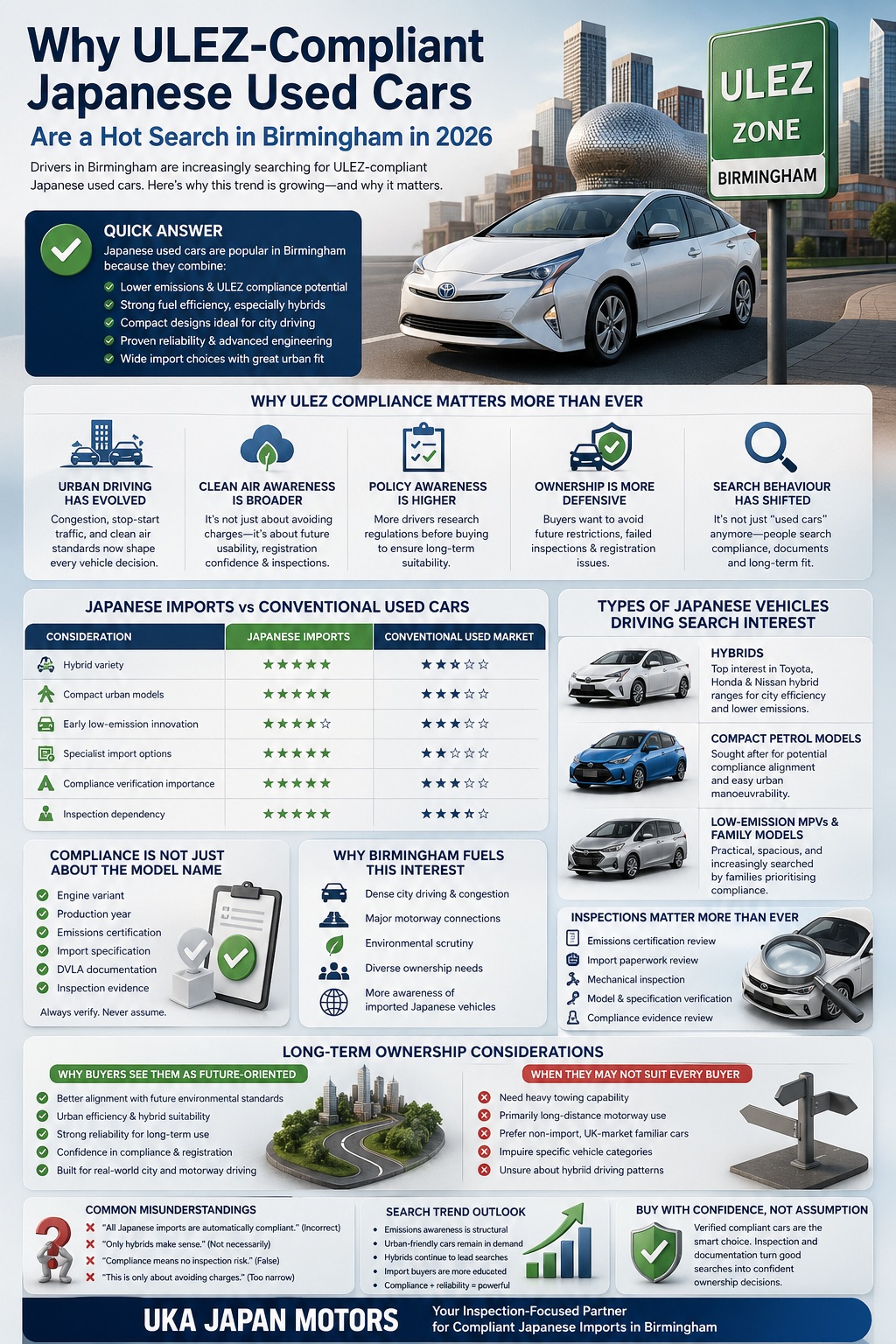
Quick Answer: Why Are They Being Searched So Much?
Japanese used cars that meet ULEZ standards are gaining attention in Birmingham because they often combine:
- Lower emissions compatibility
- Strong urban fuel efficiency, especially hybrids
- Compact but practical designs suited to city roads
- Proven reliability histories
- Advanced emissions technology introduced earlier than many expected
- Strong suitability for Birmingham’s Clean Air and broader low-emission concerns
- Attractive import options for drivers seeking alternatives to mainstream UK stock
The search trend is largely about compliance meeting practicality.
That combination matters.
Why ULEZ Compliance Has Become a Bigger Birmingham Concern
Urban Driving Conditions Have Changed
Driving in Birmingham has evolved.
Congestion through the city centre, ring road traffic patterns, daily commuting routes toward the M6, M42 and A38 corridors, and increasing focus on emissions zones all influence vehicle suitability.
Cars once chosen simply for size or reputation are now often judged through additional questions:
- Will it meet emissions requirements?
- Is it future-resilient?
- Does it suit stop-start urban driving?
- Will inspections or registration present difficulties?
- Does it remain practical for long-term ownership?
These questions have reshaped demand.
Clean Air Awareness Is Broader Than Charges
An important reason searches have grown is that many motorists now view compliance as broader than avoiding charges.
It increasingly relates to:
- Future usability
- Registration confidence
- Environmental standards
- Inspection readiness
- Potential policy tightening
- Urban access reassurance
That has changed how people search for vehicles.
They are not only searching for cars.
They are searching for confidence.
Why Japanese Used Cars Fit This Search Trend
Many Japanese Models Were Early Adopters of Low-Emission Engineering
One reason Japanese vehicles stand out is historical engineering direction.
Many manufacturers placed heavy focus on:
- Efficient petrol engines
- Early hybrid systems
- Cleaner combustion technologies
- Compact lightweight platforms
- Urban-oriented drivetrain development
That legacy matters in 2026.
Some imported models now align surprisingly well with modern compliance expectations.
Hybrid Strength Has Shifted Search Behaviour
Hybrid interest has heavily influenced this trend.
Particularly in Birmingham traffic conditions, hybrids often appeal because:
- Frequent stop-start driving suits regenerative systems
- Lower idling inefficiency can help city usage
- Urban fuel behaviour tends to favour hybrid platforms
- Emissions output may align well with compliance priorities
This has pushed searches beyond traditional “used car” intent into “ULEZ-compliant Japanese hybrid” specific searches.
That is a major shift.
Why Birmingham Drivers Are Looking Specifically at Japanese Imports
Practical Urban Sizing
Birmingham’s mixture of tighter urban routes, residential streets, car parks, and congested retail corridors often favours practical vehicle footprints.
Many Japanese models offer:
- Compact external dimensions
- Excellent turning circles
- Efficient space packaging
- Good visibility
- Easy city manoeuvrability
That makes them relevant beyond emissions.
Reliability Still Matters
Compliance alone does not create long-term ownership confidence.
Reliability still drives search behaviour.
Japanese vehicles continue drawing attention because buyers often associate them with:
- Mechanical durability
- Consistent engineering standards
- Strong inspection histories when sourced correctly
- Longevity in mixed urban and motorway use
That combination strengthens demand.
ULEZ Compliance and Japanese Used Cars: Why It Matters Before Importing
Compliance Is Not Just About Badge or Model Name
A major misconception is assuming a model is compliant simply because another example of that model is.
That can be risky.
Compliance may depend on:
- Engine variant
- Production year
- Emissions certification
- Registration documentation
- Import specification differences
- DVLA documentation alignment
- Inspection evidence
This is why buyers increasingly search for vehicles already understood to fit compliance expectations.
It reduces uncertainty.
Documentation Has Become Part of the Search
Interesting change in 2026:
People are not only searching for cars.
They are searching:
- “ULEZ compliant Japanese imports Birmingham”
- “Japanese imports emissions certificate UK”
- “Can imported hybrids pass ULEZ checks”
- “Best Japanese cars for Birmingham clean air zones”
That shows compliance documentation has become part of vehicle research.
That was far less common before.
Why 2026 Has Accelerated This Search Trend
Policy Awareness Is Higher
More motorists now actively research regulations before changing cars.
That was not always typical.
Today many drivers start with:
“Will this vehicle still make sense years from now?”
That question pushes compliance-focused searches.
Ownership Decisions Have Become More Defensive
Drivers increasingly want to avoid:
- Buying something potentially restricted later
- Importing a vehicle that causes registration issues
- Choosing a model unsuited to urban environmental rules
That defensive ownership thinking has raised interest in compliant Japanese vehicles.
Japanese Imports vs Conventional UK Used Cars for ULEZ-Focused Buyers
Where Japanese Imports Often Appeal
| Consideration | Japanese Imports | Conventional Used Market |
|---|---|---|
| Hybrid variety | Often strong | Varies |
| Compact urban models | Strong | Moderate |
| Early low-emission innovation | Often notable | Mixed |
| Specialist import options | Strong | Limited |
| Compliance verification importance | High | Moderate |
| Inspection dependency | Very important | Important |
This does not make one universally better.
It shows why Japanese imports attract research attention.
Contrast in Buyer Motivation
Traditional used-car searches often focus on:
- Brand
- Mileage
- General reliability
ULEZ-focused Japanese import searches often add:
- Emissions suitability
- Documentation confidence
- Urban compatibility
- Future compliance reassurance
That is a more layered decision.
Which Types of Japanese Vehicles Are Driving Search Interest?
Hybrids
Often central to the trend.
Examples often researched include vehicles from Toyota, Honda and Nissan hybrid ranges.
Reasons:
- Urban suitability
- Efficiency reputation
- Emissions focus
Smaller Petrol Models
Some compact petrol imports are also heavily searched due to potential compliance alignment and city suitability.
Often attractive for Birmingham drivers prioritising manoeuvrability.
Low-Emission MPVs and Practical Family Models
Another growing segment.
Families increasingly search for compliant practicality rather than simply compact city cars.
That has widened demand.
Why Birmingham Specifically Fuels This Interest
Local Driving Realities Support It
Birmingham creates unusual overlap:
- Dense city driving
- Major motorway links
- Commuter congestion
- Environmental scrutiny
- Diverse ownership needs
That often favours efficient, compliant vehicles.
Import Awareness Has Matured
There is also broader awareness around imported Japanese vehicles than in earlier years.
Searches now often include inspection and compliance understanding, not merely curiosity.
That suggests a more informed market.
Inspections Matter More Than Ever
Compliance Should Always Be Verified Properly
This cannot be overstated.
Interest in ULEZ-compliant imports has grown partly because informed buyers now recognise compliance claims should be verified through inspection and documentation.
Checks may involve:
- Emissions certification review
- Import paperwork review
- Registration documentation checks
- Mechanical inspection
- Model specification verification
- Compliance evidence review
This is where informed sourcing matters.
Why Inspection-Focused Buying Has Become Central
The strongest search trend is arguably not just “compliant cars.”
It is:
Verified compliant cars.
That distinction matters.
Long-Term Ownership Considerations
Why Buyers See These Cars as Future-Oriented
Many search interest signals point to long-term thinking.
Drivers are asking:
- Will this remain practical if standards tighten?
- Will urban access remain straightforward?
- Does this suit years of city ownership?
- Is hybrid technology appropriate for my driving pattern?
Those are ownership questions, not trend questions.
When They May Not Suit Every Buyer
Balanced guidance matters.
ULEZ-compliant Japanese imports may not suit everyone.
Some buyers may need:
- Larger motorway-focused vehicles
- Heavy towing capability
- Specific UK-market familiarity
- Simpler non-import ownership routes
Suitability always depends on use.
Compliance alone should not determine the entire decision.
Why This Search Trend Is Likely Continuing
Several forces support continued demand:
1. Emissions Awareness Is Structural
This is unlikely temporary.
2. Urban-Friendly Cars Continue Growing in Relevance
Birmingham conditions support this.
3. Hybrids Remain a Strong Search Driver
Likely ongoing.
4. Import Buyers Are More Educated
Research behaviour has become more sophisticated.
5. Compliance and Reliability Together Are Powerful
This combination is difficult to ignore.
Common Misunderstandings About ULEZ-Compliant Japanese Imports
“All Japanese Imports Are Automatically Compliant”
Incorrect.
Verification matters.
“Only Hybrids Make Sense”
Not necessarily.
Some petrol models may also attract interest depending on specification and compliance evidence.
“Compliance Means No Inspection Risk”
False.
Inspection and documentation still matter greatly.
“This Is Only About Avoiding Charges”
Far too narrow.
For many buyers it is about long-term suitability.
How This Relates to Broader Buyer Education
This topic links naturally to wider questions including:
- Japanese hybrid ownership in Birmingham
- Import emissions documentation
- Clean air zone suitability
- Hybrid vs petrol compliance choices
- Urban-use Japanese models
- Import inspection processes
That is why it sits as both a search trend and a broader buyer education topic.
UKA Japan Motors’ Role in This Process
For many buyers, the challenge is not finding a vehicle advertised as compliant.
It is understanding whether a specific imported vehicle has:
- Correct documentation
- Proper inspections
- Suitable emissions evidence
- Long-term ownership practicality
- Registration confidence
That is where inspection-focused guidance matters.
An informed import process should always prioritise verification over assumptions.
Especially with compliance-sensitive vehicles.
Frequently Asked Questions
1. Why are ULEZ-compliant Japanese cars searched so much in Birmingham?
Because they combine emissions suitability, urban practicality, reliability, and growing policy awareness.
2. Are Japanese hybrids driving most of this interest?
They form a major part of it, particularly for city-focused drivers.
3. Does ULEZ compliance automatically apply to all imported Japanese cars?
No. It depends on vehicle-specific emissions and documentation.
4. Why does Birmingham create strong demand for these cars?
Urban congestion, clean air concerns, and motorway-city mixed driving all contribute.
5. Are compact Japanese imports especially popular for this reason?
Often yes, because they pair compliance interest with urban practicality.
6. Is documentation important when checking compliance?
Extremely important. Compliance assumptions can be risky without verification.
7. Are these searches mainly about avoiding charges?
Not solely. Long-term usability is a major driver.
8. Should inspection matter even if a car appears compliant?
Yes. Inspection and paperwork checks remain essential.
9. Are hybrids always the best option for Birmingham drivers?
Not universally. Driving patterns should determine suitability.
10. Is this likely a temporary trend?
Current evidence suggests it reflects broader ownership shifts rather than short-term interest.
Conclusion
ULEZ-compliant Japanese used cars are a hot search in Birmingham in 2026 because they sit at the intersection of several major ownership priorities:
Compliance.
Urban practicality.
Reliability.
Future suitability.
Inspection confidence.
That combination is rare, and it explains the growing attention.
The trend is not simply about regulations.
It reflects a deeper shift in how Birmingham drivers evaluate what makes a sensible vehicle for modern ownership.
And that shift appears increasingly structural rather than temporary.
Contact UKA Japan Motors for availability and inspection guidance.