


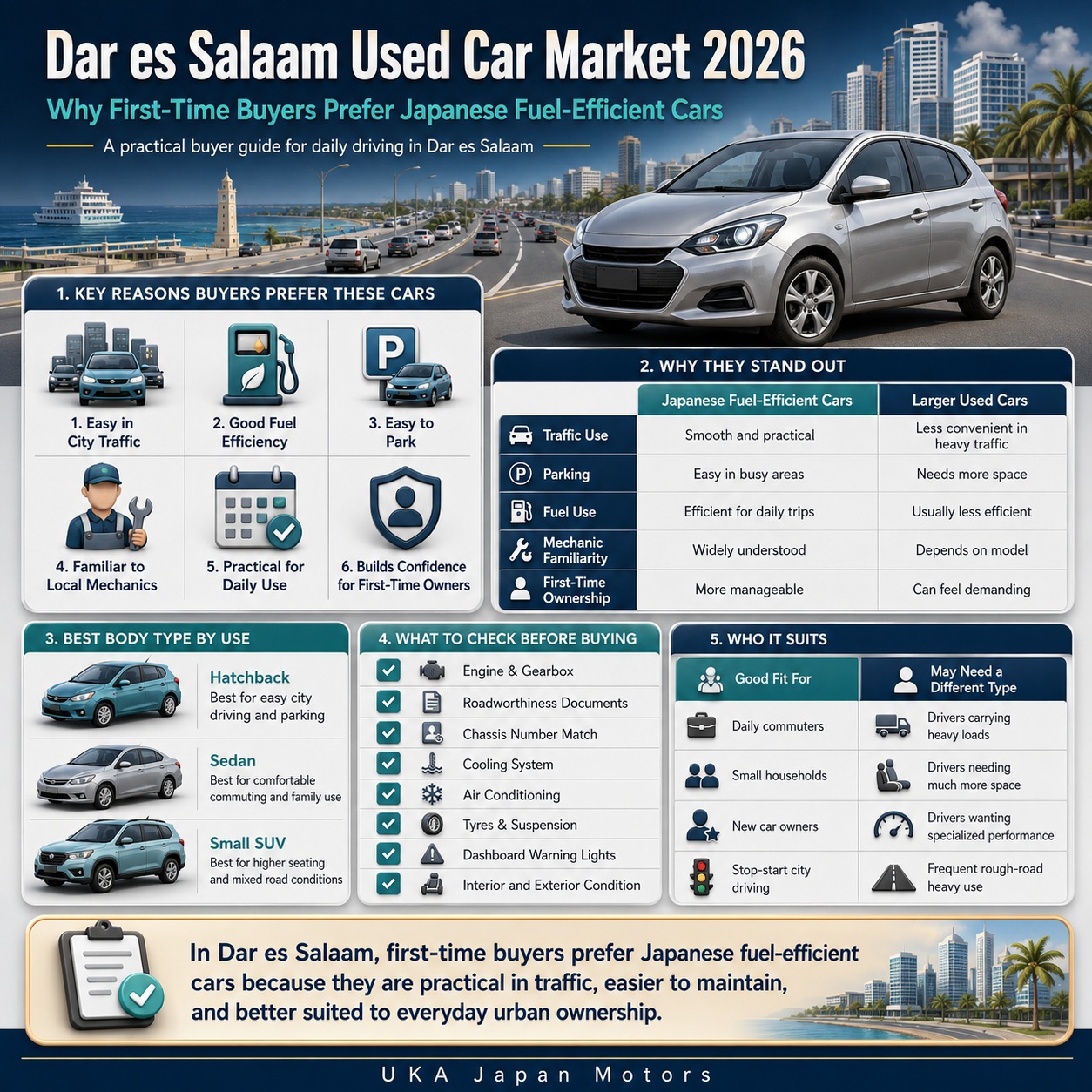
Dar es Salaam’s used car market in 2026 is shaped by practical decisions rather than impulse buying. For many first-time buyers, the main question is not simply which car looks modern or has attractive features. The real concern is whether the vehicle can handle daily traffic, changing road conditions, humid coastal weather, inspection requirements, and long-term ownership without becoming difficult to manage.
This is why Japanese fuel-efficient cars continue to stand out among first-time buyers in Dar es Salaam. They match the way many people actually use vehicles in the city: short daily trips, slow-moving traffic, school runs, office commutes, weekend family movement, and occasional travel toward nearby towns. A first car must be easy to understand, simple to maintain, comfortable in traffic, and predictable over time.
In 2026, buyers are also more careful about documentation, inspection history, roadworthiness, fuel consumption, engine size, and parts availability. A used car is no longer judged only by appearance. Buyers want to know how the vehicle was graded, whether the mileage appears consistent with its condition, whether the engine and transmission behave properly, and whether it can be registered without avoidable complications. Imported used vehicles are closely connected to inspection and roadworthiness processes, and Tanzania’s trade guidance includes procedures for obtaining a roadworthiness certificate for used motor vehicles.
For first-time buyers in Dar es Salaam, Japanese fuel-efficient cars often feel like the safest learning point in car ownership. They are familiar on local roads, widely understood by mechanics, and available in body styles that fit different lifestyles. Compact hatchbacks, small sedans, and fuel-conscious family vehicles are especially common because they suit city driving while still offering enough comfort for everyday use.
Direct Answer: Why First-Time Buyers Prefer Japanese Fuel-Efficient Cars in Dar es Salaam
First-time buyers in Dar es Salaam prefer Japanese fuel-efficient used cars because they fit the city’s daily driving reality. They are easier to manage in traffic, generally simple to inspect, familiar to local technicians, and practical for long-term ownership. Their engines are usually modest in size, their parts knowledge is widespread, and their driving behavior suits urban roads, parking limitations, and stop-start movement.
The preference is also influenced by confidence. A first-time buyer wants a car that does not feel overly complex. Many Japanese models have predictable controls, manageable dimensions, and service routines that local garages understand well. When supported by proper inspection, verified documentation, and roadworthiness checks, these vehicles give new owners a clearer starting point.
In simple terms, first-time buyers are not only buying a car. They are buying their first ownership experience. Japanese fuel-efficient cars often make that experience less confusing.
Why Dar es Salaam Creates a Different Kind of Used Car Buyer
Dar es Salaam is not a city where a vehicle is used in one simple pattern. A car may spend one hour moving slowly through traffic, another hour parked under coastal heat, and the next day carrying passengers through mixed road surfaces. Areas with heavy commercial movement, residential expansion, and busy junctions place different demands on a vehicle.
This matters because first-time buyers usually have limited ownership experience. They may know how to drive, but they may not yet understand how much daily city use affects tyres, suspension parts, cooling systems, air conditioning, brakes, and transmission behavior. Dar es Salaam teaches car owners quickly. A vehicle that looks attractive but struggles in traffic can become frustrating.
Fuel-efficient Japanese cars match this environment because many are built around moderate engine output, light body weight, and easy drivability. In a city where traffic flow changes throughout the day, smooth acceleration and predictable braking are more useful than unnecessary power. First-time buyers often realize that a car does not need to be large to be useful in Dar es Salaam.
Humidity is another local factor. Coastal conditions can affect paint, rubber seals, electrical contacts, underbody areas, and cabin materials. A used car should therefore be inspected beyond the surface. Clean paint alone is not enough. Buyers need to check for corrosion signs, engine bay condition, door seals, undercarriage condition, and evidence of poor repairs.
What “Fuel-Efficient” Really Means for First-Time Buyers
Fuel efficiency is often misunderstood. It is not only about how little fuel a car uses. For a first-time buyer, fuel efficiency means the car’s engine, transmission, weight, tyres, and driving pattern work together sensibly.
A small engine does not automatically guarantee good fuel behavior. If the engine is poorly maintained, if the transmission slips, if the tyres are incorrect, or if the oxygen sensors and air intake system are neglected, the car may consume more fuel than expected. A fuel-efficient Japanese car only remains efficient when it is mechanically healthy.
In Dar es Salaam, stop-start traffic places special pressure on fuel systems and cooling systems. Cars spend long periods idling. Air conditioning is used frequently. Short trips may prevent the engine from operating at ideal conditions for long periods. This is why first-time buyers should focus on condition, not only engine size.
A truly suitable fuel-efficient used car should have:
A clean idle
Smooth gear changes
Stable engine temperature
Responsive braking
No warning lights
Consistent acceleration
Proper tyre size
Clean service indicators
A well-functioning air conditioning system
For new owners, these details matter because they affect everyday confidence. A car that behaves calmly in traffic is easier to trust.
Why Japanese Cars Dominate First-Time Buyer Shortlists
Japanese fuel-efficient cars are popular among first-time buyers in Dar es Salaam because they are familiar. Familiarity reduces uncertainty. Buyers see these cars daily on the road, mechanics understand many common models, and spare parts knowledge is widely available across the city.
This does not mean every Japanese used car is automatically a good choice. Condition still matters more than brand origin. A poorly maintained vehicle can disappoint regardless of its reputation. However, many Japanese models have earned buyer confidence because they balance simplicity, comfort, and daily usability.
First-time buyers often look at vehicles such as compact hatchbacks, small sedans, and practical family models because they are easier to park, easier to maneuver, and less intimidating in city traffic. These cars also suit mixed use: commuting during the week, visiting family, and occasional longer movement toward places such as Morogoro or Dodoma.
The preference is not only mechanical. It is emotional too. A first-time buyer wants a car that feels understandable. Japanese fuel-efficient models often have simple cabin layouts, predictable controls, good visibility, and comfortable driving positions. These qualities help new owners build confidence.
Compact Cars vs Larger Cars for First-Time Buyers
A common decision in the Dar es Salaam used car market is whether to start with a compact fuel-efficient car or move directly into a larger vehicle. The answer depends on lifestyle, driving confidence, passenger needs, and road use.
Compact cars are usually better for buyers who drive mostly within the city. They are easier to park in busy areas, easier to control in traffic, and often more manageable for daily errands. A compact hatchback or small sedan can be ideal for a new owner who mainly moves between home, work, school, shops, and family visits.
Larger cars may suit buyers who regularly carry more passengers, travel outside the city more often, or need more luggage space. However, larger vehicles demand more confidence in traffic, more attention during parking, and more careful inspection of suspension, tyres, brakes, and engine condition.
The comparison is not about one being better than the other. It is about suitability. For many first-time buyers, a compact Japanese fuel-efficient car provides the right learning curve. It allows the owner to understand maintenance routines, driving habits, and documentation responsibilities before moving to a more demanding vehicle later.
Sedan, Hatchback, or Small SUV: Which Makes Sense?
First-time buyers in Dar es Salaam commonly compare three body types: hatchbacks, sedans, and small SUVs.
A hatchback is practical for city movement. It is easy to park, usually has good visibility, and works well for daily errands. It suits individuals, small households, and buyers who mostly drive in urban areas.
A sedan offers more cabin separation and often feels more comfortable for office commutes or family movement. It may provide a more stable feel on longer roads, especially when properly maintained. Buyers who need a more formal-looking daily car often consider sedans.
A small SUV gives a higher seating position and more ground clearance. This can be useful where road surfaces vary or where drivers prefer better road visibility. However, first-time buyers should inspect suspension condition carefully because raised vehicles can hide wear if they have been used heavily.
The best choice depends on where the buyer drives most often. A person moving daily through central Dar es Salaam traffic may prefer a hatchback or compact sedan. A family frequently moving between residential areas and uneven access roads may prefer a small SUV, provided the inspection confirms good condition.
Why 2026 Buyers Are More Inspection-Aware
The 2026 first-time buyer is more cautious than previous generations of used car buyers. Many buyers now understand that a car can look clean while hiding accident repairs, odometer concerns, engine wear, or transmission issues. Online listings and yard displays may show the attractive side of a vehicle, but proper inspection reveals whether it is suitable for long-term use.
Tanzania’s vehicle registration process requires formal steps, and TRA notes that registration applications must be made to the authority by the owner with required documentation. For used imported vehicles, roadworthiness is especially important because inspection status can affect the buyer’s confidence before registration and daily use.
A good inspection should not be rushed. First-time buyers should review:
Auction or export documents where available
Chassis number consistency
Engine condition
Transmission response
Suspension noise
Brake feel
Tyre condition
Paint uniformity
Interior wear
Warning lights
Air conditioning performance
Roadworthiness documentation
This process protects the buyer from relying only on appearance. It also helps identify whether the car suits Dar es Salaam’s daily driving conditions.
Compliance Matters Before Ownership Begins
Compliance is one of the most important subjects for first-time buyers because many new owners focus only on choosing the vehicle and forget the paperwork path. A used car must match documentation requirements, roadworthiness expectations, and registration procedures before it becomes a reliable ownership decision.
The Tanzania Bureau of Standards handles conformity assessment for categories of imported goods, including inspection-related processes. Guidance on destination inspection for used vehicles indicates that a vehicle may need inspection and a Certificate of Road Worthiness before registration by TRA, depending on the inspection route.
For first-time buyers, the lesson is simple: do not separate the car from its documents. A mechanically attractive car with unclear paperwork can create avoidable stress. A properly documented vehicle with verified inspection status gives the buyer a clearer path.
Important compliance checks include:
Matching chassis details
Valid inspection pathway
Roadworthiness documentation
Import and clearance consistency
Registration readiness
Accurate vehicle identity
No unexplained document gaps
This is especially important in Dar es Salaam because many imported vehicles enter through the city’s major logistics channels before reaching buyers. Documentation discipline helps the buyer avoid confusion later.
The Role of Engine Size in First-Time Buying Decisions
Engine size is one of the first things many Dar es Salaam buyers discuss, but it should be understood carefully. A smaller engine may suit daily city use because it can be easier to manage in traffic and less demanding for a new driver. However, engine condition is more important than engine size alone.
A well-maintained moderate engine is better than a neglected small engine. First-time buyers should listen for rough idling, delayed acceleration, overheating signs, smoke, vibration, and unusual smells. The cooling system deserves close attention because Dar es Salaam’s heat and traffic can reveal weaknesses quickly.
For city-focused buyers, moderate engine sizes usually make practical sense. They offer enough response for daily driving without making the car feel difficult to control. For buyers who carry passengers often or travel beyond the city more regularly, a slightly stronger engine may feel more comfortable, but it must still be inspected carefully.
Hybrid Cars and First-Time Buyers
Hybrid vehicles are increasingly discussed by Dar es Salaam buyers, especially those who care about fuel efficiency. A hybrid can be suitable for city traffic because it is designed to manage low-speed movement efficiently. However, a hybrid is not automatically the right first car for every buyer.
A first-time buyer considering a hybrid should understand battery health, diagnostic checks, cooling systems, dashboard warning indicators, and model-specific maintenance. Hybrid inspection requires more than a basic visual check. The buyer should confirm that technicians can evaluate the system properly and that the vehicle’s electronic components are functioning as expected.
For some first-time buyers, a non-hybrid fuel-efficient Japanese car may be simpler to begin with. For others, a properly inspected hybrid may be a good match for heavy city use. The right answer depends on confidence, inspection access, and long-term ownership expectations.
A helpful internal link for this topic would be: Hybrid Cars in Tanzania: What First-Time Buyers Should Check Before Importing.
Why Condition Matters More Than Mileage Alone
Mileage is important, but it should never be judged alone. A car with lower mileage can still have hidden issues if it was poorly maintained, repaired badly, or stored in harsh conditions. A car with higher mileage may still perform well if its maintenance history is clear and its mechanical systems remain healthy.
First-time buyers often focus too much on the number shown on the dashboard. A better approach is to compare mileage with physical evidence. Seat wear, steering wheel condition, pedal wear, engine bay cleanliness, suspension feel, and service records can reveal whether the mileage appears consistent.
In Dar es Salaam, where many cars spend time in traffic, engine hours may matter as much as distance. A vehicle can have modest mileage but still experience long periods of idling. This affects cooling systems, engine mounts, air conditioning components, and fuel behavior.
Mileage should be treated as one part of the inspection, not the whole story.
Daily Ownership in Dar es Salaam
Owning a first car in Dar es Salaam is a daily learning experience. Drivers quickly understand the importance of tyre pressure, brake condition, engine temperature, fuel quality, parking safety, and regular servicing. A suitable first car should make these lessons manageable.
Fuel-efficient Japanese cars often support daily ownership because their service routines are familiar. Many models have straightforward maintenance needs, and mechanics commonly understand their common issues. This makes it easier for new owners to identify problems early.
Daily ownership considerations include:
How the car behaves in traffic
How easily it parks
How comfortable it feels with air conditioning on
How stable it feels on uneven roads
How easy it is to inspect and service
How available technical knowledge is locally
How predictable the engine and gearbox feel
The first car should not overwhelm the owner. It should help the owner build good habits.
Common Mistakes First-Time Buyers Should Avoid
The most common mistake is choosing appearance over condition. A shiny exterior, clean seats, and polished tyres can create confidence too quickly. First-time buyers should remember that the most important parts of a car are often not visible at first glance.
Another mistake is ignoring documentation until late in the process. Buyers should confirm inspection status, vehicle identity, and registration readiness early. A car should not be treated as suitable until its paperwork and physical condition both make sense.
Some buyers also choose a vehicle that does not match their actual use. A larger car may look attractive, but if the buyer mostly drives through dense traffic and limited parking areas, it may become inconvenient. A very compact car may be easy in town but may not suit a family that regularly carries passengers and luggage.
A final mistake is skipping a proper test drive. A car should be driven long enough to observe gear changes, braking, steering, temperature behavior, air conditioning performance, and dashboard warnings.
What First-Time Buyers Should Inspect Before Choosing a Fuel-Efficient Japanese Car
A proper inspection should be systematic. It should not depend only on a quick look around the car.
Start with the exterior. Check paint consistency, panel gaps, headlight alignment, door closing feel, windscreen condition, and signs of previous repair. Uneven paint or misaligned panels may suggest accident history.
Move to the interior. Check dashboard lights, seat wear, air conditioning, infotainment controls, windows, mirrors, and cabin smell. A damp smell may suggest leakage or poor storage.
Inspect the engine bay. Look for oil leaks, coolant stains, worn belts, weak mounts, unusual noises, and signs of overheating. The engine should idle smoothly and respond cleanly.
Check the transmission. Whether automatic or manual, the gear changes should feel smooth and predictable. Delays, jerks, slipping, or harsh engagement should be investigated.
Review tyres and suspension. Uneven tyre wear may point to alignment issues, suspension wear, or previous impact. Listen for knocking sounds during the test drive.
Confirm documents. Chassis details should match records. Roadworthiness and import-related documents should be reviewed carefully.
How Dar es Salaam Roads Influence Car Choice
Dar es Salaam has a mix of paved roads, busy junctions, residential access roads, and areas where surfaces may change quickly. A first-time buyer should choose a car that can handle this variety without being uncomfortable or fragile.
Ground clearance matters, but it should not be the only factor. Suspension health, tyre condition, wheel size, and driving style also matter. A compact Japanese car with healthy suspension can be more comfortable than a larger car with worn components.
Traffic also influences car choice. Smooth automatic transmissions are popular because they reduce driver fatigue in stop-start movement. However, the transmission must be inspected carefully. A fuel-efficient car loses its advantage if the gearbox is poorly maintained.
Parking is another factor. Dar es Salaam’s busy commercial and residential areas can make large vehicles harder for new drivers. A compact car can reduce stress while the driver builds confidence.
Who Should Choose a Japanese Fuel-Efficient Used Car?
A Japanese fuel-efficient used car may suit:
A first-time car owner
A daily commuter in Dar es Salaam
A small household
A driver who spends much time in traffic
A buyer who wants easy maneuverability
A buyer who values simple maintenance routines
A driver who wants a practical learning vehicle
A family needing reliable daily movement
It may not be suitable for every buyer. Someone who regularly carries heavy loads, drives on rough access routes, or needs more passenger space may require a different type of vehicle. A buyer who wants advanced performance or specialized capability may also need to look beyond compact fuel-efficient models.
The key is matching the vehicle to real use, not imagined use.
Internal Reading Connections
This article naturally connects with several supporting topics that would help first-time buyers understand the Dar es Salaam market more clearly:
Used Car Inspection Checklist for First-Time Buyers in Tanzania
This would support buyers who need a step-by-step inspection process before choosing a vehicle.
Japanese Hatchbacks vs Sedans in Dar es Salaam: Which Fits Daily Driving Better?
This would help buyers compare body types based on city use.
Understanding Roadworthiness for Imported Used Cars in Tanzania
This would explain inspection and registration readiness in more detail.
Hybrid or Petrol Car for Dar es Salaam Traffic: What Buyers Should Know
This would support buyers comparing fuel-efficient technology choices.
How to Read Auction Sheets Before Buying a Japanese Used Car
This would help buyers understand grading, repair notes, and condition indicators.
UKA Japan Motors’ Role in the First-Time Buyer Journey
UKA Japan Motors’ role is to help buyers approach used car selection with clarity, inspection awareness, and compliance discipline. The first-time buyer needs more than a vehicle list. They need guidance on condition, documentation, roadworthiness, and suitability for local use.
A responsible buying process looks at the car from multiple angles. It considers whether the model fits Dar es Salaam traffic, whether the engine and transmission are healthy, whether the documentation is consistent, and whether the buyer understands long-term ownership needs.
UKA Japan Motors supports this process through an inspection-focused and transparent approach. The aim is not to push buyers toward the largest or most visually impressive vehicle. The aim is to help buyers understand what they are choosing and why it fits their daily life.
For first-time buyers, this matters because confidence comes from verified information. A buyer who understands the vehicle’s condition, compliance path, and ownership expectations is better prepared for responsible use.
FAQ: Dar es Salaam Used Car Market 2026 and Japanese Fuel-Efficient Cars
1. Why are Japanese fuel-efficient cars popular with first-time buyers in Dar es Salaam?
They are popular because they suit daily city driving, are familiar to local mechanics, and are generally easy for new owners to understand. Many models are compact, practical, and comfortable in traffic.
2. Is a small engine always better for a first-time buyer?
Not always. A small engine can be practical, but condition matters more. A poorly maintained small engine may perform worse than a well-maintained moderate engine.
3. Should first-time buyers choose a hatchback or sedan?
A hatchback suits buyers who need easy parking and city maneuverability. A sedan may suit buyers who want more cabin comfort and a more stable feel for daily commuting or family use.
4. Are hybrid cars suitable for first-time buyers in Dar es Salaam?
They can be suitable if properly inspected. Buyers should confirm battery health, dashboard warning status, cooling system condition, and diagnostic results before choosing a hybrid.
5. What documents should a buyer check before choosing a used car?
Buyers should check vehicle identity details, inspection documents, roadworthiness status, import records, and registration readiness. The chassis number should match the documents.
6. Is mileage the most important factor when buying a used car?
No. Mileage is important, but it should be compared with physical condition, service history, engine behavior, interior wear, and inspection results.
7. Why does Dar es Salaam traffic affect fuel efficiency?
Stop-start movement, idling, frequent air conditioning use, and short trips can affect fuel behavior. A well-maintained car performs better in these conditions than one with neglected systems.
8. What should be checked during a test drive?
The buyer should check acceleration, braking, steering feel, gear changes, engine temperature, dashboard warning lights, suspension noise, and air conditioning performance.
9. Can a larger vehicle be a good first car?
Yes, if it matches the buyer’s lifestyle and the driver is comfortable managing its size. However, larger vehicles require more attention during parking, traffic movement, and inspection.
10. Why is roadworthiness important before ownership?
Roadworthiness helps confirm that the vehicle meets safety and inspection expectations before registration and daily use. It also gives the buyer more confidence in the vehicle’s condition.
11. Are all Japanese used cars reliable?
No. Reliability depends on condition, maintenance, inspection history, and how the car was used. A Japanese model with poor maintenance can still create problems.
12. What is the best first step for a first-time buyer?
The best first step is to define daily use clearly. The buyer should know where the car will be driven, how often it will carry passengers, and what level of maintenance complexity they are comfortable with.
Conclusion
The Dar es Salaam used car market in 2026 reflects a more careful and informed first-time buyer. People are not only asking which car is attractive; they are asking which car fits city traffic, local climate, inspection requirements, documentation needs, and long-term ownership.
Japanese fuel-efficient cars remain a strong preference because they match the practical rhythm of Dar es Salaam life. They are manageable in traffic, familiar to technicians, and available in body styles that suit different households and driving patterns. Their value for first-time buyers comes from simplicity, predictability, and suitability rather than appearance alone.
Still, buyers must avoid assuming that every fuel-efficient Japanese car is automatically the right choice. The best decision comes from matching the car to daily use, confirming mechanical condition, reviewing documentation carefully, and understanding compliance requirements before ownership begins.
A first car should build confidence. It should help the owner learn responsible maintenance, safe driving habits, and proper documentation discipline. For many Dar es Salaam buyers, a well-inspected Japanese fuel-efficient used car provides that balanced starting point.
Contact UKA Japan Motors for availability and inspection guidance.