


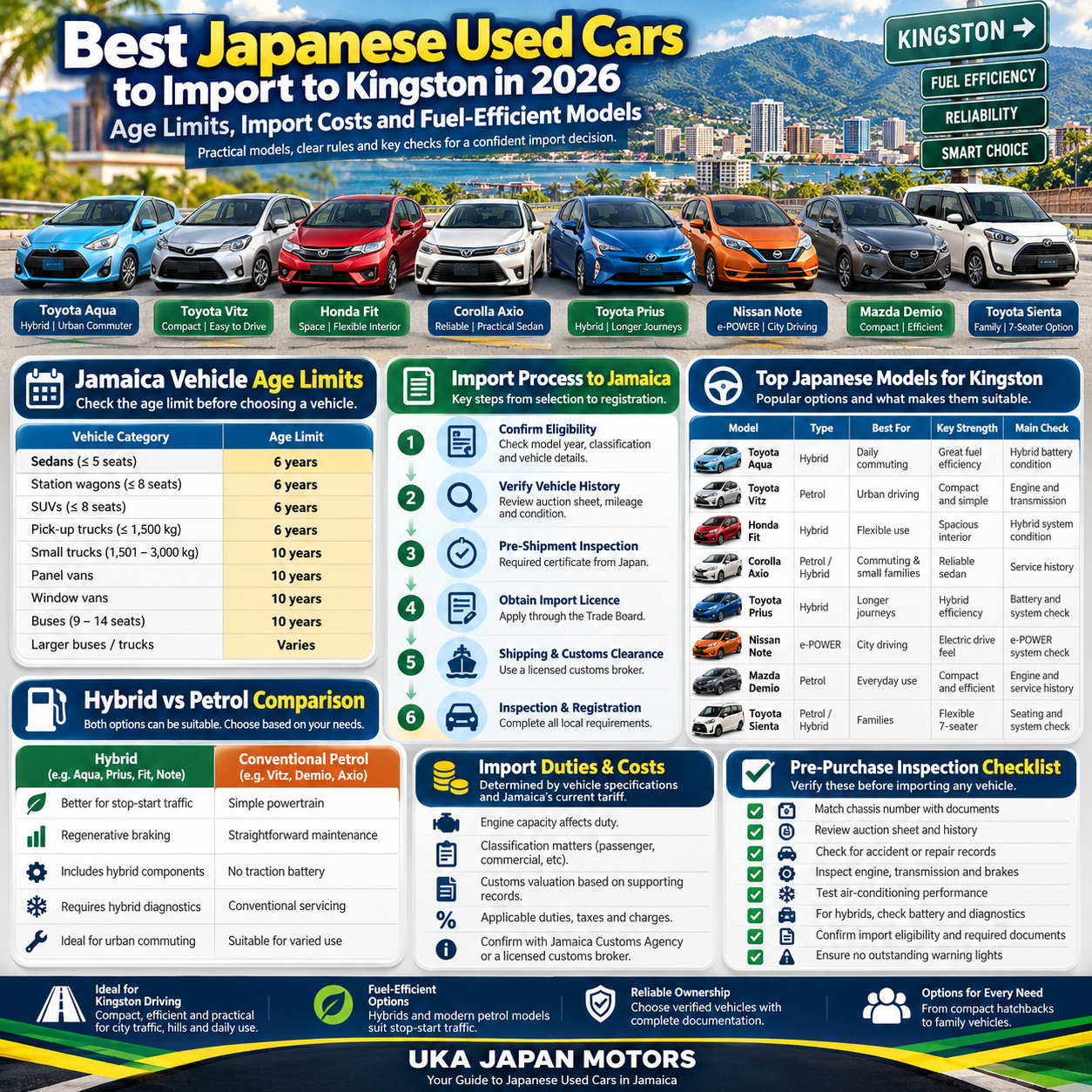
Introduction: Choosing the Right Japanese Used Car for Kingston
Importing a used Japanese vehicle can give Jamaican motorists access to a broad selection of compact hatchbacks, sedans, hybrid cars, family vehicles and practical vans. However, selecting the right vehicle involves more than comparing specifications or choosing a model known for fuel efficiency.
For drivers in Kingston and the surrounding communities, a vehicle must cope with congested roads, frequent stops, warm weather, heavy rainfall, uneven road surfaces and the demands of daily commuting. A car that performs well during a short inspection may still present problems if its maintenance history is incomplete, its hybrid battery has deteriorated or its mechanical condition has been affected by previous use.
Import eligibility is equally important. Jamaica applies age restrictions to imported motor vehicles, and used vehicles from designated countries are subject to pre-shipment inspection requirements. Importers must also arrange the appropriate licence, supporting documents, customs clearance and registration procedures before the vehicle can be used legally on public roads.
This guide examines Japanese used cars that are worth considering for Kingston motorists in 2026, explains the relevant import rules and outlines how to assess fuel efficiency, reliability and long-term suitability.
The central principle is straightforward: choose a vehicle that is eligible for importation, independently verifiable, mechanically sound and appropriate for the way it will actually be driven in Jamaica.
Quick Answer: Which Japanese Used Cars Should Kingston Buyers Consider?
The most suitable model depends on the number of passengers, daily distance, driving conditions, luggage requirements and willingness to maintain a hybrid system.
| Vehicle | Main advantage | Best suited to | Main consideration |
|---|---|---|---|
| Toyota Aqua Hybrid | Compact dimensions and hybrid operation | Daily commuting and urban driving | Hybrid battery condition and ground clearance |
| Toyota Vitz | Small footprint and straightforward urban use | Individual motorists and small households | Engine specification and cabin space |
| Honda Fit Hybrid | Flexible cabin and practical interior | Commuters needing adaptable storage | Hybrid-system condition and transmission history |
| Toyota Corolla Axio | Conventional sedan layout | Regular commuting and small families | Rear-seat space and exact powertrain |
| Toyota Prius | Hybrid efficiency with a larger cabin | Frequent commuting and longer journeys | Battery health and system diagnostics |
| Nissan Note e-POWER | Electrically driven wheels with a petrol engine generating electricity | Stop-start urban driving | System-specific servicing and diagnostics |
| Mazda Demio | Compact hatchback format | Everyday driving and parking in busy areas | Engine, transmission and service history |
| Toyota Sienta | Flexible seating and family practicality | Households needing additional passenger capacity | Seating configuration and vehicle classification |
These are candidates to investigate, not blanket endorsements. A particular example may be unsuitable because of its age, accident history, mechanical condition, missing documents or import classification.
Before selecting any model, confirm its eligibility under the rules in force when it will be imported.
1. Understand Jamaica’s Vehicle Age Limits Before Selecting a Car
One of the most important early decisions is determining whether a particular vehicle meets Jamaica’s import-age requirements.
The Jamaica Customs Agency publishes age limits by vehicle category. The Trade Board Limited also provides guidance on import licensing and the vehicle-import process. The published framework distinguishes passenger cars from different classes of commercial vehicles. <Cite refs={[“turn838598search0″,”turn838598search1”]}/>
Published age limits for commonly encountered vehicle categories
| Vehicle category | General age limit at importation |
|---|---|
| Sedans with seating for no more than five people | 6 years |
| Station wagons with seating for no more than eight people | 6 years |
| SUVs with seating for no more than eight people | 6 years |
| Pick-up trucks with an unladen weight not exceeding 1,500 kg | 6 years |
| Certain small trucks weighing 1,501–3,000 kg unladen | 10 years |
| Panel vans | 10 years |
| Window vans | 10 years |
| Buses with seating for 9–14 people | 10 years |
| Larger commercial buses | Varies by seating capacity |
| Trucks above 3,000 kg unladen | Varies by weight category |
Source: Jamaica Customs Agency and Trade Board Limited published vehicle-age guidance. <Cite refs={[“turn838598search0″,”turn838598search1”]}/>
The table is a general guide, not a substitute for an eligibility decision on a specific vehicle. Classification, seating capacity, unladen weight and any applicable exceptions must be confirmed.
What does the six-year limit mean for a passenger car?
Most conventional Japanese passenger cars considered in this guide fall within the six-year category. This includes typical examples of the Toyota Aqua, Toyota Vitz, Honda Fit, Toyota Prius and Toyota Corolla Axio, subject to their actual classification.
For a vehicle being considered in 2026, its model year alone is not sufficient proof of eligibility. The relevant manufacturing or registration information, the date of importation and the Trade Board’s applicable interpretation must be checked.
Do not assume that a car is eligible simply because a seller describes it as a 2020, 2021 or 2022 model. Confirm the exact production details and required documents before making a commitment.
Why classification matters
A passenger vehicle and a commercial vehicle can fall under different age limits even when their body styles appear similar.
For example, a compact passenger car may have a different import-age allowance from a van or small truck. Seating capacity and unladen weight can affect classification, so the appearance of a vehicle should never be the sole basis for determining its eligibility.
Returning residents may be permitted to import vehicles up to ten years old under the published guidance, but this does not automatically provide an exemption from other import requirements or grant a duty concession. <Cite refs={[“turn838598search0″,”turn838598search7”]}/>
Practical rule: establish the vehicle’s eligibility before arranging shipment. Importing a vehicle first and investigating its eligibility afterwards creates avoidable complications.
2. The Import Process: What Must Be Arranged Before Shipping?
Choosing a vehicle is only one part of the import process. A used Japanese vehicle must have the necessary documentation and meet the applicable inspection and licensing requirements.
The Jamaica Customs Agency identifies the import licence, ownership or export documentation, shipping documents, supplier invoice, applicable tax-compliance documentation and customs declarations among the relevant requirements. It also states that used vehicles must receive the required pre-inspection certificate from the country of export. <Cite refs={[“turn838598search2″,”turn838598search6”]}/>
Step 1: Confirm the vehicle’s eligibility
Obtain the information needed to establish the vehicle’s identity and classification:
- Manufacturer and model.
- Production year and available manufacturing records.
- Chassis or vehicle identification number.
- Engine capacity and fuel type.
- Seating capacity and vehicle category.
- Unladen weight, where relevant.
- Registration and export documentation.
Check the information against the official age-limit rules before proceeding.
Step 2: Verify the vehicle’s history and condition
Review available auction records, inspection sheets, export documents and maintenance information.
If the vehicle comes from a Japanese auction, pay particular attention to its auction grade, recorded damage, interior condition, mileage notation and any remarks concerning mechanical defects. Auction grades should be interpreted in context rather than treated as a guarantee of roadworthiness.
The chassis number should match across the vehicle and its supporting records. Any discrepancy needs to be resolved before import arrangements continue.
Step 3: Arrange the required pre-shipment inspection
Jamaica requires pre-shipment inspection for used vehicles imported from designated countries, including Japan. The Trade Board’s published guidance identifies the applicable inspection process and certificate requirements. <Cite refs={[“turn838598search1″,”turn838598search3”]}/>
A vehicle that has not completed the required inspection may face additional verification, delays and other consequences.
As of June 1, 2026, the Trade Board has announced a verification process for used vehicles arriving from designated countries without the mandatory inspection certificate. The announced verification is intended to establish whether the vehicle is reported stolen and to validate ownership. <Cite refs={[“turn838598search3”]}/>
This requirement makes pre-shipment documentation an essential part of the buying decision, rather than a task to leave until the vehicle arrives.
Step 4: Apply for the import licence
The import licence must be obtained from the Trade Board Limited before shipping arrangements are made, according to Jamaica Customs Agency guidance. Applications are handled through the designated licensing process. <Cite refs={[“turn838598search1″,”turn838598search2”]}/>
Check the current application instructions and required supporting documents directly with the relevant authority. An application receipt should not be confused with an approved licence.
Step 5: Prepare for shipping and customs clearance
The importer will need the relevant shipping and ownership records, including the bill of lading or shipping order, supplier invoice and export or title documents.
Customs clearance also requires the applicable declarations and supporting records. Jamaica Customs Agency states that motor vehicle clearance must be completed through a licensed customs broker. <Cite refs={[“turn838598search2″,”turn838598search7”]}/>
Step 6: Complete clearance, inspection and registration arrangements
After the vehicle arrives, the importer must follow the applicable customs clearance, release, inspection and registration procedures.
Keep the documents together and ensure that the vehicle’s identity, declared specification and ownership records remain consistent throughout the process.
A vehicle’s arrival at a Jamaican port does not by itself mean it is cleared for use on Kingston’s public roads.
3. The Best Japanese Used Cars for Different Kingston Driving Needs
The right vehicle is the one that matches the driver’s daily routine. Kingston commuters, family drivers, business owners and motorists who regularly travel through hilly areas do not necessarily need the same type of car.
Toyota Aqua Hybrid: A practical urban commuter
<row align=start gap={3}> <AsyncImage query=”Toyota Aqua NHP10 hybrid hatchback front three quarter view” aspectRatio=”3:4″ maxWidth=”145px”/> <box flex=”1″ gap={1}> **Best for:** Daily commuting, short urban journeys and compact parking spaces.
The <Entity value="Toyota Aqua" category="vehicle" disambig="Toyota compact petrol-electric hybrid hatchback"/> combines a small hatchback body with a petrol-electric hybrid powertrain. Its compact dimensions are useful when navigating busy streets, negotiating tight parking areas and dealing with stop-start traffic.

The hybrid system can recover energy during deceleration and use electric assistance under suitable operating conditions. However, actual fuel consumption depends on traffic, driving habits, air-conditioning use, battery condition and maintenance.
</box> </row>
What to inspect
- Hybrid battery condition using suitable diagnostic equipment.
- Cooling fan and battery air intake.
- Engine operation, transmission behaviour and warning lights.
- Air-conditioning performance while stationary and during a road test.
- Suspension, tyres and underside clearance.
Toyota’s owner documentation warns that obstructed hybrid-battery cooling airflow can affect battery operation and fuel efficiency. <Cite refs={[“turn734863search0″,”turn734863search3”]}/>
The Aqua is less suitable for drivers who frequently carry bulky cargo or need substantial ground clearance on rough approaches.
Toyota Vitz: A straightforward small-car option
<row align=start gap={3}> <AsyncImage query=”Toyota Vitz Yaris XP130 Japanese hatchback front three quarter view” aspectRatio=”3:4″ maxWidth=”145px”/> <box flex=”1″ gap={1}> **Best for:** Individuals, couples and small households.
The <Entity value="Toyota Vitz" category="vehicle" disambig="Toyota compact hatchback"/> is worth considering when manoeuvrability and a conventional petrol powertrain are priorities. Depending on the generation, it is available with different engine and transmission configurations.

Compared with a hybrid, a conventional petrol version avoids traction-battery maintenance, although it still requires appropriate engine, cooling-system and transmission servicing.
</box> </row>
What to inspect
Check the engine code, transmission type, service records, suspension, steering and air-conditioning system. Confirm that the exact model year and configuration are eligible for import.
The Vitz may be less suitable for households that regularly transport several adults or substantial luggage.
Honda Fit Hybrid: Flexible interior space
<row align=start gap={3}> <AsyncImage query=”Honda Fit Hybrid GP5 Japanese hatchback front three quarter view” aspectRatio=”3:4″ maxWidth=”145px”/> <box flex=”1″ gap={1}> **Best for:** Commuters who need adaptable seating and cargo space.
The <Entity value="Honda Fit Hybrid" category="vehicle" disambig="Honda compact petrol-electric hybrid hatchback"/> offers a useful balance between a compact exterior and a configurable interior. Its cabin arrangement can accommodate everyday shopping, work equipment and changing passenger requirements.

Hybrid versions differ by generation and transmission design, so the precise specification matters when evaluating a used example.
</box> </row>
What to inspect
Confirm the hybrid system and transmission type, review diagnostic reports, check for judder or hesitation, and verify that the battery and cooling arrangements have been assessed by a suitably equipped technician.
For drivers who regularly travel on steep roads, test the vehicle under appropriate conditions rather than relying exclusively on a short, level-road drive.
Toyota Corolla Axio: A conventional sedan
<row align=start gap={3}> <AsyncImage query=”Toyota Corolla Axio NRE161 Japanese sedan front three quarter view” aspectRatio=”3:4″ maxWidth=”145px”/> <box flex=”1″ gap={1}> **Best for:** Regular commuting, professional use and small families.
The <Entity value="Toyota Corolla Axio" category="vehicle" disambig="Toyota compact four-door sedan"/> provides a traditional sedan layout with a separate luggage compartment. It is worth investigating for drivers who prefer a conventional car shape and need a practical everyday vehicle.

Petrol and hybrid configurations exist, depending on generation and specification. Their inspection requirements are not identical.
</box> </row>
What to inspect
Look for evidence of regular servicing, correct engine and transmission operation, suspension wear and accident repairs. Confirm that the rear seat and boot meet the household’s actual needs.
A sedan may be more appropriate than a small hatchback for drivers who regularly carry adult passengers or prefer a separate luggage area.
Toyota Prius: A hybrid for broader daily use
<row align=start gap={3}> <AsyncImage query=”Toyota Prius ZVW50 hybrid hatchback front three quarter view” aspectRatio=”3:4″ maxWidth=”145px”/> <box flex=”1″ gap={1}> **Best for:** Frequent commuting, regular inter-community travel and drivers who need more cabin space than a small hatchback provides.
The <Entity value="Toyota Prius" category="vehicle" disambig="Toyota hybrid passenger car"/> is an established hybrid model with a powertrain designed to combine petrol-engine operation and electric assistance.

Its suitability depends on the generation, condition, available service support and the driver's requirements. A well-maintained example may be practical for regular use, but its hybrid components need proper evaluation.
</box> </row>
What to inspect
Request a hybrid-system diagnostic report, examine battery condition, check cooling airflow, inspect the inverter cooling system where fitted, and test the braking system and air-conditioning.
The Prius is not automatically the better choice simply because it is a hybrid. A smaller, well-maintained car may be more appropriate for a driver whose journeys are short and whose passenger requirements are limited.
Nissan Note e-POWER: An alternative electrified drivetrain
<row align=start gap={3}> <AsyncImage query=”Nissan Note e-POWER E12 Japanese hatchback front three quarter view” aspectRatio=”3:4″ maxWidth=”145px”/> <box flex=”1″ gap={1}> **Best for:** Drivers interested in electrically driven wheels without relying on plug-in charging.
The <Entity value="Nissan Note e-POWER" category="vehicle" disambig="Nissan petrol-electric series hybrid hatchback"/> uses a different approach from a conventional petrol vehicle. Its electric motor drives the wheels, while the petrol engine generates electricity for the system.

This distinction is important when comparing it with a conventional hybrid. The driving experience and diagnostic requirements are different, and the vehicle's condition should be assessed accordingly.
</box> </row>
What to inspect
Check the e-POWER system for fault codes, inspect the engine and generator operation, verify cooling-system condition and test all electrical systems.
Confirm that the technician handling the inspection understands the exact e-POWER generation being considered. Do not assume that every workshop familiar with conventional petrol cars can diagnose every electrified powertrain effectively.
Mazda Demio: A compact petrol hatchback
<row align=start gap={3}> <AsyncImage query=”Mazda Demio DJ Japanese hatchback front three quarter view” aspectRatio=”3:4″ maxWidth=”145px”/> <box flex=”1″ gap={1}> **Best for:** Drivers seeking a compact vehicle for daily commuting.
The <Entity value="Mazda Demio" category="vehicle" disambig="Mazda compact hatchback"/> is another candidate for urban use. Different generations offer different engine and transmission specifications, so the model name alone does not establish its mechanical characteristics.

It can be suitable for routine commuting when its service history and mechanical condition are satisfactory.
</box> </row>
What to inspect
Review engine performance, transmission behaviour, cooling, suspension and underbody condition. Check the specific engine’s service requirements and verify that parts and diagnostic support are available for the exact variant.
Toyota Sienta: A compact family vehicle
<row align=start gap={3}> <AsyncImage query=”Toyota Sienta NHP170 Japanese compact minivan front three quarter view” aspectRatio=”3:4″ maxWidth=”145px”/> <box flex=”1″ gap={1}> **Best for:** Households needing flexible seating and additional passenger capacity.
The <Entity value="Toyota Sienta" category="vehicle" disambig="Toyota compact multi-purpose passenger vehicle"/> offers a more flexible cabin arrangement than a typical five-seat hatchback. Depending on the variant, seating and powertrain configurations differ.

It may suit family routines, school journeys and transporting several passengers, provided its actual seating configuration meets the household's needs.
</box> </row>
What to inspect
Verify the number of approved seats, seatbelt condition, sliding-door operation where fitted, air-conditioning performance, suspension and any hybrid-system components.
The Sienta’s exact classification and age eligibility should be confirmed with the Trade Board before importation. Do not infer the applicable limit from its compact appearance alone.
4. Hybrid or Conventional Petrol: Which Makes More Sense?
Fuel efficiency is an important consideration, but it should not be the only factor in a vehicle-import decision.
Hybrid and conventional petrol vehicles behave differently in urban traffic, and each brings different maintenance requirements.
| Consideration | Petrol-electric hybrid | Conventional petrol |
|---|---|---|
| Stop-start traffic | Can benefit from regenerative braking and electric assistance | Relies primarily on the petrol engine |
| Hybrid battery | Requires condition assessment and appropriate diagnostics | No traction battery in a conventional configuration |
| Mechanical complexity | Includes additional electrical and hybrid-system components | Generally has a more conventional powertrain |
| Air-conditioning | Must be tested with the hybrid system operating correctly | Must be tested with the engine running under appropriate conditions |
| Servicing | Requires suitable hybrid-system knowledge where applicable | Requires the appropriate engine and transmission expertise |
| Best selection criterion | Verified hybrid health and suitability for daily use | Verified engine, transmission and overall mechanical condition |
A hybrid can be particularly useful for repeated urban journeys, but a weak battery or unresolved system fault can undermine its expected efficiency.
A conventional petrol car may be preferable for a motorist who wants a simpler powertrain and has access to appropriate servicing. That does not make every petrol vehicle more reliable than every hybrid.
The decisive factor is the condition of the individual car.
5. Import Duties, Taxes and Administrative Requirements
Importing a Japanese vehicle requires more than arranging transportation. The importer must understand the customs valuation process and the applicable duties, taxes, administrative requirements and documentation.
Jamaica Customs Agency explains that motor vehicle duty treatment is determined by factors including engine capacity. Its published guidance also identifies the relevant categories of import duties, taxes and administrative charges. <Cite refs={[“turn838598search4″,”turn838598search5”]}/>
The exact treatment of a particular vehicle must be verified against the current tariff and its declared specification.
What affects the customs assessment?
- Engine capacity: The vehicle’s engine displacement is relevant to the applicable motor vehicle duty treatment.
- Vehicle classification: Passenger cars, commercial vehicles and other categories may be treated differently.
- Customs valuation: The supporting invoice and other required records are important to the valuation process.
- Applicable taxes and duties: The vehicle may be subject to the relevant customs duties and taxes.
- Administrative documentation: Licensing, shipping records, declarations and release procedures must be completed as applicable.
Do not assume that two vehicles with similar body styles will receive identical customs treatment. Engine specifications, classification and the applicable tariff rules can affect the assessment.
Why hybrid status does not remove the need for verification
A hybrid badge does not, by itself, establish the vehicle’s import classification or the tax treatment that will apply.
The petrol engine’s capacity, the exact vehicle variant and the current rules must be checked. Similarly, do not assume that a smaller engine or an electrified powertrain automatically makes a vehicle exempt from a particular requirement.
For a specific import, confirm the applicable tariff treatment directly with Jamaica Customs Agency or through a licensed customs broker before finalising the transaction.
6. Inspection Checklist: What to Verify Before Committing to a Vehicle
A Japanese used vehicle can appear clean while still having hidden mechanical or structural problems. A thorough inspection should cover the vehicle’s identity, history, body condition, mechanical systems and documentation.
Documentation and identity
- Match the chassis number or VIN to the export and ownership records.
- Check the manufacturing or registration information relevant to age eligibility.
- Review available auction sheets and inspection certificates.
- Verify recorded mileage and investigate inconsistencies.
- Confirm the engine capacity, seating capacity and vehicle classification.
- Ensure the required pre-shipment inspection and import licence arrangements are in order.
Bodywork and accident history
Inspect the vehicle for uneven panel gaps, inconsistent paint, repaired structural areas, corrosion and signs of significant impact damage.
Look beneath the vehicle for damage to the floor, suspension mounting points and other structural components. Cosmetic repairs should not be treated as proof of structural integrity.
Jamaica Customs Agency identifies damaged or salvaged vehicles as prohibited imports under its published import guidance. If a vehicle has been recorded as damaged or repaired, establish its status and admissibility with the relevant authorities before proceeding. <Cite refs={[“turn838598search2″,”turn838598search7”]}/>
Mechanical condition
Check the engine for abnormal noise, smoke, leaks and warning lights. Test the transmission, steering, braking system and suspension under suitable conditions.
Inspect the cooling system carefully. Repeated stop-start traffic and warm operating conditions place importance on correct cooling-system function and regular maintenance.
Air-conditioning should also receive attention. A system that performs poorly while the vehicle is stationary may be especially inconvenient during urban commuting.
Hybrid-specific checks
For hybrid vehicles, request a diagnostic assessment appropriate to the exact model and generation.
The inspection should consider:
- Battery condition and performance.
- Stored fault codes and warning indicators.
- Battery cooling airflow and fan condition.
- Inverter and electric-motor system operation where applicable.
- Regenerative braking and normal braking behaviour.
- Auxiliary battery condition.
- Evidence of previous hybrid-system repairs.
Do not rely exclusively on the dashboard’s battery display or a short road test. A professional diagnostic assessment provides a stronger basis for evaluating the vehicle.
7. Choosing for Kingston’s Roads and Daily Conditions
Kingston driving places practical demands on a vehicle beyond its advertised fuel economy.
Traffic and frequent stops
Repeated braking, idling and acceleration can influence fuel consumption and wear. A compact hybrid may be well suited to this routine, provided its battery, cooling system and other components are in sound condition.
Hills and changing road conditions
Drivers who regularly travel between urban areas and hillside communities should consider engine response, transmission behaviour, braking performance and ground clearance.
A small hatchback may be convenient in the city but less suitable if its clearance is inadequate for frequently used rough roads or steep approaches.
Rain and drainage
Heavy rainfall can expose weaknesses in tyres, brakes, lighting and door or body seals. Inspect tyre condition, tread depth, brake operation and evidence of water entry.
A used vehicle with a water-damaged interior or suspicious electrical problems deserves particular scrutiny.
Heat and air-conditioning
Air-conditioning is a practical necessity for many Kingston motorists. Verify that it cools consistently, including when the car is stationary in traffic.
For hybrids, also confirm that the relevant cooling arrangements are clean and functional. Correct airflow is part of maintaining the powertrain rather than merely a comfort consideration.
8. Long-Term Ownership: Think Beyond the First Inspection
An import decision should account for how the vehicle will be maintained over several years.
Before selecting a model, investigate whether local workshops can service its exact engine, transmission or hybrid system. Confirm that suitable diagnostic equipment is available and that replacement components can be identified correctly.
Keep a maintenance record from the beginning of ownership. Record servicing, tyre changes, repairs, fluid replacements and any diagnostic findings.
For hybrid vehicles, pay particular attention to battery performance, cooling-system maintenance and any recurring warning messages. For conventional petrol cars, follow the manufacturer’s maintenance schedule for engine oil, transmission servicing, cooling and other essential systems.
Tyres, brakes, suspension components and the air-conditioning system also deserve regular attention. These are important for safety and dependable daily use regardless of the vehicle’s age or powertrain.
A well-documented vehicle with a clear service history is generally easier to assess and maintain than an otherwise similar vehicle with missing records and unexplained repairs.
9. How UKA Japan Motors Fits Into the Import Decision
UKA Japan Motors’ role in the import process should be approached through clear information, vehicle documentation and inspection guidance.
For anyone considering a Japanese used car, the useful questions are practical:
- Can the vehicle’s identity and available history be verified?
- Is its age and classification appropriate for importation?
- Are the relevant inspection and export documents available?
- Has the vehicle’s mechanical condition been assessed?
- For a hybrid, has its system received suitable diagnostic attention?
- Are there unresolved questions about its specification or import eligibility?
The answers should be based on supporting records and inspection findings rather than assumptions about a model’s reputation.
Where a vehicle is being considered for import, confirm the requirements with the Trade Board Limited and Jamaica Customs Agency, and use a licensed customs broker for the applicable clearance process. Inspection guidance can help identify questions that should be resolved before shipping or final acceptance.
The aim is to make the vehicle’s condition, documentation and requirements easier to understand so that the importer can make an informed decision.
Frequently Asked Questions
1. What is the general age limit for importing a Japanese used car into Jamaica in 2026?
The published age limit for sedans, station wagons and SUVs in the specified passenger categories is six years. Other vehicle categories have different limits. Confirm the exact vehicle’s eligibility with the Trade Board Limited before arranging shipment. <Cite refs={[“turn838598search0″,”turn838598search1”]}/>
2. Which Japanese used car is best for commuting in Kingston?
The Toyota Aqua, Toyota Vitz, Honda Fit and Mazda Demio are all worth considering for urban commuting. The best choice depends on the particular vehicle’s condition, passenger requirements, ground clearance, transmission and maintenance history.
3. Are Japanese hybrid cars suitable for Kingston traffic?
They can be suitable because hybrid systems can use electric assistance and regenerative braking during appropriate driving conditions. However, hybrid-battery condition, cooling airflow, air-conditioning performance and system diagnostics should be checked before purchase.
4. Is the Toyota Aqua better than the Toyota Vitz?
Not in every situation. The Aqua offers hybrid operation, while a conventional petrol Vitz has a more traditional powertrain. The Aqua may suit repeated stop-start commuting, whereas the Vitz may suit someone who prefers a conventional petrol car. The condition of the individual vehicle is more important than the model name alone.
5. Can a used Japanese vehicle be shipped before its import licence is approved?
Jamaica Customs Agency guidance states that the import licence must be obtained before shipping arrangements are made. Confirm the current procedure with the Trade Board Limited rather than assuming an application is sufficient. <Cite refs={[“turn838598search1″,”turn838598search2”]}/>
6. Is pre-shipment inspection mandatory for used cars from Japan?
Yes. Used vehicles imported from Japan are subject to the applicable pre-shipment inspection requirement. The Trade Board has also announced a verification process for certain vehicles arriving without the required inspection certificate. <Cite refs={[“turn838598search2″,”turn838598search3”]}/>
7. Which documents are needed to import a used Japanese vehicle?
Relevant documents include the approved import licence, supplier invoice or bill of sale, export or ownership documentation, shipping documents and the required inspection certificate. Additional customs declarations and tax-compliance documentation may apply. Check the current official requirements for the specific import. <Cite refs={[“turn838598search1″,”turn838598search2”]}/>
8. How are import duties determined for Japanese used cars?
The applicable assessment depends on the vehicle’s specification and classification, including engine capacity, together with the current tariff and customs valuation rules. Jamaica Customs Agency provides the relevant guidance. A licensed customs broker can assist with the assessment for a specific vehicle. <Cite refs={[“turn838598search4″,”turn838598search5”]}/>
9. Can a returning resident import a car older than six years?
Published guidance allows returning residents to import vehicles up to ten years old, subject to the applicable requirements. This does not automatically mean the vehicle qualifies for a duty concession. Confirm the applicable conditions with the Trade Board Limited. <Cite refs={[“turn838598search0″,”turn838598search7”]}/>
10. Should I rely on a Japanese auction grade when selecting a used car?
No. An auction grade is useful supporting information, but it should be read alongside the inspection sheet, damage remarks, mileage records, vehicle photographs and available mechanical assessments. It does not replace verification of the vehicle’s identity, structural condition and import documentation.
11. What should I check before importing a Toyota Prius or Honda Fit Hybrid?
Request a suitable hybrid-system diagnostic report and check battery condition, cooling airflow, warning codes, transmission operation, braking and air-conditioning. Confirm that the workshop conducting the assessment is familiar with the particular generation being considered.
12. Can I clear an imported car myself in Jamaica?
Jamaica Customs Agency states that motor vehicle clearance must be handled through a licensed customs broker. The importer should ensure that the relevant documents and declarations are prepared correctly. <Cite refs={[“turn838598search2″,”turn838598search7”]}/>
Conclusion
The best Japanese used car to import to Kingston in 2026 is not necessarily the newest model or the one with the strongest reputation for fuel efficiency. It is the vehicle that meets Jamaica’s import requirements, suits the driver’s daily routine and has a verifiable history and sound mechanical condition.
The Toyota Aqua and Prius are candidates for drivers interested in hybrid operation. The Vitz and Demio offer compact petrol-car alternatives, while the Honda Fit and Toyota Corolla Axio provide different combinations of passenger space and everyday practicality. The Nissan Note e-POWER and Toyota Sienta are also worth considering when their particular drivetrain or seating arrangement suits the intended use.
Before committing to any vehicle, establish its age eligibility, verify the chassis and export documentation, complete the required pre-shipment inspection and arrange the appropriate licensing and customs procedures. Give particular attention to hybrid diagnostics, accident history, cooling, suspension, tyres and air-conditioning.
A careful import decision begins with documentation and inspection, continues through correct customs handling, and ends with a maintenance plan that supports dependable ownership on Kingston’s roads.
Contact UKA Japan Motors for availability and inspection guidance.