


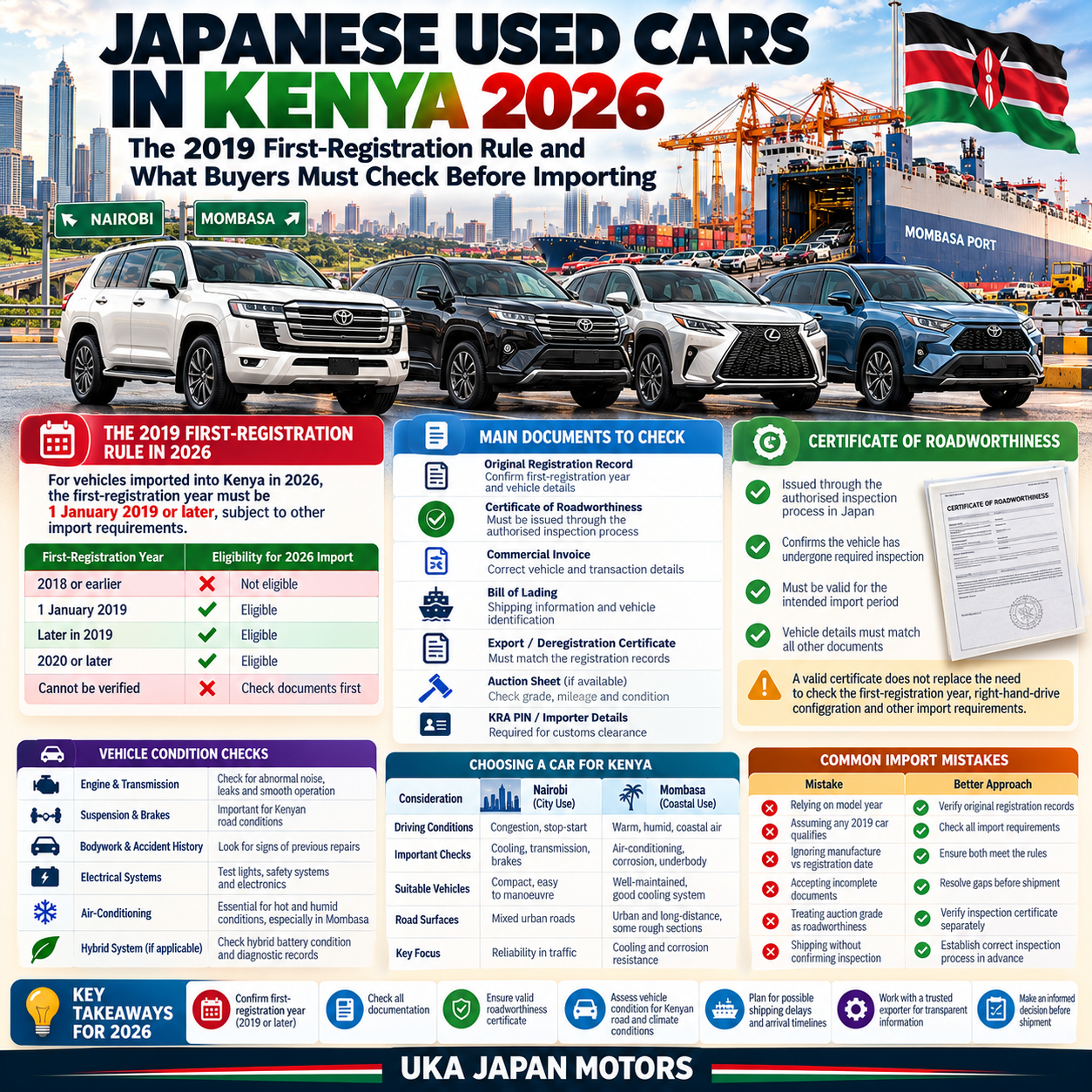
Introduction: Why the 2019 First-Registration Rule Matters in 2026
Importing a used Japanese vehicle into Kenya involves more than selecting a suitable model and arranging shipment. The vehicle must meet Kenya’s import requirements, pass the applicable roadworthiness and conformity checks, and arrive with the documentation needed for customs clearance and registration.
One of the most important requirements is the age limit for used motor vehicles. For 2026, the applicable eligibility threshold is associated with the vehicle’s year of first registration, with the minimum qualifying year moving forward as the calendar year changes.
The Kenya Bureau of Standards (KEBS) has published import notices explaining how the eight-year age limit is applied. The notice for vehicles entering in 2025 specified first registration from 1 January 2018 onwards, while information published concerning the 2026 threshold identifies vehicles first registered from 1 January 2019 onwards. The underlying standard is KS 1515:2000, Kenya’s Code of Practice for Inspection of Road Vehicles.
This distinction is particularly important for Japanese used cars because their manufacturing dates, initial registration dates, export records and shipment dates do not always fall in the same calendar year.
A vehicle manufactured in 2018 but first registered in 2019, for example, presents a different registration-date question from a vehicle manufactured and first registered in 2018. The actual eligibility decision must follow the applicable Kenyan requirements and the vehicle’s verifiable records, not the seller’s description alone.
For buyers in Nairobi, Mombasa and other parts of Kenya, understanding this rule before committing to an import can help prevent avoidable documentation problems, inspection failures and the rejection of a vehicle that does not meet the required standard.
This guide explains how the 2019 first-registration threshold works, which documents should be examined, how to assess a Japanese vehicle before shipment, and what buyers should understand about clearance and long-term ownership.
Quick Answer: What Does the 2019 Rule Mean?
For standard used motor vehicles being imported into Kenya in 2026, the applicable eight-year age-limit framework generally requires the vehicle to have been first registered on or after 1 January 2019. The vehicle must also meet the other applicable import requirements, including right-hand-drive configuration and roadworthiness certification.
The first-registration year is a critical eligibility check, but it is not the only requirement.
Before arranging shipment, buyers should establish the following:
-
The vehicle’s original first-registration date is supported by authentic records.
-
Its manufacturing date and registration history are consistent with the applicable requirements.
-
It is right-hand drive, unless a specific lawful exception applies.
-
It meets the required roadworthiness and inspection standards.
-
The relevant Certificate of Roadworthiness is valid for the intended import period.
-
The export and shipping documents identify the same vehicle.
-
A licensed customs agent can confirm the documentation and clearance requirements for the specific consignment.
The essential point: a vehicle should not be selected for import solely because an advertisement describes it as a 2019 model. Buyers need to establish the actual first-registration date and confirm compliance before shipment.
How the 2019 Threshold Applies to Japanese Used Cars
Japanese used vehicles are commonly assessed through a combination of registration records, export documentation and inspection results. The year displayed in an online listing may not be sufficient to establish eligibility.
The following examples illustrate how buyers should approach the threshold.
| Vehicle record | Position for a 2026 import |
|---|---|
| First registered in 2018 | Does not meet the normal 2026 age threshold |
| First registered on 1 January 2019 | Meets the registration-year threshold, subject to other requirements |
| First registered later in 2019 | Meets the registration-year threshold, subject to other requirements |
| First registered in 2020 or later | Within the registration-year threshold, subject to other requirements |
| First-registration date cannot be verified | Eligibility should be established before shipment |
These examples address the ordinary age-limit requirement, not every possible compliance issue. KEBS and the relevant authorities determine compliance under the applicable rules.
For vehicles from Japan, the distinction between the first-registration year and the date the vehicle was manufactured should be checked against the original records.
A buyer should be especially cautious when:
-
The vehicle’s manufacture and registration years differ.
-
The export document contains incomplete date information.
-
The seller cannot provide reliable registration or deregistration records.
-
The vehicle has been registered or re-registered in more than one jurisdiction.
-
The inspection certificate does not clearly correspond to the vehicle being shipped.
Where the evidence is inconsistent, obtain clarification from the relevant inspection authority or a qualified customs agent before proceeding.
The Certificate of Roadworthiness: What It Proves and What It Does Not
The Certificate of Roadworthiness (CoR) is a central part of the compliance process for used Japanese vehicles imported into Kenya.
According to the published KEBS framework, vehicles exported from countries where KEBS has an appointed inspection arrangement, including Japan, must be accompanied by the applicable Certificate of Roadworthiness issued through the authorised inspection process. Quality Inspection Services Inc. Japan (QISJ) is identified by KEBS as the contracted inspection company for this purpose.
The certificate provides evidence that the vehicle has undergone the prescribed inspection process. It should not be treated as a substitute for checking all other import requirements.
What buyers should verify
1. Vehicle identity
Confirm that the chassis number and other identifying details match the vehicle and its supporting records.
2. Certificate validity
Check that the certificate remains valid for the planned import and arrival period. A certificate issued under an earlier age threshold should not automatically be assumed valid for a later import year.
3. Inspection status
Establish whether the vehicle has completed the required inspection and whether the documentation is authentic.
4. Registration history
Check the first-registration year against the source registration records and any required validation procedures.
5. Document consistency
Ensure that the certificate, registration documents, export paperwork and shipping records all refer to the same vehicle.
Why a valid certificate is not the end of the process
A vehicle may have a genuine inspection certificate but still present a problem if its registration information is inconsistent, the certificate is no longer valid for the relevant import period, or another mandatory requirement has not been satisfied.
The distinction is important because compliance depends on the complete set of applicable requirements rather than a single document.
What If the Japanese Vehicle Does Not Have a Certificate of Roadworthiness?
Buyers should distinguish between a vehicle that has completed the prescribed pre-export inspection and one that is being handled under an applicable destination-inspection procedure.
KEBS published a notice in 2025 concerning validation of import documents for used vehicles subject to destination inspection. The notice states that QISJ validates documents for vehicles arriving without a Certificate of Roadworthiness and that the documents must be validated before the vehicles undergo destination inspection.
This is not a general exemption from inspection or age requirements.
The notice makes document validation an important part of the process for the specified category of vehicles. An importer should therefore establish the correct inspection route before shipment rather than assume that a missing certificate can be resolved automatically after arrival.
For buyers, the practical questions are:
-
Does the vehicle qualify for the applicable destination-inspection procedure?
-
Which original or supporting registration documents are required?
-
Have the documents been validated by the authorised service?
-
Does the vehicle meet the relevant age and technical requirements?
-
Has the current process been confirmed with KEBS or the authorised inspection provider?
A vehicle that lacks the required documentation should not be treated as eligible simply because it is physically present at the port.
The Main Documents to Check Before Importing
Import documentation should be reviewed as a connected set. Each document serves a different purpose, and the information should be consistent throughout the process.
KRA identifies the commercial invoice, original foreign logbook, original bill of lading, pre-shipment inspection certificate and the importer’s KRA PIN or company incorporation documentation, where applicable, among the supporting documents for motor vehicle imports.
The exact requirements should be confirmed for the individual consignment.
| Document | What the buyer should verify |
|---|---|
| Original foreign logbook or applicable registration record | First-registration details, vehicle identity and registration history |
| Commercial invoice | Correct description of the vehicle and the parties to the transaction |
| Bill of lading | Correct vehicle or shipment identification and shipping details |
| Certificate of Roadworthiness | Authenticity, inspection status and validity for the intended import |
| Export or deregistration certificate, where applicable | Consistency with the original registration record and vehicle identity |
| Auction sheet or condition report, where available | Vehicle grade, recorded damage, mileage and reported mechanical condition |
| KRA PIN or company documentation | Correct importer details and applicable supporting requirements |
| Additional customs and clearance documents | Compliance with the requirements confirmed by the licensed customs agent |
An auction sheet is useful supporting information, but it should not replace the original records needed to establish registration history and import eligibility.
Similarly, a commercial invoice confirms transaction details; it does not independently prove that the vehicle meets Kenya’s age and roadworthiness requirements.
How to Check a Japanese Vehicle Before Shipment
A disciplined pre-shipment review reduces the likelihood of discovering important problems only after the vehicle has arrived.
The process should begin with identity and eligibility, move to mechanical condition, and finish with documentation and shipping readiness.
Step 1: Establish the first-registration year
Obtain the relevant registration or deregistration records. Confirm that the vehicle meets the 2019 threshold for a normal 2026 import and that the records support the date claimed by the seller.
Step 2: Match the chassis number
Compare the chassis number on the vehicle with the auction, registration, export and inspection records. Investigate any discrepancy before the vehicle is shipped.
Step 3: Confirm the inspection route
Establish whether the vehicle must undergo the applicable pre-export roadworthiness inspection and whether the correct certificate has been issued. If destination inspection is relevant, confirm the prescribed document-validation procedure.
Step 4: Assess mechanical condition
Review accident history, engine operation, transmission behaviour, suspension, steering, brakes, cooling, electrical systems and any model-specific components. An eligibility certificate is not a complete mechanical assessment.
Step 5: Complete the document review
Confirm that the invoice, shipping documents, registration records and inspection documentation identify the same vehicle. Have unresolved questions checked by the appropriate authority or licensed customs agent.
Step 6: Confirm shipment readiness
Check that the vehicle satisfies the applicable age threshold, that its inspection documentation is valid for the planned arrival, and that the required export and shipping arrangements are in order.
The order matters. It is better to identify an eligibility problem before shipping than to discover it during clearance.
Vehicle Condition: What to Examine Beyond the Registration Year
Once eligibility has been established, the next question is whether the vehicle is mechanically suitable for its intended use in Kenya.
Two vehicles with the same first-registration year may differ significantly in condition. Mileage, servicing, previous repairs, operating environment and maintenance practices all influence reliability.
Engine and transmission
Check for abnormal engine noise, uneven idling, visible fluid leaks, excessive smoke and signs of overheating. Transmission operation should be assessed for delayed engagement, harsh shifts or unusual noises.
For a vehicle with limited service records, an independent mechanical assessment can help identify uncertainty that the auction grade or seller’s description does not resolve.
Suspension, steering and braking
Suspension and steering components deserve particular attention if the vehicle will regularly encounter uneven road surfaces, potholes or frequent changes in road conditions.
The assessment should cover suspension joints, dampers, bushes, wheel alignment, steering response and brake operation.
Bodywork and accident history
Inspect structural areas, chassis sections, panels and signs of poor-quality repairs. A vehicle that appears clean externally may still have a history of significant accident damage.
Where available, compare auction photographs and condition records with the vehicle’s current state.
Electrical systems and air-conditioning
Test the lights, dashboard warnings, power windows, central locking, safety systems and other electrical equipment.
Air-conditioning performance is also relevant for vehicles used in Mombasa, where warm and humid coastal conditions can make a reliable cooling system important for everyday driving.
Hybrid and other specialised systems
Hybrid vehicles require checks appropriate to their powertrain, including the hybrid battery system, electrical components and diagnostic information where available.
A conventional petrol or diesel vehicle and a hybrid should not be assessed using exactly the same mechanical checklist.
The buyer should ensure that the inspection is appropriate for the particular model and its technology.
Choosing a Vehicle for Nairobi, Mombasa and Long-Distance Driving
Import eligibility is a national compliance question, but the vehicle’s intended use should guide the mechanical assessment.
Driving in Nairobi
Nairobi’s congestion and frequent stop-start driving can place demands on the cooling system, transmission, brakes and air-conditioning.
For regular urban use, consider:
-
Ease of manoeuvring and parking.
-
Visibility in dense traffic.
-
Cooling-system condition.
-
Transmission behaviour at low speeds.
-
Fuel-system and engine performance.
-
Availability of appropriate maintenance expertise.
A compact vehicle may suit a driver who spends most of the day in urban traffic, while a larger vehicle may be appropriate for family transport or other specific needs.
Driving in Mombasa
In Mombasa, warm and humid conditions make air-conditioning and cooling-system performance important considerations. Exposure to coastal air also makes it sensible to inspect underbody sections, fasteners, suspension components and electrical connections for corrosion.
Not every vehicle operated near the coast will have serious corrosion. The purpose of the inspection is to establish the actual condition rather than make assumptions based on location.
Long-distance travel
A vehicle intended for frequent travel between Nairobi, Mombasa and other parts of Kenya should be assessed for sustained engine performance, cooling, braking, tyres and suspension condition.
Ground clearance and tyre suitability may also matter for journeys that include uneven road surfaces.
Comparison: a car that performs well in short urban journeys is not automatically the best choice for frequent long-distance use. The appropriate decision depends on its condition, configuration, maintenance history and intended operating environment.
What Happens When the Vehicle Reaches Mombasa?
For vehicles arriving through the Port of Mombasa, arrival is only one stage of the import process.
The vehicle must still complete the applicable customs, standards and registration procedures.
A typical process involves the following stages:
-
Shipping documentation: The importer or authorised representative obtains and checks the bill of lading and other required shipping records.
-
Customs declaration: A licensed customs agent prepares the import declaration through the applicable KRA system.
-
Standards compliance: The vehicle’s inspection documentation and other required conformity records are checked under the relevant procedures.
-
Customs and other releases: The applicable clearance requirements must be completed before the vehicle is released.
-
Registration: The vehicle proceeds through the applicable National Transport and Safety Authority (NTSA) registration process, including the issuance of the Kenyan registration record where requirements are met.
KRA and InfoTradeKenya provide official guidance on vehicle importation, customs clearance and subsequent registration.
The precise steps can depend on the vehicle’s documentation and inspection status. Buyers should therefore establish the applicable process before shipment rather than rely on a generic checklist alone.
Why arrival timing matters
The age-limit rule is tied to the relevant import period, and inspection certificates issued under an earlier threshold may cease to be valid for vehicles arriving in a later year.
KEBS’s notice for the 2025 transition specified that vehicles first registered in 2017 or earlier had to arrive by 31 December 2024 under the previous threshold. The subsequent 2026 threshold moved to first registration from 1 January 2019.
This illustrates why buyers should not assume that a certificate issued when a vehicle was selected will remain sufficient regardless of shipping delays or changes in the applicable requirements.
If shipment timing changes, the importer should reconfirm eligibility and certificate validity.
Common Import Mistakes and How to Prevent Them
| Mistake | Why it matters | Better approach |
|---|---|---|
| Relying on the model year in an advertisement | The model year may not establish the first-registration year | Verify the original registration records |
| Assuming any 2019 vehicle qualifies | Registration year is only one requirement | Check age, configuration, inspection and documentation |
| Ignoring the gap between manufacture and registration | The applicable framework also addresses the relationship between the two years | Confirm that the records meet the relevant requirements |
| Accepting incomplete export documents | Missing or inconsistent records may complicate validation and clearance | Resolve gaps before shipment |
| Treating an auction grade as a roadworthiness certificate | Auction assessment and regulatory inspection have different purposes | Verify both condition and compliance |
| Shipping before confirming inspection requirements | A missing or invalid certificate can create clearance problems | Establish the correct inspection process in advance |
| Assuming arrival guarantees registration | Clearance and registration remain subject to the applicable requirements | Confirm the required steps with the relevant authorities |
The common theme is that the import decision should be supported by verifiable evidence.
A buyer should not need to rely solely on verbal assurances about registration dates, inspection status or the vehicle’s history.
How UKA Japan Motors Approaches Import Guidance
UKA Japan Motors’ role in the import process should be understood in terms of vehicle information, inspection awareness and documentation checks.
For buyers considering Japanese used vehicles, the important questions concern whether the available records establish the vehicle’s identity, whether the vehicle meets the applicable age requirement, and whether the inspection and shipping documentation is in order.
An informed review should distinguish between three separate matters:
-
Import eligibility: Whether the vehicle meets Kenya’s applicable age, configuration and regulatory requirements.
-
Mechanical condition: Whether the vehicle’s actual condition is suitable for its intended use.
-
Documentation readiness: Whether the relevant registration, inspection, export and shipping records are complete and consistent.
These matters are related, but one does not replace the others.
UKA Japan Motors can provide vehicle-related information and inspection guidance to help buyers understand the checks involved. Regulatory eligibility, customs clearance and registration remain subject to the requirements and decisions of the relevant Kenyan authorities.
Where a registration date is unclear, a certificate’s validity is uncertain or a document appears inconsistent, the appropriate step is to obtain verification before proceeding.
This approach supports transparent decision-making and reduces reliance on assumptions that may not hold during clearance.
Frequently Asked Questions
1. Can I import a Japanese used car first registered in 2019 into Kenya in 2026?
A vehicle first registered on or after 1 January 2019 meets the normal registration-year threshold for a 2026 import. It must also satisfy the other applicable requirements, including right-hand-drive configuration and the required inspection and documentation standards.
2. Can I import a vehicle first registered in 2018 during 2026?
Under the normal age-limit framework, a vehicle first registered in 2018 falls outside the 2026 threshold. Buyers should not rely on an earlier inspection certificate as proof of current eligibility.
3. Is the model year the same as the first-registration year?
No. The model year identifies a vehicle’s model designation or generation, while the first-registration year identifies when it was initially registered. The two may differ, so the original records should be checked.
4. Does a 2019 manufacture date automatically mean the car qualifies?
No. The first-registration year is central to the age-limit assessment. The relationship between manufacture and registration years must also comply with the applicable requirements, and the vehicle must meet the other import conditions.
5. Is a Certificate of Roadworthiness mandatory for Japanese used cars?
The standard inspection process requires the applicable roadworthiness documentation for used vehicles exported from Japan. KEBS identifies QISJ as the contracted inspection company for the relevant Certificate of Roadworthiness process. Buyers should confirm the correct procedure for their particular vehicle and import circumstances.
6. What happens if a Japanese used car arrives without a Certificate of Roadworthiness?
KEBS has published a specific document-validation process for used vehicles subject to destination inspection. The importer must establish whether that procedure applies and complete the required validation before destination inspection. It should not be treated as an automatic exemption from the age limit or other requirements.
7. Can I use an auction sheet instead of the original Japanese registration records?
An auction sheet can help explain the vehicle’s recorded condition, mileage and history. It does not automatically replace the original registration or deregistration records needed to establish first-registration details and support the import process.
8. What documents should I check before arranging shipment?
Start with the original foreign logbook or applicable registration record, commercial invoice, bill of lading, required inspection certificate, and the relevant export or deregistration documentation. Confirm any additional requirements with a licensed customs agent and the appropriate inspection authority.
9. Does a right-hand-drive vehicle automatically qualify for importation?
No. Right-hand drive is an important requirement for standard used vehicle imports, but the vehicle must also satisfy the applicable age, roadworthiness, documentation and other regulatory requirements.
10. Can a vehicle be rejected even if the documents appear complete?
Yes. Documents may be incomplete, inconsistent, invalid or insufficient to establish compliance. The vehicle must meet the actual regulatory requirements, and its supporting records may need to be verified by the relevant authorities.
11. Does passing the import inspection guarantee that the vehicle will be mechanically reliable?
No. A regulatory roadworthiness inspection and a detailed assessment of long-term mechanical condition are not identical. Buyers should separately consider maintenance history, accident repairs, engine and transmission condition, suspension, brakes and any specialised powertrain components.
12. Should I confirm the age rule before or after the vehicle is shipped?
Before shipment. Confirm the first-registration year, applicable inspection requirements, certificate validity and documentation status before the vehicle leaves Japan. If there is uncertainty about eligibility, obtain clarification from the appropriate authority or a qualified customs agent first.
Conclusion: Verify the Vehicle Before Committing to Import
The 2019 first-registration threshold is one of the most important checks for anyone considering a Japanese used car import into Kenya in 2026. It establishes the normal minimum first-registration year for eligibility under the eight-year age-limit framework, but it does not guarantee that a vehicle satisfies every other requirement.
A sound import decision starts with the original registration records, confirmation of the chassis identity, the appropriate roadworthiness documentation and a review of the vehicle’s actual condition. Buyers should also account for shipment timing, document validation, customs clearance and the subsequent registration process.
For vehicles intended for Nairobi, Mombasa or long-distance driving, mechanical suitability should be considered separately from regulatory eligibility. The right choice is one that meets the applicable rules, has a verifiable history and suits the demands of its intended use.
UKA Japan Motors’ approach to inspection-focused guidance is to help buyers understand the documentation and condition checks involved, while recognising that compliance decisions rest with the relevant authorities.
Contact UKA Japan Motors for availability and inspection guidance.