


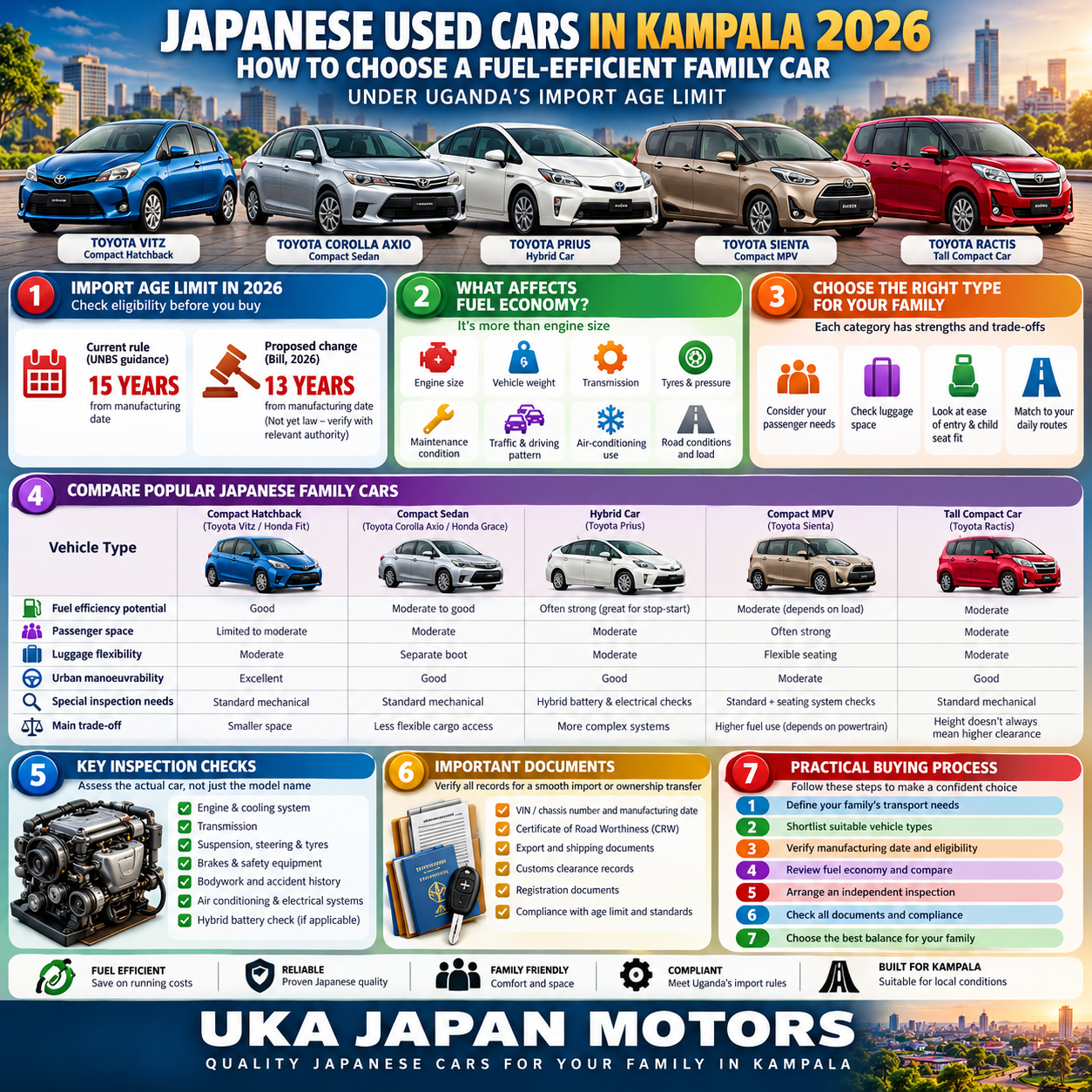
Introduction: Choosing a Family Car That Works in Kampala
Choosing a Japanese used car for family use in Kampala requires a balance between fuel efficiency, passenger comfort, mechanical condition, legal eligibility and the demands of everyday driving. A vehicle may have an excellent reputation for reliability yet still be unsuitable for a particular household because it lacks luggage space, has insufficient ground clearance for regular journeys or requires technical support that is difficult to access.
For many families, the car serves several purposes throughout the week. It may carry children to school, transport adults to work, handle shopping and appointments, and provide transport for longer journeys outside the city. These different responsibilities influence which vehicle type makes sense and how much attention should be given to engine performance, seating arrangements, suspension condition and fuel consumption.
Uganda’s import requirements add another layer to the decision. A vehicle must meet the applicable rules before it can be imported through the intended process. Manufacturing dates, roadworthiness certification and supporting documentation therefore matter just as much as the vehicle’s advertised specifications.
The year 2026 also calls for particular care when interpreting the import-age rules. Uganda’s proposed change to the maximum age of imported vehicles was the subject of a legislative process, but the relevant amendment bill was subsequently recorded as withdrawn by Parliament. Buyers should distinguish that proposal from the existing legal position and verify the rules applicable to their individual transaction.
This guide explains how to choose a suitable Japanese used family car for Kampala, compare conventional petrol and hybrid vehicles, assess realistic fuel economy, verify import eligibility and carry out the checks that help establish whether a particular vehicle is appropriate for long-term family use.
The essential decision in brief
A suitable family car should meet five conditions:
-
It complies with the import and vehicle standards applicable to the transaction.
-
Its fuel consumption is appropriate for the household’s usual journeys.
-
It accommodates passengers, child seats and luggage safely.
-
Its mechanical condition is supported by a proper inspection and available records.
-
Its servicing and technical requirements can be managed throughout ownership.
These conditions should be considered together. Fuel efficiency alone does not establish that a car is safe, suitable or legally eligible for importation.
1. Understanding Uganda’s import-age limit in 2026
Import-age requirements determine whether a used vehicle can enter Uganda through the applicable import process. For anyone considering a Japanese vehicle, establishing its manufacturing date should be one of the first steps in creating a shortlist.
The Uganda National Bureau of Standards (UNBS) identifies the manufacturing date as a key factor in enforcing the age restriction for imported used vehicles. Its compulsory standard for used-vehicle inspection includes an amendment addressing vehicles that are 15 years old or more from their date of manufacture.
What happened to the proposed 13-year limit?
The Traffic and Road Safety (Amendment) Bill, 2026, proposed reducing the maximum permitted age from 15 years to 13 years from manufacture. However, Parliament’s official bill tracker records the bill as withdrawn on 21 April 2026. It should therefore not be presented as an enacted 13-year prohibition.
For buyers planning an import during the remainder of 2026, the important distinction is between a proposal and a rule that is legally in force. The applicable requirements should still be confirmed with the relevant authorities before shipment, particularly if the transaction involves unusual circumstances or transitional arrangements.
The existing age restriction does not remove the need to meet other applicable standards. A vehicle within the permitted age range may still be unsuitable for importation if it fails required inspection or documentation conditions.
How should you establish a car’s age?
Japanese used vehicles may have several dates associated with them. These dates are not interchangeable.
| Date or record | What it tells you | How to use it |
|---|---|---|
| Manufacturing date | When the vehicle was built | Establish the age relevant to import eligibility |
| Model year | The manufacturer’s model-year designation, where applicable | Understand the vehicle’s generation and specification |
| First registration date | When the vehicle was first registered for road use | Provide background on its history |
| Export or shipment date | When the vehicle was prepared for or sent for export | Establish the movement of the vehicle, not its manufacturing age |
| VIN or chassis record | Identifies the particular vehicle | Match supporting records to the physical vehicle |
A car advertised as a particular model year may have been manufactured earlier. The description in an advertisement is not sufficient evidence of the date that matters for regulatory purposes.
Obtain the chassis or VIN details and ask for credible manufacturing information. Confirm that the details match the vehicle and the accompanying documents.
What if the vehicle is already in Uganda?
A vehicle that is already registered in Uganda presents a different transaction from a vehicle being imported directly from Japan. The buyer should verify the existing registration, ownership, customs and compliance records, as applicable, rather than assuming that all import checks can be skipped.
Import eligibility and registration or transfer eligibility are related but distinct questions. Documentation should establish the vehicle’s status and the legal basis for the transaction.
Practical rule: Verify the applicable age requirement and the vehicle’s manufacturing date before committing to an import. Do not rely solely on a seller’s statement that the vehicle is eligible.
2. What fuel efficiency means for a family in Kampala
Fuel efficiency describes how effectively a vehicle uses fuel to travel a distance. It is commonly expressed in kilometres per litre (km/L) or litres per 100 kilometres (L/100 km).
For a family that drives around Kampala, the useful question is not simply which model has the best published figure. It is which vehicle is likely to perform efficiently under the family’s actual driving conditions.
Why urban driving changes fuel consumption
Kampala driving can involve prolonged queues, frequent braking, short journeys and repeated acceleration. These conditions affect vehicles differently from sustained travel at a steady speed.
A conventional petrol car consumes fuel while its engine is running, including when the vehicle is stationary. Repeated acceleration also requires energy, and some of that energy is lost as heat during braking.
A conventional hybrid can recover some braking energy and use its electric motor to assist the engine. This can improve efficiency in certain stop-start conditions, although the outcome depends on the hybrid design, battery condition, driving pattern and vehicle load.
A small petrol hatchback can also be an efficient choice because it may weigh less than a larger vehicle and require less energy to move. Its suitability depends on whether its cabin, engine and luggage capacity meet the family’s needs.
Factors that influence actual consumption
| Factor | Why it matters |
|---|---|
| Engine and powertrain | Determine how the vehicle generates and delivers power |
| Vehicle weight | A heavier vehicle generally requires more energy to accelerate |
| Transmission | Influences how efficiently engine power is delivered under different conditions |
| Traffic pattern | Frequent stopping, idling and acceleration can increase consumption |
| Passenger and luggage load | Adds weight that the vehicle must carry |
| Tyre condition and pressure | Incorrect pressure or unsuitable tyres can increase rolling resistance |
| Maintenance | Faulty sensors, worn components and poor servicing can affect performance |
| Air conditioning | Adds a load that can influence consumption, particularly in slow traffic |
| Journey length | Repeated short trips may prevent the engine from reaching its normal operating temperature |
No single factor tells the whole story. A well-maintained sedan with a suitable engine may outperform a neglected hatchback, while a healthy hybrid may suit a congested urban commute better than a larger conventional vehicle.
How to interpret fuel-economy figures
If a specification lists consumption in litres per 100 kilometres, a lower figure indicates better efficiency. If it lists kilometres per litre, a higher figure indicates better efficiency.
The relationship is:
For example, a hypothetical consumption figure of 6 L/100 km is equivalent to approximately 16.7 km/L on the same measurement basis. This conversion does not mean that the vehicle will achieve that result during Kampala traffic.
When comparing two cars, identify whether their published figures were obtained using the same testing method. Different testing cycles can produce results that are not directly comparable.
Actual consumption should be considered alongside the vehicle’s condition and the journeys for which it will be used. An official test result is useful for comparing specifications, but it is not a guarantee of real-world performance.
3. Choosing the right type of Japanese family car
The most appropriate vehicle category depends on the number of passengers, luggage requirements, daily routes and the family’s preference for conventional or hybrid technology.
Rather than choosing a model first, identify the type of vehicle that meets the household’s needs. Then compare specific vehicles within that category.
Compact hatchbacks: Toyota Vitz and Honda Fit
The Toyota Vitz and Honda Fit are examples of compact hatchbacks that families may investigate.
Their relatively small dimensions can help with parking and manoeuvring through busy streets. A hatchback’s rear opening can also make loading shopping or everyday luggage convenient.
However, passenger space varies by generation and configuration. Before choosing one for a family, check rear-seat legroom, the space available for child seats and whether the luggage area remains practical when all regular passengers are travelling.
A compact hatchback may suit a small household that primarily drives within Kampala. It may be less convenient for a family that regularly carries several large bags, a pushchair and multiple passengers.
Compact sedans: Toyota Corolla Axio and Honda Grace
The Toyota Corolla Axio and Honda Grace offer sedan layouts that may appeal to households seeking a separate luggage compartment.
A sedan can be suitable for commuting, school transport and longer journeys, provided its rear-seat dimensions and luggage capacity match the family’s needs.
Inspect the boot opening and the shape of the luggage compartment. A large-looking boot may still be inconvenient for bulky items if its opening is narrow or its internal shape restricts loading.
Also establish the exact engine and transmission configuration. Model names can cover multiple specifications, and fuel consumption or maintenance requirements should not be assumed to be identical across every version.
Hybrid passenger cars: Toyota Prius and other suitable hybrids
The Toyota Prius is an example of a hybrid that may be considered for frequent urban driving.
Hybrids combine a combustion engine with electric drive components. Depending on the design, they can use electric assistance during acceleration and recover some braking energy.
This arrangement may be beneficial in stop-start traffic, but a used hybrid requires a more specialised inspection than a conventional petrol car. Battery condition, cooling arrangements, power electronics and stored diagnostic faults should be assessed by a qualified technician.
A hybrid should not be selected purely because of its reputation for efficiency. The specific vehicle’s condition and the availability of suitable technical support in Uganda are equally important.
Compact MPVs: Toyota Sienta
The Toyota Sienta is an example of a compact multi-purpose vehicle designed around passenger access and flexible seating.
This category may suit families that frequently carry children, older relatives or additional passengers. Depending on the configuration, the cabin can offer more seating flexibility than a small hatchback.
The key question is how much usable space remains when all intended seats are occupied. Inspect access to the rear rows, seat belts, head restraints, child-seat compatibility and luggage space.
If a family regularly uses every available seat, a vehicle with a high advertised seating capacity may still be unsuitable if the passengers have limited space or the luggage area becomes impractical.
Tall compact cars and compact crossovers
The Toyota Ractis illustrates a taller compact-car layout that may offer a more upright seating position than some conventional hatchbacks.
Such a layout can make entry and exit more convenient for some passengers. Selected compact crossovers may also be appropriate where the family needs particular ground clearance or a more upright cabin.
However, body height should not be confused with ground clearance. A tall car may still have a low underside, and a crossover’s suitability for uneven roads depends on its actual dimensions, tyres, suspension and condition.
Comparison of the main categories
| Family need | Category to consider | Main limitation to examine |
|---|---|---|
| Mostly urban driving with a small passenger group | Compact hatchback | Rear-seat and luggage capacity |
| Daily commuting with separate luggage storage | Compact sedan | Boot access and rear-seat comfort |
| Frequent stop-start traffic | Suitable hybrid | Battery health and specialised maintenance |
| Regularly carrying additional passengers | Compact MPV | Usable space with every seat occupied |
| Easier entry and a more upright cabin | Tall compact car | Actual ground clearance and vehicle condition |
These categories are starting points, not universal rankings. A specific vehicle’s condition, equipment, manufacturing date and service history can be more important than its body style.
4. Matching the car to the family’s weekly routine
A family should consider the journeys it makes most often rather than choosing a car for an occasional trip.
School runs and short journeys
Repeated short trips can place particular demands on a vehicle because the engine may not consistently reach its normal operating temperature. Frequent starting also makes the condition of the 12-volt battery and starting system important.
A compact hatchback may be convenient for school transport and parking. A hybrid may be worth evaluating where congestion and repeated braking are common.
Whichever type is selected, inspect the engine, cooling system, brakes and electrical equipment. Ask whether the vehicle’s service history reflects the way it has been used.
Daily commuting through Kampala
For commuting, low-speed drivability, visibility, comfortable seats and effective air conditioning can make a substantial difference to everyday use.
An automatic transmission may be convenient in heavy traffic, but its mechanical condition must be checked. Confirm that it engages drive and reverse appropriately and does not exhibit abnormal hesitation, slipping or harsh engagement.
A vehicle that is economical on paper but uncomfortable during repeated stop-start journeys may not be the best choice for the household.
Journeys beyond the city
Families that regularly travel on longer routes should consider stability, braking, tyre condition, suspension performance and engine response under load.
Ground clearance is important where the vehicle must negotiate uneven access roads, but the family should assess the actual roads it uses. Not every household needs an SUV, and a properly maintained hatchback or sedan may be adequate for many routes.
Check that the engine performs consistently with the intended passenger load and that the cooling system is in sound condition. Longer journeys can expose problems that are less noticeable during a short urban drive.
Carrying children and older relatives
Family suitability includes ease of access and the ability to accommodate passengers safely.
Check the door opening, rear-seat height, seat-belt arrangement and child-seat anchor points where fitted. If an older passenger has difficulty bending or climbing into a low seat, test the access arrangement before deciding.
Do not assume that every vehicle’s advertised seating capacity translates into comfortable or safe accommodation for the family. The actual seating configuration and available restraints matter.
5. Hybrid or conventional petrol: Making the right choice
The choice between a hybrid and a conventional petrol car depends on driving patterns, mechanical condition and the household’s ability to maintain the particular powertrain.
A conventional petrol car uses an internal-combustion engine to propel the vehicle. A hybrid combines that engine with an electric motor and battery system. Depending on the design, the electric motor can assist acceleration, propel the vehicle under certain conditions and recover energy during braking.
Many conventional hybrids recharge their traction batteries through the engine and regenerative braking rather than requiring an external charging connection. Plug-in hybrids are different, so buyers must establish the precise system fitted to the vehicle.
When a hybrid may be suitable
A hybrid may be attractive for a household that spends a large proportion of its driving time in congested urban traffic. Electric assistance and regenerative braking can improve efficiency under appropriate conditions.
Its advantages depend on the health of the battery and the wider hybrid system. A deteriorated battery, cooling fault or electrical problem may affect performance and require specialised diagnosis.
Before selecting a used hybrid, ask a qualified technician to assess:
-
Traction-battery condition using suitable diagnostic equipment.
-
Battery cooling fans, air passages and associated components.
-
Hybrid control-system fault codes.
-
Electric motor and power-electronics operation.
-
The condition of the 12-volt auxiliary battery.
-
Engine and cooling-system condition.
-
Evidence of previous battery repairs or replacement.
A dashboard without warning lights is not sufficient proof that the hybrid system is healthy. An appropriate inspection should examine stored faults and system performance.
When conventional petrol may be more appropriate
A conventional petrol car may suit a family that prefers a more familiar mechanical arrangement or has easier access to technicians who specialise in that model.
It still requires a proper inspection. Engine faults, transmission problems, neglected cooling systems and worn suspension components can make a conventional car unsuitable regardless of its reputation.
The comparison should therefore be between two specific vehicles in verified condition, not between the general reputations of petrol and hybrid technology.
A practical decision table
| Consideration | Conventional petrol | Conventional hybrid |
|---|---|---|
| Urban traffic | Consumption depends on engine, weight and driving conditions | Can benefit from electric assistance and regenerative braking |
| Inspection | Conventional engine, transmission and chassis checks | Conventional checks plus hybrid-system diagnostics |
| Maintenance support | Confirm parts and technician availability | Confirm parts and hybrid diagnostic capability |
| Battery systems | Conventional starting and auxiliary battery requirements | Traction battery and auxiliary battery requirements |
| Long-term suitability | Depends on condition and service support | Depends on condition, battery health and service support |
Neither option is automatically better for every family. Select the powertrain that fits the driving pattern and can be maintained appropriately over the vehicle’s expected period of ownership.
6. Inspecting a used car for Kampala’s driving conditions
A model’s reputation cannot establish the condition of an individual vehicle. Inspection should identify existing faults, signs of neglect and potential problems that may affect safety or long-term use.
Engine and cooling system
Check that the engine starts and runs consistently. An inspector should investigate abnormal knocking, persistent misfiring, excessive smoke, oil leaks and signs of overheating.
The cooling system deserves particular attention because traffic congestion and prolonged low-speed driving can expose weaknesses in cooling performance. Inspect the radiator, hoses, coolant condition, cooling fans and evidence of previous overheating repairs.
An engine bay that looks clean is not necessarily well maintained. Recent cleaning may hide leaks or residue, so inspect the engine carefully for evidence of oil or coolant loss.
Transmission and drivetrain
The transmission should engage appropriately and operate without abnormal slipping, hesitation or harsh changes.
The inspection must match the transmission type fitted to the car. Different automatic transmission designs have different operating characteristics and maintenance requirements.
A short stationary check may not reveal every problem. Where appropriate and safe, a qualified inspector should assess the vehicle under operating conditions and check for relevant diagnostic faults.
Suspension, steering and tyres
Potholes, road joints and uneven surfaces make suspension condition an important ownership concern.
Check the shock absorbers, suspension joints, control-arm bushes, steering components, wheel bearings and mounting points. Listen for abnormal noises and investigate excessive steering play or instability.
Tyres should be checked for uneven wear, damage, age-related deterioration and correct specification. Incorrect tyre pressure can affect handling and fuel consumption, while unsuitable tyre sizes may compromise the vehicle’s intended operating characteristics.
Ground clearance should be assessed on the actual vehicle. Previous suspension modifications or incorrectly sized tyres may have changed its original characteristics.
Brakes and safety equipment
Confirm that the brakes operate consistently and investigate vibration, grinding, pulling to one side or unusual pedal behaviour.
Check the condition and operation of seat belts, exterior lights, mirrors, windscreen wipers and relevant dashboard warning indicators. Where fitted, the airbag system and anti-lock braking system should be assessed appropriately.
Do not assume that a vehicle retains every safety feature associated with its original model designation. Equipment can differ by specification, and previous accident repairs may have affected the system.
Bodywork and accident history
Inspect panel gaps, paint consistency, glass markings and visible evidence of structural repairs. Where possible, compare the physical vehicle with available inspection records and photographs.
Cosmetic repairs do not automatically make a vehicle unsuitable. However, poorly repaired structural damage or compromised safety systems require serious investigation.
A qualified inspector should determine whether suspected repairs affect structural integrity, crash protection or the vehicle’s safe operation.
Air conditioning and electrical equipment
Effective air conditioning is an important practical feature for family use in Kampala.
Test the cooling performance, blower speeds and controls. Listen for abnormal noises and investigate inconsistent operation. Also check power windows, central locking, dashboard displays and other electrical equipment fitted to the vehicle.
An intermittent fault should be recorded and diagnosed. It should not be dismissed simply because the equipment happens to work during one inspection.
7. Documentation, roadworthiness and import compliance
Mechanical condition and documentary compliance are separate requirements. A vehicle with correct paperwork can still have mechanical faults, while a mechanically sound vehicle may have incomplete or inconsistent records.
UNBS guidance states that used motor vehicles imported under the applicable Pre-Export Verification of Conformity (PVoC) programme must be accompanied by the relevant Certificate of Road Worthiness (CRW) from the country of origin or export before importation. The exact inspection arrangements should be confirmed for the intended transaction.
Records to check
| Record | What to verify |
|---|---|
| VIN or chassis number | The number matches the physical vehicle and supporting records |
| Manufacturing information | The build date is supported by credible evidence |
| Certificate of Road Worthiness | The certificate is valid for the relevant process and identifies the correct vehicle |
| Export and shipping documents | Vehicle details are consistent across records |
| Customs documentation | Applicable clearance evidence is available for the transaction |
| Ownership documents | The seller’s authority to transfer the vehicle can be established |
| Registration records | Existing registration or transfer details are consistent, where applicable |
| Compliance evidence | The vehicle meets applicable age, roadworthiness and other standards |
UNBS has also published guidance on the validity of CRWs under the PVoC programme. Its notice dated 5 August 2021 states that certificates were valid for 12 months from issue under that arrangement, with destination inspection applying to certificates beyond that period. Because inspection procedures and administrative requirements can change, buyers should confirm the current requirements rather than relying solely on an older notice.
What should buyers understand about inspection certificates?
An inspection certificate provides evidence that the vehicle was assessed under the applicable inspection process. It does not guarantee that every component will remain fault-free or that no mechanical issue exists outside the scope of the assessment.
A separate pre-purchase inspection is therefore useful, especially for a family car expected to provide regular transport.
Likewise, a certificate should not be assumed to prove the vehicle’s full ownership history, service history or future reliability. Those matters require their own evidence.
Fuel-economy and emissions requirements
Uganda’s Energy Efficiency and Conservation Act, 2026, includes provisions concerning fuel-economy and vehicular-emissions standards, certification and supporting data for vehicles. Buyers and sellers should confirm the applicable requirements and implementation arrangements with the relevant authorities for the particular transaction.
This reinforces the importance of treating fuel economy as a technical characteristic supported by reliable information, rather than relying exclusively on a model’s reputation or an unverified consumption claim.
8. Long-term ownership: Looking beyond the initial inspection
A car that passes an inspection still needs appropriate maintenance. The buyer should understand what the vehicle is likely to require and whether those requirements can be met throughout ownership.
Parts availability and technical support
Before selecting a less common model or specialised powertrain, establish whether appropriate parts and qualified technicians are accessible in Uganda.
Check support for routine service items, braking components, suspension parts, filters, electrical equipment and model-specific components. For hybrids, confirm access to technicians who can diagnose the battery and control systems correctly.
A model’s popularity can be a useful starting point, but it does not guarantee that every component will be available. Parts compatibility should be established using the exact chassis number, engine and vehicle specification.
Service history and maintenance requirements
Request available service records and compare them with the manufacturer’s maintenance recommendations.
Records relating to engine oil, filters, cooling-system work, transmission servicing, brakes, tyres and suspension can help establish how the vehicle has been maintained. For a hybrid, relevant battery diagnostic reports and records of work on the electric-drive system are also useful.
Missing records do not automatically mean a vehicle should be rejected. They do, however, create uncertainty about its previous maintenance and make an independent inspection more important.
Dust, heat and everyday operating conditions
Vehicles used on dusty roads may need particular attention to air filtration and the condition of intake components. Repeated low-speed driving and congestion make cooling-system maintenance especially important.
Tyres should match the manufacturer’s recommendations and the vehicle’s intended use. Choosing a tyre that is unsuitable for the vehicle in an attempt to improve efficiency can compromise braking, handling or ground clearance.
Maintenance should be based on the manufacturer’s guidance and the actual conditions in which the car operates.
Family needs over time
Consider whether the vehicle will remain suitable as children grow or passenger requirements change.
A compact hatchback may be adequate for a household with one child but less convenient when the family regularly carries additional passengers and luggage. An MPV may provide greater flexibility, although its size and configuration should still suit the household’s normal journeys.
Choose for the family’s realistic needs rather than for an occasional use that does not justify the additional space or complexity.
9. A structured comparison before making a decision
The following table provides a practical way to compare candidate vehicles without assuming that one category is best for everyone.
| Decision factor | Compact petrol hatchback | Hybrid passenger car | Compact sedan | Compact MPV |
|---|---|---|---|---|
| Urban manoeuvrability | Often very good | Depends on model | Generally good | Depends on dimensions |
| Fuel-efficiency potential | Depends on weight and engine | Can be strong in stop-start traffic | Depends on engine and condition | Depends on powertrain and load |
| Passenger capacity | Best assessed for a smaller household | Model-dependent | Model-dependent | Often offers greater seating flexibility |
| Luggage practicality | Depends on boot and rear-seat layout | Model-dependent | Separate luggage compartment | Depends on seating configuration |
| Inspection priorities | Engine, transmission and chassis | Conventional checks plus hybrid diagnostics | Engine, transmission and chassis | Mechanical condition and seating systems |
| Long-term support | Verify parts and technician availability | Verify hybrid diagnostic support | Verify model-specific support | Verify configuration-specific parts |
| Main compromise | Limited space in some models | Greater system complexity | Less flexible cargo access | Greater space does not guarantee better fuel efficiency |
This comparison should be used to narrow the shortlist, not to replace a physical inspection.
Two vehicles of the same model may differ significantly because of maintenance history, previous damage, powertrain specification or component wear. The individual car’s evidence should determine the final decision.
10. A practical buying process for Japanese used cars in Kampala
Use the following sequence to make the selection process more systematic.
-
Define the family’s needs.
Establish the usual number of passengers, luggage requirements, daily journey pattern and frequency of longer trips.
-
Choose the appropriate vehicle category.
Decide whether a hatchback, sedan, hybrid or MPV offers the most suitable combination of space and everyday usability.
-
Confirm the manufacturing date and import eligibility.
Obtain the chassis or VIN details, establish the manufacturing date and verify the rules that apply to the intended transaction.
-
Compare fuel-economy information carefully.
Use comparable specifications where possible, and consider the effects of traffic, vehicle load, maintenance and journey length.
-
Arrange an independent inspection.
Assess the engine, transmission, cooling system, brakes, suspension, tyres, body structure and electrical equipment. Include hybrid diagnostics when applicable.
-
Verify the documentation.
Check the relevant inspection certification, import and customs records, ownership evidence and registration information as applicable.
-
Assess maintenance support.
Establish the servicing requirements and the availability of appropriate parts and technical expertise for the exact model.
-
Decide on the evidence.
Select the vehicle that best meets the household’s needs while satisfying the applicable requirements and demonstrating sound mechanical condition.
Frequently asked questions
1. What is Uganda’s used-car import age limit in 2026?
The existing framework addresses a 15-year restriction measured from manufacture. A proposed amendment to reduce the limit to 13 years was recorded as withdrawn by Parliament on 21 April 2026. Buyers should verify the operative requirements with the relevant authority before importing a vehicle.
2. How do I verify the manufacturing year of a Japanese used car?
Obtain the chassis or VIN details and request credible manufacturing records. Compare the information with the physical vehicle and accompanying documentation. Do not rely exclusively on the model year, first registration date or an advertisement’s description.
3. Which Japanese car is suitable for a small family in Kampala?
A compact hatchback, such as a Toyota Vitz or Honda Fit, may suit a small household that primarily drives within the city. A compact sedan may be more appropriate where a separate luggage compartment is important. The correct choice depends on actual seating space, child-seat requirements, luggage and mechanical condition.
4. Is a hybrid better than a petrol car for Kampala traffic?
A suitable hybrid can benefit from electric assistance and regenerative braking in stop-start conditions. However, its battery and electrical systems require specialised inspection. A well-maintained conventional petrol car may be more appropriate where hybrid diagnostic support is limited or the particular hybrid’s condition is uncertain.
5. Does a smaller engine always use less fuel?
No. Engine displacement is only one influence on consumption. Vehicle weight, transmission, maintenance, traffic, passenger load and driving style also matter. Compare the actual specifications and condition of the vehicles under consideration.
6. What documents should I check before importing a Japanese used car?
Depending on the transaction, relevant records may include manufacturing information, a Certificate of Road Worthiness, export and shipping documents, customs clearance evidence and ownership or registration records. Confirm that the required documents are valid and relate to the exact vehicle.
7. Does a roadworthiness certificate guarantee a fault-free car?
No. A roadworthiness certificate provides evidence of assessment under the applicable inspection process. It does not guarantee that every mechanical component is fault-free or that no problem will develop later. A separate pre-purchase inspection remains valuable.
8. Is an SUV necessary for Kampala’s roads?
Not for every family. A well-maintained hatchback or sedan may suit many urban journeys and ordinary regional travel. The decision should be based on actual ground clearance, suspension condition, tyres, passenger needs and the roads the household regularly uses.
9. How can I tell whether advertised fuel consumption is realistic?
Establish whether the figure comes from a manufacturer specification, an independent road test or actual use. Compare equivalent measurement methods and account for congestion, short trips, air-conditioning, vehicle load and maintenance condition. Published figures are useful for comparison but do not guarantee identical real-world results.
10. What should I check when inspecting a used hybrid?
Request an assessment of the traction battery, battery cooling system, electric motor, power electronics, stored fault codes and auxiliary battery. Also inspect the conventional engine, transmission, brakes, suspension and cooling system, and review available service records.
11. Can an older car be suitable if it is mechanically sound?
Mechanical condition is important, but it does not replace import eligibility or other applicable standards. Establish the vehicle’s manufacturing date and legal status first, then assess its condition, maintenance history, safety equipment and ongoing support requirements.
12. Should I prioritise fuel economy or passenger space?
Start with the number of passengers and the luggage the vehicle must accommodate regularly. Compare suitable vehicles within that group, then evaluate consumption, safety equipment, mechanical condition and maintenance requirements. A vehicle that cannot comfortably meet everyday family needs may not be the right choice even if its published fuel consumption is attractive.
13. How important is air conditioning in a family car?
Effective air conditioning can improve comfort during warm weather and prolonged traffic congestion. Its condition should be checked during inspection, alongside the blower, controls, cooling performance and any unusual noises. A system that operates intermittently should be diagnosed rather than assumed to need only minor attention.
14. Should I buy a vehicle with incomplete service records?
Incomplete records create uncertainty, but they do not automatically establish that a vehicle is unsuitable. Request whatever history is available and arrange a thorough independent inspection. Pay particular attention to the engine, transmission, cooling system and any specialised powertrain components.
UKA Japan Motors’ role in informed vehicle selection
Choosing a Japanese used family car requires attention to the individual vehicle rather than assumptions based on a model’s reputation. Manufacturing dates, inspection evidence, documentation, fuel-consumption information and mechanical condition all contribute to an informed decision.
UKA Japan Motors’ role is to support a transparent, inspection-focused selection process by helping buyers understand vehicle suitability, documentation and applicable compliance considerations. Information about a particular vehicle should be assessed against verifiable records, and uncertainties about its manufacturing date, condition or eligibility should be resolved before a decision is made.
For hybrid vehicles, this includes recognising the importance of battery health and appropriate diagnostic assessment. For conventional petrol vehicles, it includes checking the engine, transmission, cooling system and other components relevant to everyday operation.
The objective is not to suggest that one vehicle type suits every household. It is to help buyers understand the strengths and limitations of each candidate and identify the evidence needed to make a considered decision.
Conclusion: Choose a vehicle that fits both the family and the rules
The right Japanese used family car for Kampala in 2026 is the one that meets the household’s practical needs, complies with the applicable import requirements and demonstrates sound mechanical condition.
Start by verifying the manufacturing date and eligibility. Then compare vehicle categories according to passenger space, luggage requirements and the family’s usual driving pattern. Assess conventional petrol and hybrid options using realistic expectations about fuel consumption, maintenance and technical support.
Finally, check the documentation and arrange an independent mechanical inspection. These steps help establish whether a particular vehicle is suitable for everyday family transport rather than relying on appearance, reputation or advertised efficiency alone.
Contact UKA Japan Motors for availability and inspection guidance.