


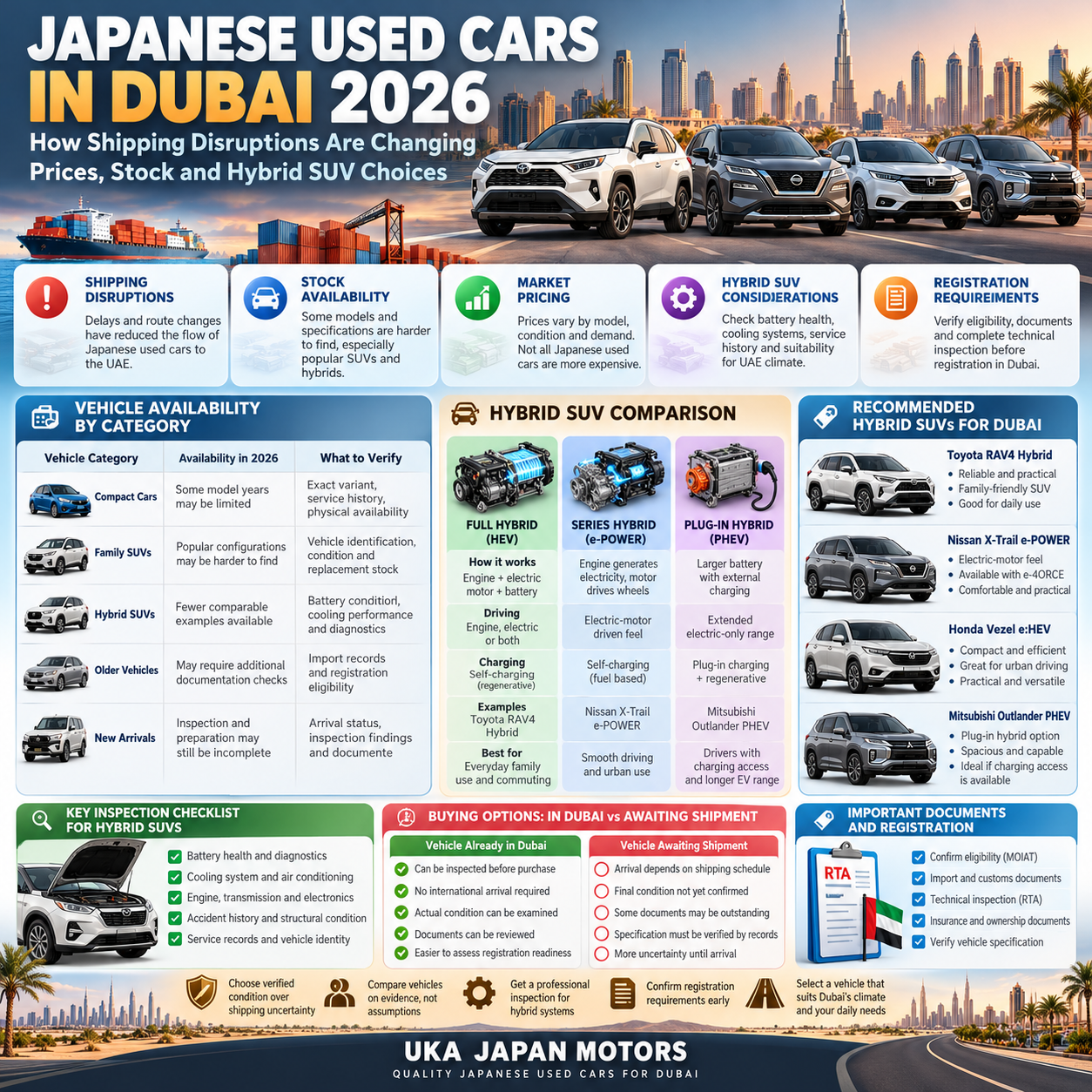
Introduction: A Changing Environment for Japanese Used Cars in Dubai
Japanese used cars remain an important part of Dubai’s automotive market, with buyers considering everything from compact passenger vehicles and practical family SUVs to full hybrids and plug-in hybrid models. Their appeal often comes from a combination of practical design, varied specifications and the availability of vehicles suited to different driving requirements.
In 2026, however, choosing a Japanese used car requires attention to another factor: the reliability of the international vehicle supply chain.
Shipping disruptions can affect the movement of vehicles from export facilities to destination ports, complicate delivery schedules and interrupt the regular replenishment of local stock. For buyers in Dubai, these developments can influence which models are available, how quickly particular variants can be sourced and how confidently an expected arrival date can be treated.
The effect is not identical across the market. A common Japanese passenger car already available in Dubai may be relatively straightforward to assess, while a specific hybrid SUV variant awaiting shipment can involve additional uncertainty. Even when two vehicles appear similar in photographs and specifications, their actual availability, documentation and condition may differ considerably.
Market pricing also requires careful interpretation. Shipping disruption can affect supply, but it does not automatically increase the value of every Japanese used car. Existing stock, model demand, vehicle condition, specification and the availability of alternatives all influence individual asking prices.
Hybrid SUVs introduce further considerations. A suitable vehicle must have a healthy powertrain, effective thermal management, appropriate maintenance records and a specification that meets the owner’s needs. In the UAE’s hot climate, the condition of the air-conditioning system and any dedicated hybrid battery cooling arrangements deserves particular attention.
For buyers, the central issue is therefore not simply whether Japanese used cars are becoming harder to find. It is how to distinguish a genuinely suitable vehicle from one whose availability, condition or registration status remains uncertain.
This guide examines the relationship between shipping disruptions, Japanese used-car stock in Dubai, market pricing and hybrid SUV selection. It also explains how to approach vehicle inspections, import documentation and long-term ownership decisions in the UAE.
Quick Summary: What Buyers Need to Know in 2026
Shipping disruption can make the Japanese used-car market less predictable, but its effects vary by vehicle and supplier.
The main considerations are:
-
Availability: Some models, model years and equipment variants may become harder to source when shipments are delayed or stock replenishment becomes irregular.
-
Market pricing: Asking prices may respond to changes in supply and demand, but there is no universal price movement across every Japanese used vehicle.
-
Hybrid SUV selection: Buyers should evaluate the specific powertrain, battery condition, cooling systems and maintenance history rather than choosing solely by brand or fuel-system type.
-
Import documentation: Physical arrival does not automatically establish registration eligibility.
-
Purchase timing: A vehicle already available for inspection provides a different level of certainty from one that is still in transit.
-
Long-term ownership: Climate suitability, service support, replacement-component availability and daily driving requirements should influence the final choice.
The most reliable approach is to assess the actual vehicle, establish what can be verified and separate confirmed information from shipping estimates or general market expectations.
1. Why Shipping Disruptions Matter to Dubai’s Japanese Used-Car Market
Dubai’s automotive supply chain depends on the coordinated movement of vehicles through export facilities, maritime transport, destination ports, customs procedures and local vehicle preparation.
Japanese used cars do not become available to UAE buyers immediately after they are selected for export. They must pass through several stages, each of which can affect the timing and certainty of delivery.
How the import process works
A typical imported used vehicle follows this sequence:
-
Vehicle selection and export preparation: The vehicle is identified, its documentation is prepared and the necessary export arrangements are completed.
-
Port handling and vessel loading: The vehicle is transported to the departure facility and prepared for shipment.
-
International transport: The vessel follows its assigned route and schedule.
-
Arrival and handling: The vehicle is discharged and processed at the destination port.
-
Customs and import procedures: Applicable documentation and clearance requirements are addressed.
-
Local inspection and preparation: The vehicle’s condition, equipment and documentation are reviewed.
-
Registration-related checks: The applicable eligibility, technical inspection and registration requirements are completed.
A delay at one stage can affect the subsequent stages. For example, completing export documentation does not mean that a vehicle has been loaded onto a vessel. Similarly, arriving at a UAE port does not necessarily mean that the vehicle is ready for registration.
Shipping disruption can affect different consignments in different ways. One shipment may experience a delay before departure, while another may encounter a change in routing or arrival arrangements.
For buyers, understanding the vehicle’s current stage is more useful than relying on a general statement that Japanese imports are delayed.
Why stock availability can become uneven
The effect of shipping disruption depends partly on how much local stock is already available.
If a seller has several comparable vehicles in Dubai, a delayed shipment may have limited immediate impact on the buyer’s options. If the seller relies on a forthcoming consignment to replenish a particular model, the same disruption may significantly reduce the number of examples available.
The result can be an uneven market in which some vehicles remain accessible while others become temporarily difficult to source.
This is especially relevant when buyers are searching for a specific combination of:
-
Model year and generation.
-
Engine or hybrid powertrain.
-
Trim level and factory equipment.
-
Exterior and interior configuration.
-
Seating capacity.
-
Safety and driver-assistance features.
A buyer seeking a general family SUV may have several alternatives. Someone requiring a particular plug-in hybrid configuration or a specific Japanese-market variant may have fewer suitable choices.
The distinction is important because a shortage of one specification does not necessarily indicate a shortage of the entire vehicle category.
What shipping disruption does not establish
A disruption in vehicle transport does not prove that every Japanese used car is becoming scarce, that every import will be delayed or that every asking price will rise.
Those conclusions require evidence specific to the relevant models and market conditions.
For an individual buyer, the more useful questions are whether the chosen vehicle is physically available, whether its history can be verified, whether it has passed an appropriate inspection and whether the documentation supports its intended use in Dubai.
2. How Shipping Disruptions Affect Stock Availability
Stock availability is more complicated than the number of cars shown in online listings.
A vehicle advertised for sale may already be in Dubai, may have arrived but still require preparation, or may be awaiting shipment. These situations offer different levels of certainty.
Three stages of availability
| Availability stage | What it means | What buyers should establish |
|---|---|---|
| Physically available in Dubai | The actual vehicle can potentially be inspected locally | Condition, history, documentation and registration eligibility |
| Arrived but not fully prepared | The vehicle has reached the UAE but may require further processing | Outstanding inspections, documentation and preparation |
| Awaiting shipment or in transit | The vehicle has not completed the import journey | Confirmed location, shipment status, supporting records and expected next steps |
This distinction helps prevent a common misunderstanding: a vehicle described as available may not necessarily be ready for immediate inspection or registration.
Buyers should ask for a clear explanation of the vehicle’s current location and status. Where practical, the explanation should be supported by documentation rather than an informal estimate.
Which vehicle categories may experience different effects?
| Vehicle category | Potential supply issue | Important buyer check |
|---|---|---|
| Compact passenger cars | Particular generations or specifications may be temporarily limited | Confirm the exact variant and physical availability |
| Family SUVs | Popular configurations may be harder to replenish consistently | Compare actual condition, equipment and maintenance records |
| Hybrid SUVs | Fewer comparable vehicles may be available for simultaneous inspection | Verify battery condition and hybrid-system diagnostics |
| Older Japanese vehicles | Import records or registration suitability may require closer review | Check identification details and eligibility |
| Recently arrived vehicles | Inspection or preparation may remain incomplete | Establish what has been completed and what remains outstanding |
These are possible market effects rather than guaranteed outcomes. The availability of any individual model depends on local inventory, demand and the seller’s sourcing arrangements.
Why physical availability matters
A vehicle that is already in Dubai can usually be assessed more directly than one still travelling through the import process.
The buyer may be able to arrange an inspection, review the cabin and bodywork, assess the mechanical systems and establish whether the actual specification matches the advertised description.
For hybrid SUVs, this also allows a technician to evaluate the battery and related systems on the particular vehicle rather than rely solely on information supplied before shipment.
Physical availability does not guarantee good condition. A locally available car may still have accident damage, mechanical faults or incomplete documentation. Its advantage is that more of the relevant evidence can be examined before the purchase decision.
3. What Shipping Disruptions Mean for Japanese Used-Car Prices
Shipping disruption can influence asking prices through changes in supply, delivery uncertainty and the availability of comparable vehicles. However, the relationship between shipping conditions and market pricing is not straightforward.
It is important to distinguish between an asking price, an actual transaction value and the underlying condition of a vehicle.
An advertised figure represents the seller’s current position. It does not independently establish the vehicle’s market value or prove that shipping disruption has changed what buyers are willing to pay.
Why different models may respond differently
Consider two Japanese used vehicles with similar ages.
One is a commonly available passenger car with several comparable examples already present in Dubai. The other is a less frequently available hybrid SUV variant that depends on regular imported stock.
If shipments are delayed, the second vehicle may face a more restricted supply situation. Yet its asking price will still depend on demand, specification, condition and the alternatives available to buyers.
The first vehicle may experience little change if local stock remains sufficient. Alternatively, its market position could change for reasons unrelated to shipping.
This is why broad statements about Japanese used-car prices should not replace model-specific research.
Four factors that influence asking prices
1. Existing local inventory
Vehicles already in Dubai may continue to be offered even when replenishment slows. The quantity and condition of comparable local stock influence the options available to buyers.
2. Demand for particular models
A model with strong practical appeal may attract different levels of interest from a less commonly selected variant. Demand can affect market behaviour independently of shipping conditions.
3. Vehicle condition and history
A car with documented maintenance, consistent mileage evidence and sound mechanical condition should be evaluated differently from a superficially similar vehicle with unresolved issues.
4. Specification and equipment
Two vehicles carrying the same model name may differ in powertrain, safety equipment, trim, drivetrain and other features. Such differences complicate direct comparisons.
How to compare vehicles when market conditions are uncertain
Use a consistent evaluation process instead of assuming that limited availability justifies a particular asking price.
| Comparison factor | Questions to consider |
|---|---|
| Model identity | Are the vehicles from the same generation and model year? |
| Powertrain | Do they have the same engine, hybrid system and drivetrain? |
| Condition | Are there differences in accident history, repairs or maintenance? |
| Mileage | Can the recorded mileage be supported by available evidence? |
| Equipment | Are the safety, comfort and convenience features equivalent? |
| Hybrid health | Have the relevant battery and electronic systems been assessed? |
| Availability | Is each vehicle physically present or dependent on future shipping? |
| Documentation | Can the vehicle’s history and registration pathway be verified? |
This approach helps separate genuine differences in vehicle quality from differences in market availability.
Why buyers should avoid making assumptions about future prices
It is not possible to determine from shipping disruption alone whether a particular Japanese used car will become more or less desirable in the future.
A shortage may affect one model without materially affecting another. New arrivals may also change the selection available in Dubai.
Rather than attempting to predict the market from headlines, buyers should focus on their requirements, the condition of the available vehicles and the evidence supporting the individual purchase.
4. Understanding Hybrid SUVs Before Choosing One
Hybrid SUVs are an important option for buyers who want a combination of passenger space, SUV practicality and electrified powertrain technology.
However, hybrid is a broad term. Different systems operate in different ways, and these differences influence driving behaviour, maintenance requirements and suitability for individual owners.
Before comparing models, it is useful to understand the three main categories.
Full hybrid: HEV
A full hybrid combines a combustion engine, an electric motor and a battery.
Depending on the design and driving conditions, the vehicle may move using the electric motor, the engine or both together. Regenerative braking can recover some energy during deceleration, while the engine may also recharge the battery.
A conventional full hybrid does not generally require external charging.
For buyers who cannot regularly access charging facilities, this arrangement may be more practical than a plug-in hybrid, provided the vehicle suits their daily requirements.
Series hybrid and engine-generator systems
Nissan’s e-POWER system uses an electric motor to drive the wheels while the combustion engine generates electricity.
This arrangement can provide a driving experience characterised by electric-motor propulsion, but it remains dependent on fuel and retains engine-related maintenance requirements.
Buyers should understand the specific system fitted to the vehicle rather than assuming that every hybrid operates like a conventional HEV.
Plug-in hybrid: PHEV
A plug-in hybrid has a rechargeable battery that can be charged using an external power source.
Depending on the model and battery condition, it can generally support more electric-only driving than a conventional full hybrid.
However, a plug-in hybrid is most suitable when the owner can accommodate regular charging and the vehicle’s charging equipment and battery are in good condition.
A buyer who cannot charge conveniently should consider whether the vehicle’s additional complexity and charging requirements suit their circumstances.
Comparing the main hybrid systems
| Feature | Full hybrid (HEV) | Series hybrid, such as e-POWER | Plug-in hybrid (PHEV) |
|---|---|---|---|
| Main driving arrangement | Engine, electric motor or both, depending on design | Electric motor drives the wheels; engine generates electricity | Engine and electric drive, depending on design |
| External charging | Generally not required | Generally not required | Supported |
| Electric-only operation | Available under suitable conditions, depending on model | Electric motor provides propulsion; operating details vary | Typically supports a greater electric-only driving range |
| Main ownership consideration | Battery, engine and hybrid-system condition | Generator, engine, electric drive and control systems | Battery, charging equipment and combined powertrain |
| Suitable buyer | Someone seeking a conventional self-charging hybrid | Someone interested in electric-motor-driven operation without routine external charging | Someone with practical access to charging |
These are general descriptions. The exact operating behaviour and maintenance requirements depend on the vehicle’s design.
5. Japanese Hybrid SUVs to Consider for Dubai
Several Japanese hybrid SUVs illustrate the different requirements buyers may have. Their suitability depends on the exact variant, physical condition, equipment and registration eligibility.
The following models are examples for comparison, not a representation of current stock availability.
Toyota RAV4 Hybrid
The Toyota RAV4 Hybrid is a practical candidate for buyers looking for a family-oriented SUV with a conventional hybrid powertrain.
When assessing a used example, verify:
-
The exact model year and generation.
-
Battery condition and available diagnostic results.
-
Engine and hybrid-system service history.
-
Air-conditioning performance.
-
Suspension, steering and braking condition.
-
The actual safety and convenience equipment fitted.
Do not assume that all RAV4 vehicles carry the same specification or hybrid-system configuration.
Nissan X-Trail e-POWER
The Nissan X-Trail e-POWER is relevant to buyers who prefer an electric-motor-driven experience within an SUV format.
Important checks include the operation of the engine-generator system, electric drive, cooling arrangements and relevant electronic controls.
Buyers should also establish whether the specific vehicle has e-POWER, whether it includes e-4ORCE all-wheel drive and which safety features are installed. These details should be confirmed against the vehicle itself and its documentation.
Honda Vezel e:HEV
The Honda Vezel e:HEV is a compact crossover that may suit buyers who prioritise urban manoeuvrability and everyday passenger use.
The inspection should cover the hybrid powertrain, transmission operation, service records, cabin condition and the exact equipment specification.
Its suitability depends on the driver’s space requirements and the particular vehicle’s condition rather than the model name alone.
Mitsubishi Outlander PHEV
The Mitsubishi Outlander PHEV is worth considering for buyers who want a plug-in hybrid SUV and can accommodate external charging.
In addition to conventional mechanical checks, examine battery health, charging operation, charging equipment and the operation of the electric and combustion powertrains.
Charging compatibility and practical access to a suitable charging point should be established before purchase.
Choosing between the models
| Primary requirement | What to prioritise |
|---|---|
| Everyday commuting and family errands | Hybrid operation, comfort, service history and air conditioning |
| Electric-motor-driven experience | Exact powertrain design and diagnostic condition |
| Compact urban use | Exterior dimensions, parking convenience and passenger access |
| Regular electric-only journeys | Plug-in capability, battery condition and charging access |
| Longer journeys | Highway performance, cooling condition and powertrain operation |
| Family flexibility | Rear-seat space, luggage capacity and installed safety features |
No single model is automatically the best choice for every driver in Dubai. The actual vehicle, its condition and its intended use should determine the decision.
6. Why the UAE Climate Makes Hybrid Inspection Important
Dubai’s climate places substantial demands on air conditioning, cooling systems and vehicle components exposed to heat.
Hybrid vehicles add another consideration because their powertrains may include dedicated battery and inverter cooling arrangements in addition to conventional engine cooling.
High temperatures do not automatically mean that a hybrid battery is defective. Battery condition depends on several factors, including chemistry, age, operating temperatures, maintenance, cooling performance and the vehicle’s control systems.
Nevertheless, buyers should give these systems appropriate attention.
Battery health and diagnostic evidence
A suitable hybrid inspection may examine:
-
Available battery-health information.
-
Battery voltage and monitored block data, where supported.
-
Differences between monitored battery sections.
-
Stored, pending and active diagnostic fault codes.
-
Evidence of previous battery repairs or replacement.
-
Cooling fans, ducts and associated components.
-
Signs of water ingress, corrosion or physical damage.
Not every hybrid model provides identical diagnostic information. Results should be interpreted by a technician familiar with the particular system.
A statement that a battery is healthy should be supported by appropriate evidence wherever possible.
Cooling system and air conditioning
Check whether the cabin air conditioning cools consistently, including after the vehicle has been running.
The inspection should also cover the engine cooling system and any separate inverter or battery cooling arrangements fitted to that model.
Look for coolant leaks, unusual fan behaviour, warning messages and evidence of previous overheating.
Where the battery uses dedicated ventilation, confirm that the air intake and related pathways are unobstructed. Depending on the design, dust or restricted airflow may affect cooling performance.
Engine, transmission and electronic systems
Even when electric propulsion is prominent, a hybrid’s combustion engine and related mechanical systems remain important.
A comprehensive inspection should consider:
-
Engine operation and fluid leaks.
-
Transmission or hybrid transaxle behaviour.
-
Transitions between operating modes.
-
Regenerative braking.
-
Conventional braking-system condition.
-
Steering, suspension and wheel alignment.
-
Hybrid control systems and warning indicators.
-
Charging operation on plug-in hybrids.
Where appropriate, a road test can help identify faults that do not appear during a stationary inspection.
Accident history and structural condition
Inspect the chassis, underbody, body panels and paintwork for signs of accident damage or previous repairs.
Seat belts, airbags and warning indicators should also be examined. Any evidence of significant structural repair should be investigated to determine the nature and quality of the work.
A vehicle’s clean appearance does not establish that its structure or safety systems are in good condition.
Service history and vehicle identity
Where records are available, compare the VIN or chassis details, mileage entries and maintenance history.
For Japanese-market vehicles, original documentation can help establish the vehicle’s identity and specification. It should not, however, be treated as a replacement for physical inspection.
Dubai’s Roads and Transport Authority offers a Technical Vehicle Status Report service that can provide historical information for imported vehicles from Japan. The authority also cautions that a report may not identify every defect, reinforcing the importance of an independent technical inspection.
7. Import Documentation and Registration Requirements in Dubai
Shipping disruption can draw attention to the arrival date of a vehicle, but arrival is only one part of the import process.
A vehicle must also satisfy the applicable documentation, eligibility and technical requirements before it can be registered for use on Dubai’s roads.
Check registration eligibility early
The UAE Ministry of Industry and Advanced Technology provides a Product Status Statement service for used imported vehicles. This service is intended to confirm eligibility for registration in the UAE traffic system and requires the vehicle’s unified identification number.
This is particularly relevant when considering a vehicle with an unusual specification, an unclear history or uncertain compliance status.
Do not assume that a vehicle can be registered merely because it has been imported or is being offered for sale in the UAE.
Understand Japanese-market specifications
Japanese-market vehicles may differ from GCC-specification vehicles in lighting, safety equipment, infotainment, language settings and other details.
The relevant question is whether the specific vehicle meets the requirements applicable to its intended use and registration.
Before purchase, confirm its specification and investigate whether any additional approvals or documentation are required.
Documents that may be relevant
Depending on the vehicle and transaction, the process may involve:
-
Customs and import documentation.
-
Export or transfer records, as applicable.
-
Vehicle identification details.
-
Relevant conformity or eligibility documentation.
-
Insurance documentation.
-
Technical inspection results.
Dubai RTA’s published registration guidance identifies technical inspection and the relevant ownership or import documentation among the requirements for applicable used and imported vehicles. The exact requirements depend on the transaction and vehicle category.
If any requirement is unclear, verify it with the relevant UAE authority before proceeding.
Separate shipping status from registration status
These are two distinct questions.
Shipping status: Where is the vehicle, and what stage of the transport process has it reached?
Registration status: What eligibility checks, technical requirements and documentation must be completed before the vehicle can be registered?
A vehicle may have arrived but still require documentation or inspection. Another may have completed its export paperwork but remain in transit.
Keeping these questions separate gives buyers a more accurate understanding of what remains outstanding.
8. Buying a Vehicle Already in Dubai or Waiting for Shipment
A useful decision in the current market is whether to focus on vehicles physically available in the UAE or consider one that has not yet arrived.
Neither option is automatically better. The difference is how much can be verified before the purchase decision.
| Consideration | Vehicle already in Dubai | Vehicle awaiting shipment |
|---|---|---|
| Physical inspection | Can generally be arranged locally | Depends on access to the vehicle before departure |
| Delivery certainty | International arrival is no longer outstanding | Depends on the shipping arrangements |
| Mechanical condition | The actual vehicle can be examined | Final condition on arrival still needs confirmation |
| Documentation | Available import and local documents can be reviewed | Some arrival or clearance documents may remain outstanding |
| Specification | Can be checked against the actual vehicle | Initially depends on records and supporting evidence |
| Registration readiness | Can be investigated against the vehicle and documents | May remain uncertain until applicable checks are completed |
A vehicle awaiting shipment may still be suitable when its identity, condition, shipping arrangements and intended registration pathway are properly documented.
However, an estimated arrival date should not be treated as a confirmed delivery commitment.
For a vehicle already in Dubai, arrange the inspection before finalising the decision wherever possible. For a vehicle still in transit, establish which claims are supported by records and which remain provisional.
The principle is simple: the commitment should reflect the evidence available.
9. Long-Term Ownership Considerations for Dubai Drivers
A suitable Japanese used car must match the conditions in which it will be driven. The vehicle’s original specification is only one part of that decision.
Daily commuting and stop-start traffic
Frequent stop-start driving creates different operating conditions from uninterrupted highway travel.
Hybrid systems can be useful in certain urban situations because regenerative braking and electric-motor assistance may reduce reliance on the combustion engine. Actual performance depends on the system, vehicle condition, driving pattern and operating conditions.
Assess the vehicle against realistic journeys rather than relying on broad efficiency claims.
Heat exposure and cabin comfort
Air-conditioning performance is central to daily usability in Dubai.
Check that the cabin cools effectively and that the system operates consistently. For hybrids, pay additional attention to battery and inverter thermal management where applicable.
If the vehicle is regularly parked outdoors, consider the effect of prolonged heat exposure on its cabin materials, rubber components and general condition. This does not automatically make outdoor parking unsuitable, but it reinforces the importance of maintenance and preventive care.
Maintenance support and parts availability
Before choosing an uncommon hybrid variant, establish whether suitable technical expertise, diagnostic equipment and replacement components are accessible within the UAE.
A sophisticated powertrain can be appropriate when it is maintained correctly. However, unclear service support can complicate ownership when a specialist component needs diagnosis or replacement.
Investigate the specific model’s requirements instead of assuming that every vehicle from the same manufacturer has identical maintenance needs.
Passenger space and practical use
The most suitable SUV is not necessarily the largest or most technically advanced.
Consider rear-seat access, luggage capacity, parking convenience, visibility and the equipment needed for everyday use.
A vehicle that meets these practical requirements and has a verifiable maintenance history may be more appropriate than an alternative selected primarily because of its model reputation.
10. A Practical Pre-Purchase Checklist
Before committing to a Japanese used car in Dubai, work through the following checks.
Vehicle identity
-
Confirm the model year, variant and VIN or chassis details.
-
Establish the exact powertrain and installed equipment.
-
Verify that the advertised specification matches the actual vehicle.
Availability and shipping
-
Confirm whether the vehicle is physically in Dubai, at a port or still in transit.
-
Establish which delivery details are confirmed.
-
Identify any outstanding import or preparation steps.
Mechanical and structural condition
-
Review the maintenance history and mileage evidence.
-
Arrange an independent mechanical inspection.
-
Check the bodywork, underbody, suspension, brakes and electronics.
-
Investigate accident damage and previous repairs.
Hybrid-specific checks
-
Request suitable battery diagnostics.
-
Assess battery and inverter cooling arrangements.
-
Check the engine, transmission and hybrid control systems.
-
Verify charging operation and equipment on plug-in hybrids.
Documentation and registration
-
Review available import and customs documentation.
-
Confirm the relevant eligibility and conformity requirements.
-
Establish the applicable technical inspection and registration steps.
-
Resolve uncertainties with the appropriate UAE authority.
Long-term suitability
-
Consider daily driving patterns and passenger requirements.
-
Assess air conditioning and heat-related maintenance needs.
-
Confirm access to appropriate servicing and replacement components.
-
Choose a powertrain that matches practical charging and maintenance arrangements.
This checklist supports a structured decision but does not replace an official eligibility assessment or a professional vehicle inspection.
11. How UKA Japan Motors Supports an Informed Buying Decision
In a market affected by changing shipping schedules, buyers need clear information about individual vehicles rather than broad assurances about Japanese imports as a category.
UKA Japan Motors’ role is to support informed vehicle selection through transparent communication, attention to vehicle condition and awareness of applicable import and registration requirements.
For buyers considering Japanese used cars in Dubai, the important questions include:
-
Is the specific vehicle available for inspection?
-
Can its identity, specification and available history be verified?
-
Have relevant mechanical and hybrid-system checks been considered?
-
Are the import documents and registration pathway understood?
-
Are any outstanding matters clearly identified before the buying decision?
These questions are particularly important for hybrid SUVs, where battery condition, thermal management and electronic controls can affect the ownership experience.
No general description can establish that an individual vehicle is mechanically sound. An inspection also cannot guarantee that future faults will not occur. Findings should be explained clearly, with additional specialist assessment recommended where necessary.
The same transparency should apply to shipping information. Buyers should be able to distinguish confirmed availability from expected transport progress and outstanding administrative requirements.
A trust-based approach means explaining what is known, identifying what remains uncertain and helping buyers understand the next appropriate step.
Frequently Asked Questions
1. Are Japanese used cars harder to find in Dubai in 2026?
Some models and specifications may be harder to source when shipping disruption affects vehicle movement and stock replenishment. However, availability varies by model, demand and existing local inventory. Confirm the physical availability of the specific vehicle rather than assuming every Japanese used car is affected equally.
2. Are shipping disruptions increasing Japanese used-car prices in Dubai?
Shipping disruption can influence asking prices through changes in supply and demand, but the effect is not uniform. Individual prices also depend on specification, vehicle condition and available alternatives. Compare equivalent vehicles and their inspection findings instead of relying on general claims about market direction.
3. Should I buy a Japanese used car that has not arrived in Dubai?
It may be appropriate if the vehicle’s identity, condition, shipping arrangements and intended registration pathway are adequately documented. However, the final physical condition and arrival timing cannot be established through an advertisement alone. Understand what remains unconfirmed before committing.
4. Which hybrid SUV is suitable for daily driving in Dubai?
The right choice depends on passenger needs, daily travel patterns, maintenance requirements and the vehicle’s condition. The Toyota RAV4 Hybrid, Nissan X-Trail e-POWER and Honda Vezel e:HEV illustrate different options. Each should be assessed by exact variant, battery condition and suitability for UAE ownership.
5. Is a Japanese-market hybrid SUV suitable for the UAE climate?
It can be suitable when its cooling systems, battery management and air conditioning are in sound condition. Japanese-market origin alone does not establish suitability. Inspect the specific vehicle and confirm its applicable registration and compliance requirements.
6. How can I check the battery health of a used hybrid SUV?
Arrange a diagnostic assessment by a technician familiar with the vehicle. Depending on the model, the assessment may examine battery-health data, voltage variation, fault codes, cooling components and previous repairs. A dashboard warning-light check alone is insufficient.
7. Can every Japanese used car be registered in Dubai?
No. Registration depends on the vehicle’s circumstances, documentation, eligibility requirements and technical checks. The UAE Ministry of Industry and Advanced Technology provides a Product Status Statement service for used imported vehicles, while Dubai RTA publishes applicable registration procedures. Verify the requirements for the exact vehicle before purchase.
8. What documents should I check before buying an imported Japanese car?
Review the vehicle identification details, relevant customs and import documentation, export or transfer records, and any required conformity or eligibility documents. Insurance and technical inspection requirements should also be confirmed as applicable. The precise documentation depends on the vehicle and registration transaction.
9. Is a vehicle already in Dubai always a safer choice than one awaiting shipment?
Not necessarily. A locally available vehicle is easier to inspect physically, but it may still have mechanical defects, accident damage or incomplete documentation. A vehicle awaiting shipment may be suitable if its history and arrangements are adequately documented. The important difference is how much can be verified before the decision.
10. What should I inspect first when considering a Japanese hybrid SUV?
Start with vehicle identity, maintenance history, accident history and overall mechanical condition. Arrange a model-specific assessment of the hybrid battery, cooling system, electronic controls and powertrain. Finally, verify that the vehicle’s specification and documentation support its intended use and registration in Dubai.
11. Does a Japanese used car need a technical inspection before registration in Dubai?
Applicable registration procedures for used and imported vehicles include technical inspection requirements. The exact process depends on the vehicle and transaction. Confirm the current requirements with Dubai RTA or the relevant authority before proceeding.
12. Should I choose a full hybrid or a plug-in hybrid for Dubai?
A full hybrid may be more practical for someone who does not have regular access to charging. A plug-in hybrid may suit a driver who can charge consistently and wants greater electric-only driving capability. Both require condition checks, and the correct choice depends on the vehicle’s design and the owner’s routine.
Conclusion: Make the Vehicle’s Condition the Priority
Shipping disruption has made the movement and availability of Japanese used cars less predictable in 2026. It can influence stock selection and market pricing, but it does not change the fundamentals of a sound buying decision.
A suitable vehicle should have a verifiable identity, an acceptable maintenance and accident history, sound mechanical condition and a clear registration pathway. Hybrid SUVs require additional attention to battery diagnostics, thermal management and access to appropriate technical support.
Buyers should distinguish between vehicles already available in Dubai and those still in transit, compare equivalent models using evidence and avoid allowing temporary stock limitations to overshadow inspection findings.
The strongest decision is not necessarily the fastest purchase or the newest available model. It is the vehicle whose condition, specification, documentation and long-term suitability can be established with confidence.
Contact UKA Japan Motors for availability and inspection guidance.