


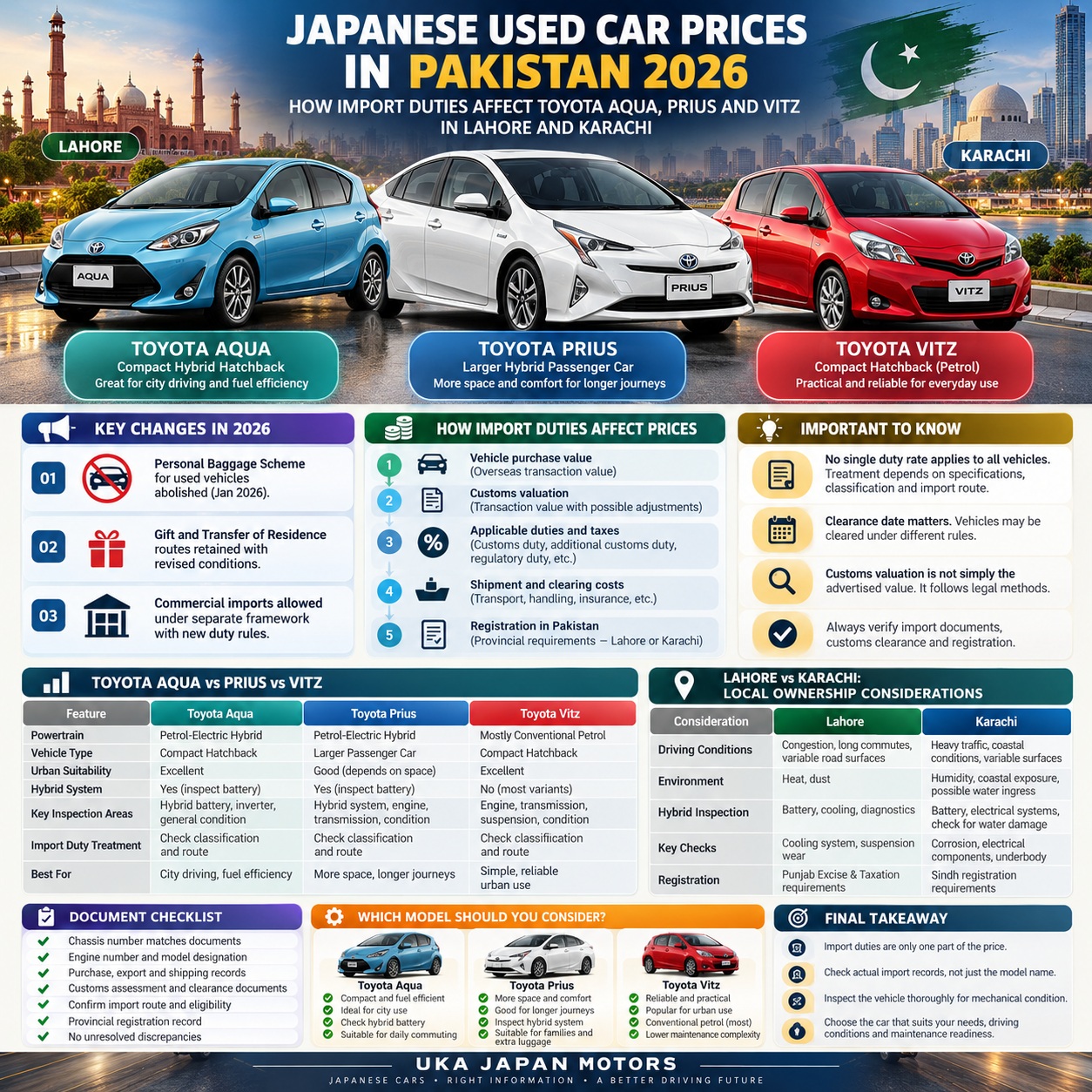
Introduction: Why a Japanese car’s price tells only part of the story
When buyers in Lahore or Karachi compare Japanese used cars, the first questions are often about the model year, mileage, condition and equipment. Yet these details explain only part of a vehicle’s position in Pakistan’s market. Its import history, customs assessment, clearance status and registration documents can be equally important.
This is particularly relevant when comparing the Toyota Aqua, Toyota Prius and Toyota Vitz. These vehicles are frequently considered for everyday urban driving, but they differ in powertrain, dimensions, mechanical requirements and the specifications that must be established for regulatory purposes.
Pakistan’s import framework also changes over time. The rules applicable to a vehicle cleared in an earlier period may differ from those applicable to a vehicle imported under a later notification. Consequently, a statement about import duties is useful only when it identifies the relevant vehicle category, import route and effective date.
For a prospective buyer, the central question is not simply whether import duties have increased or decreased. It is how the applicable rules affect the vehicle being considered, what evidence establishes that it was imported and cleared correctly, and whether its condition justifies proceeding with the purchase.
Lahore and Karachi add another dimension to the decision. Daily traffic, road conditions, summer heat, dust, humidity and the possibility of water exposure influence the practical inspection required before ownership. A car with complete documentation may still have mechanical problems, while a mechanically sound vehicle may require clarification of its import or registration records.
This article examines the relationship between import regulations and the local used-car market in 2026, with a focus on the Toyota Aqua, Prius and Vitz. It explains how customs valuation works, which documents matter, how the three models differ, and what buyers should verify before making a decision.
The aim is to help readers distinguish confirmed regulatory requirements from general market claims and assess an individual vehicle on evidence rather than assumptions.
1. The three different values behind an imported car’s market position
One reason buyers misunderstand Japanese used-car prices is that they often treat the overseas vehicle value, customs value and local asking amount as if they were the same figure. They serve different purposes.
The difference becomes important when a buyer compares two vehicles that look similar but have different import histories.
Overseas transaction value
This is the amount paid or payable for the vehicle in the overseas transaction, subject to the applicable customs valuation rules. Supporting evidence may include purchase documentation, auction records where relevant, export documents and payment records.
An auction grade or overseas inspection report may help explain a vehicle’s condition, but neither establishes its final customs treatment by itself.
Customs-assessed value
Pakistan’s customs valuation framework generally uses transaction value where the legal requirements are satisfied. Where it cannot be accepted, alternative valuation methods under the Customs Act, 1969 may apply. Relevant additions and adjustments can also affect the value used for assessment.
The key point is that the customs-assessed value must be understood under the applicable legal process. A buyer should not assume that an online auction figure is automatically the value accepted by Customs.
Landed vehicle position
The landed position includes the vehicle’s arrival and import-related requirements, with relevant shipment, handling, clearance and other applicable components taken into account.
It is useful to distinguish these components from duties and taxes because logistics and administrative charges are not all customs duties. Their applicability and calculation can depend on the shipment and the services involved.
Local asking amount
The amount requested by a seller in Lahore or Karachi reflects a different set of considerations. These may include the vehicle’s condition, documentation, registration status, maintenance history, equipment and the seller’s assessment of the local market.
A local asking amount is not proof of the customs value, and it does not establish that the vehicle was cleared correctly.
| Value or record | Main purpose | What it does not prove |
|---|---|---|
| Overseas purchase evidence | Establishes the transaction history | Final customs assessment |
| Customs assessment | Establishes the assessment basis under applicable rules | Mechanical condition |
| Clearance records | Support the vehicle’s import-clearance history | That the car has no accident damage |
| Registration documents | Establish registration status | Hybrid battery or engine health |
| Local asking amount | States the seller’s requested amount | Legal compliance or vehicle quality |
These distinctions help buyers avoid relying on a single number when several different questions need to be answered.
2. Pakistan’s 2026 import-policy changes and their practical significance
Pakistan’s used-vehicle import rules are not static. Buyers need to understand the policy applicable to a vehicle’s actual import route and clearance rather than relying on an old article or a statement made before a regulatory change.
The Personal Baggage Scheme was abolished
The Ministry of Commerce issued SRO 61(I)/2026 in January 2026, abolishing the Personal Baggage Scheme for used vehicles and revising conditions under the retained Gift and Transfer of Residence schemes. The changes include requirements concerning eligibility and the country associated with a Transfer of Residence import.
This matters because an explanation based on the former scheme may no longer describe a valid route for a new import in 2026.
Buyers should ask which scheme or commercial-import provision was actually used and check the relevant records. A seller’s verbal description should not substitute for the applicable import documents.
Gift and Transfer of Residence are not unrestricted routes
The continued existence of these schemes does not mean that every buyer can use them or that any used vehicle can be imported without satisfying their conditions.
Eligibility, supporting documentation, vehicle requirements and restrictions must be checked against the operative policy. The January 2026 amendments also address safety, environmental and regulatory measures applicable to vehicles imported under the retained schemes.
For a vehicle already available locally, buyers should establish the actual import history rather than assuming that its model year or country of manufacture identifies the route used.
Commercial imports have a distinct duty framework
Commercial imports of used vehicles are governed by their own policy and customs provisions. In September 2025, the government announced a framework allowing commercial imports of used vehicles under specified conditions and initially imposing an additional 40% regulatory duty on eligible commercial imports of vehicles less than five years old until 30 June 2026.
That initial arrangement should not be treated as the definitive rate for the entire remainder of 2026. The FBR lists SRO 1065(I)/2026, dated 30 June 2026, as the notification replacing the previous regulatory-duty notification for commercial imports of vehicles. It also lists updated notifications concerning additional customs duty and regulatory duty.
Consequently, the current treatment of a commercial import must be established from the operative notification and relevant tariff provisions. An older percentage should not be repeated as a universal rate for every Toyota Aqua, Prius or Vitz.
Where to verify the rules
The most relevant official sources are:
-
The Federal Board of Revenue’s customs tariff and operative customs notifications.
-
The Ministry of Commerce’s Import Policy Order amendments.
-
The applicable customs classification and statutory provisions.
-
The vehicle’s own assessment and clearance records.
The FBR publishes the Pakistan Customs Tariff for financial year 2026–27 and the updated Fifth Schedule to the Customs Act, 1969. These should be considered alongside the applicable notifications, not in isolation.
The distinction is important: a policy announcement describes the intended framework, while the operative legal instruments determine the treatment that must be applied to a particular import.
3. Why model year, engine specification and import route must be considered together
A common mistake is to assume that every car carrying the same model badge receives identical import treatment. In practice, the exact vehicle specification and the applicable regulatory provisions matter.
The manufacturing year may be relevant to eligibility under a particular scheme. Engine capacity and vehicle configuration may be relevant to classification or a specific provision. The import route and clearance date determine which rules need to be examined.
These factors should be considered together.
For example, a Toyota Prius from one generation may have a different engine specification from a Prius in another generation. The same applies to different Aqua and Vitz variants. An advertisement that states only the model name leaves important details unresolved.
A proper assessment should establish:
-
The exact model designation and manufacturing date.
-
The engine capacity and powertrain configuration.
-
The applicable customs tariff classification.
-
The import route and its eligibility conditions.
-
The regulations and notifications applicable to the clearance.
-
The consistency of the physical vehicle with the supporting records.
This is not merely a paperwork exercise. A mismatch between the vehicle and its records may raise questions about its identity, classification or legal status.
Buyers should also avoid assuming that a hybrid badge automatically establishes eligibility for a special duty treatment. Any exemption or concession must be supported by the applicable legal provision and the vehicle’s actual specifications.
4. Toyota Aqua: compact dimensions, hybrid inspection and documentation
The Toyota Aqua is a compact hybrid hatchback often considered for everyday commuting. Its size can be useful in Lahore’s congested streets and Karachi’s crowded parking areas, but the suitability of a particular vehicle depends on its condition, generation and the driver’s requirements.
What makes the Aqua different?
Many Aqua variants combine a petrol engine with an electric motor and hybrid battery. The system manages the use of the engine and electric drive according to driving conditions, while regenerative braking can recover some energy during deceleration.
In stop-and-go traffic, hybrid operation can be useful, but the result depends on battery condition, system health, temperature and driving behaviour. The hybrid designation alone does not establish that a used car is mechanically sound.
What should an Aqua buyer examine?
The inspection should cover the hybrid battery, cooling arrangements, inverter and diagnostic information, alongside the engine, transmission-related components, braking system and suspension.
A diagnostic scan can help identify stored faults, but it should not be treated as a complete health certificate. Battery performance and the operation of the wider hybrid system need to be assessed using suitable procedures.
The body and underbody should also be checked for signs of structural repair, corrosion or water exposure. In Karachi, particular attention to electrical components and possible water ingress is prudent. In Lahore, cooling performance and wear associated with prolonged traffic use deserve attention.
What about import duties?
The Aqua’s hybrid powertrain does not by itself determine its applicable duty treatment. The exact engine specification, customs classification, import route and clearance date must be established.
A buyer should not assume that an Aqua has qualified for a particular exemption merely because the advertisement describes it as a hybrid. The relevant legal provision and vehicle-specific documentation must support that conclusion.
Who might find the Aqua suitable?
The Aqua may suit drivers who prioritise compact dimensions, routine urban commuting and hybrid operation. It may be less suitable for buyers who regularly carry substantial luggage or require a larger cabin.
The deciding factors should include the actual battery condition, the availability of competent diagnostic support, the vehicle’s maintenance history and the completeness of its import and registration records.
5. Toyota Prius: a larger hybrid with generation-specific requirements
The Toyota Prius offers a different passenger-car layout from the Aqua, with more cabin space in many versions. It can be considered by households or commuters who regularly carry passengers and luggage.
However, Prius models vary across generations. Buyers should identify the exact version instead of treating every vehicle with the Prius badge as mechanically identical.
Why generation matters
Different generations can have different engine specifications, hybrid-system designs, equipment and maintenance considerations. These differences affect the inspection required and may also be relevant to the vehicle’s customs classification.
The exact engine capacity and configuration should be confirmed from reliable vehicle records. A model name or an informal description is not enough to determine the applicable regulatory treatment.
What deserves attention during inspection?
A Prius inspection should include hybrid battery condition, inverter operation, cooling arrangements, diagnostic information, engine performance and transmission or transaxle operation appropriate to the version.
The suspension, steering, brakes and underbody also need to be assessed. Evidence of overheating, coolant loss, accident repair, corrosion or flood exposure warrants further investigation.
A short idle test may not reveal every problem. Where possible, the vehicle should be inspected under suitable operating conditions and checked with appropriate diagnostic equipment.
Import-policy considerations
The Prius should be assessed according to its exact specification and the rules applicable to its import route. Any claimed concession or special treatment must be supported by the relevant provision.
Buyers should also verify that the vehicle’s identification and clearance documents match its actual generation and configuration. If the records describe a different specification, the discrepancy should be resolved before proceeding.
Who might find the Prius suitable?
The Prius may suit drivers who need more passenger or luggage space than a compact hatchback provides and who can maintain its hybrid system appropriately.
It may be less suitable for someone who needs the smallest possible vehicle for confined parking or lacks access to reliable hybrid diagnostics and repair support.
The model should be judged on the individual car’s condition and suitability, not on an assumption that all Prius vehicles have the same maintenance needs or import status.
6. Toyota Vitz: a compact petrol car with a different inspection profile
The Toyota Vitz is another common consideration for urban driving. Many versions use a conventional petrol powertrain, although specifications vary by generation and variant. Buyers should confirm the exact engine and equipment rather than rely solely on the model name.
Why it belongs in the comparison
The Vitz can suit drivers who want a compact vehicle for everyday commuting without specifically seeking a hybrid powertrain. Its smaller footprint can help with parking and manoeuvring, while the cabin and luggage space should be assessed against the owner’s actual requirements.
Its conventional petrol configuration also creates a different inspection focus from that of a hybrid Aqua or Prius. Engine performance, transmission behaviour, cooling, suspension and electrical systems remain important.
What should be inspected?
A thorough inspection should consider:
-
Engine starting, idle quality, cooling performance and evidence of leaks.
-
Transmission operation and any abnormal noise or vibration.
-
Steering, brakes, suspension and tyre condition.
-
Signs of collision repair, corrosion or water ingress.
-
Chassis identity and consistency with the vehicle’s import and registration documents.
Odometer readings should be considered alongside the physical condition and available maintenance records. A low displayed mileage does not establish that a vehicle has been maintained properly.
How do import duties apply?
The Vitz should be assessed according to its actual specifications and applicable customs classification. A conventional petrol variant should not be treated as a hybrid simply because another vehicle in the comparison uses hybrid technology.
The relevant import route, clearance date and operative provisions must be verified. The vehicle’s badge is not evidence of its customs status.
Who might find the Vitz suitable?
The Vitz may suit drivers who want a compact car for everyday use and prefer a conventional petrol powertrain. It may not meet the needs of someone specifically seeking hybrid operation or greater cabin space.
Its suitability depends on the particular car’s mechanical condition, documented history and the owner’s driving requirements.
7. Comparing the Aqua, Prius and Vitz for ownership in Pakistan
The three models should be compared according to their intended use and inspection requirements rather than a general assumption about which has the most favourable import treatment.
| Feature | Toyota Aqua | Toyota Prius | Toyota Vitz |
|---|---|---|---|
| Typical powertrain | Petrol-electric hybrid | Petrol-electric hybrid | Commonly petrol; verify variant |
| Vehicle format | Compact hatchback | Larger hybrid passenger car | Compact hatchback |
| Urban driving | Suits compact-city use | Suits city and longer journeys, depending on needs | Suits compact-city use |
| Main technical checks | Battery, inverter, hybrid diagnostics | Battery, hybrid system, engine and transaxle | Engine, transmission and general mechanical condition |
| Passenger needs | Compact everyday use | More space in many versions | Compact everyday use |
| Import-duty assessment | Verify exact specification and route | Verify exact generation and route | Verify exact engine and route |
| Long-term consideration | Hybrid-system maintenance | Hybrid-system and broader mechanical maintenance | Conventional powertrain maintenance |
| Documentation priority | Clearance and registration records | Clearance and registration records | Clearance and registration records |
Which one should a buyer choose?
For compact urban use, the Aqua and Vitz are natural candidates to compare. The choice depends on whether hybrid operation, the condition of the individual vehicle or the preference for a conventional petrol powertrain is more important.
For buyers who regularly carry passengers or luggage, the Prius may be worth considering because of its larger layout in many versions.
For anyone concerned about import compliance, none of the three should be preferred on its badge alone. A complete documentary history and a satisfactory mechanical inspection are more meaningful than a broad assumption about model popularity.
The most appropriate vehicle is the one that matches the buyer’s routine, has a verifiable history and can be maintained properly.
8. Lahore and Karachi: how local driving conditions change the inspection
Import duties are governed by federal rules, but vehicle registration and everyday ownership involve local requirements and operating conditions. Buyers should therefore consider where and how a car will be used.
Lahore: traffic, heat and commuting
Lahore’s driving environment can involve extended traffic queues, frequent stops, long commutes and road surfaces that vary in quality. Summer heat and dust can place additional demands on cooling systems, air conditioning and routine maintenance.
For a hybrid vehicle, the battery and associated cooling arrangements deserve attention. For a petrol vehicle, cooling performance, transmission operation and the condition of the suspension are important.
A vehicle’s odometer alone cannot fully explain how much time it has spent operating in congestion. Service history, physical wear and a suitable mechanical inspection help provide a more complete picture.
Registration should be checked against the applicable Punjab Excise and Taxation requirements. The location where a car is advertised does not establish that its registration is complete.
Karachi: humidity, coastal exposure and water ingress
Karachi’s environment creates additional reasons to inspect the underbody, electrical connections and areas where moisture or corrosion can develop. Vehicles exposed to standing water or flooding may have problems that are not visible after the exterior has dried.
Hybrid vehicles need careful assessment because water exposure can affect electrical and electronic systems. Conventional petrol vehicles also require checks for corrosion, electrical faults and mechanical damage.
Buyers should distinguish between a vehicle that has arrived in Karachi and one whose import clearance and registration requirements have been completed. The city of arrival is not proof of legal status.
Local comparison
| Inspection factor | Lahore | Karachi |
|---|---|---|
| Driving pattern | Congestion, commuting and frequent stops | Heavy urban traffic and frequent stops |
| Environment | Heat, dust and variable road surfaces | Humidity, coastal exposure and possible water ingress |
| Hybrid checks | Battery, cooling and diagnostic condition | Battery, electrical components and water-damage checks |
| General mechanical checks | Cooling, suspension, steering and brakes | Corrosion, suspension, steering and brakes |
| Registration | Verify Punjab requirements | Verify Sindh requirements |
These are general considerations, not a claim that every vehicle in either city has experienced the same conditions.
9. The documents that establish a vehicle’s import history
Before deciding whether to proceed with a used Japanese car, establish that the available records correspond to the actual vehicle. Documentary verification should be separate from mechanical inspection because each addresses different risks.
The FBR’s vehicle-import guidance and the Ministry of Commerce’s import-policy documents explain the relevant frameworks and procedures. The documents required for an individual vehicle depend on the import route and operative requirements.
Vehicle identity
Start with the chassis number and other identifying details. Compare the physical markings with the import and registration records.
Any mismatch should be investigated. A seller’s explanation is not a substitute for appropriate verification, particularly where a number appears altered, unclear or inconsistent with the paperwork.
Import and clearance records
Ask to examine the relevant purchase and export documents, shipping records, Goods Declaration and customs assessment or clearance evidence, as applicable to the vehicle’s import history.
These records should support a coherent explanation of how the vehicle entered Pakistan and under which applicable route or provision it was cleared.
Registration status
Check the registration documents and the records maintained by the relevant provincial authority. Import clearance and registration serve different purposes and should not be treated as interchangeable.
If the registration record does not correspond with the vehicle’s identity or other supporting documents, the discrepancy should be resolved before a purchase decision.
A practical verification table
| Record or check | What to establish |
|---|---|
| Chassis number | Physical identity matches the documents |
| Engine and model details | Actual configuration matches the recorded specification |
| Purchase and export records | The vehicle’s transaction and export history are supported |
| Shipping documentation | Shipment details are consistent with the import history |
| Goods Declaration and customs records | Relevant assessment and clearance can be verified |
| Import route | The actual route and eligibility requirements are established |
| Registration record | The relevant provincial registration status is confirmed |
| Physical inspection | Mechanical condition and structural integrity are assessed |
Not every document will look identical across import routes. The objective is to establish a consistent, verifiable record appropriate to the vehicle’s actual circumstances.
10. Why duty-related claims need careful interpretation
A change in customs duty can affect the regulatory treatment of a vehicle, but it does not automatically determine its local market position.
Consider two Toyota Aqua vehicles of similar age. One may have completed customs clearance under an earlier applicable framework, while the other was cleared under a later one. Their documentation and import histories may differ even if their exterior appearance is similar.
The same principle applies to the Prius and Vitz. The existence of a new notification does not establish that every vehicle already in Pakistan receives a new assessment, nor does it prove that every seller’s explanation is correct.
When evaluating a duty-related claim, buyers should ask:
-
Which official notification or provision is being referenced?
-
When did the provision take effect?
-
Does it apply to the vehicle’s actual import route and classification?
-
What evidence confirms the vehicle’s clearance history?
The FBR’s operative notifications and current customs tariff are the appropriate starting points for checking such claims.
A claim that a particular model has become more or less attractive because of a duty change should be treated as incomplete until the relevant legal provision and vehicle-specific circumstances have been established.
11. Long-term ownership: the factors that import duties cannot tell you
Import compliance is important, but it cannot establish the mechanical condition of a car. A vehicle may have complete paperwork and still require substantial mechanical attention. Conversely, a well-maintained vehicle may need further documentary verification before its status is clear.
For the Aqua and Prius, hybrid-system health should be considered alongside ordinary maintenance. For the Vitz, the exact petrol-engine and transmission configuration should guide the inspection. All three require checks of the cooling system, suspension, steering, brakes, tyres and electrical components.
In Lahore, long periods in traffic and summer heat make cooling performance and maintenance history relevant. In Karachi, humidity, corrosion and potential water exposure deserve particular attention.
Four questions to answer before proceeding
Is the vehicle’s legal status clear?
Confirm that the import and registration records are complete and consistent with the physical vehicle.
Is the mechanical condition satisfactory?
Arrange an inspection that goes beyond exterior appearance. Where appropriate, include diagnostic testing, a road assessment and examination of the underbody.
Does the model fit the intended use?
Consider passenger capacity, luggage requirements, daily distance, parking conditions and the type of driving the vehicle will regularly experience.
Can the vehicle be maintained appropriately?
Consider access to suitable diagnostic equipment, technical expertise and the parts and maintenance support needed for the exact model and powertrain.
These questions are relevant regardless of whether the buyer chooses a hybrid or a conventional petrol car.
Frequently asked questions
1. How do import duties affect Japanese used-car prices in Pakistan in 2026?
Import duties and other applicable taxes contribute to the importer’s overall clearance requirements. Their treatment depends on the vehicle’s classification, specifications, import route and the rules effective at the time of assessment. Local market conditions and the vehicle’s condition also influence the seller’s asking amount.
2. Are Toyota Aqua, Prius and Vitz subject to the same import duties?
Not necessarily. The applicable treatment depends on the exact vehicle and the relevant legal provisions. Engine capacity, powertrain, classification, import route and clearance date should be established before drawing a conclusion.
3. Can every Toyota Aqua qualify for a hybrid-related duty concession?
No such assumption should be made. Any concession must be supported by the applicable provision and the vehicle’s actual specifications. The presence of a hybrid powertrain alone does not establish eligibility.
4. Is the Personal Baggage Scheme still available for used cars in 2026?
No. The Personal Baggage Scheme for used-vehicle imports was abolished through SRO 61(I)/2026 in January 2026. Gift and Transfer of Residence schemes were retained under revised conditions, while commercial imports are governed by their own provisions.
5. Does a new customs notification automatically change the treatment of a car already cleared?
Not automatically. The applicable legal provisions, their effective dates and the vehicle’s clearance history must be examined. A subsequent regulatory change should not be assumed to alter the assessment of every previously cleared vehicle.
6. How can I confirm the import history of a Japanese used car?
Request the relevant purchase, shipping, customs assessment and clearance records, including the Goods Declaration where applicable. Confirm that the records correspond to the vehicle’s chassis identity and seek appropriate official verification if there are discrepancies.
7. Is a registered car necessarily mechanically sound?
No. Registration and customs documentation establish aspects of legal and administrative status, not the vehicle’s mechanical health. A separate inspection should examine the engine, transmission, suspension, braking system and, for hybrids, the hybrid battery and associated components.
8. Which Toyota is more suitable for city driving in Lahore or Karachi?
The Aqua and Vitz are compact hatchbacks that may suit urban use. The Prius may be more appropriate for buyers who need additional passenger or luggage space. The final choice depends on the specific vehicle’s condition, the driver’s requirements and the availability of suitable maintenance support.
9. What should Karachi buyers check when inspecting a Japanese import?
In addition to confirming the import and registration records, examine the underbody, electrical connections and other areas vulnerable to corrosion or water ingress. Hybrid vehicles warrant particular care where flood exposure or electrical-system damage is suspected.
10. What should Lahore buyers prioritise during inspection?
Cooling performance, suspension condition, steering, brakes and maintenance history deserve attention given the combination of traffic, commuting and summer heat. Hybrid vehicles should also receive suitable battery and system diagnostics.
11. Can the advertised model year determine the applicable import-duty rate?
No. Model year can be relevant to eligibility, but it does not establish the complete tax treatment. The exact specification, import route, clearance date and operative provisions must also be considered.
12. Where can buyers verify Pakistan’s current import-duty rules?
The Federal Board of Revenue publishes customs tariffs and operative customs notifications, while the Ministry of Commerce publishes relevant import-policy amendments. For a particular vehicle, these sources should be considered alongside its own customs and clearance records.
UKA Japan Motors’ role in inspection and documentation
UKA Japan Motors approaches Japanese used-car evaluation through vehicle condition, identification and documentary consistency. Understanding import duties is one part of the process; it should not replace verification of the individual vehicle.
For the Toyota Aqua, Prius and Vitz, relevant checks include the exact model specification, chassis identity, available customs clearance records, registration status and mechanical condition. Hybrid vehicles also require appropriate attention to battery health, diagnostic information and related electrical systems.
Where a seller makes a claim about import duties or a regulatory concession, the claim should be checked against the applicable official provision and the vehicle’s own records. A model name, advertisement or verbal assurance cannot independently establish the vehicle’s legal status.
This approach helps buyers distinguish between information that has been verified, issues that require further investigation and matters that remain uncertain. It also recognises that documentary compliance and mechanical condition are separate parts of a responsible ownership decision.
Conclusion
Japanese used-car prices in Pakistan in 2026 cannot be understood through a single duty rate or a model name alone. Import-policy changes, customs valuation, the vehicle’s specifications, the applicable import route and its clearance history all affect how a particular car should be assessed.
The Toyota Aqua, Prius and Vitz offer different options for urban driving and passenger needs. The Aqua and Prius require careful hybrid-system inspection, while the Vitz should be assessed according to its exact engine and variant. None should be selected solely on assumptions about import-duty treatment.
For buyers in Lahore and Karachi, the most reliable approach is to verify the operative import rules, establish the vehicle’s documentary history, confirm registration and arrange a thorough mechanical inspection. Local traffic, heat, dust, humidity and road conditions should also inform the assessment.
Contact UKA Japan Motors for availability and inspection guidance.