


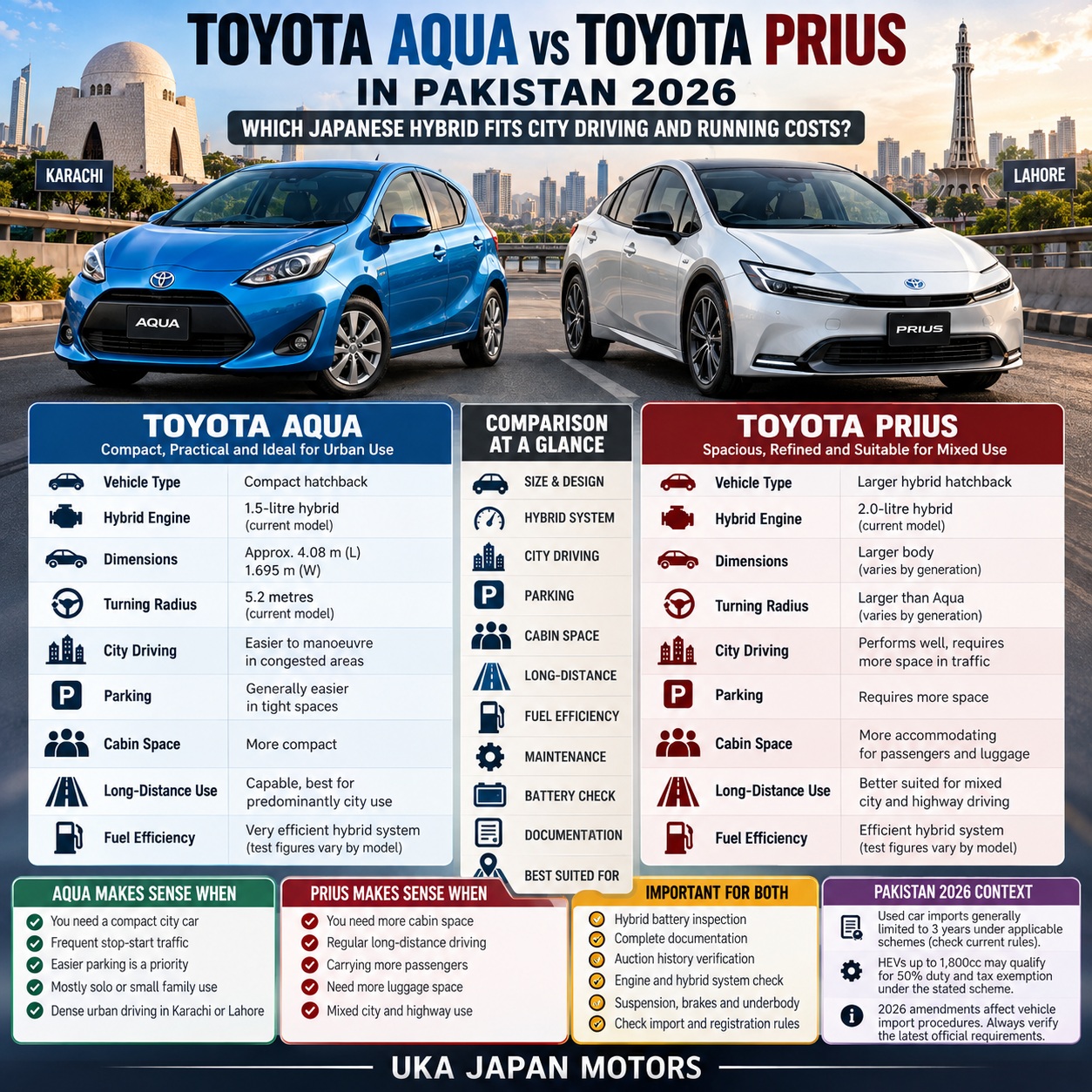
Toyota Aqua and Toyota Prius are both familiar names among Japanese hybrid cars in Pakistan, but they are not simply two versions of the same ownership experience.
The Aqua is a compact hatchback designed around easy urban movement, modest dimensions and efficient hybrid operation. The Prius is a larger hybrid hatchback with more cabin space, a different driving character and, depending on generation, a more powerful hybrid system.
That difference becomes particularly relevant in Karachi and Lahore.
A driver spending hours in congested roads, making frequent stops, navigating narrow streets, parking in crowded areas and dealing with summer heat may value different characteristics from someone covering longer daily distances with several passengers and luggage.
There is also another issue that matters more with imported Japanese hybrids: the badge alone does not tell you the condition of the vehicle.
A well-inspected Aqua can be a very different ownership proposition from a poorly maintained Aqua. The same is true of the Prius. Hybrid battery condition, engine condition, cooling-system maintenance, accident history, mileage verification, underbody condition and import documentation can have a greater effect on ownership than the model name itself.
So the useful question in 2026 is not simply, “Is Aqua better than Prius?”
It is:
Which car better matches the driver’s daily environment, space requirements, driving pattern and ability to verify the condition of the imported vehicle?
Quick answer
For predominantly urban driving in Karachi or Lahore, the Aqua and Prius serve somewhat different purposes.
The Aqua generally makes more sense when compact dimensions, easier parking, lower vehicle weight and frequent stop-start city use are priorities.
The Prius generally makes more sense when additional cabin space, a larger body, longer-distance driving and stronger acceleration are more important.
Neither should automatically be considered the better hybrid.
The more important distinction is between vehicle suitability and vehicle condition.
A clean, properly inspected example with a healthy hybrid system and complete documentation can be a sensible long-term city car. A vehicle with questionable auction history, accident repairs, weak battery performance or incomplete documentation can create ownership problems regardless of whether it is an Aqua or Prius.
For a buyer in Pakistan in 2026, model selection and inspection therefore need to be considered together.
Why Aqua and Prius Are Often Compared
The two cars attract similar buyers because both combine a petrol engine with an electric hybrid system and are widely associated with efficient urban driving.
The similarity can sometimes hide an important difference in their design priorities.
The Aqua is a compact hatchback. Its relatively small footprint is useful in environments where road space and parking space are limited.
The Prius is physically larger and has traditionally been positioned as a more spacious hybrid passenger car.
This creates two different ownership patterns.
An Aqua may feel particularly natural when the vehicle spends most of its life:
- Moving through congested urban roads
- Entering narrow streets
- Parking in restricted spaces
- Carrying one or two occupants
- Making frequent short urban journeys
- Dealing with repeated acceleration and braking
A Prius may be more suitable for a driver who regularly:
- Carries several passengers
- Needs additional luggage space
- Covers longer distances
- Uses wider roads and highways more frequently
- Wants more cabin room
- Prefers a larger vehicle footprint
The difference is therefore not just about fuel consumption.
It is about how the entire vehicle fits into daily use.
Toyota Aqua: What Its Compact Size Means in Pakistan
The modern Aqua uses a 1.5-litre hybrid powertrain and has a compact body measuring roughly 4.08 metres long and 1.695 metres wide in current Japanese-market specifications. Toyota lists a 5.2-metre minimum turning radius for the current model.
Those dimensions matter in Pakistan because urban driving is rarely performed under ideal conditions.
In Lahore, a driver may move between major roads and congested inner areas within the same journey. Karachi creates another combination of long distances, dense traffic, dusty conditions and frequent braking.
A compact hatchback can be easier to position in these situations.
Aqua in heavy traffic
Hybrid vehicles benefit from conditions involving repeated slowing and acceleration because regenerative braking can recover some energy that would otherwise be lost as heat through conventional braking.
The Aqua’s compact size adds another advantage.
When traffic becomes tightly packed, the driver is not constantly managing the larger footprint of a sedan-sized vehicle.
This can make the car easier to position around:
- Motorcycles
- Rickshaws
- Parked vehicles
- Narrow lanes
- Busy intersections
- Tight parking areas
That does not mean the Aqua is automatically easier or safer in every situation. Driver awareness remains more important than vehicle size.
But for pure urban manoeuvrability, its compact format is an important part of the ownership equation.
Toyota Prius: Where the Larger Hybrid Makes a Difference
The Prius has historically occupied a larger category than the Aqua.
The exact specifications depend heavily on generation. This is particularly important in Pakistan because used Japanese imports can represent several generations rather than a single current model.
The current Prius uses Toyota’s fifth-generation hybrid system with a 2.0-litre petrol engine in the Japanese/US-market configurations represented in current Toyota documentation. Toyota’s 2026 Prius documentation lists 194 horsepower for front-wheel-drive versions, with a larger overall vehicle footprint than the Aqua.
However, a buyer looking at a used Prius in Pakistan should never assume that current-generation specifications apply to an older imported car.
A 2016 Prius, for example, should be evaluated according to its own generation, battery technology, engine, equipment and maintenance history.
This is one of the biggest differences between reading a brochure and buying a used Japanese hybrid.
Prius in longer urban commutes
A Prius can make more sense when city driving is combined with regular longer-distance travel.
For example, someone travelling between different parts of Lahore every day may value the additional cabin space and larger overall vehicle more than the compact footprint of an Aqua.
The same applies to Karachi, where daily journeys can cover substantial distances.
The Prius is still a hybrid, so stop-start traffic remains part of its operating environment. But the ownership experience is less focused on compact-city manoeuvrability and more balanced between urban efficiency, passenger space and longer-distance usability.
Aqua vs Prius: City Driving Comparison
| Factor | Toyota Aqua | Toyota Prius |
|---|---|---|
| Body size | Compact | Larger |
| Urban manoeuvrability | Strong advantage from smaller footprint | Requires more space |
| Parking in tight areas | Generally easier | Requires more attention |
| Cabin space | More compact | More accommodating |
| Long-distance use | Capable | Better suited to mixed urban/highway use |
| Typical hybrid character | Efficiency-focused compact car | Efficiency combined with greater size/performance |
| Used-import variation | Generation and grade matter | Generation and grade matter significantly |
| Inspection importance | Very high | Very high |
| Battery assessment | Essential | Essential |
| Best ownership environment | Dense urban use | Mixed city and longer-distance use |
The table should not be read as a quality ranking.
It shows how the two models are designed around somewhat different requirements.
Which One Handles Karachi Traffic Better?
Karachi presents a demanding combination for any vehicle.
Traffic can involve long periods of crawling, sudden acceleration, frequent lane changes, dust, heat and extended daily journeys.
For a driver whose priority is manoeuvrability, the Aqua’s compact body can be useful.
Its smaller dimensions make it easier to place in congested roads and parking spaces.
The hybrid system is also well matched to repeated stop-and-go operation. Regenerative braking can recover energy during deceleration, while the hybrid system can manage engine and motor operation according to driving conditions.
But Karachi’s heat creates an important ownership consideration.
A hybrid battery depends on an appropriate cooling system. If the battery cooling intake is obstructed by dust or debris, or if the cooling system has not been maintained correctly, the battery can operate under less favourable conditions.
Therefore, an Aqua imported into Pakistan should not be assessed solely through a test drive.
The hybrid battery cooling arrangement, warning history, battery performance and related components should be checked as part of a proper inspection.
The Prius faces the same basic requirement.
Its larger size does not remove the need for hybrid-system inspection.
Which One Makes More Sense in Lahore?
Lahore presents a different but equally demanding combination.
Daily driving can involve congested commercial areas, major roads, uneven surfaces, road construction, dust, summer heat and seasonal rain.
The Aqua’s smaller footprint can be helpful for urban parking and movement through congested streets.
The Prius can become more attractive when the vehicle is used by a family or when longer daily journeys are common.
This is where the driver’s routine becomes more important than general reputation.
A person who spends most of the day travelling alone through dense traffic may not benefit much from choosing a larger vehicle.
A family carrying several occupants and luggage may find the Prius’s additional space more useful.
In other words:
The right choice depends on what the car does every day.
Running Costs: What Should Actually Be Compared?
“Running costs” are often reduced to fuel consumption, but that is too narrow for an imported hybrid.
A realistic ownership assessment should include at least five areas:
- Fuel consumption
- Routine maintenance
- Hybrid-system condition
- Tyres, brakes and suspension
- Unexpected repairs caused by poor previous maintenance
Fuel consumption
Both Aqua and Prius are designed to use their hybrid systems efficiently, particularly in conditions involving frequent braking and acceleration.
Toyota’s current Japanese Aqua specifications show a 1.5-litre hybrid system and an official WLTC combined figure of 33.6 km/L for one current 2WD configuration, with a city-mode figure of 34.3 km/L. These are laboratory/test-cycle figures, not a promise of real-world Pakistani fuel consumption.
Actual consumption in Karachi or Lahore can be substantially different because of:
- Traffic congestion
- Air-conditioning use
- Tyre pressure
- Road gradients
- Vehicle load
- Driving style
- Engine condition
- Battery condition
- Outside temperature
- Idling and stop-start patterns
The same principle applies to the Prius.
A published laboratory figure should therefore be treated as a technical reference rather than a guaranteed result.
Maintenance
A hybrid does not eliminate maintenance.
The petrol engine still needs appropriate servicing.
The cooling system still needs attention.
The transmission/hybrid transaxle still needs inspection.
The suspension and steering components still experience Pakistan’s road conditions.
The brakes may experience a different wear pattern because regenerative braking can reduce the use of conventional friction brakes, but that does not mean the braking system can be ignored.
The Hybrid Battery Question
The battery is one of the most important areas when buying either model.
It is also one of the areas where buyers can make a mistake by relying on assumptions.
A hybrid battery is not simply a normal car battery.
It is a high-voltage component integrated into the vehicle’s hybrid control system.
Its condition should be evaluated using appropriate diagnostic equipment and by examining battery performance rather than relying only on whether the car currently drives normally.
A vehicle can start, move and appear smooth while still having battery-related issues that deserve investigation.
What should be checked?
A proper hybrid inspection should consider:
- Diagnostic trouble codes
- Battery state-of-charge behaviour
- Battery block or cell voltage balance where applicable
- Battery temperature readings
- Cooling-fan condition
- Hybrid-system warning history
- Charging and discharging behaviour
- Engine start-stop behaviour
- Abnormal battery fluctuation
- Signs of previous battery repair
- Evidence of water or accident damage
The exact diagnostic procedure varies by generation.
This is why an inspection should be performed with equipment appropriate to the specific vehicle.
Why Auction History Matters
For an imported Japanese vehicle, the vehicle’s history can be as important as its current appearance.
A clean exterior does not prove that a vehicle has never been involved in an accident.
Likewise, a clean interior does not prove that mileage is accurate.
Auction documentation can provide useful information about the vehicle’s condition before export, depending on the vehicle and documentation available.
The buyer should examine:
- Auction sheet information
- Chassis number consistency
- Mileage records
- Grade and equipment
- Previous damage notation
- Repair history
- Export documentation
- Registration-related documentation
- Any evidence of structural repair
This is particularly important when comparing Aqua and Prius because imported examples may come from different production years and generations.
A model name is not a substitute for vehicle-specific verification.
Aqua vs Prius: Inspection Differences
The inspection philosophy should be similar for both, but the vehicle-specific details are different.
Aqua inspection priorities
For an Aqua, pay particular attention to:
- Hybrid battery health
- Battery cooling system
- Engine operation
- Hybrid warning codes
- CVT/hybrid transaxle behaviour
- Suspension condition
- Steering components
- Underbody damage
- Accident repairs
- Water ingress
- Auction history
Because the vehicle is compact, suspension and underbody condition should not be overlooked.
Urban roads can still create substantial impacts through potholes, broken surfaces and poorly repaired sections.
Prius inspection priorities
For a Prius, the same basic checks apply, but additional attention should be paid to:
- Hybrid battery performance
- Engine condition
- Cooling systems
- Hybrid transaxle operation
- Brake system
- Suspension
- Underbody
- Accident repair
- Water damage
- Mileage and auction documentation
With Prius models, generation identification is particularly important.
The technology changed over time.
A buyer should therefore identify the exact chassis code, model year and hybrid configuration before interpreting diagnostic results or maintenance requirements.
Import Documentation in Pakistan in 2026
Import rules are not simply a matter of choosing a model and arranging shipment.
Pakistan’s vehicle-import framework includes specific requirements concerning eligibility, vehicle age, import schemes, documentation, duties and taxes.
FBR’s current vehicle guidance states that used vehicles may be imported by eligible overseas Pakistanis under the Personal Baggage, Gift and Transfer of Residence schemes, with cars generally limited to three years of age under those schemes. FBR also currently lists a 50% exemption from duty and taxes for HEVs up to 1,800cc and 25% for HEVs from above 1,800cc to 2,500cc under the stated scheme.
The Ministry of Commerce has also issued 2026 amendments affecting vehicle-import procedures. Its January 2026 SRO, for example, amended conditions concerning minimum safety, environmental and regulatory standards and included a requirement relating to the country of origin for vehicles imported under the Transfer of Residence scheme.
This means buyers should not rely on older advice circulating online.
The applicable rules should be checked against the current official notifications and documentation requirements at the time the vehicle is imported.
Registration Considerations After Import
Import clearance is only one part of the process.
The vehicle must also have the appropriate documentation for registration and subsequent ownership transfer.
Before proceeding, documentation should be checked for consistency across:
- Chassis number
- Import documents
- Customs clearance
- Vehicle identification information
- Registration records
- Ownership documents
Any mismatch should be investigated before completing the transaction.
This is especially important for imported Japanese hybrids because vehicles can pass through several stages between auction, export, customs clearance and local registration.
A vehicle that drives well but has unresolved documentation problems can become difficult to transfer or verify later.
Fuel Efficiency in Real Pakistani Traffic
The Aqua and Prius both benefit from hybrid technology, but real-world fuel consumption should never be judged from a single trip.
Consider a Lahore driver who travels through congested roads during summer.
Air-conditioning demand can remain high.
Traffic can involve repeated acceleration followed by braking.
The road may be uneven.
The vehicle may carry passengers.
The driver may also spend time stationary in traffic.
These conditions can change fuel consumption significantly compared with controlled test conditions.
The same applies in Karachi, particularly during long periods of slow traffic.
A hybrid can still be well suited to these conditions, but the expected result should be based on the vehicle’s actual condition and usage pattern rather than a catalogue number.
What About Highway Driving?
This is where the distinction between Aqua and Prius becomes more noticeable.
Both can travel comfortably outside city traffic, but the Prius’s larger hybrid powertrain and vehicle format can make it more suitable for drivers who regularly combine urban driving with longer journeys.
The Aqua is still capable of longer trips, but its main strength is its compact urban format.
A driver who spends 80–90% of driving time in dense city traffic may value the Aqua’s size more.
A driver whose routine includes substantial intercity or highway travel may place greater value on the Prius’s space and larger powertrain.
The important point is that highway use changes the importance of factors such as cabin space, ride behaviour, luggage capacity and acceleration.
Ground Clearance and Road Conditions
Neither vehicle should be treated as an off-road vehicle.
Pakistan’s urban roads can contain:
- Broken patches
- Deep potholes
- Uneven speed breakers
- Poor drainage
- Road construction
- Loose gravel
- Flooded sections after heavy rain
A buyer should therefore inspect the underside of any imported Aqua or Prius.
Look for:
- Scrapes
- Bent components
- Damaged covers
- Oil or fluid leakage
- Suspension damage
- Signs of previous impact
- Corrosion
- Evidence of flood or water exposure
A clean exterior can hide underbody damage.
This is one reason an inspection should include both electronic diagnostics and physical examination.
Heat, Dust and Humidity: A Pakistan-Specific Consideration
Hybrid systems operate in an environment that can be more demanding than a mild climate.
Karachi combines heat, humidity and coastal conditions.
Lahore experiences intense summer temperatures, dust and seasonal rain.
These conditions make cooling and ventilation important.
The hybrid battery cooling path should be kept clean.
Engine cooling components should also be maintained properly.
Air-conditioning performance matters because it can influence how the vehicle is used in prolonged hot-weather traffic.
A buyer should also be alert to signs of water ingress after flooding or heavy rain.
Water damage can affect electrical connectors, sensors, wiring and electronic control systems, and the effects may not always appear immediately.
Which Is Easier to Live With Every Day?
The answer depends on what “easy” means.
If easy means:
- Easy to park
- Easy to manoeuvre
- Compact dimensions
- Mostly solo or two-person urban use
- Frequent stop-and-go traffic
then the Aqua’s design aligns closely with those requirements.
If easy means:
- More cabin room
- More space for passengers
- More luggage flexibility
- Regular longer-distance driving
- A larger hybrid vehicle
then the Prius may fit the requirement more naturally.
There is no need to force one model into every use case.
The two cars occupy overlapping but different parts of the hybrid ownership spectrum.
Aqua or Prius for a Family?
For a family, the decision should begin with actual passenger requirements.
A small family that spends most of its time in Lahore or Karachi traffic may find the Aqua sufficient.
A family that regularly carries several adults, luggage or children may find the Prius’s larger format more practical.
Rear-seat comfort should be checked physically rather than assumed from the model name.
Boot requirements should also be considered.
A family carrying luggage frequently should assess whether the available cargo area works for its normal routine.
This is a practical consideration that fuel consumption figures cannot answer.
Aqua or Prius for a Long Daily Commute?
For long daily commuting, both can make sense because hybrid systems are particularly useful when the journey includes frequent traffic interruptions.
But the definition of “long commute” matters.
If the commute means a long distance through dense urban traffic, the Aqua can still be a logical format because compact dimensions remain useful.
If it means a mixture of city roads and faster open-road driving, the Prius may provide a more balanced combination of space and power.
Again, the condition of the individual vehicle should remain central to the decision.
A healthy hybrid system matters more than a theoretical difference between two model names.
Used Japanese Hybrid: What Should the Buyer Avoid?
Regardless of whether the vehicle is an Aqua or Prius, several warning signs deserve attention.
Avoid proceeding casually when:
- The chassis number is unclear
- Import documents are incomplete
- Auction documentation cannot be explained
- Mileage information conflicts between records
- Hybrid warning lights are present
- Diagnostic faults are ignored
- Battery performance is unstable
- The vehicle shows signs of flood exposure
- Structural repairs are poorly documented
- The seller discourages independent inspection
- The vehicle’s exact generation cannot be established
A vehicle should be evaluated as a complete system.
A good exterior is only one part of the inspection.
A Practical Buying Checklist
Before deciding between Aqua and Prius, a buyer can use this sequence.
Step 1: Define the daily route
Record how much of the driving is:
- Congested city traffic
- Open urban roads
- Highway driving
- Short trips
- Long commuting
Step 2: Define the passenger requirement
Ask:
- How many people normally travel?
- Is luggage carried regularly?
- Is rear-seat space important?
- Is compact parking important?
Step 3: Identify the exact vehicle
Do not stop at “Aqua” or “Prius.”
Confirm:
- Model year
- Chassis code
- Grade
- Engine
- Hybrid system
- Drive configuration
- Production period
Step 4: Check documentation
Verify:
- Auction documentation
- Import records
- Chassis information
- Customs documentation
- Registration information
- Ownership records
Step 5: Perform hybrid diagnostics
Check the battery and hybrid system using appropriate diagnostic equipment.
Step 6: Inspect the mechanical condition
Check:
- Engine
- Cooling system
- Suspension
- Steering
- Brakes
- Tyres
- Underbody
- Air-conditioning system
Step 7: Assess the vehicle after inspection
Only after these steps should the buyer compare the two models for their particular usage.
Aqua vs Prius: The Most Important Difference Is Not Fuel Economy
Fuel efficiency is one of the reasons these cars attract attention, but it should not dominate the entire decision.
Suppose an Aqua is highly efficient but has questionable documentation and a hybrid battery requiring attention.
Now consider a Prius that has complete documentation, a verified history and a properly functioning hybrid system.
The comparison changes immediately.
Likewise, a buyer who rarely carries passengers may gain little practical advantage from selecting the larger Prius if the compact dimensions of the Aqua are more useful every day.
The most meaningful comparison is therefore:
Vehicle condition + driving environment + passenger needs + documentation.
Not simply:
Aqua vs Prius.
What the 2026 Buyer Should Remember
The Japanese hybrid market available to Pakistani buyers is not made up of one specification for each model.
Toyota has produced Aqua and Prius vehicles across multiple generations, with changes in engines, batteries, hybrid systems, dimensions and equipment.
Toyota’s own documentation shows this evolution clearly for the Aqua, with separate production periods extending from older generations through the current 2026 production range.
The current Aqua uses a 1.5-litre hybrid system, while the current Prius uses a 2.0-litre hybrid system. But a used vehicle imported into Pakistan should always be judged according to its exact generation rather than today’s brochure specifications.
That distinction is essential.
A buyer looking at a used Japanese Prius in 2026 is not necessarily buying the same technology represented by the latest Prius documentation.
The same principle applies to the Aqua.
Final Comparison
The Aqua and Prius are both capable Japanese hybrids, but they solve somewhat different everyday problems.
Choose the Aqua format when your priority is compact urban mobility.
Its smaller footprint can be valuable in Karachi and Lahore, especially for drivers dealing with congested roads, tight parking areas and frequent stop-start journeys.
Consider the Prius format when your priority includes greater cabin space and more mixed-distance driving.
Its larger body and hybrid powertrain make it a different proposition for drivers who regularly carry passengers, luggage or combine city use with longer journeys.
For both, however, the condition of the individual imported vehicle should remain the deciding technical factor.
A hybrid battery check, diagnostic scan, physical inspection, auction-history review and documentation verification should be treated as part of the vehicle-selection process rather than optional extras.
The best way to compare an Aqua and Prius is therefore not to ask which model has the better reputation.
Ask which vehicle:
- Fits the driver’s daily route
- Fits the passenger requirement
- Fits the parking environment
- Has a verified hybrid system
- Has a properly documented history
- Has been inspected for accident and water damage
- Can be maintained correctly over long-term use
For Karachi’s dense traffic, the Aqua’s compact dimensions can be particularly useful.
For Lahore’s combination of congestion, longer urban journeys and family use, the Prius can offer advantages where additional space is important.
But neither model should be selected solely on fuel-economy claims or model reputation.
In Pakistan in 2026, a properly inspected and correctly documented hybrid is more important than simply choosing the more popular nameplate.
Frequently Asked Questions
1. Is Toyota Aqua better than Toyota Prius for city driving in Pakistan?
They suit different types of city driving. The Aqua’s smaller dimensions can make it easier to manoeuvre and park in dense urban areas, while the Prius provides a larger vehicle and more cabin space. The driver’s route and passenger requirements should determine the choice.
2. Which uses less fuel, Aqua or Prius?
The answer depends on the exact generation, engine, hybrid system, vehicle condition and driving conditions. Current Aqua specifications show a very high official fuel-efficiency figure, but laboratory figures should not be treated as guaranteed Pakistani real-world consumption.
3. Is the Aqua suitable for Karachi traffic?
Its compact size and hybrid powertrain make it well suited to many urban conditions, including congested roads and frequent braking. Battery cooling and overall hybrid-system condition should be checked carefully because Karachi’s heat, dust and humidity can affect vehicle maintenance requirements.
4. Is the Prius suitable for Lahore?
Yes, depending on the driver’s needs. The Prius can be practical for Lahore’s urban traffic and longer daily journeys, particularly where additional passenger and luggage space is useful.
5. Does a hybrid battery need to be inspected before buying?
Yes. A test drive alone cannot establish the complete condition of a high-voltage hybrid battery. Appropriate diagnostic checks and physical inspection should be performed.
6. Can I judge a Prius by its model year alone?
No. Different Prius generations use different engines, hybrid systems, batteries and equipment. The exact chassis code, production period and configuration should be confirmed.
7. Does the Aqua have lower maintenance requirements than the Prius?
Not automatically. Routine maintenance depends on the exact vehicle, condition and service history. The Aqua’s smaller size does not eliminate the need to maintain its engine, hybrid system, suspension, brakes, cooling system and other components.
8. What documents should be checked on an imported Aqua or Prius?
The buyer should check the vehicle identification information, auction documentation where available, import and customs records, and registration and ownership documentation. The information should be consistent across the relevant records.
9. Are Japanese hybrid imports still subject to age and import-scheme requirements in Pakistan?
Yes. The applicable import framework includes eligibility and age requirements for used vehicles under specified schemes, and the rules have been amended during 2026. Current official requirements should be verified before importing a vehicle.
10. Is a newer Aqua automatically a better choice than an older Prius?
No. Newer technology can offer advantages, but the condition of the individual vehicle remains important. A buyer should compare exact specifications, hybrid condition, maintenance history, documentation and intended usage.
11. Which is easier to park in Karachi?
The Aqua’s compact dimensions generally make it easier to position in tight urban parking areas. The Prius is larger and may require more space.
12. Which should be chosen for frequent long-distance driving?
The Prius may better suit drivers who regularly combine city driving with longer-distance travel because of its larger vehicle format and powertrain. However, the exact generation and condition should be considered before making a decision.
UKA Japan Motors’ Role in the Process
Choosing an imported Japanese hybrid should involve more than checking exterior appearance and taking a short drive.
UKA Japan Motors approaches the vehicle from an inspection and documentation perspective, with attention to the condition of the individual vehicle rather than relying only on the model name.
For an Aqua or Prius, the relevant areas include identifying the exact vehicle specification, checking available documentation, assessing hybrid-system condition, examining the mechanical and physical condition, and helping the buyer understand what should be verified before ownership.
The purpose of this process is straightforward: a Japanese hybrid should be evaluated as a complete vehicle with a specific history, not simply as an Aqua or Prius badge.
This approach is particularly relevant in Karachi and Lahore, where heat, dust, traffic congestion, road conditions and long daily journeys can expose weaknesses that may not be obvious from a visual inspection alone.
Conclusion
Toyota Aqua and Toyota Prius remain two important Japanese hybrid choices for Pakistani city drivers, but they should not be treated as interchangeable vehicles.
The Aqua’s compact dimensions make it particularly relevant to dense urban driving, tight parking and frequent stop-start movement.
The Prius offers a larger vehicle format that can be more useful when passenger space, luggage capacity and longer-distance driving are important.
Running costs should also be considered broadly. Fuel consumption matters, but so do battery condition, routine maintenance, suspension, brakes, cooling systems, tyres, previous repairs and the quality of the vehicle’s documentation.
For imported Japanese hybrids, the individual vehicle matters.
A well-documented, properly inspected Aqua may be a more appropriate daily car for one driver, while a properly inspected Prius may suit another driver’s requirements better.
The correct comparison is therefore not simply about which Toyota uses less fuel.
It is about matching the exact vehicle to the roads, traffic, passengers, driving distance and long-term ownership conditions in Pakistan.
Contact UKA Japan Motors for availability and inspection guidance.