


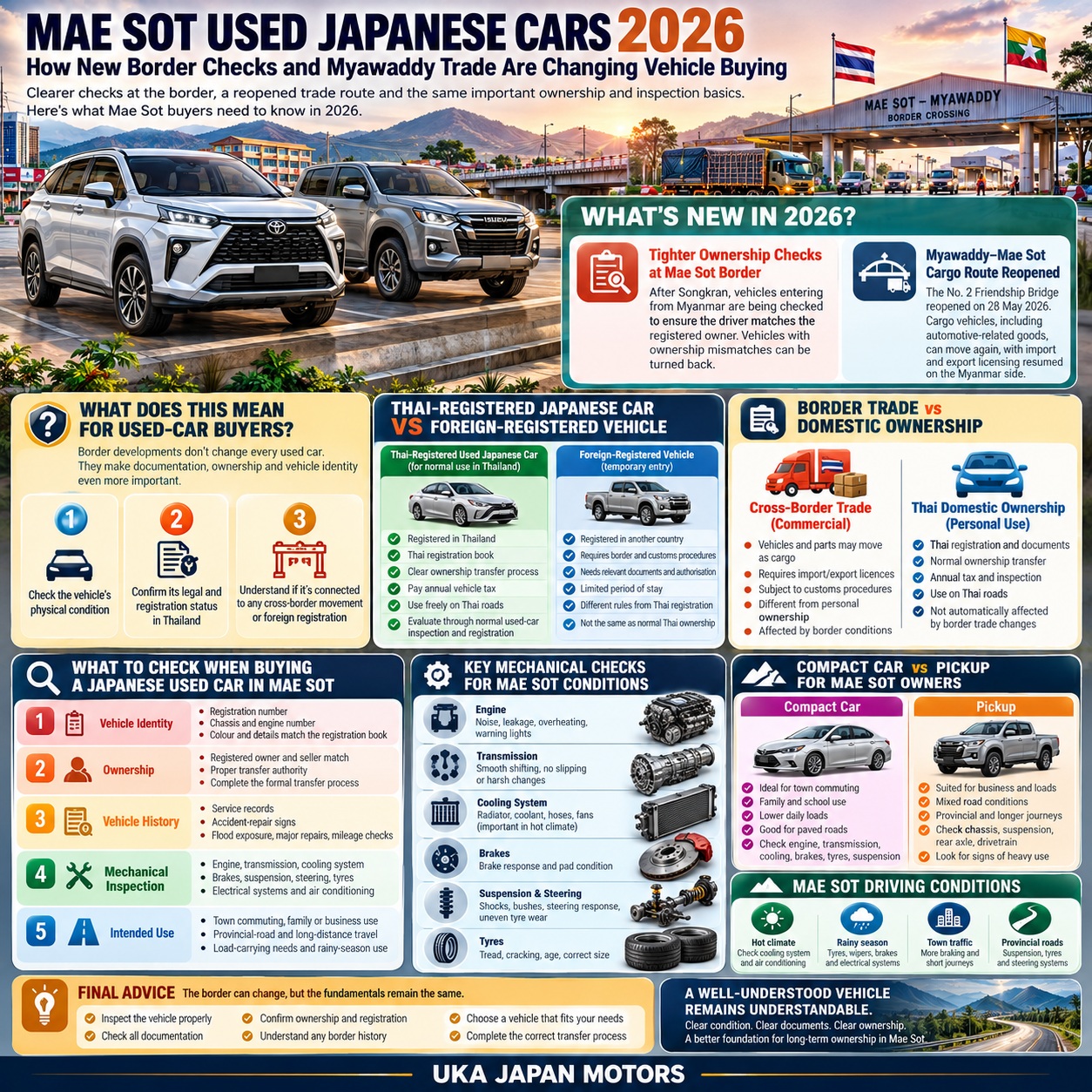
Buying a used Japanese car in Mae Sot has always required more than checking the engine, body and interior. In 2026, the border environment adds another layer of attention.
Mae Sot is both a normal Thai town where people commute, take children to school, operate businesses and travel on provincial roads, and a major border-area transport centre facing Myawaddy in Myanmar. That combination means vehicles can exist within very different documentation and movement arrangements.
A vehicle registered in Thailand for normal domestic road use is not the same thing as a foreign-registered vehicle temporarily entering Thailand. A vehicle involved in cross-border commercial trade is also not automatically equivalent to a Thai-registered used car being transferred to a new owner.
This distinction has become particularly important during 2026.
Thailand tightened ownership checks on Myanmar vehicles entering Mae Sot after Songkran, according to reporting from the Karen Information Center. The reported change focused on whether the person using the vehicle matched the ownership information recorded in the registration documents. Vehicles where the current user and registered owner did not correspond were reportedly being turned back at the border.
At the same time, the Myawaddy–Mae Sot cargo route reopened on 28 May 2026 after being closed since August 2025. Thailand’s Department of International Trade Promotion reported that cargo vehicles resumed movement and that Myanmar-side import and export licensing processes had restarted.
For someone buying a Japanese used car in Mae Sot, these developments do not mean that every vehicle has suddenly become a border vehicle.
They mean something more practical:
Documentation, ownership identity, registration status and the intended use of the vehicle deserve closer attention than ever.
The border may influence the local automotive environment, but a buyer should still evaluate each vehicle as an individual Thai ownership proposition.
The Direct Answer: What Has Changed for Used-Car Buyers in Mae Sot?
The main change in 2026 is not simply that the Mae Sot–Myawaddy border has reopened or that additional checks have appeared.
The important change is that vehicle identity and ownership documentation have become especially visible issues in a border environment where vehicles may move between different legal and registration systems.
There are three separate questions a buyer should keep apart:
- What is the vehicle’s physical condition?
- What is the vehicle’s legal and registration status in Thailand?
- Is the vehicle connected to any cross-border movement or foreign registration arrangement?
A Japanese used car intended for ordinary ownership and daily driving in Mae Sot should have a clear Thai registration position and documentation that corresponds with the physical vehicle.
Thailand’s Department of Land Transport advises used-car buyers to check the original registration book, registered owner, chassis number, engine number, vehicle colour and tax status. It also advises completing the formal ownership transfer rather than relying on an informal “floating transfer” arrangement.
That guidance remains relevant regardless of what is happening at the border.
The 2026 border situation simply makes the reason for careful documentation easier to understand.
Why the Mae Sot–Myawaddy Border Matters to the Local Vehicle Market
Mae Sot’s position creates a connection between ordinary Thai vehicle ownership and wider regional trade.
The Myawaddy–Mae Sot No. 2 Friendship Bridge is primarily a cargo route, while the No. 1 Friendship Bridge has a different role associated more closely with passenger movement. The cargo crossing was closed on the Myanmar side from August 2025 and reopened on 28 May 2026. Initial reports described limited cargo activity before operations gradually resumed.
Thailand’s Department of International Trade Promotion subsequently reported that vehicles and other goods could move through the reopened trade route, while Myanmar-side import licences and export licences were again being processed. The same report advised businesses to obtain the appropriate licences before goods move through the relevant checkpoint.
This matters to Mae Sot’s automotive environment because border trade can involve:
- passenger vehicles;
- pickups;
- commercial vehicles;
- vehicle components;
- spare parts;
- machinery;
- transport equipment;
- other automotive-related goods.
But it is important not to make a second assumption:
The reopening of a cargo route does not automatically change the Thai registration status of an individual used car.
A Japanese used car sitting in Mae Sot with valid Thai registration is still primarily a Thai-registered vehicle.
A foreign-registered vehicle entering Thailand temporarily is governed by different procedures.
A vehicle being exported as commercial cargo is another matter again.
Understanding this distinction prevents one of the most common forms of confusion in a border town: assuming that because vehicles cross the border, any vehicle can be treated as a normal domestic vehicle.
What the New Ownership Checks Actually Tell Buyers
Reports from the border in April 2026 described tighter checking of ownership information for Myanmar vehicles entering Mae Sot.
The reported issue was straightforward: the person using the vehicle needed to have an ownership position consistent with the registration documents. Where a current owner had acquired a vehicle but the registration information had not been properly updated, the vehicle could reportedly face problems at the crossing.
This is particularly relevant to understanding the difference between possession and registered ownership.
Having physical possession of a vehicle does not necessarily mean that the registration record has been updated.
Similarly, having a purchase agreement or informal transfer paperwork does not necessarily mean that the government registration system reflects the new owner.
For a buyer in Mae Sot, this reinforces a basic principle:
The person selling the vehicle, the person recorded as the owner, the vehicle itself and the supporting documents should make sense as one consistent set of information.
This is not a border-only principle.
It is good practice for any used vehicle purchase in Thailand.
The border simply creates another situation where inconsistencies can become immediately visible.
Thai Registration and Border Movement Are Two Different Systems
A buyer should avoid treating these as one issue.
Thai domestic ownership
If the vehicle is intended for normal use in Mae Sot and elsewhere in Thailand, the central questions include:
- Is the vehicle properly registered in Thailand?
- Is the registration book genuine and complete?
- Does the registered owner correspond with the seller and transfer documents?
- Do the chassis details correspond?
- Does the engine information correspond where applicable?
- Does the vehicle colour correspond with the registration record?
- Has annual vehicle tax been properly accounted for?
- Is the vehicle ready for the required inspection and transfer process?
- Can the ownership transfer be completed correctly?
The Department of Land Transport specifically advises buyers and sellers to verify the vehicle’s source and registration evidence, and to complete the transfer at the relevant transport office rather than leaving the registration unresolved.
Temporary foreign vehicle entry
A foreign-registered vehicle temporarily entering Thailand follows a different process.
Thailand’s government guidance explains that vehicles entering Thailand overland for driving purposes must undergo the appropriate documentation and inspection process. Documents can include vehicle registration evidence, identity and travel documents, relevant vehicle forms and, where appropriate, an authorisation document.
Thai Customs also distinguishes temporary vehicle importation from ordinary domestic ownership and requires documentation associated with the vehicle and its temporary entry arrangement.
Therefore, a foreign vehicle crossing from Myawaddy into Mae Sot should not be used as the model for how a buyer evaluates an ordinary Thai-registered Japanese used car.
What This Means When Looking at a Japanese Used Car in Mae Sot
The phrase “Japanese used car” describes the vehicle’s origin or model history, not its current legal status.
A Japanese-brand vehicle in Mae Sot could have very different histories.
For example:
| Vehicle situation | Main question |
|---|---|
| Thai-registered used Japanese car | Is Thai registration and ownership documentation correct? |
| Foreign-registered vehicle | What legal arrangement permits its presence and use in Thailand? |
| Vehicle connected to commercial export | Are customs and destination-side requirements satisfied? |
| Vehicle undergoing ownership transfer | Can the transfer be completed through the proper Thai registration process? |
| Vehicle with incomplete ownership history | Can its identity and source be properly established? |
This is why a buyer should not rely on appearance alone.
Two vehicles can look almost identical but have completely different documentation positions.
One may be straightforward for Thai ownership.
Another may require additional investigation before it can be considered suitable for normal domestic use.
Physical Inspection Still Comes First Alongside Documentation
Border-related checks do not replace mechanical inspection.
A vehicle with perfect-looking documents can still have mechanical problems.
Likewise, a mechanically strong vehicle can still have documentation problems.
The two areas must be considered together.
For a Japanese used car in Mae Sot, begin with the basic mechanical systems.
Engine condition
Check for:
- abnormal engine noise;
- excessive vibration;
- visible oil leakage;
- coolant leakage;
- overheating signs;
- irregular idle;
- warning lights;
- poor cold-start behaviour;
- evidence of previous major repairs.
Mae Sot’s hot climate makes cooling-system condition particularly important.
A cooling system that is already marginal may become more noticeable during extended idling, heavy traffic or hot-weather driving.
Transmission condition
Check for:
- delayed engagement;
- harsh shifting;
- unusual noises;
- slipping;
- hesitation;
- leakage;
- inconsistent behaviour between cold and warm operation.
This is relevant for compact cars, family vehicles, vans and pickups alike.
Cooling system
The radiator, coolant condition, hoses, fans and associated components deserve attention.
Rainy-season driving does not eliminate the need for cooling-system maintenance. Heat and humidity remain part of everyday vehicle use in Thailand.
Brakes
Inspect:
- brake response;
- pedal feel;
- brake noise;
- disc condition;
- pad condition;
- uneven braking;
- warning lights.
A vehicle used regularly in Mae Sot town traffic may experience repeated braking that differs from longer provincial-road travel.
Suspension and steering
Check:
- shock absorbers;
- bushes;
- ball joints;
- steering response;
- unusual knocking;
- uneven tyre wear;
- vehicle stability over uneven surfaces.
Provincial roads and uneven surfaces can reveal suspension problems that may not be obvious during a very short drive.
Tyres
Tyres should be checked for:
- tread condition;
- uneven wear;
- cracking;
- age;
- correct size;
- matching specifications;
- signs of alignment or suspension problems.
Tyres are one of the clearest examples of why mechanical inspection and intended use need to be considered together.
Documentation Inspection Should Follow the Same Discipline
After checking the physical vehicle, compare it against its documents.
Look at the original registration book and verify that the recorded details correspond with the vehicle.
Important points include:
- registered owner’s name;
- chassis number;
- engine number where recorded;
- colour;
- registration information;
- tax information;
- supporting transfer documents;
- seller identity;
- purchase documentation.
The Department of Land Transport specifically recommends checking these details and warns against informal transfer arrangements because they can leave registration responsibility attached to the previous owner and make the vehicle’s legal history harder to verify.
This is particularly relevant in Mae Sot because a buyer may encounter vehicles connected in some way with cross-border activity.
A border connection does not automatically mean that a vehicle is problematic.
But it does make documentation consistency worth checking carefully.
Myawaddy Trade Is Changing the Environment, Not Rewriting Thai Registration Rules
The reopening of the cargo checkpoint has practical importance for Mae Sot’s wider business environment.
The Department of International Trade Promotion reported that the No. 2 Myawaddy checkpoint resumed cargo operations in May 2026 and that import and export licence processes were again available.
That can affect logistics, commercial activity and the movement of automotive-related goods.
It can also influence how businesses think about vehicle use.
A pickup used for business may have different requirements from a compact car used mainly for commuting.
A van moving equipment or personnel may experience greater loading and suspension demands.
A vehicle involved in commercial transport may also encounter different documentation requirements from a privately owned passenger car.
But the correct conclusion is not that every Japanese used car in Mae Sot is now part of cross-border trade.
The more accurate conclusion is:
Border trade increases the importance of understanding what category of vehicle movement or ownership arrangement applies to the individual vehicle.
Japanese Used Car vs Cross-Border Vehicle: What Buyers Should Not Confuse
A useful comparison is between an ordinary Thai-registered Japanese used car and a foreign-registered vehicle moving temporarily across the border.
Thai-registered Japanese used car
The buyer should concentrate on:
- Thai registration;
- ownership transfer;
- registration book;
- chassis and engine identity;
- physical condition;
- annual tax;
- inspection readiness;
- road-use suitability;
- maintenance history.
Foreign-registered vehicle entering Thailand
The focus can include:
- foreign registration documents;
- identity of the person controlling the vehicle;
- authorisation where necessary;
- temporary entry procedures;
- customs requirements;
- permitted period of stay;
- applicable route or use conditions.
Thai government guidance specifically describes documentation and inspection requirements for vehicles entering Thailand through land routes, while Thai Customs separately describes temporary importation and re-export procedures.
These are not interchangeable processes.
For someone buying a vehicle for long-term ownership in Mae Sot, the key question is therefore not whether the vehicle has crossed the border before.
The question is whether its current Thai ownership and registration position is clear and appropriate for the intended use.
Does Myawaddy Trade Make Buying a Used Japanese Car More Complicated?
It can make the surrounding environment more complicated, but it does not necessarily make every purchase complicated.
The distinction is important.
A normal Thai-registered vehicle with consistent records can be evaluated through ordinary used-car inspection and registration procedures.
A vehicle with unclear ownership, foreign registration, incomplete transfer records or an uncertain movement history deserves additional attention.
This is where buyers should resist assumptions.
Do not assume:
- a border-area vehicle is automatically a cross-border vehicle;
- a Japanese vehicle is automatically an imported vehicle;
- a vehicle physically located in Thailand is automatically Thai-registered;
- a seller’s possession automatically proves registered ownership;
- a previous border crossing automatically makes a vehicle unsuitable;
- a clean-looking vehicle automatically has clean documentation.
Each point needs evidence.
What Buyers in Mae Sot Should Check Before Agreeing to a Purchase
A practical inspection can be organised into five stages.
Stage 1: Establish the vehicle’s identity
Confirm:
- make and model;
- chassis number;
- engine information;
- colour;
- registration number;
- registration-book information.
The physical vehicle should correspond with its records.
Stage 2: Establish the ownership position
Ask:
- Who is the registered owner?
- Who is selling the vehicle?
- Do the names and documents correspond?
- Is there a proper transfer process available?
- Is anyone acting on behalf of the registered owner?
- If so, what authority and documentation support that arrangement?
The DLT recommends completing the proper transfer process rather than relying on a transfer left unresolved for later.
Stage 3: Establish the vehicle’s history
Look for:
- maintenance records;
- accident-repair evidence;
- body repairs;
- replacement panels;
- signs of flood exposure;
- engine or transmission replacement;
- unusual mileage patterns;
- inconsistent service information.
Mileage should be treated as one piece of evidence, not the entire vehicle history.
Stage 4: Inspect the mechanical condition
Check:
- engine;
- transmission;
- cooling system;
- brakes;
- steering;
- suspension;
- tyres;
- electrical systems;
- air conditioning;
- body structure.
Stage 5: Confirm the intended use
Ask how the vehicle will actually be used.
Will it mainly handle:
- Mae Sot town commuting?
- school and family transport?
- business use?
- provincial-road travel?
- regular longer-distance driving?
- occasional heavy loading?
- mixed town and rural-road use?
The correct vehicle condition standard depends partly on the work the vehicle will perform.
Mae Sot Driving Conditions Make Long-Term Condition Important
The border issue may attract attention in 2026, but long-term ownership still comes down to ordinary vehicle realities.
Mae Sot drivers deal with a combination of town traffic, heat, humidity, seasonal rain and provincial-road conditions.
That combination affects maintenance priorities.
Rainy-season considerations
During periods of heavy rain, inspect:
- tyre condition;
- tread depth;
- windscreen visibility;
- wiper condition;
- brake response;
- electrical connections;
- underbody condition;
- evidence of water entry.
A vehicle that has previously experienced significant water exposure should receive particularly careful inspection.
Heat and cooling
Hot conditions place importance on:
- radiator condition;
- coolant;
- cooling fans;
- hoses;
- belts;
- air-conditioning performance;
- battery condition.
Town driving
Frequent short journeys can place different demands on:
- brakes;
- battery;
- air conditioning;
- transmission;
- engine operating temperature;
- suspension components.
Provincial-road use
Longer journeys and uneven road surfaces increase the importance of:
- tyres;
- suspension;
- steering;
- wheel alignment;
- brakes;
- cooling performance.
Compact Car vs Pickup: The Border Does Not Decide the Vehicle Type
A useful ownership comparison is between a compact Japanese car and a pickup.
Compact car
A compact car may suit an owner whose routine consists mainly of:
- town commuting;
- family errands;
- school travel;
- regular paved-road use;
- lighter daily loads.
Its inspection priorities remain engine, transmission, cooling, tyres, brakes, suspension and electrical systems.
Pickup
A pickup may be more appropriate where the vehicle routinely handles:
- equipment;
- business loads;
- mixed road conditions;
- heavier carrying requirements;
- longer provincial journeys.
But a pickup that has spent its life carrying substantial loads should receive particular attention to:
- chassis;
- suspension;
- rear axle;
- drivetrain;
- tyres;
- brakes;
- underbody;
- signs of structural repair.
Neither category is automatically suitable for every Mae Sot owner.
The intended work should determine the inspection focus.
What Happens If Documentation Does Not Match?
Do not treat a documentation mismatch as a minor administrative detail.
A mismatch can indicate something simple, such as an incomplete transfer.
But it can also create questions about:
- who legally owns the vehicle;
- whether the seller has authority to transfer it;
- whether the registration information is current;
- whether the vehicle’s identity corresponds with the official record;
- whether additional documentation is required;
- whether the vehicle can be transferred normally.
The DLT has specifically warned that incomplete transfer practices can create problems for both buyers and previous owners. It also recommends verifying the source and registration evidence before completing a used-car transaction.
The practical rule is simple:
Do not allow uncertainty in the paperwork to become the buyer’s problem after the vehicle has changed hands.
What About a Vehicle That Has Been Near or Across the Border?
Border proximity alone is not proof of a problem.
Many legitimate businesses and individuals operate in Mae Sot because it is a border town.
A vehicle can be used near the border without having an unusual legal status.
The important distinction is whether the vehicle’s documentation and intended use are consistent.
If a seller says a vehicle has previously crossed into Myanmar, ask what documentation governed that movement.
If the vehicle is Thai-registered and remains a Thai vehicle, verify its Thai registration independently.
If it is foreign-registered, understand the applicable temporary-entry arrangements.
If it is being moved as commercial cargo, verify the relevant customs and trade documentation.
Thai Customs guidance demonstrates that vehicle movement across borders can involve specific documentation, declarations and re-export obligations depending on the circumstances.
The key is not to create suspicion without evidence.
The key is to establish the vehicle’s actual status.
How the 2026 Border Environment Changes the Buyer’s Questions
In previous years, a buyer might have focused mainly on:
“Is this car mechanically good?”
In 2026, a more complete set of questions is:
“Is this car mechanically sound, correctly identified, properly registered, owned by the person who can transfer it, and suitable for the way I intend to use it?”
For Mae Sot, an additional question is useful:
“Does any cross-border history or foreign registration arrangement affect the vehicle’s current legal position?”
This is a better framework because it does not exaggerate the effect of border developments.
The border matters.
But it is one part of the ownership picture.
Long-Term Ownership: Look Beyond the Border Story
Border conditions can change.
The Myawaddy cargo checkpoint itself demonstrates this clearly: it was closed for many months and then reopened in May 2026. Initial reopening operations were not immediately described as fully normal, and trade activity remained subject to conditions and licensing requirements.
A vehicle, however, may remain with its owner for years.
Long-term ownership decisions should therefore not be based on a temporary border situation.
Instead, consider:
Maintenance access
Can the vehicle receive appropriate servicing in Thailand?
Parts awareness
Are the required service and wear components realistically supportable?
Mechanical condition
Is the engine, transmission, suspension and cooling system appropriate for continued use?
Climate suitability
Can the vehicle handle Mae Sot’s heat, humidity and rainy-season conditions with proper maintenance?
Daily usability
Does the vehicle suit town traffic, family use or business requirements?
Documentation continuity
Will the registration and ownership records remain clear for future transfer?
Road-use suitability
Is the vehicle appropriate for the roads and distances it will actually travel?
These questions remain useful even if border conditions change again.
Why Documentation Should Be Checked Before Mechanical Excitement Takes Over
Used vehicles can create a psychological trap.
A buyer sees a clean body, a good interior and a smooth engine and begins mentally treating the purchase as complete.
That is precisely when documentation can be overlooked.
A better sequence is:
Identify → Verify → Inspect → Confirm → Transfer
First identify the vehicle.
Then verify its records.
Then inspect the physical condition.
Then confirm that the vehicle is appropriate for the intended use.
Finally, complete the proper registration and ownership process.
This sequence reduces the risk of discovering after the purchase that the vehicle’s legal identity or ownership position does not match expectations.
UKA Japan Motors’ Role in a Changing Mae Sot Vehicle Environment
UKA Japan Motors Thailand – Mae Sot approaches used Japanese vehicles from an inspection and ownership perspective rather than treating the vehicle as a simple transaction.
In a border-area market, that means paying attention to the relationship between the physical vehicle and its documentation.
The practical role includes helping buyers understand:
- vehicle condition;
- mechanical inspection points;
- chassis and engine identity;
- documentation consistency;
- Thai registration considerations;
- ownership-transfer requirements;
- inspection readiness;
- road-use suitability;
- long-term maintenance considerations.
This is particularly relevant when a vehicle’s history intersects with the wider border environment.
A professional inspection should not assume that a border connection is automatically negative.
It should establish what the connection actually means.
Likewise, documentation should not be treated as a formality that can be sorted out after a vehicle is selected.
The vehicle, its records and its intended use should make sense together before ownership is considered complete.
For buyers in Mae Sot, this approach creates a clearer distinction between vehicle condition and vehicle status.
Both matter.
A Practical 2026 Checklist for Mae Sot Buyers
Before proceeding with a used Japanese car, check the following.
Vehicle identity
- Registration number confirmed
- Chassis number checked against documents
- Engine information checked where applicable
- Colour corresponds with registration
- Original registration book available for verification
Ownership
- Registered owner identified
- Seller’s identity checked
- Transfer authority established
- No unresolved informal transfer arrangement
- Transfer process understood
Mechanical condition
- Engine inspected
- Transmission inspected
- Cooling system inspected
- Brakes inspected
- Suspension inspected
- Steering inspected
- Tyres inspected
- Electrical systems checked
- Air conditioning checked
- Body and structural repair signs checked
History
- Service history reviewed where available
- Mileage considered alongside other evidence
- Accident-repair signs checked
- Flood or water-exposure signs checked
- Major component replacement considered
Border-related questions
- Determine whether the vehicle is Thai-registered
- Determine whether it is foreign-registered
- Establish whether it has any relevant cross-border history
- Do not confuse temporary entry with Thai domestic registration
- Confirm any applicable customs or movement documentation
Intended use
- Town commuting
- Family use
- Business use
- Provincial-road travel
- Longer-distance travel
- Load-carrying requirements
- Rainy-season use
- Long-term maintenance needs
Frequently Asked Questions
1. Have new border checks changed every used Japanese car in Mae Sot?
No. Reported tighter ownership checks in 2026 specifically concerned vehicles crossing the border from Myanmar into Mae Sot. They should not be interpreted as a new rule that every Thai-registered Japanese used car is subject to the same border procedure.
2. Why does the Myawaddy reopening matter to Mae Sot’s automotive sector?
The reopening restored an important cargo route between Myawaddy and Mae Sot. Thai trade authorities reported that cargo movement resumed and that relevant import and export licensing processes on the Myanmar side restarted. Vehicles and automotive-related goods are part of the wider trade environment.
3. Does a vehicle coming from Myanmar automatically have a problem?
No. A border connection by itself does not establish that a vehicle is unsuitable or improperly documented. The important questions are its registration status, ownership, documentation and legal basis for movement.
4. Is a Thai-registered Japanese used car affected by foreign-vehicle entry rules?
Not simply because it is a Japanese vehicle. A Thai-registered vehicle for normal domestic use should be evaluated according to its Thai registration and ownership position. Foreign-registered vehicles temporarily entering Thailand can be subject to separate procedures.
5. What should I check in the registration book?
Check the registered owner’s information and compare the chassis number, engine information where recorded, colour and other identifying details with the actual vehicle. The DLT specifically recommends this verification before used-car transfer.
6. Should I accept an informal ownership transfer?
It is better to complete the formal transfer process. The Department of Land Transport has warned about the risks of leaving vehicle ownership transfers unresolved, including continuing registration responsibility for the previous owner and difficulty fully verifying the vehicle.
7. Does border history matter if the vehicle is now properly registered in Thailand?
It may be relevant as part of understanding the vehicle’s history, but it does not by itself determine the vehicle’s condition or legal status. The current Thai registration, ownership documents, physical identity and mechanical condition should be checked directly.
8. What mechanical areas matter most in Mae Sot?
Engine, transmission, cooling system, brakes, tyres, suspension and steering deserve particular attention. Heat, humidity, rainy-season conditions, town traffic and provincial-road use can all influence long-term maintenance requirements.
9. Is a pickup more suitable than a compact car for border-area use?
Not automatically. The appropriate vehicle depends on its actual role. A compact car may suit commuting and family use, while a pickup may be more appropriate for regular load carrying or business work. The vehicle should be inspected according to the demands placed on it.
10. Does the reopening of the cargo bridge mean vehicle movement is unrestricted?
No. The reopening restores a formal cargo route, but trade and vehicle movements remain subject to applicable customs, licensing, documentation and border procedures. Thai trade authorities specifically advised businesses to obtain the relevant licences before importing or exporting through the Myanmar side.
11. Can a foreign-registered vehicle simply become a Thai-registered vehicle because it has been in Mae Sot for a long time?
No assumption should be made on that basis. Foreign-registered temporary entry and Thai domestic registration are different matters. The applicable registration, customs and transport procedures must be followed.
12. Should I inspect the vehicle before checking its documents?
Both should be checked, and neither should be treated as a substitute for the other. Physical inspection establishes condition; documentation checks establish identity and ownership. A sound buying process connects the two.
Final Practical Guidance for Mae Sot Buyers in 2026
The most useful lesson from the 2026 Mae Sot–Myawaddy developments is not that used Japanese cars have suddenly become a border product.
The lesson is that vehicle identity and documentation deserve the same attention as mechanical condition.
The Myawaddy cargo checkpoint reopened on 28 May 2026 after a lengthy closure, restoring an important trade route. Thai trade authorities reported renewed cargo movement and the resumption of licensing processes on the Myanmar side.
At the same time, reports from the border described tighter checks concerning whether Myanmar vehicles entering Mae Sot were being used by the person shown in the ownership records.
Together, these developments show why a border-area vehicle market requires clear distinctions.
A Thai-registered used Japanese car should be assessed as a Thai vehicle with a specific registration and ownership history.
A foreign-registered vehicle should be assessed under the rules applicable to its foreign registration and temporary movement.
A vehicle involved in commercial cross-border trade should be considered in relation to customs and licensing requirements.
And a vehicle intended for long-term ownership should always be judged on its actual mechanical condition, documentation, registration position and suitability for its intended use.
For everyday Mae Sot ownership, the fundamentals remain practical: inspect the engine and transmission, check the cooling system, brakes, tyres and suspension, examine the body carefully, verify the registration book, confirm ownership information and complete the proper transfer process.
The changing border environment does not remove those fundamentals.
It makes them more important.
A reopened trade route can change how goods and vehicles move around Mae Sot. A change in border checking can expose weaknesses in ownership records. But neither development replaces the buyer’s responsibility to understand the individual vehicle.
The strongest approach is therefore to look for consistency.
The physical car should correspond with its documentation.
The seller should correspond with the ownership record.
The intended use should correspond with the vehicle’s condition.
And the registration process should correspond with the vehicle’s actual legal status in Thailand.
For a used Japanese car intended for long-term ownership in Mae Sot, that combination of inspection, documentation awareness and practical road-use assessment provides a clearer foundation than focusing on the border situation alone.
Neutral Expert Conclusion
Mae Sot’s position beside Myawaddy gives its vehicle environment characteristics that are different from many other parts of Thailand. The reopening of the No. 2 Friendship Bridge in 2026 has restored an important cargo connection, while reported changes to ownership checks have highlighted the importance of accurate vehicle records and ownership information.
For buyers, however, the practical response is not to assume that every border-area vehicle carries additional risk.
Instead, establish the facts of the individual vehicle.
Check its Thai registration status. Confirm the registered owner. Match the chassis and engine information. Review the documentation. Inspect the mechanical condition. Understand any relevant cross-border history. Confirm that the vehicle is appropriate for its intended use in Mae Sot and Thailand. Then complete the proper ownership and registration process.
The border can change.
Trade routes can open and close.
Administrative checks can become more detailed.
A well-understood vehicle should remain understandable because its identity, condition, documentation and ownership position are clear.
That is the foundation of responsible used-car ownership in Mae Sot in 2026.
Contact UKA Japan Motors for availability and inspection guidance.