


For anyone importing a Japanese used car into Tanzania in 2026, vehicle age is no longer a specification that should be checked after choosing the model.
It needs to be considered near the beginning of the import process.
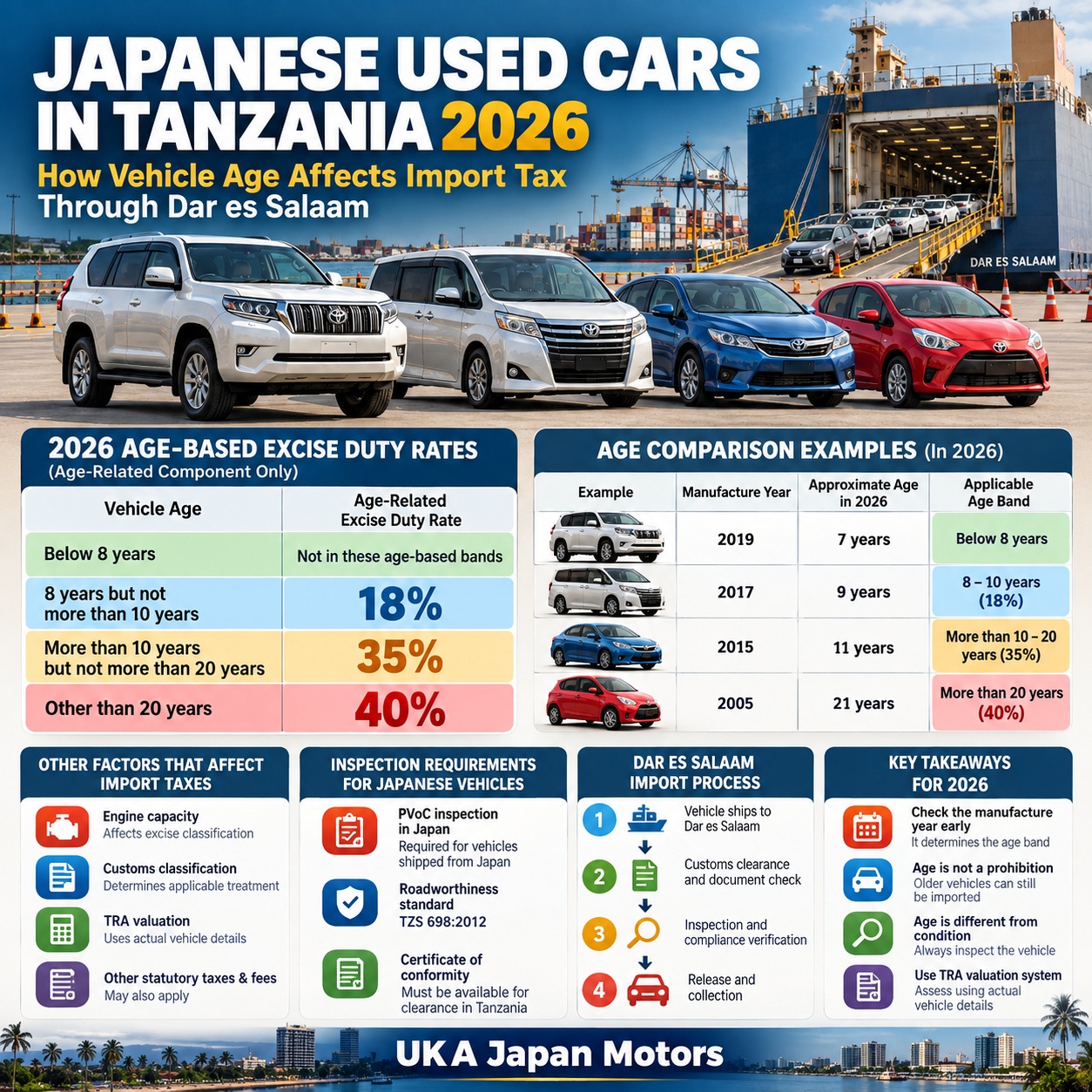
The reason is the revised age-based excise-duty structure introduced under Tanzania’s Finance Act, 2026. The law came into operation on 1 July 2026 and established different excise-duty bands for imported vehicles according to age. Vehicles aged eight years but not more than ten years fall within an 18% age-related excise band, vehicles aged more than ten years but not more than twenty years fall within a 35% band, and vehicles aged more than twenty years fall within a 40% band.
This does not mean that Tanzania has introduced a simple rule under which every vehicle older than eight years is prohibited from importation.
It means that vehicle age has a direct effect on the tax treatment applied to qualifying imported used vehicles.
For Japanese vehicles arriving through Dar es Salaam, that distinction matters because customs assessment, vehicle documentation, conformity inspection and port clearance all form part of the same import process.
A vehicle may look suitable from a mechanical or specification perspective, but the manufacture year can place it in a different regulatory tax category.
The practical lesson for 2026 is straightforward:
Do not assess a Japanese used vehicle by model, mileage and condition alone. Check the manufacture year, applicable excise category, engine specification, customs classification, inspection status and documentation together.
The 2026 Position at a Glance
The Finance Act, 2026 amended Tanzania’s Excise (Management and Tariff) Act and replaced the previous age-related rates with a three-band structure. The enacted rates are:
| Vehicle age | 2026 age-related excise position |
|---|---|
| Below 8 years | Outside these age-based bands |
| 8 years but not more than 10 years | 18% |
| More than 10 years but not more than 20 years | 35% |
| More than 20 years | 40% |
These figures describe the age-related excise component only. They should not be interpreted as the complete tax treatment for a vehicle.
The Tanzania Revenue Authority’s Used Motor Vehicle Valuation System is designed to provide vehicle-specific calculations involving the vehicle’s details, customs value, duties, taxes and applicable fees.
That distinction is important.
A vehicle’s age is one variable. Engine capacity, vehicle classification, customs valuation and other applicable statutory charges can also affect the final assessment.
Why the change matters
The most important change for many Japanese used-car importers is the stronger separation between the 8–10-year category and the over-10-year category.
The difference is not simply that an older vehicle has had more time on the road.
The law now places vehicles in substantially different age-related excise categories once they cross the ten-year boundary.
That means two vehicles from the same model generation can have different tax treatment even when their body design, engine family and equipment are broadly similar.
Why Vehicle Age Matters Before a Car Reaches Dar es Salaam
Dar es Salaam is the principal port for Tanzania’s international trade and includes facilities for handling vehicles, including a roll-on/roll-off berth.
For an imported Japanese used vehicle, the port is therefore not simply the place where the car physically arrives.
It is part of a wider clearance process involving documentation, customs assessment, inspection requirements, port procedures and release.
The Tanzania Ports Authority states that imported cargo is cleared through the relevant customs and port processes, with a registered clearing and forwarding agent handling the required documentation. The import process includes customs clearance, port charges, cargo checks and release procedures.
This is why an incorrect assumption about vehicle age should be resolved before shipment.
Once a vehicle has been selected and shipped, changing the underlying vehicle specification is no longer possible.
The manufacture year is therefore an early-stage compliance question rather than a final administrative detail.
How the 2026 Age Bands Work
Vehicles Below Eight Years
A vehicle below the eight-year threshold does not enter the three age-related excise bands introduced by the 2026 amendment.
This does not mean that such a vehicle is free from normal import taxation.
It means only that the additional age-based categories do not apply on the basis of being eight years old or more.
Other factors remain relevant, including engine capacity, customs classification and the valuation applied for customs purposes.
This distinction is important because a buyer can otherwise misunderstand the phrase “under eight years” as meaning that age is the only factor in determining the vehicle’s tax treatment.
It is not.
Age is one component of the assessment.
Vehicles Aged Eight to Ten Years
The first age-related band covers vehicles aged eight years but not more than ten years.
The applicable rate under the 2026 Finance Act is 18%.
This creates a clearly defined regulatory category.
For example, a vehicle manufactured in a year that places it within this statutory age range must be assessed under the applicable age-related provision rather than being treated like a vehicle below eight years.
The important point is not to rely on the model name or registration year alone.
A vehicle can be registered in one year but have been manufactured in another.
When the legislation refers to vehicle age, the manufacture-year information becomes particularly important.
The Ten-Year Boundary
The ten-year boundary deserves special attention in 2026.
Once a vehicle moves from the 8–10-year category into the more-than-10-year category, the applicable age-related excise rate changes from 18% to 35%.
This makes the manufacture year particularly important when comparing vehicles from the same generation.
Imagine two Japanese vehicles that share:
- The same model generation
- Similar engine specifications
- Similar equipment
- Similar body design
- Similar recorded mileage
If one remains within the 8–10-year band while the other has crossed the ten-year boundary, they are not necessarily in the same tax position.
This is one reason why selecting a vehicle purely from photographs or a model listing is insufficient.
The year needs to be verified alongside the chassis information and supporting export documentation.
Vehicles More Than Ten Years Old
The second major band covers vehicles aged more than ten years but not more than twenty years.
The 2026 Finance Act sets the age-related excise rate at 35% for this category.
This category can include older Japanese SUVs, MPVs, sedans, wagons and other vehicles that may still have a strong reputation for durability.
However, mechanical reputation and tax classification are separate issues.
A vehicle may have:
- A durable engine
- A proven transmission
- A straightforward mechanical design
- Strong service history
- Familiarity among Tanzanian technicians
None of those characteristics changes the statutory age category.
This is an important distinction for experienced buyers.
A mechanically sound older vehicle should still be evaluated according to its actual condition, but its condition should not be confused with its customs or excise classification.
Vehicles More Than Twenty Years Old
The Finance Act, 2026 created a separate age-related excise category for vehicles more than twenty years old.
The applicable rate is 40%.
At this age, the import assessment should go beyond the vehicle’s model reputation.
A detailed inspection becomes particularly important because age can affect multiple systems independently.
Areas that deserve attention include:
- Structural corrosion
- Previous accident repairs
- Suspension components
- Steering components
- Cooling systems
- Rubber seals and hoses
- Electrical systems
- Transmission condition
- Engine oil leaks
- Brake components
- Air-conditioning systems
- Underbody condition
- Evidence of prolonged storage
A vehicle can have a durable powertrain and still have age-related deterioration elsewhere.
For that reason, very old vehicles should be assessed as individual mechanical examples rather than simply as representatives of a particular model.
A Simple 2026 Age Comparison
The following examples illustrate how manufacture year can change the applicable age category.
| Example | Approximate age in 2026 | Applicable age band |
|---|---|---|
| Vehicle A — 2019 manufacture | 7 years | Below 8 years |
| Vehicle B — 2017 manufacture | 9 years | 8–10 years |
| Vehicle C — 2015 manufacture | 11 years | More than 10–20 years |
| Vehicle D — 2005 manufacture | 21 years | More than 20 years |
The table is intended to explain the statutory age bands rather than provide a complete tax calculation.
The difference between Vehicle B and Vehicle C is particularly important.
Both could belong to similar generations.
Both could have comparable equipment.
Both could have similar mechanical characteristics.
Yet they occupy different age-related excise categories.
That is why the manufacture year should be checked before a buyer commits to an import decision.
Age Is Not the Same as Condition
It is easy to treat vehicle age as a substitute for vehicle condition.
That is a mistake.
Age tells you how long the vehicle has existed.
It does not tell you:
- How it was maintained
- Whether it was involved in an accident
- Whether the odometer history is credible
- Whether it was exposed to corrosion
- Whether the engine has been rebuilt
- Whether the transmission has been repaired
- Whether the suspension has significant wear
- Whether the vehicle has been modified
- Whether replacement components are readily identifiable
The opposite is also true.
A newer vehicle is not automatically mechanically perfect.
A vehicle manufactured more recently can still have poor maintenance history or evidence of accident damage.
Therefore, the correct approach is to evaluate age and condition separately.
Age affects the regulatory and tax position.
Inspection establishes evidence about the vehicle itself.
Why the Japanese Inspection Process Matters
Tanzania Bureau of Standards requirements are another important part of the import process.
TBS states that used motor vehicles are regulated under its conformity-assessment system and provides specific procedures for used motor vehicles under the Pre-Shipment Verification of Conformity programme.
TBS previously announced that, for vehicles shipped from Japan, inspection would be carried out in Japan under the PVoC procedure rather than relying on the earlier destination-inspection arrangement. The stated purpose is to ensure that imported used vehicles meet the applicable Tanzanian standards.
The relevant roadworthiness standard is TZS 698:2012, which covers inspection and testing of used motor vehicles for roadworthiness.
This makes inspection documentation an essential part of the import file.
A buyer should not think of the vehicle’s tax assessment and inspection certificate as unrelated paperwork.
Both can affect whether the vehicle can move through the import process correctly.
What Happens If the Required Inspection Documentation Is Missing?
TBS documentation states that used motor vehicles regulated under PVoC that arrive without the required conformity documentation may be subject to destination inspection and the applicable penalty framework. TBS also states that a vehicle found non-compliant may need repair and re-inspection, while a vehicle that cannot be brought into compliance may be re-exported or destroyed at the importer’s expense.
This is why inspection should not be treated as something to resolve after the vehicle has arrived at Dar es Salaam.
The better approach is to establish:
- Whether the vehicle falls under the relevant inspection requirements.
- Which conformity procedure applies.
- Whether the required certificate has been issued.
- Whether the vehicle details on the certificate match the vehicle being shipped.
- Whether the chassis and identification information are consistent across the documents.
A mismatch between documents can create unnecessary clearance complications.
Dar es Salaam Clearance: Why Documentation Matters
The Tanzania Ports Authority describes a structured import process involving a registered clearing and forwarding agent, customs clearance, shipping documentation, port procedures, cargo checks and release.
For a vehicle arriving at Dar es Salaam, the documentation should therefore be treated as part of the vehicle itself.
Important records may include:
- Bill of Lading
- Commercial and shipping documentation
- Vehicle identification information
- Customs documentation
- Inspection or conformity documentation
- Relevant release documentation
- Other documents required by the authorities
The exact documentation depends on the vehicle and import circumstances.
The central principle is consistency.
The chassis number, manufacture information, vehicle description and supporting records should correspond.
A vehicle should not be selected on the assumption that paperwork can be corrected later without consequence.
The TRA Valuation System Should Be Used Before Finalising a Vehicle
Tanzania Revenue Authority provides a Used Motor Vehicle Valuation System that allows users to enter vehicle information and obtain an assessment showing the applicable customs value, duties, taxes and fees.
This is particularly useful in 2026 because vehicle age is now a more significant variable.
A sensible assessment should consider at least:
Manufacture year + vehicle make/model + engine capacity + chassis/specification + customs classification + applicable age band.
The valuation system should therefore be consulted using the actual vehicle details rather than an approximate model description.
For example, two vehicles carrying the same model name may have different:
- Manufacture years
- Engine capacities
- Specifications
- Customs classifications
- Tax treatment
The more precise the vehicle information, the more useful the assessment becomes.
Vehicle Age Versus Engine Size
Vehicle age is not the only factor affecting excise treatment.
The 2026 changes also introduced a new 5% excise duty for vehicles with engine capacities not exceeding 1,000cc that were previously exempt, according to reporting on the enacted measures.
This creates another reason not to look at age in isolation.
A buyer evaluating a small Japanese hatchback, compact car or other low-capacity vehicle should check both:
- The vehicle’s manufacture year
- The applicable engine-capacity classification
The same principle applies to larger vehicles.
Engine size and age are separate characteristics and can interact with the wider tax assessment.
Therefore, a useful pre-import checklist should never contain only “vehicle year.”
It should contain the complete specification.
How Age Changes the Way Buyers Should Compare Japanese Vehicles
A conventional vehicle comparison often starts with:
- Model
- Engine
- Mileage
- Equipment
- Colour
- Condition
For a Tanzania import in 2026, the order should be broader.
A more complete comparison is:
| Factor | Why it matters |
|---|---|
| Manufacture year | Determines the applicable age category |
| Engine capacity | Can affect excise classification |
| Chassis specification | Helps establish exact vehicle identity |
| Inspection status | Demonstrates conformity with applicable requirements |
| Mechanical condition | Indicates likely ownership requirements |
| Service history | Provides evidence of maintenance |
| Accident history | Identifies structural or repair concerns |
| Customs classification | Determines applicable treatment |
| Documentation | Supports clearance and registration processes |
| Intended use | Determines whether the vehicle suits its owner’s daily requirements |
This approach prevents one specification from dominating the decision.
Which Vehicle Age Makes Sense for Different Uses?
There is no universal age category that suits every Tanzanian driver.
The appropriate choice depends on the intended use and the individual vehicle.
Daily urban driving in Dar es Salaam
A vehicle intended for regular urban use should be assessed for:
- Cooling-system condition
- Air-conditioning performance
- Transmission condition
- Suspension wear
- Brake condition
- Fuel-system condition
- Traffic-related stop-start operation
Dar es Salaam’s traffic conditions can place repeated demands on cooling, transmission and braking systems.
Age is therefore relevant, but actual mechanical condition remains essential.
Longer-distance use
For regular travel between Dar es Salaam and other parts of Tanzania, attention should also be given to:
- Tyre condition
- Suspension
- Steering
- Cooling
- Engine condition
- Electrical reliability
- Spare-part availability
- Previous repair quality
A vehicle that performs adequately during a short inspection may reveal different issues during prolonged driving.
SUV and four-wheel-drive use
Older Japanese SUVs can have established mechanical reputations, but their age should be assessed separately from their capability.
Inspect:
- Four-wheel-drive operation
- Differential condition
- Transfer case
- Driveshafts
- Suspension
- Underbody
- Chassis
- Cooling system
A capable drivetrain does not eliminate the need for age-related inspection.
Common Mistakes When Importing Older Japanese Cars
Mistake 1: Looking only at the registration year
The relevant age assessment should be based on the statutory rules and the vehicle information required for the customs assessment.
Do not assume first registration automatically determines the applicable age category.
Mistake 2: Treating eight years as a prohibition
The 2026 Finance Act establishes age-related excise bands beginning with vehicles aged eight years but not more than ten years. It does not, by itself, state that every vehicle beyond eight years is prohibited from importation.
The distinction between higher tax treatment and prohibition is important.
Mistake 3: Ignoring the ten-year threshold
Moving beyond ten years changes the applicable age-related excise category from 18% to 35%.
That is a substantial regulatory distinction and should be checked before shipment.
Mistake 4: Choosing by model generation alone
A model generation can span several manufacture years.
Two vehicles that look almost identical can therefore fall into different statutory age bands.
Mistake 5: Treating inspection as a formality
TBS conformity requirements are part of the import process.
Inspection documentation should be verified before shipment rather than treated as paperwork to resolve after arrival.
Mistake 6: Using an estimated vehicle specification
The TRA valuation system depends on vehicle information.
The assessment should therefore be based on the actual vehicle details rather than a generic description of the model.
A Practical Pre-Shipment Checklist for 2026
Before confirming a Japanese used vehicle for Tanzania, verify the following.
Vehicle identity
- Manufacture year
- Chassis number
- Engine number where applicable
- Model designation
- Engine capacity
- Vehicle specification
Tax assessment
- Applicable age band
- Applicable engine-related excise
- Customs classification
- TRA valuation
- Other applicable statutory taxes and fees
Inspection
- Required PVoC procedure
- Certificate of conformity or roadworthiness documentation
- Inspection provider
- Consistency between inspection records and vehicle identification
Shipping
- Bill of Lading information
- Port of discharge
- Shipping documentation
- Clearing and forwarding arrangements
Physical condition
- Accident history
- Corrosion
- Engine condition
- Transmission
- Suspension
- Steering
- Brakes
- Cooling system
- Electrical systems
- Tyres
This checklist helps separate three different questions:
Can the vehicle be imported?
What tax treatment applies?
Is the vehicle mechanically suitable?
Those questions should not be treated as one.
Why Vehicle Age Should Be Checked Before Shipment
The strongest reason to verify age before shipment is simple: the manufacture year cannot be changed after the vehicle is already in transit.
If a buyer discovers at the Dar es Salaam clearance stage that the vehicle falls into a different age category than expected, the underlying vehicle specification remains unchanged.
The 2026 Finance Act therefore makes pre-shipment verification particularly important.
The sequence should be:
Identify → Verify → Assess → Inspect → Ship → Clear
rather than:
Select → Ship → Discover the tax position at the port
This is especially important when comparing vehicles close to the eight-year, ten-year or twenty-year boundaries.
A difference of one or two manufacture years can place otherwise similar vehicles into different statutory categories.
Japanese Used Cars and Long-Term Ownership in Tanzania
Import assessment should not end once the vehicle has cleared Dar es Salaam.
The vehicle still has to work in the conditions in which it will actually be driven.
Tanzania’s climate, road surfaces, traffic conditions and driving patterns can all influence vehicle wear.
For long-term ownership, buyers should think about:
- Cooling-system maintenance
- Suspension wear
- Brake servicing
- Air-conditioning maintenance
- Electrical reliability
- Transmission servicing
- Tyre condition
- Availability of appropriate replacement components
- Quality of previous repairs
An older vehicle can sometimes have a straightforward mechanical layout and a long history of use on Tanzanian roads.
But age-related deterioration remains a separate concern.
The objective should therefore be to establish evidence about the individual vehicle rather than assume that the model’s reputation tells the whole story.
A Useful Contrast: Newer Vehicle Versus Older Well-Maintained Vehicle
Consider two hypothetical Japanese vehicles.
Vehicle A is newer but has incomplete maintenance records and evidence of previous body repairs.
Vehicle B is older but has consistent maintenance records, clean inspection documentation and strong mechanical evidence.
Vehicle A may have a different age-related tax position.
Vehicle B may have a higher age-related excise category.
Neither fact alone establishes which vehicle is more suitable.
The comparison has to combine:
- Regulatory treatment
- Inspection status
- Mechanical condition
- Documentation
- Intended use
- Long-term maintenance requirements
This is the correct way to interpret the 2026 changes.
The law changes the tax treatment of vehicle age.
It does not replace mechanical inspection.
Frequently Asked Questions
1. Does Tanzania prohibit Japanese used cars older than eight years?
No. The 2026 Finance Act establishes additional age-related excise-duty categories for imported vehicles beginning with vehicles aged eight years but not more than ten years. The age category should not be confused with a blanket import prohibition.
2. What is the 2026 excise rate for a vehicle aged eight to ten years?
The Finance Act, 2026 sets the age-related excise rate at 18% for an imported vehicle aged eight years but not more than ten years.
3. What happens when a vehicle is more than ten years old?
An imported vehicle aged more than ten years but not more than twenty years falls into the 35% age-related excise category under the 2026 law.
4. What is the rate for vehicles more than twenty years old?
Vehicles more than twenty years old fall into the 40% age-related excise category under the Finance Act, 2026.
5. Is vehicle age the only factor used to determine import taxes?
No. Vehicle age is only one part of the assessment. Vehicle details, engine capacity, customs classification and valuation can also affect the applicable duties, taxes and fees. TRA provides a Used Motor Vehicle Valuation System for vehicle-specific calculations.
6. Does the manufacture year matter when importing a Japanese used car?
Yes. The age-related provisions refer to vehicle age, and the underlying rules use manufacture-year information. Buyers should therefore verify the actual manufacture year rather than relying solely on first registration information.
7. Are Japanese vehicles inspected before shipment?
Japanese used motor vehicles are subject to Tanzania’s conformity-assessment requirements. TBS announced that vehicles shipped from Japan are handled through the PVoC inspection procedure, with the applicable conformity documentation required for clearance.
8. What standard applies to used-vehicle roadworthiness?
TBS lists TZS 698:2012 as the standard covering the inspection and testing of used motor vehicles for roadworthiness.
9. What happens if a required conformity certificate is missing?
TBS states that regulated used vehicles arriving without the required Certificate of Roadworthiness may be subject to destination inspection and the applicable penalty framework. Vehicles that do not comply may require repair and re-inspection, while non-repairable vehicles may be re-exported or destroyed under the stated procedure.
10. Why is Dar es Salaam important for Japanese vehicle imports?
Dar es Salaam is Tanzania’s principal port and handles a major share of the country’s international trade. The port has facilities for vehicle handling and forms a central part of the customs, inspection and release process for imported vehicles.
11. Should I check the TRA valuation before the vehicle is shipped?
Yes. Checking the vehicle-specific assessment before shipment helps establish the relevant tax treatment using the actual vehicle specifications. TRA’s Used Motor Vehicle Valuation System is designed for this purpose.
12. Is a newer vehicle automatically a better choice?
No. A newer manufacture year can place a vehicle in a different age-related tax category, but it does not prove mechanical condition. Inspection history, maintenance records, accident history, specification and intended use remain important.
How UKA Japan Motors Approaches Vehicle Age and Import Compliance
UKA Japan Motors’ role should be understood primarily through verification rather than assumptions.
For a Japanese used vehicle intended for Tanzania, the important questions are not limited to whether a particular model is popular.
The process should establish:
- What year the vehicle was manufactured
- Which age-related category applies
- What engine specification the vehicle has
- Whether the vehicle’s documentation is consistent
- Whether the applicable inspection requirements have been satisfied
- Whether the vehicle’s physical condition is supported by inspection evidence
- Whether the vehicle information is sufficient for the relevant customs assessment
This approach is particularly important in 2026 because the Finance Act has made age a more significant part of the import-tax calculation.
UKA Japan Motors should therefore be viewed as an inspection- and compliance-focused source of guidance, helping buyers understand the relationship between the vehicle they select and the Tanzanian requirements that apply to it.
The objective is transparency.
A buyer should know the vehicle’s age, specification, inspection position and documentation before the vehicle enters the shipping and clearance process.
Final Takeaway: Check the Year Before You Check the Model
The biggest lesson from Tanzania’s 2026 used-vehicle tax changes is that vehicle age should move much earlier in the buying process.
The Finance Act, 2026 established:
- 18% age-related excise for vehicles aged eight years but not more than ten years
- 35% for vehicles aged more than ten years but not more than twenty years
- 40% for vehicles more than twenty years old
These rates do not represent the complete import-tax calculation, and they do not replace inspection, valuation or customs classification.
For a Japanese used vehicle entering Tanzania through Dar es Salaam, the sensible process is therefore to verify the manufacture year first, establish the applicable tax category, confirm the vehicle specification, complete the required conformity inspection and then proceed with shipping and customs clearance.
The most important boundaries to check are eight years, ten years and twenty years.
At the same time, age should never be used as a substitute for mechanical inspection.
A vehicle’s real condition, maintenance history, accident history, documentation and intended use all remain essential to a sound ownership decision.
In 2026, the right question is not simply whether a Japanese used car is old or new.
It is whether the vehicle’s age, specification, inspection status, regulatory treatment and actual condition all make sense together for its intended use in Tanzania.
Contact UKA Japan Motors for availability and inspection guidance.