


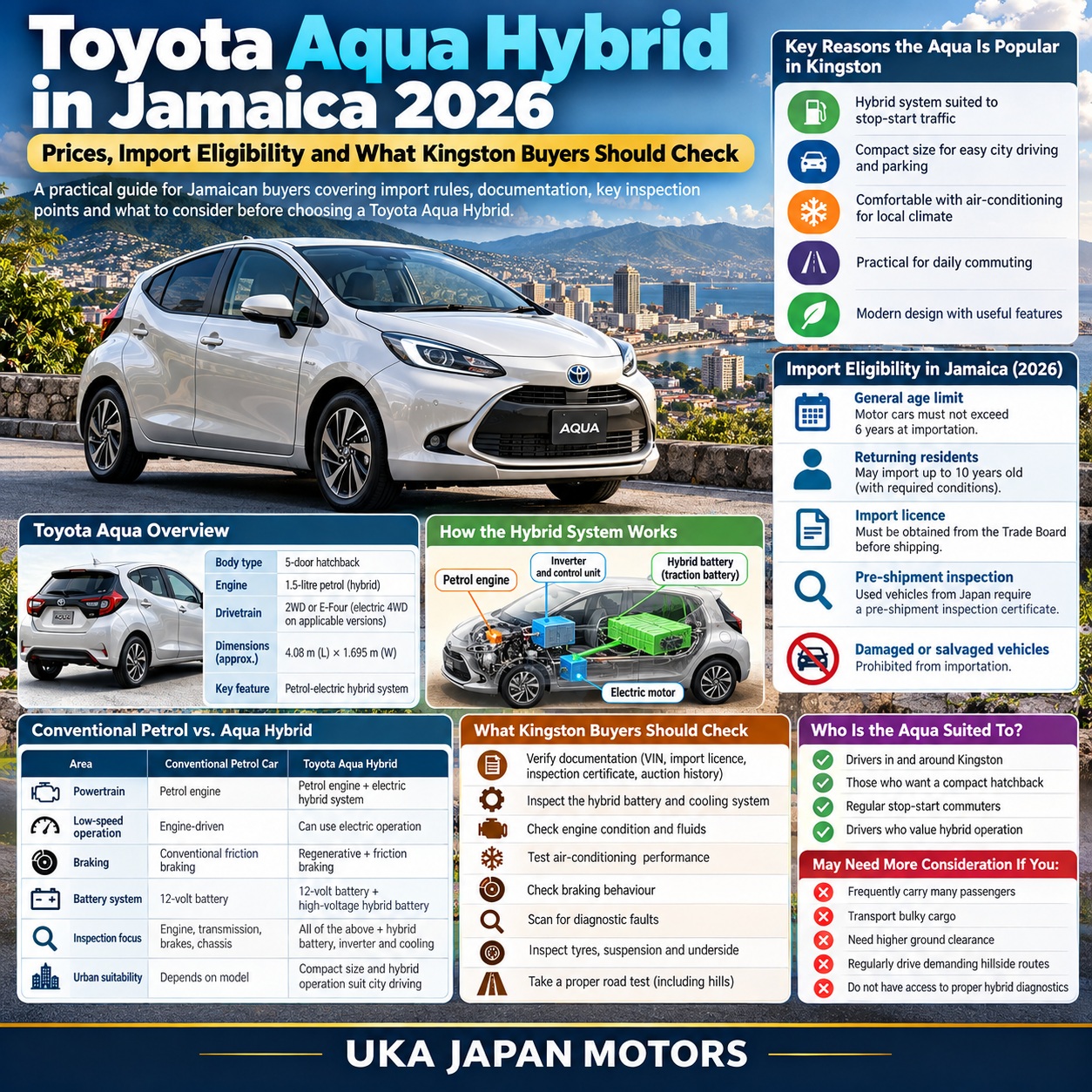
The Toyota Aqua Hybrid has become a familiar name among compact cars in Jamaica, particularly for drivers looking for a small vehicle suited to daily commuting and urban driving. Its combination of a compact body, petrol-electric hybrid system and automatic operation makes it relevant to the conditions many Kingston motorists encounter every day.
But buying or importing a Toyota Aqua in Jamaica involves more than choosing a model year and checking the exterior. A buyer needs to establish whether the particular vehicle is eligible for importation, whether its documentation is complete, whether its hybrid system has been properly inspected and whether its condition matches what the records indicate.
That becomes particularly important in 2026 because Jamaica’s import process places clear requirements on used vehicles. Cars generally fall within a six-year import-age limit, while specific provisions apply to returning residents. Used vehicles imported from Japan also require pre-shipment inspection, and the Jamaica Trade Board has issued a 2026 notice concerning additional verification where the required inspection certificate is missing.
For a Kingston buyer, the question is therefore not simply whether an Aqua is available. The more useful question is whether the particular Aqua has the right combination of eligibility, documentation, condition and hybrid-system history.
The short answer
A Toyota Aqua Hybrid can be a practical compact car for Jamaican urban driving, but buyers should treat each vehicle as an individual inspection case.
Before proceeding with an imported Aqua, confirm:
- The model year and exact vehicle specification.
- Whether the vehicle falls within Jamaica’s applicable import-age requirement.
- Whether the importer qualifies under the relevant importer category.
- That the required Trade Board import licence has been obtained before shipping.
- That a used vehicle from Japan has the required pre-shipment inspection certificate.
- That the Japanese export documentation agrees with the vehicle’s identity.
- That the auction or inspection history is available where applicable.
- That the hybrid battery and associated cooling system have been examined.
- That the petrol engine, inverter, electrical system and braking system operate correctly.
- That the vehicle has not been imported in a damaged or salvaged condition.
- That the vehicle’s mileage, condition and documentation tell the same story.
The Aqua’s hybrid system is not something that should be assessed by looking only at whether the car starts and drives. Hybrid operation involves a traction battery, electric motor, power-control components and high-voltage cabling. Toyota’s current Aqua documentation specifically identifies high-voltage components and warns that the hybrid system contains high-voltage and high-temperature areas.
That makes inspection an important part of the buying decision.
What is the Toyota Aqua Hybrid?
The Toyota Aqua is a compact five-door hybrid hatchback designed around a petrol-electric powertrain.
Current Japanese-market Aqua specifications include a 1.5-litre three-cylinder petrol engine, with the hybrid system combining the engine with electric propulsion. Toyota lists the current model at approximately 4.08 metres long and 1.695 metres wide, making it relatively compact for urban use. The current specification is available in front-wheel-drive form, with E-Four electric four-wheel drive offered on applicable versions.
The compact dimensions are particularly relevant in Kingston.
A vehicle that spends much of its life moving through congested streets, negotiating tight parking areas and dealing with frequent stops benefits from being easy to manoeuvre. The Aqua’s size can also be useful when moving through built-up areas where larger vehicles require more space.
However, compact dimensions should not be confused with universal suitability.
A buyer who regularly carries several adults, transports bulky equipment or frequently drives demanding hillside routes should consider the vehicle’s interior space, ground clearance, luggage requirements and powertrain characteristics rather than choosing the model solely because it is a hybrid.
Why the Aqua’s hybrid system matters in Kingston
Hybrid vehicles operate differently from conventional petrol cars.
During suitable driving conditions, the electric motor can provide propulsion without requiring the petrol engine to operate continuously. The petrol engine can also assist when additional power is required. During deceleration, the system can recover some energy through regenerative braking and store that energy in the hybrid battery.
This operating pattern is particularly relevant to stop-and-go urban traffic.
A Kingston commute can involve repeated acceleration, braking and periods of low-speed movement. In a conventional vehicle, those conditions mean the engine may continue operating while the vehicle is stationary or moving slowly. A hybrid system is designed to manage these conditions differently.
That does not mean every trip will produce the same fuel-consumption result.
Actual performance depends on traffic, driving style, air-conditioning use, road gradient, tyre condition, vehicle load and the condition of the hybrid system. Published laboratory fuel-consumption figures should therefore be treated as controlled-test measurements rather than a guarantee of what a particular Kingston driver will experience.
Toyota’s current Aqua specifications publish official test-cycle figures, but Toyota also notes that those measurements are obtained under prescribed testing conditions.
Import eligibility: the first check before anything else
One of the most important mistakes an importer can make is treating vehicle selection and import eligibility as separate issues.
They are connected.
Jamaica’s Trade Board states that motor cars generally must not exceed six years of age at importation. Jamaica Customs publishes the same six-year limit for cars, including sedans, station wagons and SUVs within the listed categories.
For a Toyota Aqua, the relevant question is therefore not simply the calendar year printed on a listing. The importer should establish the vehicle’s actual manufacturing or model information and determine how the applicable age rule affects that particular vehicle before arranging shipment.
Returning residents have a different provision. Jamaica Customs states that returning residents may import a motor vehicle up to ten years old where the applicable requirements are satisfied, including possession of the vehicle for at least six months. This is a specific category and should not be assumed to apply to an ordinary resident importing a vehicle.
Why the six-year rule matters
A vehicle can look attractive in an overseas listing and still create an import problem if its age falls outside the permitted range.
The correct order is:
- Identify the vehicle.
- Confirm its exact year and specification.
- Determine the importer’s category.
- Check the applicable age requirement.
- Confirm the required inspection and documentation.
- Apply for the appropriate import licence.
- Only then proceed with shipping arrangements.
Jamaica Customs specifically states that the Trade Board import licence must be obtained before shipping arrangements are made.
Importer categories also matter
Jamaica’s rules distinguish between different types of importers.
The Jamaica Customs Agency identifies individual importers including Jamaican residents, returning residents, contract officers and holders of work permits. Individuals have defined vehicle-import facilities and restrictions, including a three-year interval for residents accessing the facility.
Companies have separate provisions, while certified motor vehicle dealers operate under their own category.
This distinction matters because two people looking at the same Toyota Aqua may not necessarily have the same import eligibility.
A buyer should therefore establish their own importer category before assuming that a particular vehicle can be brought into Jamaica.
The import licence is not optional
Motor vehicles require an import licence.
Jamaica Customs states that an importer must first apply to the Trade Board and receive the import licence before making arrangements to ship the vehicle.
This is an important distinction because an overseas vehicle listing is not the same thing as an approved Jamaican import.
A buyer should be cautious about treating a supplier’s statement that a vehicle is “ready to ship” as proof that Jamaican import requirements have been satisfied.
The licence and supporting documentation should be handled as part of the import process rather than as paperwork to resolve after the vehicle is already on its way.
Pre-shipment inspection for Japanese vehicles
For a Toyota Aqua coming from Japan, pre-shipment inspection is one of the most important documentation checks.
Jamaica Customs states that used vehicles must be inspected and issued with a pre-inspection certificate in the country of export. For Japanese vehicles, the relevant inspection process is identified in the Customs guidance.
The Jamaica Trade Board issued a specific notice effective June 1, 2026, reminding importers that used vehicles from designated countries, including Japan, require the appropriate pre-shipment inspection certificate. Where a used vehicle arrives without the required certificate, verification can be required to establish whether the vehicle is listed as stolen and to validate ownership.
For a buyer, the lesson is straightforward:
Do not treat the inspection certificate as secondary paperwork.
It is part of the vehicle’s import history.
Documentation a Kingston buyer should check
The paperwork should be examined alongside the physical vehicle.
Jamaica Customs identifies several documents relevant to motor vehicle importation, including:
- Import licence
- Title or export certificate
- Bill of lading or order
- Supplier invoice
- Tax Compliance Certificate
- Special declaration prepared by a licensed Customs Broker
Customs also identifies additional documentation requirements within its motor vehicle processing procedures.
The important point is consistency.
The VIN or chassis identification should correspond across the vehicle and its documents.
The model information should be consistent.
The stated year should be consistent.
The vehicle’s specification should not contradict the documentation.
Mileage should also be considered in conjunction with inspection and auction records rather than accepted solely because it appears on a dashboard.
Auction history can reveal what the vehicle has experienced
Many Japanese-used Aqua vehicles enter the market with an auction history or inspection record.
Where such documentation is available, it can help establish:
- Recorded mileage
- Previous damage
- Exterior condition
- Interior condition
- Repair history
- Auction grade
- Identified mechanical or cosmetic defects
- Whether the vehicle was modified before export
The document should not be treated as a substitute for a current inspection.
An auction sheet describes the vehicle at an earlier point in time. A vehicle can change condition between auction, export, shipping and arrival in Jamaica.
The best approach is to compare the historical record with the vehicle that is actually being inspected.
If the documentation describes damage that is no longer visible, ask how the repair was completed.
If the mileage differs materially from historical records, establish why.
If the current condition appears substantially different from the documented condition, investigate before proceeding.
Hybrid battery inspection: one of the most important checks
The hybrid battery is one of the components that separates the Aqua from a conventional petrol hatchback.
A visual inspection alone cannot establish battery health.
A proper inspection should consider available diagnostic information and look for signs of abnormal battery behaviour.
Relevant checks can include:
- Hybrid-system diagnostic codes
- Battery state-of-charge behaviour
- Battery block or cell voltage balance where diagnostic equipment supports it
- Battery cooling system operation
- Cooling-air intake condition
- Warning messages
- Irregular charging and discharging behaviour
- Unusual changes in engine operation
- Evidence of previous hybrid-system repairs
Toyota’s current Aqua documentation identifies a dedicated traction-battery cooling intake and high-voltage components as part of the hybrid system.
This is particularly relevant in Jamaica’s climate.
Heat and humidity should not be ignored
Kingston’s warm climate means vehicles regularly operate in conditions where air-conditioning is important and under-hood temperatures can become substantial.
For a hybrid, thermal management matters.
The traction battery has a cooling system, and restricted airflow can affect the system’s ability to manage battery temperature. A buyer should therefore inspect the battery cooling intake and associated ventilation areas rather than focusing only on the engine compartment.
Dust, debris and accumulated material can interfere with airflow.
The same principle applies to the conventional engine cooling system.
A vehicle may spend long periods in slow-moving traffic with the air-conditioning operating heavily. That makes cooling-system condition particularly important for long-term ownership.
The 12-volt battery should also be checked
The hybrid traction battery receives much of the attention, but the smaller 12-volt battery should not be ignored.
A weak 12-volt battery can create starting and electronic-system problems even though the vehicle has a much larger high-voltage hybrid battery.
When inspecting an Aqua, the 12-volt battery should be tested rather than judged only by its physical appearance.
A diagnostic inspection should also look for stored faults that may not be obvious during a short road test.
Air-conditioning performance matters in Kingston
For many Kingston drivers, air-conditioning is not an optional comfort feature.
A buyer should test the system from cold and observe how it behaves during both stationary operation and driving.
The air-conditioning system is integrated into the vehicle’s overall electrical and thermal architecture, so abnormal behaviour should be investigated rather than dismissed as a minor issue.
A proper inspection should consider:
- Cooling performance
- Fan operation
- Compressor operation
- Unusual noises
- Temperature stability
- Electrical warnings
- Signs of previous repair
The vehicle should be tested under conditions representative of normal use, not simply started for a few minutes in a shaded inspection area.
Braking behaviour deserves special attention
Hybrid vehicles use regenerative braking alongside conventional friction braking.
Toyota identifies the Aqua’s braking system as using hydraulic and regenerative-braking coordination.
The transition between regenerative and conventional braking should feel controlled and predictable.
A buyer should pay attention to:
- Brake-pedal feel
- Vehicle stability during braking
- Brake noise
- Uneven braking
- Warning lights
- Unusual vibration
- Brake-disc condition
- Tyre condition
A road test should include gentle braking and stronger controlled braking where safe.
If braking behaviour feels inconsistent, the vehicle should receive further inspection before purchase.
Engine condition still matters
A hybrid is not an engine-free vehicle.
The Aqua’s petrol engine remains an important part of the powertrain.
The current model uses Toyota’s M15A-FXE 1.5-litre three-cylinder engine.
A buyer should inspect:
- Engine oil condition
- Coolant condition
- Leaks
- Starting behaviour
- Engine vibration
- Exhaust behaviour
- Warning lights
- Cooling-system operation
- Service history
The engine may not run continuously during a road test because the hybrid system controls when petrol power is required.
That means an inspection should be more deliberate than simply listening for an engine at idle.
Kingston traffic changes how the vehicle is used
A vehicle used primarily in Kingston may experience a very different operating pattern from one used mainly on open roads.
Frequent stop-start traffic can mean:
- More repeated acceleration and braking
- Extended air-conditioning operation
- More low-speed operation
- More time spent stationary
- More exposure to congested road conditions
This is one reason the hybrid system deserves specific attention.
The Aqua’s compact dimensions can make it convenient for urban driving, but buyers should still consider whether their actual route includes long periods of climbing, heavily loaded driving or regular travel outside the city.
Hillside driving is another consideration
Jamaica’s geography means that a Kingston-based driver may regularly move between relatively flat urban areas and hillside routes.
The hybrid system can provide electric assistance and engine power according to operating conditions, but the buyer should not assume that a compact hybrid will behave identically to a larger petrol vehicle on every steep road.
During an inspection drive, pay attention to:
- Acceleration while climbing
- Engine behaviour under sustained load
- Temperature behaviour
- Brake performance on descents
- Steering stability
- Tyre grip
- Suspension noise
A short flat-road test may not reveal issues that appear during a longer uphill drive.
2WD versus E-Four: what is the difference?
Some current Aqua versions are available with front-wheel drive, while E-Four versions use an electric four-wheel-drive system. Toyota describes E-Four as automatically controlling the transition between front-wheel drive and electric four-wheel drive according to driving conditions.
These versions should not simply be treated as identical cars with different badges.
The drivetrain configuration affects the vehicle’s mechanical and electrical specification.
For a Kingston buyer, the relevant question is not whether one configuration is universally better. Instead, consider the roads the vehicle will actually use.
A mainly urban commuter may have different requirements from a driver who regularly travels steep or slippery roads.
The exact specification should also be confirmed from the Japanese documentation rather than inferred from photographs.
A useful comparison: conventional petrol car versus Aqua Hybrid
| Area | Conventional petrol compact car | Toyota Aqua Hybrid |
|---|---|---|
| Powertrain | Petrol engine | Petrol engine plus electric hybrid system |
| Low-speed operation | Engine-driven | Hybrid system can combine engine and electric operation |
| Braking | Conventional friction braking | Regenerative and friction braking coordination |
| High-voltage system | Not present | Present |
| Battery inspection | Conventional 12-volt battery | 12-volt battery plus traction battery |
| Diagnostic requirements | Conventional vehicle diagnostics | Conventional and hybrid-system diagnostics |
| Urban suitability | Depends on model | Compact dimensions and hybrid operation suit many urban conditions |
| Inspection focus | Engine, transmission, brakes and chassis | Those areas plus hybrid battery, inverter, cooling and high-voltage components |
The important difference is inspection complexity.
The Aqua does not eliminate conventional vehicle maintenance. It adds a hybrid system that needs its own inspection.
What Kingston buyers should check before committing
A sensible inspection can be organised into several stages.
1. Confirm identity
Verify the VIN or chassis number against all available documentation.
2. Confirm eligibility
Establish the model year, importer category and applicable age requirement before shipping or purchase.
3. Confirm import documentation
Check the import licence and relevant export and inspection documents.
4. Review vehicle history
Look for auction records, previous damage and mileage history.
5. Inspect the body
Check panel alignment, paint differences, corrosion, repaired areas and signs of accident damage.
6. Inspect the underside
Look for structural damage, leaks, corrosion, damaged suspension components and evidence of poor repairs.
7. Scan the vehicle
Use appropriate diagnostic equipment to check for stored and current faults.
8. Check the hybrid system
Assess battery operation, cooling, inverter-related systems and warning messages.
9. Test the engine
Check cooling, fluids, starting behaviour and abnormal noises.
10. Conduct a road test
Test acceleration, braking, steering, suspension and hybrid-system transitions.
11. Reconcile the results
The final decision should be based on the combination of physical condition, diagnostics and documentation.
What should make a buyer pause?
Several situations deserve further investigation.
A missing inspection certificate is one.
Jamaica’s 2026 Trade Board notice specifically highlights the consequences of failing to meet the pre-shipment inspection requirement for used vehicles from designated countries.
Other warning signs include:
- A VIN or chassis number that does not match the paperwork.
- Missing export documentation.
- A large unexplained mileage discrepancy.
- Evidence of major accident repair.
- Salvage or damaged-vehicle history.
- Hybrid warning messages.
- Battery cooling problems.
- Unexplained electrical faults.
- Inconsistent paint or panel alignment.
- Excessive engine vibration.
- Brake-system warnings.
- An incomplete service history.
- A seller who cannot clearly explain the vehicle’s import history.
Jamaica Customs states that the importation of vehicles considered damaged or salvaged is prohibited.
That makes damage history more than simply a matter of cosmetic preference.
Why documentation and inspection should be considered together
Documentation answers one set of questions.
Inspection answers another.
The documents can tell you what the vehicle was recorded as being when it was exported. The inspection tells you what condition the vehicle is in now.
Neither should automatically replace the other.
For example, a vehicle may have an apparently clean history but still have a weak battery or worn suspension.
Conversely, a vehicle may have had a minor documented repair that does not necessarily indicate a serious current problem.
The goal is to establish whether the vehicle’s history and present condition are consistent.
Long-term ownership considerations in Jamaica
A Toyota Aqua should be maintained as both a petrol vehicle and a hybrid vehicle.
Routine servicing remains important for the engine, fluids, tyres, suspension and brakes.
Hybrid-specific areas should also be monitored.
The battery cooling intake should remain unobstructed.
Warning messages should not be ignored.
Hybrid diagnostic faults should be investigated promptly.
The air-conditioning system should be maintained properly.
Tyres should be kept at the correct specification and pressure.
The vehicle should also receive regular inspections rather than being serviced only after a problem becomes obvious.
This is particularly important for used imported vehicles because the new owner may not know exactly how the vehicle was maintained before arriving in Jamaica.
Who is the Toyota Aqua suited to?
The Aqua can make sense for a driver who:
- Primarily drives in and around Kingston.
- Wants a compact hatchback.
- Frequently encounters stop-start traffic.
- Values hybrid operation.
- Does not need a large cargo area.
- Is comfortable maintaining a vehicle with both conventional and hybrid systems.
- Is prepared to verify the vehicle’s history before ownership.
It may require more consideration for someone who:
- Regularly carries a large number of passengers.
- Frequently transports bulky cargo.
- Needs substantial ground clearance.
- Regularly drives demanding roads under heavy loads.
- Does not have access to appropriate hybrid-system diagnostics.
- Is unwilling to investigate documentation or vehicle history.
The point is not that the Aqua is unsuitable for these drivers. Rather, the vehicle should be matched to the actual pattern of use.
A note about model year and generation
Not every Toyota Aqua listed for sale in Jamaica will be mechanically identical.
The Aqua has evolved over time, and equipment, hybrid-system specifications, drivetrain configurations and safety technology can differ between model years and grades.
A buyer should therefore avoid using the name “Aqua Hybrid” as if it described one single specification.
The exact year, grade, drivetrain and equipment level should be confirmed from the vehicle’s documentation.
This is particularly important when comparing an imported vehicle with another Aqua already registered in Kingston.
Frequently Asked Questions
1. Can a Toyota Aqua Hybrid be imported into Jamaica in 2026?
Yes, provided the specific vehicle and importer satisfy Jamaica’s applicable requirements. Motor cars are generally subject to a six-year age limit at importation, while specific rules apply to categories such as returning residents.
2. Does a Toyota Aqua require an import licence?
Yes. Jamaica Customs states that an import licence must be obtained from the Trade Board before shipping arrangements are made.
3. Does a used Toyota Aqua from Japan need pre-shipment inspection?
Yes. Used vehicles from Japan fall under Jamaica’s pre-shipment inspection requirements. The required certificate should be obtained before the vehicle is shipped.
4. Can a damaged or salvaged Toyota Aqua be imported?
Jamaica Customs states that the importation of motor vehicles considered damaged or salvaged is prohibited.
5. What should I check on the Aqua’s hybrid battery?
The battery should be assessed using appropriate diagnostic procedures rather than a visual inspection alone. Battery behaviour, diagnostic codes, cooling and related hybrid-system components should be examined.
6. Does the Aqua still have a petrol engine?
Yes. The current Aqua uses a 1.5-litre petrol engine as part of its hybrid powertrain.
7. Is the Toyota Aqua suitable for Kingston traffic?
Its compact dimensions and hybrid powertrain can suit urban stop-start driving, but actual suitability depends on the driver’s route, vehicle condition, passenger requirements and maintenance history.
8. Does every Toyota Aqua have four-wheel drive?
No. Toyota offers Aqua versions with front-wheel drive, while E-Four electric four-wheel drive is available on applicable versions.
9. Should I inspect the Aqua before completing a purchase?
Yes. A physical and diagnostic inspection can identify issues that are not apparent from photographs, advertisements or a short visual examination.
10. What documents should I request?
Relevant documentation includes the import licence, title or export certificate, invoice, bill of lading or order, applicable Tax Compliance documentation and the required inspection documentation.
11. Is the auction sheet enough to confirm the vehicle’s condition?
No. An auction record is historical documentation. The vehicle should still receive a current physical and diagnostic inspection after arrival or before purchase.
12. Why is the hybrid cooling system important?
The hybrid battery and related components operate within a managed temperature range. Toyota identifies a dedicated traction-battery cooling intake as part of the Aqua’s hybrid system. Keeping the cooling system unobstructed is therefore an important ownership consideration.
The role of UKA Japan Motors
UKA Japan Motors’ role should be based on helping buyers understand the vehicle they are considering rather than simply presenting a model as a purchase option.
For a Toyota Aqua Hybrid, that means paying attention to the details that can affect ownership after the vehicle reaches Kingston.
The useful work begins with identifying the correct vehicle and specification. It continues with checking documentation, reviewing available vehicle history and identifying areas that deserve inspection.
For hybrid vehicles, that inspection should include the hybrid system rather than concentrating exclusively on the petrol engine and exterior.
A transparent approach also means distinguishing between what the documentation confirms, what an inspection establishes and what still requires further verification.
That distinction is particularly important when dealing with imported used vehicles, because the vehicle may have a history outside Jamaica that cannot be determined from its appearance alone.
Final takeaway
The Toyota Aqua Hybrid can be a relevant option for Kingston drivers because its compact format and petrol-electric powertrain are well suited to many forms of urban driving.
However, the most important consideration in 2026 is not simply the Aqua badge.
The individual vehicle matters.
Import eligibility must be confirmed before shipping. The applicable age requirement must be checked. The required import licence and inspection documentation must be in place. Japanese export records should correspond with the vehicle. Damage history should be investigated. Hybrid-system diagnostics should form part of the inspection. Battery cooling, the 12-volt system, braking, air-conditioning, engine operation and suspension should all be examined.
Jamaica’s current import rules make documentation an essential part of the process, while the Aqua’s hybrid architecture makes technical inspection equally important.
For a Kingston buyer, the safest approach is therefore to evaluate the Aqua as a complete vehicle rather than as a model name: verify its eligibility, establish its history, inspect its current condition and make sure the documentation supports what the vehicle appears to be.
Contact UKA Japan Motors for availability and inspection guidance.