


Choosing a used truck for business use in Jamaica requires more than selecting a familiar badge or finding a vehicle with a large cargo bed. The truck must match its intended workload, Jamaica’s vehicle-import categories, the published duty structure, local commercial-vehicle licensing requirements, and the operating conditions it will face after registration.
In Kingston, a truck may spend part of the day moving slowly through traffic, several hours loading or unloading in restricted spaces, and the remainder travelling through St. Andrew’s hillside communities or along exposed coastal roads. A vehicle that performs well when empty may behave very differently when carrying tools, building supplies, farm produce, appliances, water tanks, or delivery cargo.
Import classification is equally important. Jamaica does not treat every vehicle with an open cargo bed as the same type of truck. Unladen weight, body construction, fuel type, intended use, and Customs tariff classification can affect the permitted vehicle age and the duty assessment.
This guide examines the Japanese used trucks that make the most practical sense for Jamaica in 2026. It also explains the import-cost structure without relying on individual purchase quotations, which can change according to vehicle condition, shipping arrangements, exchange rates, Customs valuation, and port processing.
Direct Answer: Which Japanese Used Trucks Are Best for Jamaica?
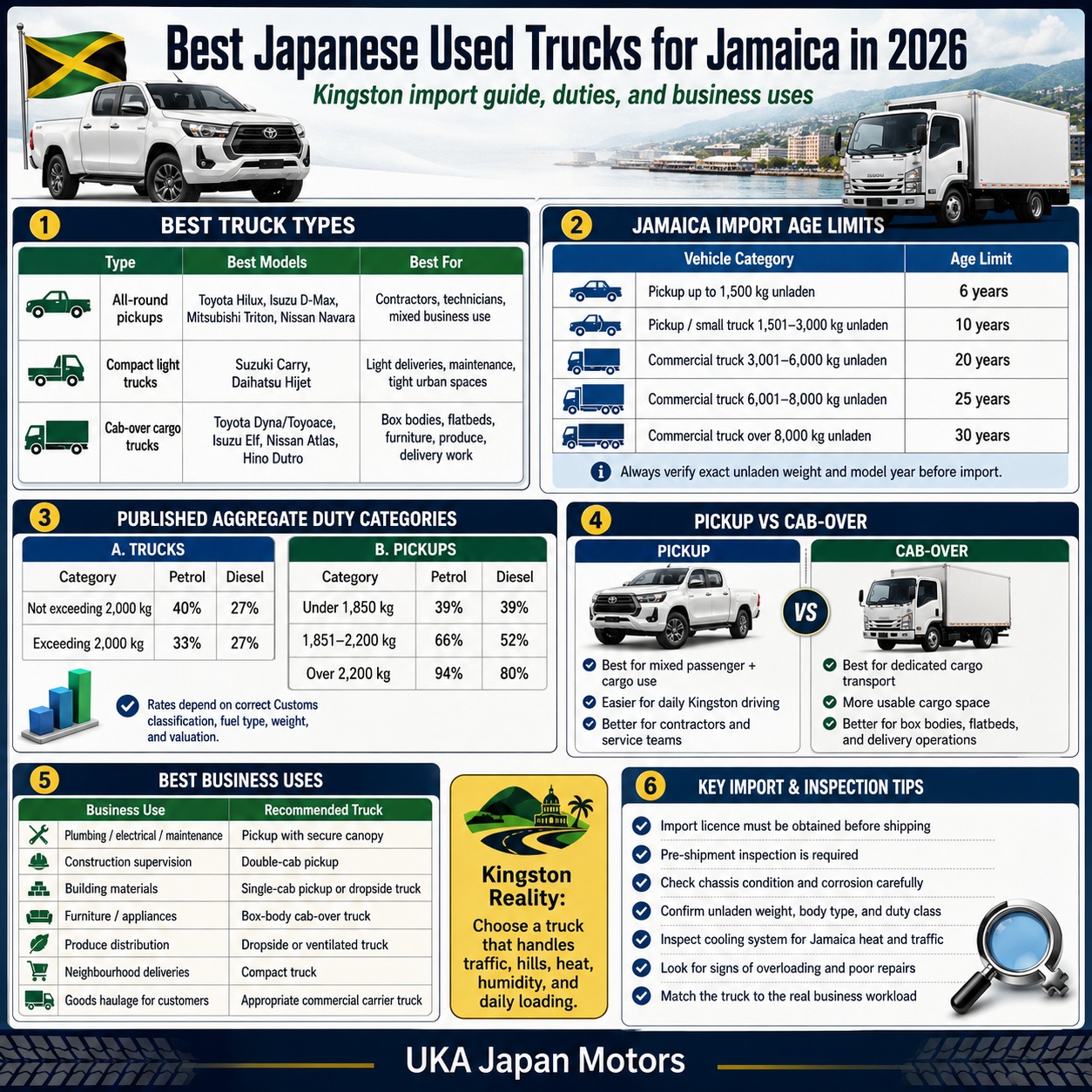
For general business use, the strongest all-round choices are the Toyota Hilux, Isuzu D-Max, Mitsubishi Triton, and Nissan Navara. These pickups combine a separate cargo bed with a cabin that remains manageable in Kingston traffic.
For compact deliveries, property maintenance, and light urban work, the Suzuki Carry and Daihatsu Hijet can be useful when their payload limitations are respected.
Businesses requiring a dedicated cargo platform should consider cab-over trucks such as the Toyota Dyna or Toyoace, Isuzu Elf, Nissan Atlas, and Hino Dutro. These vehicles provide more usable load space than a conventional pickup and are better suited to box bodies, flatbeds, refrigerated bodies, dropside trays, and specialist equipment.
The best choice depends on five questions:
- What will the truck carry?
- How heavy is the normal load?
- Will it transport the owner’s goods or carry goods for customers?
- How much of its work will be completed in congested Kingston streets?
- Under which Jamaican import and duty category will the vehicle be classified?
A well-maintained truck that correctly answers those questions is usually more suitable than a larger vehicle selected only for appearance or stated maximum capacity.
Why Japanese Used Trucks Suit Jamaican Business Operations
Japanese trucks cover a wide range of commercial needs. The available designs extend from narrow mini-trucks and conventional one-ton pickups to cab-over chassis capable of supporting substantial commercial bodies.
This range is valuable in Jamaica because businesses do not all operate under the same conditions. A plumbing contractor travelling between Kingston properties has different requirements from a produce distributor, furniture delivery operator, construction supplier, landscaper, or business moving palletised goods.
Japanese trucks are also commonly available in several body and drivetrain configurations. Depending on the model, an importer may encounter:
- Single-cab, extended-cab, and double-cab pickups
- Two-wheel-drive and four-wheel-drive systems
- Manual and automatic transmissions
- Standard and long cargo beds
- Flatbed, dropside, box-body, tipper, and refrigerated configurations
- Single or dual rear-wheel layouts
- Petrol, diesel, hybrid, and limited electric commercial variants
Configuration matters as much as the model name. Two trucks carrying the same badge may have different chassis codes, unladen weights, axle capacities, suspension arrangements, body lengths, and Customs classifications.
The inspection decision should therefore be based on the exact chassis rather than the reputation of the model family alone.
Jamaica’s Truck Import Age Limits in 2026
Jamaica’s approved import age varies according to vehicle type and unladen weight.
The Trade Board’s published age-limit schedule states that pickups not exceeding 1,500 kilograms unladen are permitted up to six years. Pickups and other small trucks from 1,501 to 3,000 kilograms unladen are permitted up to ten years.
Commercial cargo trucks between 3,001 and 6,000 kilograms unladen have an approved age limit of 20 years. The limit increases to 25 years for trucks between 6,001 and 8,000 kilograms and to 30 years for trucks exceeding 8,000 kilograms unladen.
| Vehicle category | Unladen-weight classification | Published age limit |
|---|---|---|
| Light pickup | Not exceeding 1,500 kg | 6 years |
| Pickup or other small truck | 1,501–3,000 kg | 10 years |
| Commercial cargo truck | 3,001–6,000 kg | 20 years |
| Commercial cargo truck | 6,001–8,000 kg | 25 years |
| Commercial cargo truck | Exceeding 8,000 kg | 30 years |
These limits do not mean that every vehicle within the maximum age should automatically be imported. Age eligibility only answers whether the vehicle may qualify under the policy. It does not confirm mechanical condition, corrosion level, maintenance history, body integrity, or suitability for the planned workload.
Annual model-year cut-off notices can also affect permit timing. Importers should obtain confirmation for the exact model year and weight category before committing to the vehicle.
Unladen Weight Is Not the Same as Payload
One of the most important distinctions when selecting a commercial truck is the difference between unladen weight and payload.
Unladen weight is generally the weight of the vehicle without cargo. It includes the installed body and standard equipment according to the applicable documentation and classification method.
Payload refers to the load the vehicle is designed to carry within its permitted gross vehicle weight.
A truck may have an unladen weight of more than 1,500 kilograms while still being described in everyday conversation as a one-ton pickup. The “one-ton” description usually refers broadly to its payload class, not its empty weight.
This distinction matters because Jamaican import age limits and duty categories use weight thresholds. Importers should not estimate the vehicle’s category from its appearance, cabin size, cargo-bed length, or marketing description.
The export certificate, manufacturer data, pre-shipment inspection records, chassis information, and Customs classification should agree.
Understanding Kingston Truck Import Costs
The full import commitment includes several components. It is not limited to the supplier’s invoice or the published duty percentage.
A complete assessment may include:
- The vehicle’s Customs value
- Freight and marine insurance
- Pre-shipment inspection and sanitisation
- Import duty
- Special Consumption Tax where applicable
- General Consumption Tax
- Customs Administrative Fee
- Environmental levy
- Shipping-agent and port handling
- Storage where clearance is delayed
- Customs-broker processing
- Inland transport from the port
- Registration and fitness procedures
- Commercial-carrier licensing where required
- Body repairs, tyres, fluids, filters, batteries, and initial servicing
- Adaptation of the cargo body for the intended operation
Customs commonly works from a CIF basis: the vehicle value together with insurance and freight. Customs may also review the declared value against available valuation information rather than accepting every invoice figure without examination.
The important planning principle is to identify the truck’s classification before estimating the total import commitment. A pickup and a cargo truck can attract different duty treatment even when they appear similar in overall size.
Published Truck and Pickup Duty Categories
At the time of writing, the individual-importer rate sheet displayed by the Jamaica Customs Agency is marked as revised with effect from 2025. The Customs website continues to direct importers to that published sheet, but the applicable rate should still be confirmed before shipment because tariff treatment and administrative requirements may be amended.
The official sheet separates conventional trucks from pickups.
Trucks Classified by Weight
| Customs description | Petrol aggregate rate | Diesel aggregate rate |
|---|---|---|
| Trucks not exceeding 2,000 kg | 40% | 27% |
| Trucks exceeding 2,000 kg | 33% | 27% |
Pickups Classified by Unladen Weight
| Customs description | Petrol aggregate rate | Diesel aggregate rate |
|---|---|---|
| Compact pickup under 1,850 kg | 39% | 39% |
| Pickup from 1,851–2,200 kg | 66% | 52% |
| Pickup over 2,200 kg | 94% | 80% |
These are published aggregate rates, not individual clearance quotations. Jamaica Customs notes that Import Duty, Special Consumption Tax and GCT are compounded, while the processing fee and environmental levy are included in the aggregate duty calculation. The percentages should therefore not be treated as figures that can simply be added together independently.
The table also demonstrates why correct classification is essential. “Pickup” and “truck” are not interchangeable descriptions for Customs purposes. The body type, tariff heading, fuel, weight and construction must be verified for the exact vehicle.
Best Japanese Used Pickups for Jamaica
1. Toyota Hilux: Best All-Round Business Pickup
The Toyota Hilux is one of the most versatile choices for businesses that need a vehicle capable of carrying cargo while remaining practical for daily travel around Kingston.
It suits contractors, property-maintenance teams, agricultural suppliers, technical service companies, tradespeople, and businesses that divide the vehicle’s time between work sites and administrative duties.
Single-cab versions normally prioritise cargo-bed length. Double-cab versions provide more protected passenger space but sacrifice part of the usable bed. Extended-cab versions sit between those two arrangements.
For hillside or undeveloped work sites, a four-wheel-drive Hilux may provide greater operational flexibility. For mostly paved routes, a two-wheel-drive version may be mechanically simpler. The correct choice should be based on actual route conditions rather than the assumption that every commercial pickup requires four-wheel drive.
Inspection priorities include:
- Chassis-rail condition
- Signs of previous overloading
- Rear leaf springs and mounting points
- Differential and axle noise
- Four-wheel-drive engagement where fitted
- Injector condition on diesel versions
- Cooling-system performance
- Cargo-bed floor and mounting points
- Evidence of structural repair
- Correct tyre load ratings
The Hilux is best suited to owners who need one vehicle to cover several duties. It is less suitable when the business regularly requires a large enclosed cargo body or carries bulky loads that exceed the practical dimensions of a pickup bed.
2. Isuzu D-Max: Best Work-Focused Pickup
The Isuzu D-Max is a strong candidate for owners who place commercial loading, diesel operation, and work-site use ahead of passenger-car refinement.
Isuzu describes the D-Max as a one-ton pickup and has developed the model around broad commercial and rough-road requirements. Recent generations use a robust frame-based construction and are available in work-focused and passenger-oriented configurations.
For Jamaica, the D-Max is well matched to agricultural support, equipment transport, construction supervision, utility work, landscaping, and delivery operations that regularly carry moderate loads.
The inspection should pay close attention to fuel-system condition, turbocharger behaviour, cooling performance, underbody corrosion, rear suspension wear, and evidence that the previous operator exceeded the truck’s intended loading.
A clean cargo bed does not always mean the truck had an easy working life. Some pickups have carried heavy loads under bed liners or enclosed canopies, leaving chassis and suspension wear that is not immediately visible.
The D-Max suits operators who need a pickup first and a family-style vehicle second. Businesses primarily carrying passengers or fragile enclosed cargo may find another body type more appropriate.
3. Mitsubishi Triton: Best for Mixed Kingston and Hillside Work
The Mitsubishi Triton offers a useful balance for owners who travel between Kingston’s paved road network and steeper or less consistent routes.
Mitsubishi positions the Triton as a one-ton pickup designed around frame strength, commercial utility, ride control, and operation across varied road conditions. Depending on the generation and grade, it may be available with selectable four-wheel-drive systems and several cab configurations.
For businesses, its main advantage is versatility. It can serve a technician, surveyor, farm operator, building contractor, or property manager without feeling excessively cumbersome in urban traffic.
The turning circle, rear overhang, body width, and wheelbase should still be examined carefully. A double-cab pickup can be more difficult to position at small Kingston loading areas than photographs suggest.
Inspection priorities include:
- Transfer-case operation
- Four-wheel-drive warning lights
- Front suspension and steering components
- Rear spring condition
- Transmission behaviour
- Cooling-system cleanliness
- Underbody impact damage
- Chassis alignment
- Diesel particulate and emissions-system condition where fitted
The Triton may not be the first choice for a business that requires the longest possible open cargo bed. In that case, a single-cab pickup or cab-over truck provides more usable load space.
4. Nissan Navara: Best for Urban Business and Dual-Purpose Use
The Nissan Navara is well suited to owners who want a work-capable pickup that will also spend substantial time in Kingston traffic, attending client locations, or carrying staff.
Its cabin and road behaviour can make it attractive for businesses that do not treat the truck solely as a load carrier. However, the exact suspension arrangement varies by model, grade, body type, and generation. Importers should not assume that all Navaras have the same rear suspension or payload behaviour.
For sustained business use, the vehicle should be assessed under the type of load it will actually carry. A suspension that feels comfortable when empty may sit or respond differently with tools, stock, or equipment in the cargo bed.
Particular attention should be given to:
- Chassis condition
- Rear suspension design and wear
- Cooling performance in slow traffic
- Automatic-transmission servicing
- Turbocharger and intake condition
- Differential operation
- Electronic four-wheel-drive controls
- Cargo-bed mounting areas
- Previous towing or overloading evidence
The Navara suits service businesses, technical teams, property operations, and owners needing a dual-purpose cabin. It is less suitable when maximum cargo-body volume is more important than passenger comfort.
Best Compact Japanese Trucks for Kingston Deliveries
5. Suzuki Carry: Best for Light Urban Work
The Suzuki Carry is a compact cab-over truck designed around manoeuvrability and efficient use of exterior dimensions.
Its narrow body and short wheelbase can be useful for neighbourhood deliveries, grounds maintenance, small-property services, light agricultural movement, and operations with restricted parking or loading space.
The Carry’s compact size must not be mistaken for unlimited commercial capability. It is intended for light work. Heavy building materials, large water tanks, dense aggregate, or repeated overloading can place excessive stress on the chassis, rear axle, tyres, brakes, and cooling system.
Kingston operators should also consider cabin space, crash protection, highway stability, air-conditioning performance, and the truck’s behaviour on steep roads when loaded.
A Carry is suitable when the cargo is light, frequent and space-sensitive. It is not a substitute for a one-ton pickup or a larger cab-over truck.
6. Daihatsu Hijet Truck: Best for Restricted Loading Areas
The Daihatsu Hijet follows a similar compact-truck concept. It offers a small turning footprint and a flat cargo area that is easy to access.
It may suit florists, small food distributors, maintenance teams, plant nurseries, light courier operations, hardware support services, and businesses serving densely developed areas.
Before import, confirm:
- The exact payload rating
- The vehicle’s unladen weight
- Transmission condition
- Cooling and air-conditioning operation
- Tyre availability and correct ratings
- Cab corrosion
- Cargo-bed rust
- Engine access and service condition
- Whether the dimensions fit the intended route and load
Compact trucks work best when the business accepts their limits. Selecting one because it is easy to park, then routinely loading it beyond its design capacity, removes the operational advantage.
Best Cab-Over Japanese Trucks for Jamaican Businesses
7. Toyota Dyna or Toyoace: Best Flexible Commercial Platform
The Toyota Dyna and closely related Toyoace nameplates are commonly associated with cab-over light-truck platforms. Depending on the chassis, they may be configured as flatbeds, dropsides, box trucks, refrigerated carriers, tippers, or specialist bodies.
Their forward-control design places the cabin over the engine area, allowing a greater portion of the vehicle’s overall length to be used for cargo. That is useful where a pickup bed is too small but a large commercial truck would be difficult to manage.
A Dyna can suit:
- Appliance and furniture delivery
- Building-material distribution
- Produce movement
- Bottled-goods distribution
- Equipment transport
- Mobile workshop installation
- Enclosed dry-goods delivery
The exact chassis code is critical. Different Dyna versions may fall into different weight, licence, and duty categories.
Inspection should include cab tilt operation, chassis straightness, spring condition, brake components, steering play, differential noise, tyre ratings, body mounts, cooling performance, and evidence of corrosion around the cab floor.
A cab-over truck also places the driver differently from a conventional pickup. Visibility ahead can be excellent, but ride behaviour, front-impact structure, cab access, and heat insulation should be assessed before selection.
8. Isuzu Elf: Best Dedicated Cargo Truck
The Isuzu Elf is a dedicated commercial platform offered across a broad range of wheelbases, weight classes, cab styles, and body configurations. Isuzu continues to identify the Elf as part of its commercial-truck product range.
For Jamaican businesses, the Elf is suitable when carrying cargo is the truck’s primary duty rather than a secondary function.
It can support box bodies, dropside beds, refrigeration systems, service bodies, and other specialised installations. Its configuration range makes it relevant to distribution, wholesale operations, equipment movement, food logistics, and trade services.
However, buying by the “Elf” name alone is not sufficient. Buyers must verify:
- Chassis code
- Engine code
- Wheelbase
- Rear axle type
- Single or dual rear wheels
- Gross vehicle weight
- Unladen weight
- Payload rating
- Body dimensions
- Brake system
- Transmission type
- Emissions equipment
A short-wheelbase Elf may work well in urban distribution, while a longer truck may require more space for turning, reversing, loading and overnight storage.
9. Nissan Atlas: Best Medium Urban Distribution Truck
The Nissan Atlas occupies a useful position between small commercial vehicles and larger cargo trucks. It is commonly found in flatbed, dropside and enclosed-body configurations.
For Kingston operations, a correctly sized Atlas can provide more cargo volume than a pickup while remaining manageable on regular delivery routes.
The condition of the installed body deserves as much attention as the chassis. A poorly mounted box body can create stress around the frame, produce uneven tyre wear, affect handling, and introduce water leaks.
Inspect the truck for:
- Chassis extensions or non-standard welding
- Uneven body mounting
- Rear-axle leaks
- Brake imbalance
- Steering play
- Cab corrosion
- Door and windscreen sealing
- Cooling-system condition
- Correct tyre size and load index
The Atlas suits businesses with predictable routes and defined cargo. It may not suit owners who frequently carry passengers or need the open-bed flexibility of a pickup.
10. Hino Dutro: Best for Larger Delivery Operations
The Hino Dutro is a light-duty commercial truck designed for logistics and delivery applications. Hino continues to use the Dutro name for its light-duty truck range, including urban-delivery developments.
A conventional diesel Dutro may suit established businesses carrying larger or denser loads, particularly where a purpose-built flatbed or box body is required.
It should be selected only after confirming that the business has suitable drivers, loading procedures, storage space, maintenance capacity, and route access.
A larger truck brings responsibilities that are less noticeable with a pickup:
- Greater braking distance
- More restricted turning and reversing space
- Increased tyre and brake inspection needs
- Higher sensitivity to load distribution
- More demanding body-mounting requirements
- Additional attention to height and width restrictions
- Greater need for disciplined preventive maintenance
The Dutro is appropriate when the workload justifies a dedicated commercial chassis. It is unnecessary for operations that normally carry light goods and only occasionally require extra cargo space.
Pickup Versus Cab-Over Truck
| Consideration | Conventional pickup | Cab-over truck |
|---|---|---|
| Kingston manoeuvrability | Generally easier for mixed daily use | Depends heavily on wheelbase and body |
| Passenger accommodation | Better in extended and double cabs | Usually limited |
| Cargo-bed length | Restricted by cabin arrangement | Greater proportion of vehicle length available |
| Enclosed-body installation | Possible but limited | Well suited |
| Work-site access | Strong with suitable drivetrain | Depends on ground clearance and configuration |
| Loading height | Moderate | Varies by chassis and body |
| Driver comfort | Often more passenger-vehicle-like | More commercial in design |
| Best use | Mixed work, staff and cargo | Dedicated goods movement |
The decision should be based on the truck’s most frequent task. A pickup is usually the better multi-purpose vehicle. A cab-over truck is usually the better cargo platform.
Diesel Versus Petrol for a Used Work Truck
Diesel engines are widely associated with commercial trucks because they provide useful low-speed pulling characteristics and are available across many pickup and cab-over platforms.
However, a diesel badge does not automatically make a used truck suitable. Modern diesel systems may include high-pressure fuel injection, turbocharging, exhaust-gas recirculation, diesel particulate filters, selective catalytic reduction, and associated sensors.
These systems should be inspected for proper operation rather than removed, bypassed, or ignored.
A truck that has spent most of its previous life making short, low-speed journeys may show different emissions-system wear from one that regularly operated under steady load.
Petrol trucks can be mechanically appropriate for lighter or less intensive use, but engine size, weight classification and published duty treatment still need examination. The official individual-importer sheet separates petrol and diesel rates across several truck categories.
The correct engine choice depends on route length, load, service support, expected idling, maintenance discipline and exact chassis specification.
Two-Wheel Drive or Four-Wheel Drive?
Four-wheel drive can be valuable for construction sites, loose surfaces, steep access roads, wet grass, agricultural properties, and hillside routes.
It also adds components that require inspection and maintenance. These may include a transfer case, front differential, additional driveshafts, hubs, actuators, switches, sensors, and control modules.
For a truck operating mainly on paved Kingston roads, two-wheel drive may be sufficient. For a vehicle regularly travelling to undeveloped or steep sites, four-wheel drive may be justified.
The decision should not be made from appearance. Off-road tyres, raised suspension, large wheels, and decorative accessories do not confirm that the drivetrain is healthy or that the vehicle is properly configured for commercial loading.
Pre-Shipment Inspection Requirements
A used vehicle must be inspected before export and issued with the required pre-shipment documentation. The Jamaica Customs Agency states that an import licence must be obtained before shipping arrangements and that used vehicles require a pre-inspection certificate. It also identifies Auto Terminal Japan as the inspection provider for used vehicles shipped from Japan.
The Trade Board explains that pre-shipment inspection records can cover:
- Year of manufacture
- Model year
- Odometer reading
- First registration date
- Distance travelled
- Country of manufacture and export
- Fuel information
- Original colour
- Modifications
- Previous structural or natural-disaster damage
- Tyre wear
- Laden and unladen weight for cargo trucks
- Contamination checks
These details are especially important for trucks because vehicle weight and modification history can affect both import classification and road use.
A pre-shipment certificate is an essential compliance document, but it should not replace a detailed purchasing inspection focused on the intended business use.
Documents Required to Import a Used Truck
The core documentation identified by Jamaica Customs includes:
- Trade Board import licence
- Title or export certificate
- Bill of Lading or shipping order
- Supplier invoice
- Tax Compliance Certificate
- Special Declaration prepared by a licensed Customs broker
- Pre-shipment inspection documentation for a used vehicle
Customs also states that damaged or salvaged vehicles are prohibited from importation.
Businesses should ensure that the company name, taxpayer information, invoice, shipping documents, permit details, chassis number, weight data, and ownership records are consistent.
For company processing, Customs may require documentation supporting the legal status of the business, together with ownership evidence and tax-compliance information.
A mismatch that appears minor before shipment can become significant during clearance. Typical areas requiring close review include:
- Chassis number formatting
- Model year versus first registration year
- Incorrect body description
- Unclear unladen weight
- Inconsistent company name
- Missing body or modification details
- Invoice description that does not match the physical truck
- Engine or fuel information that differs from the inspection record
Import Licence Must Come Before Shipping
The Trade Board and Jamaica Customs both state that the import licence must be obtained before shipping arrangements are made.
This sequence protects the importer from purchasing or shipping a truck that does not qualify under the relevant age or vehicle category.
For individuals, the Trade Board states that eligible importers may import a permitted combination of vehicles once every three years. Non-dealer companies are generally allowed up to three vehicles every three years, while certified motor-vehicle dealers operate under a different framework.
The exact eligibility and entitlement should be confirmed before purchasing more than one vehicle or importing through a company.
Commercial Carrier Licensing in Jamaica
Clearing and registering a truck does not automatically complete every requirement for commercial operation.
The Transport Authority distinguishes between two commercial-carrier categories:
Private carrier: A vehicle used to carry goods connected with the owner’s business. It is not used to carry goods for hire or reward.
Public carrier: A vehicle used to carry goods for customers for hire or reward.
This distinction affects delivery companies, independent truck operators, contractors, wholesalers, farmers, retailers, and businesses transporting their own stock.
A retailer using a truck to move its own goods may fall under private-carrier use. A truck operator carrying another party’s goods as a paid transport service may require public-carrier licensing.
The intended use should be declared correctly. Changing the business model after registration may require a different licence or updated documentation.
Fitness, Registration, Licensing and Insurance
Jamaica’s road-traffic framework requires a vehicle used on the road to have valid fitness certification, registration, a motor-vehicle licence and the required insurance coverage.
The legislation also allows fitness certification to be refused or revoked where the vehicle does not meet the prescribed requirements.
For a work truck, inspection readiness should include:
- Functional service and parking brakes
- Sound steering and suspension
- Correct lighting and reflectors
- Secure body and cargo-bed mounting
- Suitable tyres with adequate load ratings
- No dangerous corrosion or structural defects
- Clear chassis and identification details
- Safe doors, seats, belts and mirrors
- Proper exhaust and emissions equipment
- No fluid leaks that affect safety
- Correctly secured tanks, toolboxes, ramps, tail lifts or specialist equipment
A truck that clears Customs may still require mechanical work before it can pass fitness inspection or operate reliably.
Kingston Business Uses and Suitable Truck Types
| Business activity | Suitable truck type | Main selection concern |
|---|---|---|
| Plumbing, electrical and maintenance | Pickup with secure canopy | Tool security and payload |
| Construction supervision | Double-cab pickup | Site access and passenger space |
| Building-material delivery | Single-cab pickup or dropside truck | Load weight and bed length |
| Furniture and appliance delivery | Box-body cab-over truck | Cargo volume and body condition |
| Produce distribution | Dropside or ventilated box truck | Load security and cleaning |
| Refrigerated delivery | Purpose-built cab-over truck | Refrigeration installation and body integrity |
| Landscaping | Pickup or light tipper | Loose-load containment |
| Courier and light neighbourhood delivery | Compact truck | Payload discipline and manoeuvrability |
| Equipment transport | Flatbed truck | Tie-down points and axle loading |
| Goods haulage for customers | Appropriate public carrier | Licensing and commercial inspection |
Heat, Humidity and Coastal Exposure
Jamaica’s climate creates several long-term ownership concerns.
Heat places additional demand on the cooling system, air-conditioning system, battery, engine oil, transmission fluid and tyres. A truck that operates normally during a short inspection may still develop temperature problems during slow Kingston traffic with a full load.
Humidity and coastal exposure can affect chassis rails, electrical connectors, brake lines, cargo-body seams, door apertures and under-cab areas.
Imported trucks should be inspected for both existing corrosion and poor previous repairs. Fresh undercoating can be protective, but it can also conceal scaling, welds or patched metal. The underlying surface should be examined before relying on its appearance.
Cooling-system checks should include the radiator, fan operation, hoses, expansion tank, water pump, thermostat behaviour and signs of previous overheating.
Load Management and Long-Term Reliability
A truck’s published maximum payload should not be treated as the normal target for every journey.
Cargo weight must be distributed correctly. Placing a dense load behind the rear axle can reduce steering control, increase rear suspension stress, alter braking behaviour and overload the rear tyres even when the total cargo appears acceptable.
Businesses should develop clear loading procedures covering:
- Maximum permitted cargo
- Weight distribution
- Tie-down locations
- Tyre-pressure checks
- Driver responsibility
- Inspection of straps and restraints
- Separate handling of liquids or shifting loads
- Height and width limits
- Daily brake and light checks
Preventive maintenance should be linked to operating severity. A truck carrying cargo in traffic, idling for deliveries, climbing hills and operating in heat may require more frequent checks than a lightly used private vehicle.
Common Mistakes When Importing a Used Truck
Choosing by Model Name Alone
A model family may contain several chassis and weight classes. The exact chassis code determines whether the truck matches the intended business use.
Confusing Payload with Unladen Weight
Payload descriptions do not determine the import age or duty bracket. Use verified documentation.
Shipping Before the Import Permit
The permit should be approved before shipping arrangements are made.
Assuming Every Pickup Receives the Same Duty Treatment
The official rate sheet divides pickups by weight and fuel type. Confirm the exact Customs category.
Buying Too Much Truck
A large truck may create unnecessary difficulty with parking, turning, storage, driver suitability and route access.
Buying Too Little Truck
A compact vehicle that is repeatedly overloaded will not provide dependable commercial service.
Ignoring the Cargo Body
On a commercial truck, the box, flatbed, tipper or refrigeration body can be as important as the engine and chassis.
Treating Inspection as Paperwork Only
The pre-shipment certificate supports compliance, but buyers still need a condition assessment focused on the truck’s future workload.
How UKA Japan Motors Supports a Trust-Based Selection Process
UKA Japan Motors’ role is to help buyers understand the vehicle before it becomes part of a Jamaican business operation.
That process should begin with the intended use, not with a model recommendation. The cargo type, route, loading frequency, passenger requirements, parking environment and commercial-carrier category all influence the correct truck.
An inspection-oriented review can include:
- Chassis and frame identification
- Export-document consistency
- Model-year verification
- Unladen-weight confirmation
- Body and drivetrain configuration
- Structural condition
- Corrosion review
- Cargo-bed or commercial-body condition
- Engine and transmission observations
- Tyre and suspension suitability
- Signs of overloading or difficult previous use
- Import-age and documentation compatibility
This approach does not replace decisions made by the Trade Board, Jamaica Customs, the Island Traffic Authority, Tax Administration Jamaica or the Transport Authority. It helps the buyer prepare accurate information and avoid selecting a truck that is unsuitable for its planned role.
Transparency is especially important with commercial vehicles because the consequence of a poor selection is not limited to driver comfort. It can affect deliveries, maintenance scheduling, licensing, employee safety and the continuity of the business operation.
Frequently Asked Questions
1. What is the best Japanese used pickup for general business use in Jamaica?
The Toyota Hilux, Isuzu D-Max and Mitsubishi Triton are strong general-purpose choices. The correct selection depends on cab type, payload, drivetrain, unladen weight and the routes the truck will use.
2. What is the best truck for deliveries in Kingston?
For light deliveries in restricted areas, a Suzuki Carry or Daihatsu Hijet may be appropriate. For larger goods, a short-wheelbase Toyota Dyna, Isuzu Elf or Nissan Atlas with a suitable body provides greater cargo capacity.
3. Can a ten-year-old pickup be imported into Jamaica?
A pickup or other small truck with an unladen weight between 1,501 and 3,000 kilograms has a published age limit of ten years. A pickup not exceeding 1,500 kilograms has a six-year limit. The exact model year should be confirmed with the Trade Board before purchase.
4. Are heavier commercial trucks allowed to be older?
Yes. The published age limit increases according to the commercial truck’s unladen-weight category, reaching 20, 25 or 30 years for the heavier classifications. Eligibility does not confirm that an older truck is mechanically suitable.
5. Are pickups and commercial trucks assessed under the same duty category?
Not necessarily. The official individual-importer sheet lists separate sections for trucks and pickups, with pickups divided into specific unladen-weight brackets. The exact tariff classification must be confirmed.
6. Is diesel automatically the best choice for a business truck?
No. Diesel may be suitable for regular commercial loading, but condition, emissions equipment, route type, service support and maintenance history are more important than the fuel label alone.
7. Does a used Japanese truck need pre-shipment inspection?
Yes. Used vehicles require the appropriate pre-shipment inspection documentation, and the import licence must be obtained before shipping.
8. Can a damaged or salvaged truck be imported?
Jamaica Customs states that vehicles considered damaged or salvaged are prohibited from importation.
9. What documents are needed to clear a used truck?
Core documents include the import licence, title or export certificate, Bill of Lading, supplier invoice, Tax Compliance Certificate, pre-shipment records and the Customs declaration prepared through the appropriate process.
10. Do I need a Transport Authority licence to carry goods?
Commercial goods transport generally falls under private- or public-carrier licensing. A private carrier transports goods connected with the owner’s business, while a public carrier transports goods for hire or reward.
11. Is four-wheel drive necessary for Kingston?
Not for every operation. Two-wheel drive may be sufficient for businesses that remain mainly on paved roads. Four-wheel drive is more relevant where the truck regularly enters steep, loose, wet or undeveloped areas.
12. Is a double-cab pickup better for business?
It is better when staff or passengers must travel with the vehicle. A single-cab pickup usually provides more cargo-bed length, so it may be more suitable where load space is the priority.
13. Should a business choose a pickup or a cab-over truck?
Choose a pickup for mixed passenger, site and cargo duties. Choose a cab-over truck when dedicated cargo space, a box body, flatbed or specialised installation is the main requirement.
14. What should be inspected first on a used commercial truck?
Begin with chassis identity, structural condition, corrosion, unladen weight, body mounting, suspension, brakes, tyres, cooling system and evidence of previous overloading.
15. Can the published aggregate duty rate be used as a final clearance figure?
No. The rate assists with classification planning, but the final assessment depends on Customs valuation, the exact tariff heading, fuel type, weight, applicable fees and the official rules in effect when the truck is cleared.
Conclusion
The best Japanese used truck for Jamaica in 2026 is the one that matches its business task, legal classification and daily operating environment.
Toyota Hilux, Isuzu D-Max, Mitsubishi Triton and Nissan Navara pickups are practical for mixed business use. Suzuki Carry and Daihatsu Hijet trucks can serve light, space-sensitive operations. Toyota Dyna, Isuzu Elf, Nissan Atlas and Hino Dutro platforms are better suited to businesses that need a dedicated commercial body and greater cargo volume.
Before purchase, buyers should confirm the truck’s unladen weight, chassis code, age eligibility, body classification, published duty category and commercial licensing requirements. The vehicle should also undergo a workload-focused inspection rather than a basic appearance check.
Careful documentation and realistic load planning are as important as engine condition. A properly selected truck can become a dependable working asset, while a poorly classified or unsuitable vehicle may create inspection, licensing and operational difficulties long after it reaches Kingston.
Contact UKA Japan Motors for availability and inspection guidance.