


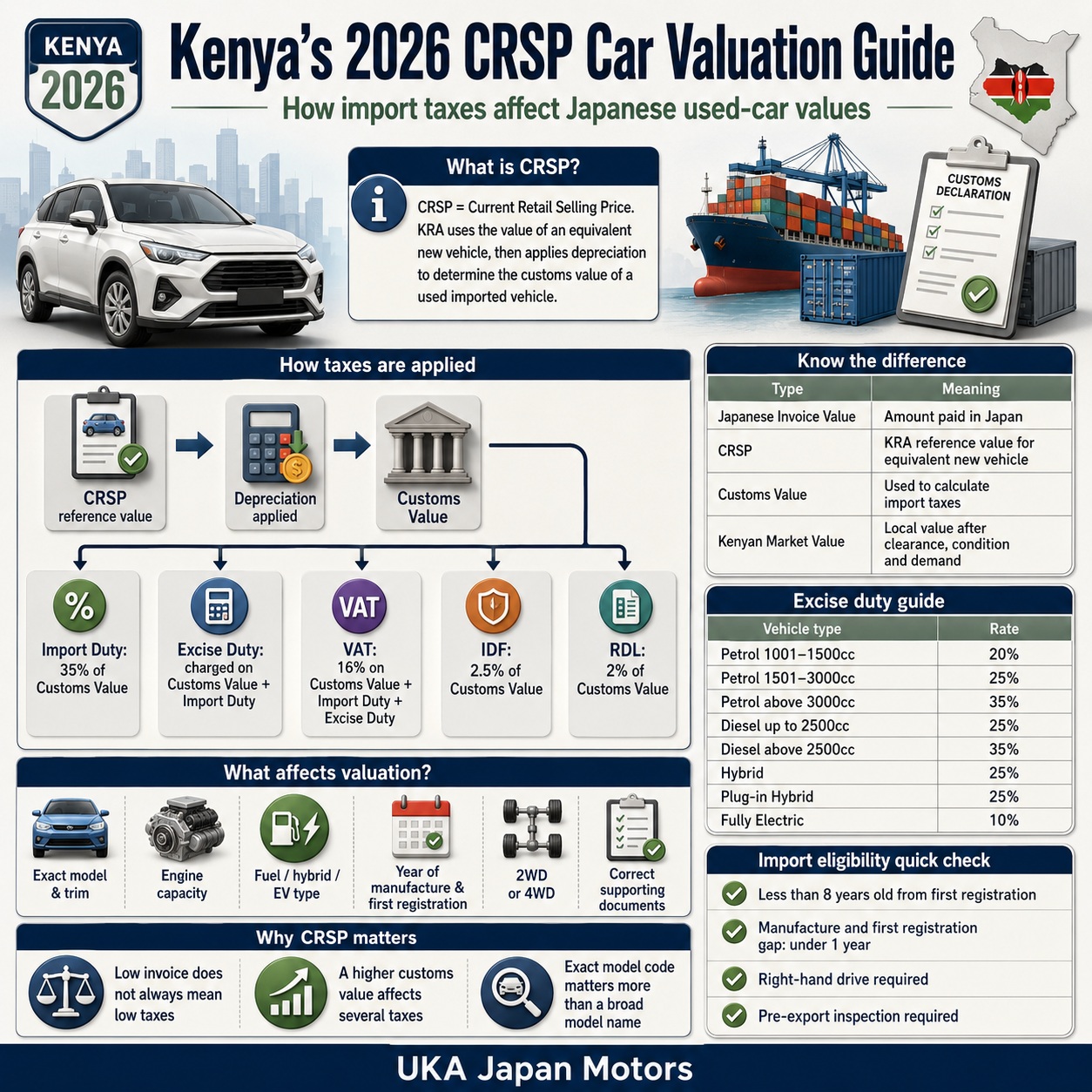
Importing a Japanese used vehicle into Kenya involves more than identifying a suitable model, checking its condition and arranging shipment. Before the vehicle can be cleared and registered, the Kenya Revenue Authority must determine its customs value. That value becomes the foundation on which import duty, excise duty, Value Added Tax and applicable import levies are assessed.
For most Japanese used passenger vehicles, the declared purchase invoice is not treated as the only measure of value. Kenya uses the Current Retail Selling Price, commonly known as CRSP, as part of the customs valuation system for used motor vehicles.
A revised CRSP schedule took effect on 1 July 2025. It remains central to vehicle valuation in 2026. The revised schedule contains more detailed distinctions between models, trim levels and vehicle specifications than the earlier schedule. As a result, two vehicles that appear similar in an auction listing may receive different customs assessments when their exact model codes, engine types, propulsion systems or trim specifications are examined.
Understanding CRSP is therefore important before selecting a vehicle for shipment. It allows a Kenyan buyer to distinguish between the amount shown on a Japanese invoice, the customs value assessed at entry and the eventual Kenyan value of a cleared and registered vehicle.
Direct Answer: What Should Kenyan Buyers Know About CRSP in 2026?
CRSP is the assessed current retail selling value of an equivalent new vehicle. KRA uses that reference value, together with the prescribed depreciation treatment and vehicle specifications, to determine the customs value of a used imported vehicle.
Import taxes are then applied to the customs value in stages. They are not all calculated directly from the Japanese auction or supplier invoice. Import duty is applied first. Excise duty is generally assessed on a value that includes customs value and import duty. VAT is then calculated on a broader taxable base that includes customs value, import duty and excise duty.
This sequence means that a change in CRSP can affect several parts of the assessment. A higher customs value does not affect only one tax line. It can increase the base used for import duty and, through the calculation sequence, influence excise duty and VAT as well.
The most important practical lesson is that buyers should establish the likely KRA classification of the exact vehicle before shipment. The model code, engine capacity, fuel system, year of manufacture, first registration date, trim level and drive configuration should all be checked against the supporting documents.
What CRSP Means in Kenya’s Vehicle Import System
The letters CRSP stand for Current Retail Selling Price. In this context, they refer to the current retail value assigned to an equivalent new motor vehicle.
For a used vehicle, KRA does not necessarily use the full new-vehicle CRSP as the customs value. Depreciation is applied according to the vehicle’s age and the prescribed valuation method. The resulting customs value is then used as the base for tax assessment.
KRA explains that the CRSP method was adopted to improve standardisation, transparency and predictability in the valuation of used motor vehicles. The legal foundation for customs valuation is connected to the World Trade Organization Agreement on Customs Valuation, as applied through section 122 and the Fourth Schedule of the East African Community Customs Management Act.
The method addresses a practical challenge in used-car imports: invoice values can vary considerably even for vehicles with similar specifications. Differences may arise from auction grade, body condition, mileage, optional equipment, supplier arrangements or the circumstances under which a vehicle was purchased.
CRSP provides a common reference point. This does not mean that every vehicle of the same badge will automatically receive the same assessment. The revised schedule contains thousands of model entries and places greater emphasis on precise specifications.
Why the Revised CRSP Schedule Matters in 2026
The current CRSP schedule became effective on 1 July 2025. It replaced a valuation list that had remained largely unchanged since 2019.
KRA stated that the review was intended to reflect changes in the economic environment, tax rates, exchange conditions, newly introduced vehicle models and developments in vehicle specifications. The updated list expanded from approximately 3,000 unique models in the older schedule to more than 5,200 model entries.
The level of detail is particularly important for Japanese vehicles because one familiar model name can represent several materially different vehicles.
A single model family may include:
- Multiple engine capacities
- Petrol, diesel, hybrid or plug-in hybrid versions
- Two-wheel-drive and four-wheel-drive variants
- Different transmission systems
- Standard and higher-specification trim levels
- Different body configurations
- Different safety, comfort and performance packages
The previous approach depended more heavily on broader categories such as engine capacity and drive configuration. The revised list considers detailed model specifications and trim levels more directly.
A buyer should therefore not assume that a general model name is sufficient for valuation. The exact chassis and model codes can be more important than the marketing name used in an online listing.
How a Japanese Used Car Is Valued Under CRSP
The valuation process can be understood as a sequence rather than a single calculation.
1. The vehicle is identified accurately
The first step is confirming exactly what vehicle is being imported. This normally involves reviewing the export certificate, deregistration document, commercial invoice, inspection record and shipping documents.
Important identifying information includes:
- Manufacturer and model
- Chassis number
- Model code
- Engine code and capacity
- Fuel and propulsion type
- Year of manufacture
- Date of first registration
- Transmission
- Drive configuration
- Body type
- Trim or grade
A description such as “Japanese hybrid SUV” is not precise enough for reliable customs planning. Two hybrid SUVs with the same engine capacity may belong to different CRSP entries because of trim, drivetrain, performance or equipment differences.
2. The relevant CRSP entry is selected
The vehicle details are matched to the applicable entry in the KRA schedule. The revised CRSP list uses Japanese Yearbooks as a principal source, with supplementary model information obtained from Goo-net where relevant entries were not available in the Yearbooks.
Where the exact vehicle is not listed, additional review may be required. KRA indicated that some models were absent from the initial revised schedule and that the list could be updated as further data sources were agreed upon.
This is one reason an unlisted or unusual specification should be examined before shipment rather than after arrival in Mombasa.
3. Prescribed depreciation is applied
KRA states that the customs value of a used vehicle is calculated by applying depreciation to the relevant CRSP according to the period since manufacture or first registration.
Depreciation recognises that a used vehicle is not equivalent in value to a new one. However, customs depreciation is a prescribed valuation treatment. It should not be confused with a buyer’s personal estimate of how much value a car has lost.
Auction mileage, paint condition or interior wear may influence the vehicle’s purchase decision and ownership quality, but they do not automatically replace the CRSP depreciation framework.
4. The customs value is established
After the relevant adjustments, KRA establishes the customs value. This value is sometimes described as the CIF value because customs valuation considers cost, insurance and freight principles.
Under the CRSP method, the customs value may be derived through the valuation schedule rather than accepted solely from the amount appearing on the commercial invoice.
5. Taxes and levies are applied
Once the customs value has been established, the applicable taxes are calculated in the legally prescribed sequence.
This is the point at which engine capacity, fuel type and propulsion technology become especially important. They may affect not only the CRSP entry but also the excise-duty category.
The Main Taxes Applied to an Imported Vehicle
The principal tax components affecting an imported Japanese passenger vehicle are import duty, excise duty, VAT, Import Declaration Fee and Railway Development Levy.
Import Duty
KRA’s June 2025 clarification stated that the general import-duty rate relevant to the revised CRSP had increased from 25 per cent in 2019 to 35 per cent in 2025. That later clarification is important because some older KRA educational pages continue to display historical rates.
Import duty is calculated against the customs value.
Excise Duty
Excise duty depends on the vehicle’s tariff classification, engine capacity and propulsion type. KRA’s motor-vehicle guidance lists different categories for petrol, diesel, hybrid, plug-in hybrid and fully electric vehicles.
The published passenger-vehicle categories include:
| Vehicle category | Excise-duty treatment shown in KRA guidance |
|---|---|
| Petrol engine above 1,000 cc and up to 1,500 cc | 20% |
| Petrol engine above 1,500 cc and up to 3,000 cc | 25% |
| Petrol engine above 3,000 cc | 35% |
| Diesel engine up to 2,500 cc | 25% |
| Diesel engine above 2,500 cc | 35% |
| Non-plug-in hybrid passenger vehicle | 25% |
| Plug-in hybrid passenger vehicle | 25% |
| Fully electric passenger vehicle | 10% |
These categories should be confirmed against the tariff classification and legislation applicable when the customs entry is lodged. KRA’s guidance identifies the different powertrain and capacity bands, while its CRSP clarification notes that some excise rates reach 35 per cent.
Excise duty is generally applied to a base that includes the customs value and import duty. It is therefore affected both by the CRSP-derived customs value and by the import-duty calculation.
Value Added Tax
The standard VAT rate applicable to imported taxable goods is 16 per cent. For motor-vehicle assessment, VAT is calculated after customs value, import duty and excise duty have been brought into the taxable base.
VAT therefore reflects the cumulative effect of the earlier stages of the calculation.
Import Declaration Fee
The consolidated Miscellaneous Fees and Levies Act current in 2026 provides for an Import Declaration Fee of 2.5 per cent of customs value.
Some older KRA web pages still display an earlier percentage. For planning in 2026, the applicable law and the current customs assessment should take priority over an undated calculator, copied screenshot or older explanatory page.
Railway Development Levy
The Railway Development Levy is assessed at 2 per cent of customs value under the consolidated legislation current in 2026.
Unlike excise duty and VAT, this levy is calculated directly from the customs value rather than from the progressively expanded tax base.
Why Import Taxes Are Not a Simple Percentage of the Japanese Invoice
A common misunderstanding is to add several percentages to the supplier’s invoice and assume that the result will represent the final customs assessment.
That method can be misleading for two reasons.
First, KRA may determine customs value through CRSP rather than using the invoice as the sole valuation basis. A heavily discounted auction purchase does not automatically create an equivalent reduction in the CRSP-derived customs value.
Second, the taxes are not all calculated from the same base.
The general calculation flow can be expressed without assigning a monetary amount:
Customs value
→ Import duty is calculated
Customs value plus import duty
→ Excise duty is calculated
Customs value plus import duty plus excise duty
→ VAT is calculated
Customs value
→ IDF and RDL are calculated separately
This structure creates a cumulative effect. An increase in customs value can influence import duty first, then affect the excise base, and subsequently affect the VAT base.
For this reason, an accurate CRSP classification is more useful than a rough calculation based only on the exporter’s invoice.
The Factors That Most Strongly Affect CRSP Valuation
Exact model and trim
The revised CRSP list gives greater attention to trim and vehicle performance. A higher specification within the same model family may therefore receive a different reference value from the standard version.
Features that may help distinguish one CRSP entry from another include drivetrain, seating arrangement, engine output, body configuration and factory equipment.
Engine capacity
Engine capacity can influence both the vehicle’s CRSP classification and its excise-duty band.
A petrol vehicle positioned just above an excise threshold may be treated differently from a smaller-engine version of the same model. The same principle applies to larger diesel vehicles.
The figure shown in a marketplace description should be verified against the engine record and model code. Informal descriptions may round engine capacity or use a model label that does not reflect the customs tariff description.
Propulsion system
A conventional petrol vehicle, diesel vehicle, non-plug-in hybrid, plug-in hybrid and fully electric vehicle may be placed in different excise categories.
The word “hybrid” by itself is not enough. Documentation should establish whether the vehicle is a conventional self-charging hybrid or a plug-in hybrid, as well as the type of internal-combustion engine used.
Year of manufacture and first registration
Age determines both import eligibility and the depreciation applied during customs valuation.
KEBS requires an imported used passenger vehicle to be less than eight years old from the year of first registration. The difference between the year of manufacture and the year of first registration must also be less than one year.
In practical terms, vehicles first registered in 2019 or later generally fall within the ordinary eight-year eligibility window during 2026, subject to the precise dates, vehicle category and applicable annual import requirements.
This connects directly with the broader subject covered in Why 2019-or-Newer Japanese Cars Matter for Kenya Imports in 2026.
Drive configuration
Two-wheel-drive and four-wheel-drive versions can have different model codes, specifications and CRSP entries.
Drive configuration also has practical importance after clearance. A four-wheel-drive system may be relevant for certain rural routes, rough access roads or regular travel beyond major urban centres, while a simpler two-wheel-drive vehicle may suit predominantly urban use in Nairobi or routine movement around Mombasa.
The ownership choice and the customs classification should be considered separately. A more complex drivetrain should not be selected solely because it appears in the same model family.
Missing or unusual model entries
The revised schedule is extensive, but KRA acknowledged that some models were initially missing because they were not found in the agreed Japanese data sources.
Unusual editions, limited-production specifications or newly introduced model codes may therefore require closer examination.
The safest approach is to resolve uncertainty before shipment. Waiting until the vehicle is already at the port can complicate document review and delay the owner’s planning.
CRSP Value, Invoice Value, Vehicle Condition and Kenyan Market Value
These four concepts are related, but they are not interchangeable.
| Type of value | What it represents | Main factors |
|---|---|---|
| Japanese invoice value | The amount recorded in the purchase transaction | Supplier terms, auction outcome, vehicle condition and purchase arrangement |
| CRSP reference | The assigned current retail selling value of the corresponding new vehicle | Model, trim, powertrain, performance and official valuation data |
| Customs value | The value used as the base for import assessment | CRSP methodology, depreciation and customs rules |
| Kenyan market value | The value attached to the cleared vehicle in Kenya | Condition, documentation, specification, ownership history, suitability and local demand |
A low Japanese invoice does not automatically mean that KRA will use the same figure as customs value.
Similarly, a high CRSP does not prove that an individual used vehicle is mechanically sound. CRSP is a valuation mechanism, not an inspection certificate or condition report.
Two vehicles with the same model code and registration year may receive similar customs treatment even where one has better paintwork, a cleaner interior or a stronger maintenance record. Those condition differences remain important to the Kenyan owner, but they serve a different purpose from customs valuation.
How Different Japanese Vehicle Types Are Affected
Small petrol hatchbacks and compact cars
A compact petrol car within the lower engine-capacity bands may receive a different excise treatment from a larger saloon or SUV.
These vehicles often suit regular Nairobi commuting because their dimensions can be practical in congestion and limited parking areas. They may also serve daily urban use in Mombasa.
However, engine size alone should not guide the decision. Ground clearance, suspension condition, cooling performance and the exact transmission should still be assessed against the intended Kenyan usage.
Mid-size petrol vehicles
A petrol vehicle above the lower excise threshold may fall into a higher excise category. The effect is not limited to the excise line because excise forms part of the VAT base.
Within one model family, a smaller-engine and a larger-engine version can therefore have different customs outcomes even where their body shape looks nearly identical.
Hybrid vehicles
Many Japanese hybrids combine a petrol engine with an electric motor. KRA’s published guidance places relevant hybrid passenger-vehicle classifications in a 25 per cent excise category.
CRSP treatment still depends on the exact model and trim. Hybrid battery condition, cooling-system cleanliness and diagnostic history remain ownership concerns, but they do not replace the customs classification.
For Nairobi use, repeated low-speed traffic can suit the operating characteristics of many hybrids. In Mombasa, battery cooling paths and electrical connections should be inspected carefully because heat, humidity and coastal conditions can expose neglected components.
Larger petrol SUVs
A larger petrol SUV may fall into a higher engine-capacity and excise category. Four-wheel-drive configuration and trim level may also distinguish its CRSP entry from a visually similar two-wheel-drive version.
The buyer should separate the appeal of the body style from the actual usage requirement. A large engine and complex drivetrain may be justified for particular routes or duties, but not every urban owner requires the same configuration.
Diesel SUVs and utility-oriented vehicles
Diesel vehicles above the relevant capacity threshold may attract the higher excise category identified in KRA guidance.
Beyond valuation, the intended usage pattern matters. Regular longer-distance operation can differ significantly from repeated short urban journeys. Emission-control equipment, turbocharger condition, injector performance and service history should be reviewed before import selection.
Fully electric vehicles
KRA’s motor-vehicle guidance identifies a separate excise category for vehicles propelled only by an electric motor.
Even where the excise classification differs, CRSP valuation, customs documentation and import compliance still apply. Battery state, charging compatibility, ground clearance, technical support and intended travel routes require careful consideration for Kenyan ownership.
Inspection and Import Eligibility Are Separate From CRSP
CRSP determines customs valuation. KEBS inspection determines whether the vehicle complies with applicable import and roadworthiness requirements. Passing one process does not replace the other.
KRA’s published import procedure states that an imported used vehicle must:
- Be less than eight years old from the year of first registration
- Undergo roadworthiness inspection by a KEBS-appointed inspection agent before export
- Be right-hand drive, except where a recognised exemption applies
KEBS also requires relevant imports to be supported by the appropriate conformity or inspection documentation. Its PVoC framework assigns approved agents to conduct conformity assessment activities in the country of origin and issue the required certification. KRA uses conformity documentation as part of cargo clearance.
The inspection process should confirm the chassis identity, registration details and roadworthiness status before shipment. The chassis number can also be used through KEBS inspection-detail services to review inspection information.
Documents That Support Accurate Valuation and Clearance
A complete document file helps KRA, KEBS, the clearing agent and registration authorities confirm that they are dealing with the same vehicle.
KRA lists the main supporting documents as the original commercial invoice, cancelled foreign logbook or export ownership document, original bill of lading, pre-shipment inspection certificate and the importer’s KRA PIN or company documentation.
For Japanese used vehicles, the file should be checked for consistency across:
- Chassis number
- Model code
- Engine capacity
- Fuel type
- Manufacture date
- First registration date
- Export certificate translation
- Invoice description
- Inspection certificate
- Bill of lading
A minor difference in spelling may be explainable. A contradiction in chassis number, model code, year or engine information is more serious and should be resolved before shipment.
The original deregistration or export certificate is especially important because it supports both customs identification and the later Kenyan registration process.
Common CRSP Mistakes to Avoid
Using only the auction purchase amount
The auction result can help explain the transaction, but it is not a complete customs estimate. CRSP may remain the primary reference for establishing the used vehicle’s customs value.
Searching only by model name
A broad model name may cover several model codes, trim levels and powertrains. Customs planning should be based on the exact specification.
Assuming all hybrids receive identical treatment
Hybrid systems differ. The vehicle may be a conventional hybrid, plug-in hybrid or another configuration. The internal-combustion engine and tariff description also matter.
Ignoring the first registration date
Import eligibility is based on the year of first registration, not simply the seller’s advertised model year. The manufacture-to-registration gap must also comply with the applicable standard.
Relying on an old online tax page
Official websites may retain educational pages containing historical percentages. KRA’s later CRSP clarification confirms the change in import duty, while the consolidated 2026 legislation provides the current IDF and RDL rates. A valuation should therefore be checked against the current CRSP schedule, current law and the customs entry prepared for the vehicle.
Treating customs valuation as a mechanical inspection
A correctly assessed vehicle can still have accident repairs, corrosion, worn suspension, battery deterioration or neglected maintenance.
CRSP answers a customs question. Inspection and condition verification answer an ownership question.
Selecting a vehicle before checking whether it appears in the CRSP list
A missing or difficult-to-match model may require additional valuation review. Checking the model code before purchase gives the importer more time to address uncertainty.
Mombasa Clearance and Nairobi Buying Decisions
Most imported vehicles enter Kenya through Mombasa, making the port stage central to customs clearance, inspection-document validation and cargo release.
Errors that appear small before shipment can become significant when the vehicle is already at the coast. A mismatch between the bill of lading and export certificate, an unclear model code or an incomplete inspection record may require further verification before the vehicle can proceed through clearance.
For buyers based in Nairobi, the customs process may feel distant from the eventual ownership decision. However, the information established before shipment determines whether the Nairobi buyer receives the intended engine, drivetrain, trim and registration year.
The same principle applies to buyers in Mombasa. Proximity to the port does not reduce the need for accurate pre-purchase verification. Coastal ownership also makes underbody condition, electrical connections, seals and previous corrosion protection important long-term considerations.
The customs value should therefore be confirmed alongside the vehicle’s actual suitability for local use.
How CRSP Affects Long-Term Ownership Decisions
Import tax is a one-time clearance issue, but the specification chosen for customs purposes continues to affect the owner after registration.
The engine, drivetrain and powertrain that determine tax classification also influence:
- Fuel behaviour in congestion
- Maintenance complexity
- Availability of correct service parts
- Cooling demands
- Tyre and suspension requirements
- Suitability for rough or unpaved roads
- Long-distance comfort
- Diagnostic and repair needs
A smaller petrol vehicle may suit regular urban movement but offer less clearance on broken roads. A hybrid may operate effectively in stop-start traffic but requires proper battery and cooling-system inspection. A larger diesel four-wheel-drive vehicle may suit demanding travel but should be selected for a genuine usage requirement rather than body style alone.
CRSP planning is most useful when combined with a clear ownership profile: where the vehicle will be driven, how often it will travel outside the city, how many passengers it will carry and what road conditions it will encounter.
Who Benefits Most From Understanding CRSP?
CRSP knowledge is useful for any Kenyan importing a used vehicle, but it is particularly valuable for buyers comparing several specifications within one model family.
It is also important for buyers considering:
- A model with several engine choices
- Petrol and hybrid versions of the same vehicle
- Two-wheel-drive and four-wheel-drive variants
- Higher trim levels
- Recently introduced model codes
- Vehicles near the eight-year eligibility boundary
- Uncommon editions that may not be easy to locate in the CRSP schedule
The system may be less suitable for informal estimation by buyers who have only a model name and a supplier invoice. Without the chassis details, model code and first registration information, any assessment remains provisional.
UKA Japan Motors’ Role in CRSP and Inspection Guidance
UKA Japan Motors supports vehicle selection by treating customs valuation, inspection status and ownership suitability as connected but separate checks.
The process begins with accurate vehicle identification. The model code, chassis details, engine, drive system, year of manufacture and first registration date should be reviewed before shipment.
The next step is establishing whether the specification can be matched to the applicable CRSP entry and whether its tax category is understood. This helps prevent a buyer from relying on a broad model description that does not reflect the vehicle’s actual customs treatment.
Inspection and document checks remain equally important. A vehicle should have consistent export, inspection and shipping records, as well as a condition profile suitable for its intended use in Nairobi, Mombasa or regular travel between different parts of Kenya.
UKA Japan Motors’ role is not to replace KRA, KEBS, the appointed inspection agent or the licensed clearing process. It is to help buyers approach the import decision with clearer vehicle information, stronger documentation and realistic compliance expectations.
Frequently Asked Questions
1. What does CRSP mean when importing a car into Kenya?
CRSP means Current Retail Selling Price. It represents the assigned current retail value of an equivalent new vehicle. KRA uses it with prescribed depreciation and vehicle specifications to determine the customs value of a used imported vehicle.
2. Is CRSP the same as the amount paid for the car in Japan?
No. The Japanese invoice records the purchase transaction, while CRSP is a customs valuation reference. The invoice remains an important supporting document, but it may not be the sole basis used to assess the vehicle.
3. Does buying a vehicle at a lower auction value automatically reduce its import taxes?
Not necessarily. KRA may derive customs value through the CRSP framework. Auction condition and purchase circumstances do not automatically replace the prescribed reference value and depreciation method.
4. Why can two vehicles with the same model name have different assessments?
They may have different model codes, trim levels, engines, drive systems, propulsion types or performance specifications. The revised CRSP list distinguishes vehicles in greater detail than the earlier schedule.
5. Does vehicle age affect CRSP valuation?
Yes. KRA applies depreciation according to the vehicle’s age under the prescribed valuation method. Age also determines whether the vehicle satisfies Kenya’s import eligibility rule.
6. Which registration years are generally eligible during 2026?
Under the rule requiring a used passenger vehicle to be less than eight years old from the year of first registration, vehicles first registered in 2019 or later generally fall within the ordinary 2026 eligibility window. The exact first registration date, manufacture date, vehicle class and applicable requirements should still be verified before shipment.
7. Does engine capacity affect only excise duty?
No. Engine capacity can affect the selected CRSP entry and the excise-duty classification. Because excise duty forms part of the VAT base, its effect can continue into the later calculation stage.
8. Are all Japanese hybrid cars taxed in the same way?
No. The exact propulsion system and tariff classification must be established. KRA guidance distinguishes conventional hybrids, plug-in hybrids and fully electric vehicles. The model, internal-combustion engine and specification still matter.
9. Does a KEBS inspection certificate determine the customs value?
No. KEBS inspection documentation confirms conformity and roadworthiness requirements. KRA determines customs value and taxes. Both processes are required, but they serve different purposes.
10. Can a vehicle pass customs valuation but still be unsuitable for Kenyan use?
Yes. Customs valuation does not assess every mechanical or ownership concern. Suspension condition, corrosion, hybrid battery health, transmission behaviour, cooling performance and maintenance history still require separate inspection.
11. What happens when a model is not found in the CRSP schedule?
Additional valuation review may be required. KRA has acknowledged that some model entries were missing from the revised list and that further updates could be made as additional data became available.
12. Which document is most important for confirming the vehicle’s age?
The original export or deregistration certificate is central because it records the vehicle’s manufacture and first registration information. Its details should agree with the inspection certificate, invoice and shipping documents.
13. Why should an importer avoid old online duty calculators?
Older calculators may use superseded CRSP entries or historical tax percentages. The applicable assessment should be based on the current CRSP schedule, current legislation, the exact vehicle classification and the customs entry prepared for that import.
14. Does CRSP determine the vehicle’s Kenyan resale value?
No. CRSP helps determine customs value. Kenyan market value is also influenced by condition, documentation, specification, maintenance history, ownership suitability and local demand.
Conclusion
Kenya’s 2026 CRSP system is best understood as a structured customs valuation method rather than a direct reading of the Japanese purchase invoice.
The correct vehicle must first be identified by model code, engine, propulsion system, trim, drivetrain, manufacture date and first registration date. KRA then applies the relevant CRSP reference and depreciation treatment to establish customs value.
Import duty, excise duty, VAT, IDF and RDL are applied according to different bases and in a defined sequence. Because later taxes build on earlier stages, an error in the CRSP entry or vehicle classification can affect the wider assessment.
CRSP should also be kept separate from roadworthiness and ownership quality. A vehicle can be correctly valued but poorly maintained, just as a mechanically strong vehicle must still satisfy customs, inspection and documentation requirements.
For Kenyan buyers, the most reliable approach is to verify valuation, eligibility, inspection status and vehicle condition before shipment. This creates a clearer path through Mombasa clearance and supports a more informed ownership decision in Nairobi, Mombasa and other parts of Kenya.
Contact UKA Japan Motors for availability and inspection guidance.