


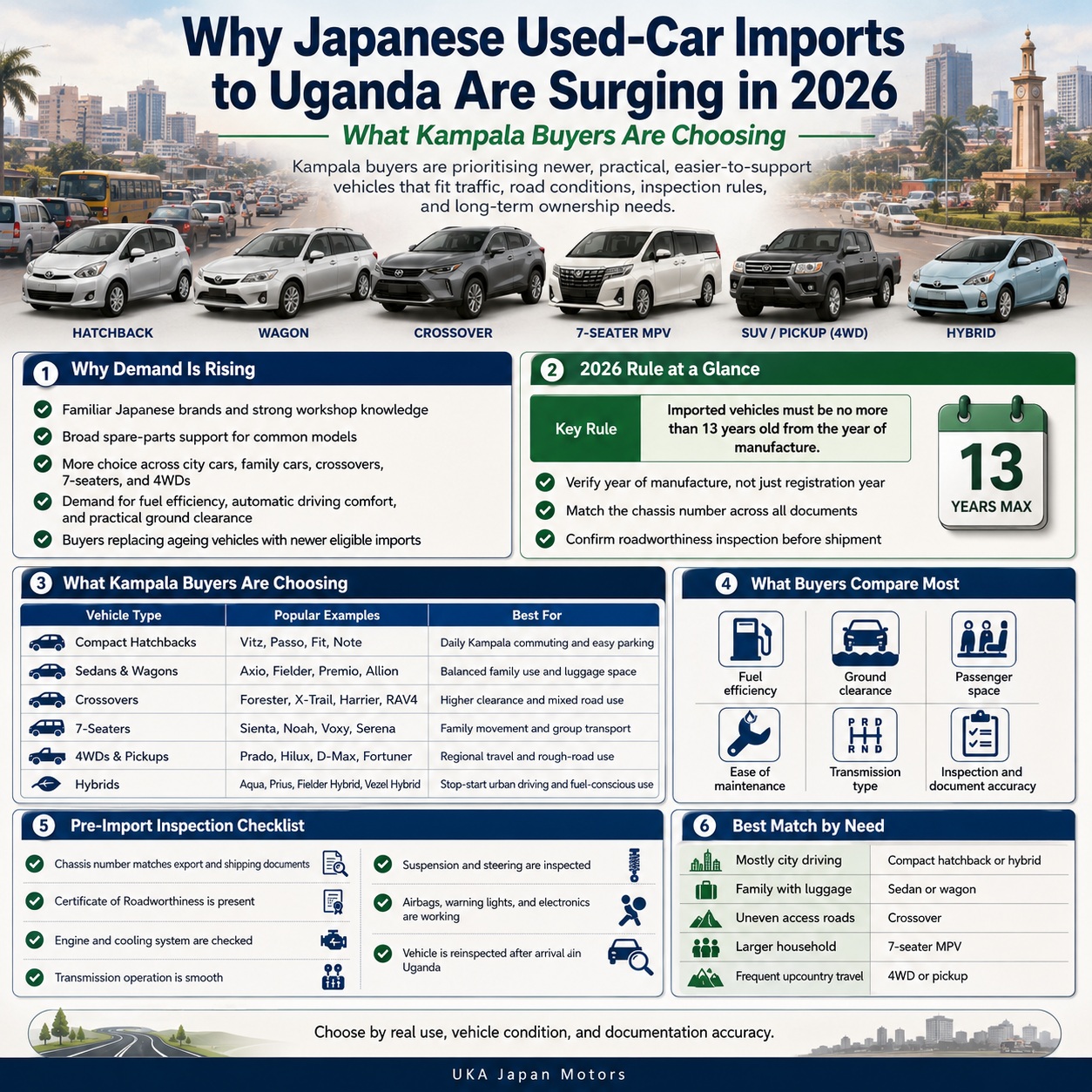
Japanese used vehicles have long been central to private transport in Uganda, but the pattern visible in 2026 is more than a continuation of familiar demand. Kampala buyers are becoming more selective about vehicle age, engine size, ground clearance, fuel consumption, passenger capacity, inspection history and long-term serviceability.
Available export information indicates that Uganda received 2,723 Japanese used vehicles in January 2026, compared with 1,933 in January 2025, representing a reported year-on-year rise of about 40.8 percent. Earlier data also recorded 3,133 units exported to Uganda in April 2025. Complete official figures for the whole of 2026 are not yet available as of July 2026, but the early movement supports the view that demand remains strong and is accelerating.
This increase is happening at the same time as Uganda is tightening vehicle-age rules, strengthening pre-export inspection requirements and placing greater emphasis on roadworthiness and emissions. The result is not simply that more Japanese vehicles are arriving. Buyers are changing the types, model years and specifications they consider suitable.
Direct Answer: Why Are Japanese Used-Car Imports Rising?
Japanese used-car imports to Uganda are rising in 2026 because they meet several practical Kampala ownership needs at the same time:
- There is broad familiarity with Japanese brands among Ugandan mechanics.
- Common models have established spare-parts support.
- Buyers can choose from compact cars, wagons, crossovers, seven-seaters, pickups and full-size four-wheel-drive vehicles.
- Many vehicles are available with fuel-efficient petrol or hybrid powertrains.
- Right-hand-drive configurations suit Uganda’s road system.
- Pre-export inspection provides an additional roadworthiness checkpoint.
- Uganda’s tighter vehicle-age rules are encouraging buyers to select newer eligible vehicles.
- Kampala traffic is increasing interest in smaller engines, automatic transmissions and compact body dimensions.
A 2025 Uganda climate and development assessment stated that the majority of vehicles in Uganda originate from Japan as reconditioned units. It also estimated the 2022/23 motorised vehicle fleet at approximately 1.823 million vehicles, with an average fleet age of more than 15 years. This helps explain why the current import discussion is increasingly focused on vehicle renewal, inspection quality and newer model years.
The Surge Is About Replacement as Much as New Ownership
It is easy to interpret rising imports as evidence that more Kampala residents are buying their first vehicle. That is only part of the picture.
A substantial number of imported vehicles replace cars that have already spent many years operating in Uganda. Older vehicles may develop recurring cooling-system problems, worn suspension components, deteriorated interior electronics, oil consumption, transmission problems or body corrosion.
Replacement demand becomes especially important where a vehicle is used every day for commuting, family transport, fieldwork or business operations. Owners may keep a familiar Japanese brand while moving to a newer generation, a smaller engine or a more suitable body style.
Uganda Bureau of Statistics data recorded 45,588 newly registered private cars in 2023. Although that figure includes vehicles from different sources and does not represent 2026 import activity, it illustrates the continuing scale of additions to the national vehicle register.
The 2026 import surge should therefore be understood through three overlapping groups:
- First-time vehicle owners entering private motoring.
- Existing owners replacing ageing cars.
- Families and organisations moving to a different vehicle category as their transport needs change.
A driver may move from a hatchback to a station wagon after needing more luggage space. A growing family may move from a five-seat sedan to a compact seven-seater. A business owner travelling outside Kampala may replace a low-clearance car with a crossover. These transitions are shaping which Japanese vehicles receive the most attention.
Why Japanese Vehicles Continue to Fit Kampala
Established mechanical familiarity
Toyota, Nissan, Subaru, Honda, Suzuki, Mazda, Mitsubishi and Isuzu vehicles have been present in Uganda for many years. Mechanics have therefore developed practical knowledge of common engines, automatic transmissions, suspension systems and electrical faults.
This familiarity does not mean every Japanese model is simple to maintain. Some direct-injection engines, turbocharged systems, continuously variable transmissions and hybrid powertrains require specialist diagnosis. However, mainstream Japanese models generally begin with a stronger local support base than unfamiliar vehicles with limited technical documentation.
Broad availability of replacement components
A common model is usually easier to support over many years because workshops, parts dealers and vehicle dismantlers recognise its component families.
Buyers increasingly understand that the badge on the bonnet is not enough. The exact engine code, transmission, chassis series and trim specification matter. Two vehicles carrying the same model name may use different sensors, gearboxes, suspension components or electronic systems.
For example, a Toyota Fielder may be petrol-powered or hybrid. A Subaru Forester may be naturally aspirated or turbocharged. A Nissan Serena may have a conventional petrol system or an electrified powertrain. Long-term support depends on the precise specification, not only the model name.
A vehicle for almost every Ugandan use case
Japanese vehicle supply covers a wide range of body styles. This allows Kampala buyers to choose according to actual use rather than forcing one type of vehicle into every role.
A compact hatchback may suit a solo commuter. A station wagon may suit a family that regularly carries luggage. A compact crossover may suit a driver dealing with uneven access roads. A seven-seater may suit school runs and extended-family travel. A pickup or full four-wheel-drive vehicle may suit frequent regional or work-related movement.
This variety is one of the strongest reasons Japanese imports remain relevant.
Suitability for stop-start city driving
Kampala traffic places vehicles under conditions that differ from steady highway use. Engines may idle for long periods. Automatic transmissions repeatedly move between low gears. Cooling fans, air-conditioning compressors and electrical systems remain active even when the vehicle is barely moving.
This operating environment encourages interest in moderate engine sizes, reliable cooling systems, light steering, compact dimensions and well-maintained automatic transmissions.
It also explains why a vehicle should not be selected only according to engine power. How calmly it operates in traffic, how easily it fits into parking spaces and how well the cooling system performs may matter more during daily Kampala use.
Uganda’s 2026 Vehicle-Age Rule Is Reshaping Demand
One of the most important changes affecting the 2026 market is the amended vehicle-age limit.
The 2026 Traffic and Road Safety amendment was designed to prohibit the importation of motor vehicles more than 13 years old from their year of manufacture. The amendment text states that the measure comes into force on 1 July 2026 and provides transitional treatment for qualifying vehicles already in transit before commencement and arriving within the stated transition period.
For Kampala buyers, the practical effect is significant.
Vehicles close to the maximum permitted age now require especially careful verification. A difference between the claimed model year, registration year and actual manufacturing year can determine whether the vehicle is eligible.
These dates are not always identical:
- The manufacturing year is when the vehicle was produced.
- The first-registration year is when it entered service.
- The model year may describe a particular specification or production series.
- The auction listing year may be based on Japanese registration information.
A buyer should therefore verify the manufacturing information from the chassis number and original export documentation rather than relying only on the year shown in an online advertisement.
The tighter rule is also shifting attention toward newer generations of familiar models. Instead of looking only for the oldest eligible Toyota Premio, Subaru Forester, Toyota Wish or Nissan X-Trail, buyers must consider later versions with different engines, transmissions and electronic systems.
That makes technical research more important than before.
What Kampala Buyers Are Choosing in 2026
There is no single “best” Japanese vehicle for Kampala. Demand is spreading across several categories, each responding to a different ownership need.
1. Compact Hatchbacks for Daily Commuting
Common examples include:
- Toyota Vitz or Yaris
- Toyota Passo
- Honda Fit
- Suzuki Swift
- Mazda Demio or Mazda2
- Nissan Note
- Mitsubishi Mirage
These cars appeal to drivers who spend most of their time within Kampala and nearby urban areas. Their compact dimensions help in dense traffic, limited parking areas and narrow access roads. Moderate engine sizes also suit stop-start use when the engine, transmission and cooling system are in good condition.
The Toyota Vitz and Passo remain familiar choices because many technicians recognise their common mechanical systems. The Honda Fit offers useful interior flexibility, while the Nissan Note provides good cabin space for its external dimensions. The Suzuki Swift is valued by drivers who prefer a compact car with controlled handling.
However, compact dimensions introduce limitations. Ground clearance may be modest. Small tyres can be more vulnerable to pothole impact. The rear suspension may sit lower when the vehicle is fully loaded. Some variants use CVT transmissions that require correct fluid and proper maintenance.
A compact hatchback is therefore suitable for urban commuting, but it should not automatically be treated as an all-road vehicle.
2. Sedans and Station Wagons for Balanced Family Use
Frequently considered models include:
- Toyota Corolla Axio
- Toyota Corolla Fielder
- Toyota Premio
- Toyota Allion
- Honda Grace
- Mazda Axela
- Subaru Impreza
- Nissan Sylphy
Sedans continue to suit buyers who prioritise cabin comfort, a separate luggage area and stable road behaviour. Station wagons add greater cargo flexibility without becoming as large as an MPV or SUV.
The Toyota Corolla Fielder remains particularly relevant because it combines moderate external dimensions with a long load area. It may suit a household that carries shopping, school items, work equipment or travel luggage.
The Corolla Axio serves buyers who prefer a conventional sedan layout. The Premio and Allion offer a larger cabin and softer road character, though buyers must pay close attention to age eligibility because many familiar versions are now near or outside the permitted import range.
Subaru Impreza models may appeal to drivers seeking all-wheel-drive traction, but they require careful inspection for oil leaks, cooling-system condition, wheel-bearing wear and previous modification.
The main contrast is between the sedan’s enclosed boot and the wagon’s flexible cargo area. A sedan may keep luggage more securely separated from passengers, while a wagon is easier to load with bulky items.
3. Compact Crossovers for Mixed Road Conditions
Popular considerations include:
- Toyota RAV4
- Toyota Harrier
- Subaru Forester
- Nissan X-Trail
- Honda Vezel
- Suzuki Escudo
- Mazda CX-5
- Mitsubishi Outlander
Crossovers are receiving increased attention because they provide a higher seating position, more ground clearance and easier entry than many hatchbacks and sedans.
This does not mean every crossover is designed for severe off-road conditions. Many are road-focused vehicles with independent suspension, road tyres and electronically controlled all-wheel-drive systems. Their main advantage in Kampala is usually greater tolerance of uneven access roads, drainage channels, speed humps and damaged road edges.
The Subaru Forester, Toyota Harrier and Toyota Land Cruiser Prado have appeared prominently in Uganda-facing Japanese vehicle search rankings, while the Toyota Noah has also shown strong interest among seven-seat buyers. Such rankings represent platform activity rather than official national registration data, but they provide a useful indication of the models Ugandan online shoppers frequently examine.
The Forester can provide useful traction, but a neglected turbocharged version may be unsuitable for an owner seeking straightforward daily maintenance. The Harrier offers a quieter, more road-oriented experience, but large wheels and low-profile tyres should be inspected carefully. The X-Trail offers practical cargo space, though transmission condition deserves close attention.
The Honda Vezel and Mazda CX-5 represent a newer generation of crossover demand. They include more advanced electronics, direct-injection engines and, in some variants, hybrid or diesel systems. These technologies can operate well, but they reward accurate diagnosis and disciplined servicing.
4. Seven-Seaters for Families and Group Transport
Common choices include:
- Toyota Sienta
- Toyota Wish
- Toyota Noah
- Toyota Voxy
- Nissan Serena
- Honda Freed
- Honda Stepwgn
- Mitsubishi Delica D:5
Kampala households often need a vehicle that can carry children, relatives, school bags and luggage without moving to a full-size four-wheel-drive vehicle.
Compact MPVs such as the Toyota Sienta and Honda Freed offer sliding doors and flexible seating while remaining manageable in city traffic. Larger MPVs such as the Noah, Voxy, Serena and Stepwgn provide more passenger space and a stronger third row.
The Toyota Wish remains familiar, but many examples belong to older production years. Buyers considering one in 2026 must verify age eligibility carefully and compare it with newer compact MPVs.
Seven seats also require realistic interpretation. In some compact vehicles, the third row is best suited to children or shorter journeys. When every seat is occupied, luggage capacity may become limited.
Buyers should inspect sliding-door motors, seat-folding mechanisms, rear air-conditioning operation, suspension height under load and evidence of previous commercial use.
5. Four-Wheel-Drive Vehicles and Pickups for Regional Use
Common considerations include:
- Toyota Land Cruiser Prado
- Toyota Hilux
- Toyota Fortuner
- Mitsubishi Pajero
- Mitsubishi Triton
- Isuzu D-Max
- Nissan Patrol
- Suzuki Jimny
These vehicles are most suitable when the owner regularly travels beyond paved urban roads, carries equipment or operates in areas where road conditions change sharply during rain.
A full four-wheel-drive vehicle has a different purpose from a compact crossover. It may include a stronger chassis, low-range gearing, greater suspension movement or higher load capability.
However, a heavy four-wheel-drive vehicle should not be selected only for its appearance. Drivers who remain almost entirely within central Kampala may find that its large turning circle, wider body and heavier controls add complexity without providing a frequently used advantage.
The Suzuki Jimny offers genuine four-wheel-drive ability in a compact body, but its small cabin and short wheelbase make it different from a family crossover. The Prado provides greater space and long-distance ability but requires thorough inspection of suspension, driveline components, cooling and evidence of hard use.
Pickups such as the Hilux, Triton and D-Max suit owners who genuinely need an open load bed or regular work capability. A buyer should verify whether the vehicle’s suspension, chassis and rear body show signs of overloading or structural repair.
6. Hybrids for Fuel-Conscious Urban Driving
Japanese hybrid imports attracting interest include:
- Toyota Aqua
- Toyota Prius
- Toyota Corolla Fielder Hybrid
- Toyota Sienta Hybrid
- Toyota Harrier Hybrid
- Honda Fit Hybrid
- Honda Vezel Hybrid
- Nissan Note e-Power
Hybrid vehicles are increasingly relevant because Kampala’s stop-start traffic creates conditions in which electric assistance and regenerative braking can be useful.
However, “hybrid” describes several different systems. A Toyota hybrid does not operate in exactly the same way as a Honda dual-clutch hybrid or Nissan e-Power system. Diagnostic requirements, battery arrangements and transmission designs vary.
A hybrid should be selected only after checking:
- Hybrid battery health
- Cooling-fan cleanliness
- Warning-light history
- High-voltage system condition
- Correct operation after a cold start
- Availability of technicians familiar with that exact system
- Evidence of flood or water exposure
- Condition of the conventional 12-volt battery
Low fuel consumption should not be the only reason to choose a hybrid. The overall vehicle condition, powertrain type and availability of proper diagnosis are equally important.
Vehicle Categories Compared for Kampala Use
| Vehicle category | Best suited to | Main advantage | Main limitation to inspect |
|---|---|---|---|
| Compact hatchback | Daily urban commuting | Easy movement and parking | Ground clearance and CVT condition |
| Sedan | Regular family and office travel | Stable road behaviour and enclosed boot | Rear clearance when loaded |
| Station wagon | Family use with frequent luggage | Flexible cargo area | Rear suspension wear |
| Compact crossover | Kampala plus uneven access roads | Higher seating and clearance | Tyres, suspension and transmission |
| Seven-seat MPV | Family and group movement | Flexible passenger capacity | Sliding doors and loaded suspension |
| Full four-wheel drive | Frequent regional or rough-road travel | Stronger driveline and road tolerance | Evidence of hard use |
| Pickup | Work equipment and load carrying | Open rear load area | Chassis, leaf springs and rear-body condition |
| Hybrid | Frequent stop-start urban driving | Electric assistance in traffic | Battery health and specialist support |
What Is Becoming Less Attractive to Careful Buyers?
The 2026 market is making some vehicle types less appealing, even where they were once common.
Vehicles at the edge of age eligibility
A vehicle close to the maximum allowed age creates little room for documentation errors. Buyers increasingly prefer a clearer age margin rather than depending on uncertain manufacturing information.
Uncommon engine and transmission combinations
An unusual trim may look attractive online, but limited parts familiarity can make long-term ownership difficult. Mainstream engine and transmission combinations usually provide a clearer support path.
Heavily modified vehicles
Lowered suspension, oversized wheels, non-standard turbo systems, altered exhausts, improvised wiring and aftermarket engine tuning can hide previous abuse or create reliability problems.
Large engines used only for city commuting
A large engine may be appropriate for towing, carrying, regional travel or full-size vehicle duty. It may be poorly matched to an owner whose driving consists almost entirely of short urban trips.
Low-clearance vehicles with unsuitable tyres
A vehicle designed around smooth roads may require greater caution on Kampala speed humps, road edges and damaged access routes. Tyre profile and suspension condition should be considered together.
Undocumented hybrids and advanced powertrains
A hybrid without diagnostic evidence, warning-light history or battery information requires greater caution than a properly inspected example.
Inspection Is More Important Than Model Reputation
Japanese brands are often associated with durability, but a durable design can still become unreliable after collision damage, neglected servicing, overheating, flood exposure or poor repair work.
The condition of the individual vehicle matters more than the general reputation of its model.
Uganda’s pre-export inspection system requires used motor vehicles to have a Certificate of Roadworthiness before importation under the UNBS Pre-Export Verification of Conformity programme. UNBS states that the inspection is conducted against Uganda Standard US 845:2017. Vehicles arriving without the required certificate may face destination inspection and regulatory penalties.
A careful inspection should go beyond confirming that a certificate exists.
Chassis and identity checks
Confirm that the chassis number matches:
- Export certificate
- Inspection certificate
- Bill of lading
- Customs declaration
- Vehicle body stamping
- Online listing information
Any unexplained difference should be resolved before shipment.
Accident and structural checks
Inspect the front chassis rails, radiator support, inner wings, floor, pillars, boot floor and suspension mounting points.
Uneven sealant, fresh undercoating, mismatched paint, distorted metal or inconsistent welds may indicate repair work. Not every repaired vehicle is automatically unsuitable, but the quality and extent of repair must be understood.
Engine and cooling checks
Kampala traffic gives a weak cooling system little opportunity to recover. Check the radiator, fans, hoses, coolant condition, water pump, thermostat behaviour and signs of previous overheating.
Oil sludge, coolant contamination, persistent smoke or unstable idle should not be dismissed as minor issues.
Transmission checks
Automatic and CVT transmissions should engage smoothly from a cold start and after warming up. Check for delayed engagement, shuddering, warning lights, fluid leakage and abnormal noise.
The correct transmission fluid specification matters. A vehicle that has been maintained with the wrong fluid may develop problems even when it appears normal during a short inspection.
Suspension and steering checks
Inspect shock absorbers, control-arm bushes, ball joints, tie rods, wheel bearings and steering-rack boots.
Kampala potholes and speed humps can quickly expose existing suspension weakness. A quiet road test on a smooth surface may not reveal all faults.
Electrical and safety checks
Confirm correct operation of:
- Airbags and warning lamps
- Anti-lock braking system
- Stability control
- Headlamps and indicators
- Air conditioning
- Electric windows
- Cameras and parking sensors
- Driver-assistance systems
- Sliding doors where fitted
A warning lamp that fails to illuminate during ignition may have been deliberately disabled.
Documents Kampala Buyers Should Verify
The required document set may vary according to the transaction and stage of clearance, but the essential records normally include:
- Commercial invoice
- Original export certificate
- Bill of lading
- Certificate of Roadworthiness
- Customs declaration records
- Importer identification information
- Vehicle registration application records
- Supporting transfer documentation where applicable
The Ministry of Works and Transport is responsible for motor-vehicle registration and licensing functions following the transfer of those responsibilities from Uganda Revenue Authority. URA continues to play a central customs and taxation role in the import process.
The buyer should not treat registration as a final-stage formality. Document accuracy begins when the vehicle is selected.
A misspelt importer name, incorrect chassis number, unclear manufacture date or missing original document can delay later steps. Every important detail should be checked before the vehicle leaves its export location.
Choosing According to Real Use
The most reliable way to select a Japanese used vehicle is to begin with the owner’s weekly routine.
Mostly central Kampala
Prioritise compact dimensions, air-conditioning condition, cooling performance, light steering and moderate engine capacity.
Kampala with family duties
Consider rear-seat comfort, luggage space, door access, seat-belt provision and suspension strength when loaded.
Kampala plus frequent regional travel
Look for comfortable seats, stable highway behaviour, full-size spare-wheel provision, suitable tyres and a proven cooling system.
Regular rough-road access
Prioritise practical ground clearance, tyre sidewall depth, suspension durability and underbody protection. Four-wheel drive is useful only where traction conditions justify it.
Frequent equipment carrying
A wagon, MPV or pickup may be more suitable than a fashionable crossover with limited usable cargo space.
Mostly short journeys
Be cautious with powertrains that require prolonged running conditions for emissions-system regeneration. The vehicle’s technology should match the actual journey pattern.
Long-Term Ownership Considerations
The strongest vehicle choice is not necessarily the one with the most features. It is the one that the owner can inspect, understand and maintain consistently.
Use the correct fluids
Modern Japanese engines and transmissions can be sensitive to oil grade, coolant type and transmission-fluid specification. Generic substitution can create long-term problems.
Maintain the cooling system
Heat, traffic and ageing rubber components make cooling-system maintenance especially important in Kampala. Replace deteriorated hoses and investigate coolant loss immediately.
Protect suspension components
Slow down for potholes, road cuts and speed humps. A crossover badge does not make suspension components immune to impact.
Keep diagnostic records
Where a vehicle uses hybrid systems, turbocharging, direct injection or advanced driver assistance, retain scan reports and maintenance records. These help identify developing faults.
Avoid unnecessary modification
Factory wheel sizes, suspension heights and engine settings are usually easier to support. Modifications should have a clear functional purpose and be carried out professionally.
Reinspect after arrival
A pre-export inspection does not replace a detailed local inspection after transit. Fluids, batteries, tyres, underbody components and electrical systems should be reviewed before regular use.
Who the Current Japanese Import Trend Suits
The 2026 Japanese used-vehicle market suits:
- Urban commuters seeking manageable dimensions
- Families needing flexible passenger capacity
- Drivers replacing ageing vehicles
- Organisations requiring familiar service support
- Buyers who prioritise inspection and documentation
- Owners who travel between Kampala and other Ugandan regions
- Drivers ready to research the exact engine and transmission specification
It may be less suitable for a buyer who selects only according to appearance, mileage display or brand reputation.
A vehicle may also be unsuitable where its technology exceeds the diagnostic capability available to the owner, its ground clearance conflicts with the intended route or its passenger capacity does not match normal use.
UKA Japan Motors’ Role in a Changing Import Market
UKA Japan Motors approaches Japanese used-vehicle sourcing as an inspection and compliance process rather than simply a model-selection exercise.
The role begins with helping buyers understand whether a vehicle’s manufacturing year, chassis identity and documentation align with Uganda’s current import requirements.
It also involves reviewing the condition information behind the listing. This may include inspection records, auction information, chassis details, powertrain specification, visible repair evidence and roadworthiness documentation.
No model should be presented as suitable merely because it is popular. A Toyota, Honda, Subaru, Nissan, Suzuki, Mazda, Mitsubishi or Isuzu must still be evaluated as an individual vehicle.
Transparency is especially important in 2026 because newer eligible vehicles often include more electronic systems, hybrid components, CVT transmissions and driver-assistance features. Buyers need clear information about what they are selecting and what must be inspected.
UKA Japan Motors’ responsibility is to support informed decision-making, accurate documentation and vehicle-condition awareness while allowing the buyer’s actual Kampala use case to guide the final choice.
Frequently Asked Questions
1. Are Japanese used-car imports to Uganda genuinely increasing in 2026?
Early export information indicates a strong year-on-year rise. Uganda reportedly received 2,723 Japanese used vehicles in January 2026 compared with 1,933 in January 2025. Complete 2026 figures are not yet available, so the trend should be described as strong early growth rather than a completed annual total.
2. Why do Kampala buyers continue choosing Japanese vehicles?
The main reasons are familiarity, broad model choice, right-hand-drive availability, established workshop knowledge and the ability to choose from compact cars, hybrids, crossovers, MPVs, pickups and four-wheel-drive vehicles.
3. What is the vehicle-age limit in Uganda in 2026?
The 2026 amendment provides that vehicles more than 13 years old from the year of manufacture are prohibited from importation, subject to the commencement and transitional provisions. Buyers should confirm the exact manufacturing year and current implementation requirements before shipment.
4. Does the model year prove that a vehicle is eligible?
Not necessarily. The model year, manufacturing year and first-registration year may differ. Eligibility should be checked using the chassis number and original export documentation.
5. Is a Certificate of Roadworthiness compulsory?
Yes. UNBS requires used vehicles to undergo pre-export roadworthiness inspection under the PVOC programme and to have the required Certificate of Roadworthiness before importation.
6. Which body style works best in Kampala?
A compact hatchback suits mainly urban commuting. A wagon suits drivers carrying regular luggage. A crossover offers greater clearance. A seven-seater suits larger families. The best body style depends on passenger numbers, road conditions and weekly usage.
7. Is four-wheel drive necessary in Kampala?
Not for most paved urban driving. Four-wheel drive becomes more useful where the owner regularly encounters slippery roads, steep unpaved routes, work sites or regional conditions requiring additional traction.
8. Are Japanese hybrids suitable for Kampala?
They can be suitable for stop-start urban use, but buyers should verify hybrid battery condition, cooling, warning-light history and access to technicians familiar with the exact system.
9. Is low displayed mileage enough to confirm good condition?
No. Mileage should be considered together with service history, auction information, interior wear, engine condition, diagnostic results and document consistency.
10. Which Japanese models are Kampala buyers considering most?
Current interest is spread across compact cars such as the Vitz, Passo, Fit and Note; wagons such as the Fielder; crossovers such as the Forester, Harrier, RAV4 and X-Trail; and MPVs such as the Sienta, Noah, Voxy and Serena.
11. Should buyers avoid CVT transmissions?
A CVT is not automatically unsuitable. It should be inspected properly, maintained with the correct fluid and checked for shuddering, delayed engagement, noise or warning codes.
12. What should be checked on a seven-seater?
Inspect the third-row space, seat belts, folding mechanisms, sliding doors, rear air conditioning, suspension height when loaded and luggage capacity with all seats in use.
13. Are modified Japanese vehicles suitable for importation?
Heavy modification increases inspection risk. Lowered suspension, altered engine management, non-standard turbo systems, oversized wheels and improvised wiring should be examined carefully.
14. What is the most important document check?
The chassis number must match across the vehicle, export certificate, inspection certificate, bill of lading and customs records. Any discrepancy should be resolved before shipment.
15. Should a vehicle be inspected again after reaching Uganda?
Yes. Transit, storage and handling can affect batteries, tyres, fluids and external components. A complete local inspection should be carried out before regular operation.
Conclusion
The rise in Japanese used-car imports during 2026 reflects a practical change in how Kampala residents approach vehicle ownership. Buyers are not merely seeking familiar brands. They are looking for vehicles that fit traffic conditions, family size, road access, fuel use, inspection requirements and long-term technical support.
Compact hatchbacks remain relevant for urban commuting. Wagons continue to serve families and work-related carrying needs. Crossovers are gaining attention because of their seating position and clearance. Seven-seaters respond to household transport needs, while pickups and full four-wheel-drive vehicles remain important for buyers who regularly leave Kampala’s paved routes.
At the same time, tighter age requirements mean vehicle selection must begin with verified manufacturing information. Mandatory pre-export roadworthiness inspection, accurate chassis documentation and careful mechanical assessment are now central to a responsible import decision.
A Japanese model’s reputation can guide the initial search, but it cannot replace inspection. The final decision should be based on the condition of the individual vehicle, the accuracy of its records and its suitability for the owner’s actual Ugandan use.
Contact UKA Japan Motors for availability and inspection guidance.