


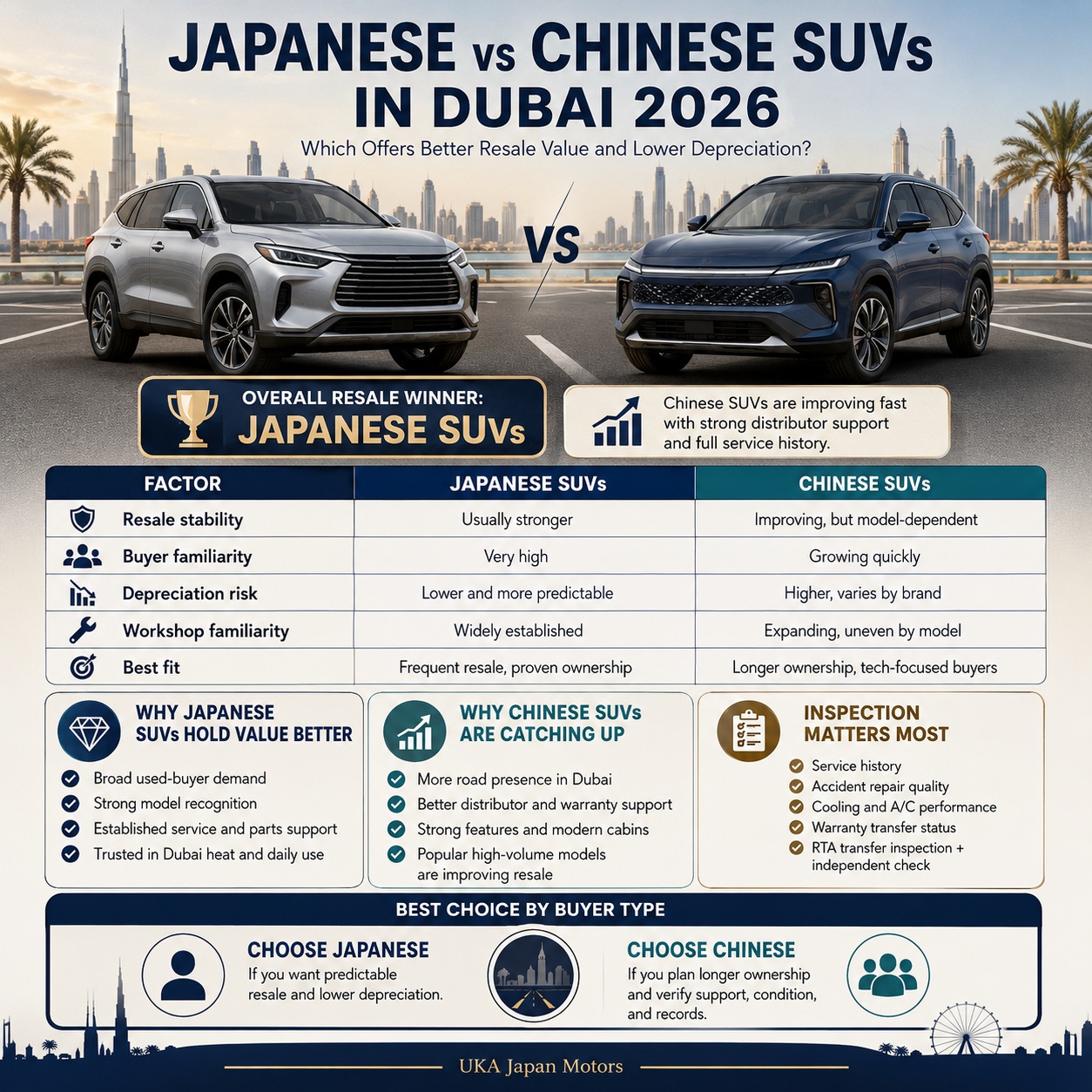
Dubai’s SUV market has changed considerably. Japanese manufacturers still occupy a strong position among family crossovers, seven-seat vehicles and full-size four-wheel drives, but Chinese brands are no longer peripheral alternatives. Their SUVs now appear throughout Dubai’s roads, dealership networks, workshops and used-vehicle listings.
This expansion has made the comparison more complicated.
A Japanese SUV may attract a larger pool of used buyers, benefit from a familiar maintenance network and carry a model name that has been recognised in the UAE for many years. A Chinese SUV may offer newer cabin technology, a generous equipment specification and remaining manufacturer support when it enters the used market.
However, equipment levels and showroom appeal do not determine resale performance on their own. In Dubai, depreciation is influenced by the depth of used-buyer demand, distributor stability, parts availability, model continuity, warranty transferability, accident history, mechanical condition and suitability for sustained operation in high temperatures.
The result is not that every Japanese SUV retains value well or that every Chinese SUV depreciates rapidly. The more accurate conclusion is that Japanese SUVs generally offer stronger resale stability in Dubai in 2026, while selected Chinese SUVs are narrowing the gap when they have high local demand, dependable distributor support and a clear service history.
Direct Answer: Which Is Better for Resale Value?
For most Dubai buyers prioritising predictable resale value and lower depreciation, a well-maintained Japanese SUV remains the safer overall choice in 2026.
Established Japanese models normally benefit from:
- A broad private-buyer and trader audience
- Familiarity among independent workshops
- Strong availability of routine service parts
- Long-standing confidence in cooling and drivetrain durability
- Recognisable model names across several generations
- Consistent demand for both urban and heavy-duty SUVs
Chinese SUVs are improving quickly, but their resale performance varies more widely between manufacturers, distributors and individual models. A popular Chinese SUV with a stable local agent, transferable warranty, good parts support and growing road presence can retain value more effectively than an obscure or discontinued Japanese model.
Current UAE marketplace information supports this more balanced interpretation. AutoData Middle East’s H1 2025 report showed established Japanese SUVs occupying many of the leading positions in local used-market demand, including the Toyota Land Cruiser, Nissan Patrol, Toyota Prado and Toyota RAV4. The same report also recorded rapid growth in Chinese-brand demand and indicated that some Chinese SUVs were beginning to narrow the residual-value gap during their early ownership years.
Japanese vs Chinese SUV Resale Comparison
| Resale Factor | Japanese SUVs | Chinese SUVs |
|---|---|---|
| Used-buyer familiarity | Generally very strong | Growing, but varies by brand |
| Secondary-market demand | Broad across many SUV categories | Stronger for popular recent models |
| Depreciation predictability | Usually more consistent | More model- and distributor-dependent |
| Parts familiarity | Widely established | Improving, but uneven |
| Independent workshop knowledge | Generally extensive | Developing as vehicle numbers grow |
| Model-name continuity | Often maintained across generations | Some line-ups change rapidly |
| Technology and equipment | Usually practical and conservative | Often extensive and highly visible |
| Remaining warranty influence | Helpful but not always decisive | Can be an important resale advantage |
| Long-term heat reputation | Established on many models | Still being proven across full ownership cycles |
| Resale after warranty expiry | Usually more stable | Depends heavily on brand confidence |
| Best suited to | Buyers prioritising predictable ownership and resale | Buyers prioritising equipment and longer ownership |
| Main resale risk | Poor condition can be hidden by brand reputation | Brand, parts or model uncertainty can reduce demand |
This comparison should be treated as a market pattern rather than an automatic verdict on every vehicle.
Why Resale Value Behaves Differently in Dubai
Depreciation is not caused by age alone. Two SUVs registered in the same year can have very different resale outcomes because the used market evaluates far more than the registration card.
Depth of the Used-Buyer Pool
A vehicle retains value more consistently when many buyers already understand it.
Dubai’s used SUV market includes daily commuters, families, fleet operators, traders, outdoor users and drivers who regularly travel between emirates. Models that suit several of these groups have greater resale liquidity.
A Toyota RAV4 may appeal to a city commuter, a small family and a driver seeking a practical highway vehicle. A Toyota Prado or Nissan Patrol may attract family users, long-distance drivers and buyers who value genuine four-wheel-drive capability. This diversity supports resale demand.
By comparison, a Chinese SUV may initially attract buyers because of its design and equipment, but its used-market audience can be narrower until the model develops a longer local history. That audience is growing, particularly for Chinese SUVs with visible road presence and consistent dealer representation. AutoData reported substantial Chinese-brand growth in UAE registrations and marketplace interest, showing that buyer acceptance is developing rather than remaining static.
Brand History Is Not the Same as Vehicle Condition
Japanese manufacturers benefit from established reputations in the UAE, but that reputation can mislead buyers into overlooking condition.
A neglected Japanese SUV can still suffer from:
- Cooling-system deterioration
- Transmission wear
- Oil leaks
- Suspension fatigue
- Poor accident repairs
- Chassis damage
- Interior heat deterioration
- Incomplete maintenance
- Inappropriate modifications
- Heavy off-road use
Brand confidence may help the advertisement attract attention, but a professional inspection can reveal defects that materially change the vehicle’s resale prospects.
Chinese SUVs face the opposite challenge. A mechanically sound example may be judged cautiously because buyers are less familiar with its long-term durability. In that situation, inspection documentation, service invoices, remaining warranty and verified distributor support become particularly important.
Why Japanese SUVs Usually Depreciate More Slowly
Established Demand Across Dubai and the UAE
Japanese SUVs have been widely used on Dubai roads for many years. Buyers understand the differences between compact crossovers, family SUVs and heavy-duty four-wheel drives from manufacturers such as Toyota, Nissan, Lexus, Honda, Mitsubishi, Mazda and Subaru.
This familiarity reduces uncertainty. A used buyer can usually find workshops familiar with the model, speak with other owners and review a substantial supply of comparable vehicles.
Current marketplace demand continues to reflect this position. AutoData and DubiCars data placed multiple Japanese SUVs among the UAE’s most searched or demanded vehicles, particularly models with strong durability and practical reputations.
Proven Model Continuity
Resale confidence is strengthened when a model name remains recognisable through several generations.
Long-running SUV lines make it easier for buyers to understand:
- Engine and transmission options
- Common mechanical issues
- Service intervals
- Parts interchangeability
- Trim differences
- Four-wheel-drive systems
- Expected behaviour at higher mileage
A model that remains in the market for many years develops a body of local knowledge. Workshops become familiar with it, parts suppliers hold relevant components and used buyers know what to inspect.
Some Chinese manufacturers also have stable SUV lines, but parts of the sector still experience rapid model introductions, extensive facelifts and changing trim names. Frequent changes can make older variants feel less familiar even when the underlying vehicle remains capable.
Workshop and Parts Familiarity
The strength of a vehicle’s support ecosystem affects buyer confidence after the manufacturer warranty ends.
Many Japanese SUVs can be serviced through both authorised facilities and experienced independent workshops. Routine parts and commonly replaced components are generally understood by the local repair sector.
Chinese-brand support is expanding, but the experience differs significantly by manufacturer. One brand may have a mature distributor, strong parts warehousing and multiple service locations, while another may have limited coverage or a smaller number of trained technicians.
A buyer should therefore compare distributors and service systems, not just manufacturing origins.
Confidence Under UAE Heat
Dubai places continuous thermal stress on vehicles.
During hotter months, the cooling system, air-conditioning, battery, tyres, interior materials and electronic modules operate under demanding conditions. Slow traffic, extended idling and frequent short journeys can increase that burden.
Many established Japanese SUV models have accumulated years of local operating history, which gives used buyers more confidence in their cooling performance and long-term durability. This does not mean that every Japanese model is automatically heat-resistant or that Chinese SUVs cannot perform well. It means there is more local evidence available for established models.
For newer Chinese SUVs, buyers should give extra attention to radiator condition, coolant quality, fan operation, air-conditioning performance, battery health, electronic warnings and evidence of overheating.
Why Chinese SUV Resale Value Is Improving
The 2026 comparison is not the same as it would have been several years earlier.
Chinese SUVs have gained significant visibility in Dubai. More vehicles on the road create more owner experience, more workshop familiarity and a larger supply of used examples. This gradually reduces uncertainty.
AutoData’s market analysis reported that Chinese-brand buyer interest and listing activity were rising strongly. It also found that Chinese SUV residual performance was becoming more competitive during the earlier ownership period, although individual results still varied.
Stronger Distributor Representation
Resale confidence improves when the local distributor demonstrates continuity.
Buyers should examine:
- How long the distributor has represented the brand
- Whether service locations are convenient
- Whether parts are held locally
- How warranty claims are managed
- Whether service records are centrally documented
- Whether software updates are available
- Whether the distributor supports older model years
- Whether warranty coverage transfers to the next owner
A Chinese SUV supported by an organised and established distributor may have substantially better resale prospects than one brought into the UAE through unclear channels.
High Road Presence
Used buyers are generally more comfortable with vehicles they see regularly.
A Chinese SUV that becomes common in Dubai benefits from:
- Greater public recognition
- More used listings for comparison
- Increased workshop exposure
- Wider availability of owner feedback
- Better familiarity among insurers and parts suppliers
- A larger future buyer pool
This is one reason high-volume models are more likely to retain value than rare trims or short-lived variants.
Transferable Warranty
Remaining manufacturer warranty can support confidence in a relatively new used Chinese SUV, particularly when the warranty is transferable and the service history meets all conditions.
However, buyers must verify the warranty rather than relying on an advertisement.
Important questions include:
- Is the warranty linked to the vehicle or only the first owner?
- Was every scheduled service completed correctly?
- Were services performed within the permitted intervals?
- Have unauthorised modifications affected coverage?
- Are batteries, screens, sensors and trim components covered differently?
- Does the warranty include roadside assistance?
- Is the coverage recognised by the official UAE distributor?
A long written warranty has limited resale influence if maintenance records are incomplete or the selling agent is not the authorised UAE representative.
The Supply Effect: Why Rapid Growth Can Also Increase Depreciation
Growing popularity does not always strengthen resale immediately.
When large numbers of new or nearly new vehicles enter Dubai, used buyers gain more alternatives. A privately owned vehicle may then compete with newer stock carrying more remaining warranty or updated equipment.
AutoData observed that increased used-car supply, including nearly new Chinese vehicles, contributed to longer selling periods and broader market pressure during 2025. Its report also noted that used SUVs generally remained more resilient than some other body styles, but increased supply still affected market behaviour.
This creates an important distinction:
Brand growth can build long-term recognition while simultaneously placing short-term pressure on individual resale listings.
For Chinese SUVs, rapid model renewal can add another layer. A vehicle may still be mechanically current, but a major interior redesign, screen update or powertrain change can make the previous version appear older to technology-focused buyers.
Japanese manufacturers often update their vehicles more gradually. That conservative approach can make a three- or four-year-old SUV look less dramatically separated from the current version, supporting steadier used demand.
Like-for-Like Comparisons Matter
A reliable resale comparison must examine equivalent vehicles.
It is not useful to compare a compact front-wheel-drive Chinese crossover with a body-on-frame Japanese four-wheel drive. Their buyers, intended use, engineering and ownership patterns are different.
Compact Urban Crossovers
In this category, Chinese SUVs may compete more closely with Japanese models because buyers often prioritise:
- Cabin technology
- Parking ease
- Rear-seat practicality
- Air-conditioning
- Smartphone connectivity
- Driver-assistance systems
- Everyday comfort
A popular Chinese compact SUV with strong distributor support may achieve reasonable used demand.
Japanese compact crossovers still tend to have an advantage after longer use because buyers are familiar with their mechanical systems and resale history. The gap can become more noticeable once both vehicles are outside warranty.
Mid-Size Family SUVs
Family buyers often place greater emphasis on reliability, rear air-conditioning, seating durability, luggage space and service accessibility.
Chinese seven-seat SUVs can be attractive when they provide a spacious cabin and extensive convenience features. Their resale success depends on whether the third row is genuinely usable, whether the air-conditioning reaches the rear effectively and whether electronic features remain reliable.
Japanese family SUVs usually benefit from stronger name recognition and a more established secondary market. A complete maintenance history remains essential, especially for turbocharged engines, continuously variable transmissions or hybrid systems.
Full-Size and Off-Road SUVs
Japanese manufacturers retain a particularly strong position among full-size SUVs and genuine four-wheel drives in Dubai.
Vehicles used for desert driving, towing, long-distance travel or large-family transport are judged heavily on drivetrain durability, cooling performance, chassis condition and parts availability.
Chinese manufacturers now offer visually distinctive off-road-oriented SUVs, and several have developed strong local interest. However, buyers should distinguish between rugged styling and verified mechanical capability.
Inspection should establish:
- Whether four-wheel-drive modes operate correctly
- Whether underbody protection shows impact damage
- Whether suspension components are suitable for the vehicle’s weight
- Whether recovery points are structural
- Whether modifications are properly installed
- Whether electronic terrain systems have stored faults
- Whether the vehicle has been exposed to heavy sand use
- Whether the cooling system has been stressed
An established Japanese off-road model will generally attract a broader resale audience. A Chinese off-road SUV can perform well in the used market when the model has developed a strong community, reliable distributor support and a proven local record.
Hybrid and Electric SUVs
Powertrain type can change the resale equation.
Japanese manufacturers have a significant presence in hybrid SUVs, while Chinese manufacturers are active across hybrid, plug-in hybrid and fully electric categories. AutoData reported growing electrified-vehicle variety in UAE used listings and noted comparatively strong early residual performance for some Chinese electric models.
However, electrified SUVs require model-specific evaluation.
The buyer should verify:
- High-voltage battery condition
- Battery warranty terms
- Charging compatibility
- Thermal-management performance
- Software support
- Diagnostic fault history
- Availability of qualified technicians
- Condition of the low-voltage battery
- Evidence of accident repairs near battery structures
- Availability of replacement electronic modules
A conventional Japanese petrol SUV may have a wider resale audience than an unfamiliar electric SUV. Conversely, a well-supported Chinese electric SUV may attract strong demand among buyers specifically seeking advanced electric technology.
The powertrain and support system matter more than the badge alone.
Condition Can Overrule Brand Origin
A professionally maintained Chinese SUV can be a stronger purchase than a poorly maintained Japanese SUV.
This is particularly relevant in Dubai, where some highly regarded Japanese vehicles are assumed to be dependable regardless of maintenance history. That assumption can lead buyers to overlook mechanical wear, accident damage or heavy previous use.
The following factors can materially weaken resale value for either origin:
Incomplete Service History
Missing records make it difficult to verify fluid changes, cooling-system maintenance, transmission servicing and warranty compliance.
Accident Repairs
Poor structural repairs, inconsistent panel gaps, paint differences, weld marks and incorrectly calibrated safety systems can reduce buyer confidence.
Flood or Water Exposure
Water intrusion can affect wiring, control modules, connectors, seat electronics and safety systems long after the visible interior has dried.
Excessive Modifications
Non-standard suspension, oversized wheels, altered lighting, engine tuning and poorly installed accessories can make inspection and resale more difficult.
Interior Heat Damage
A damaged dashboard, peeling trim, discoloured screens, weak air-conditioning or cracked leather suggests prolonged heat exposure or poor storage.
Tyre and Suspension Condition
Uneven tyre wear may indicate alignment problems, worn bushings, damaged suspension or previous impact.
Warning Lights and Software Faults
Modern Chinese and Japanese SUVs can contain extensive electronic systems. A clear dashboard does not guarantee that diagnostic faults have not been recently erased.
Inspection and Ownership Transfer in Dubai
A resale comparison should never be separated from Dubai’s inspection and transfer process.
RTA states that a vehicle technical inspection is required to check roadworthiness for ownership transfer, and a change of ownership requires inspection even when the vehicle is still within its first registration years. The technical inspection certificate is issued through approved channels and is valid for a limited period.
However, the mandatory roadworthiness inspection should not be treated as a complete pre-purchase mechanical evaluation.
A buyer-focused inspection should go further by examining:
- Engine condition
- Transmission operation
- Cooling-system pressure
- Air-conditioning output
- Suspension and steering wear
- Chassis alignment
- Paint thickness
- Previous body repairs
- Electronic diagnostic codes
- ADAS sensor operation
- Four-wheel-drive functions
- Hybrid or electric battery systems
- Service-document authenticity
- Tyre age and condition
RTA also provides a Technical Vehicle Status Report service containing important information related to eligible used vehicles, including ownership history and insurance validity. This can support due diligence, but it should be combined with physical inspection and document verification.
For a used vehicle being registered in Dubai, the required documentation may include the relevant transfer or possession certificate, valid insurance and electronic inspection records.
GCC Specification, Imports and Resale Confidence
Specification affects resale because it influences parts compatibility, software support, warranty status and confidence in hot-weather suitability.
A GCC-specification SUV sold and maintained through the authorised UAE network is usually easier for a future buyer to understand. Its documentation, service history and recall support may be easier to verify.
An imported SUV is not automatically unsuitable, but the buyer should establish:
- Original market specification
- Cooling-system configuration
- Air-conditioning specification
- Navigation and communication compatibility
- Parts availability
- Warranty status
- Recall completion
- Accident history before arrival
- Customs and registration documentation
- Whether diagnostic systems are supported locally
For Chinese SUVs, unofficial imports can create additional uncertainty when the locally appointed distributor does not support that particular variant. Software language, charging systems, connected services and electronic modules should be checked carefully.
For Japanese SUVs, an imported example may use a different engine, trim, safety package or parts configuration from the locally supported model. The badge alone does not guarantee local compatibility.
Which Japanese SUVs Tend to Hold Value Best?
In Dubai, the strongest resale performers are usually not simply the vehicles with the most features. They are models with a clear local purpose and a large established audience.
Common characteristics include:
- Recognisable model history
- Strong local road presence
- Reliable cooling and air-conditioning
- Practical seating or cargo use
- Proven drivetrain combinations
- Accessible routine parts
- Established workshop knowledge
- Limited uncertainty around future support
Full-size Toyota and Nissan SUVs have particularly strong recognition, while models such as the Toyota RAV4 and other mainstream Japanese crossovers benefit from broad everyday usability. AutoData’s UAE demand ranking reflects continued interest in several of these model lines.
That does not mean every trim performs equally. Unusual specifications, limited parts availability, poor colour combinations, non-standard modifications and incomplete records can still weaken resale interest.
Which Chinese SUVs Have the Best Chance of Strong Resale?
The most promising Chinese SUVs generally share several characteristics:
- High UAE registration volume
- A visible and stable authorised distributor
- Multiple service locations
- Reliable local parts supply
- A transferable warranty
- Consistent model naming
- Strong owner-community activity
- A practical petrol, hybrid or electric powertrain
- Clear service documentation
- Continued availability of the model
Popular vehicles from established Chinese groups are more likely to develop a functioning secondary market than rare models with limited local representation.
The badge should still not be considered enough. Buyers should evaluate the specific distributor, model, powertrain and year.
Who Should Choose a Japanese SUV?
A Japanese SUV is generally better suited to a Dubai buyer who:
- Expects to resell after a typical ownership period
- Prioritises broad used-market demand
- Wants extensive independent workshop familiarity
- Prefers proven mechanical systems
- Regularly drives between emirates
- Uses the vehicle for demanding family or outdoor duties
- Wants resale confidence after warranty expiry
- Prefers gradual model updates over rapidly changing technology
A Japanese SUV may be less suitable for a buyer who places the greatest importance on the newest screen design, extensive standard equipment or highly distinctive styling.
Who Should Choose a Chinese SUV?
A Chinese SUV can suit a buyer who:
- Plans to keep the vehicle for a longer period
- Values cabin technology and equipment
- Has verified strong distributor support
- Can maintain the vehicle through documented service channels
- Chooses a high-volume UAE model
- Confirms warranty transferability
- Accepts that resale demand may be more model-specific
- Has completed a thorough technical inspection
A Chinese SUV may be less suitable for someone who expects very predictable resale demand, frequently changes vehicles or lives far from the authorised service network.
How to Reduce Depreciation Regardless of Origin
Select a Recognised Model
A well-known model usually has more comparable listings, a larger buyer pool and better workshop familiarity.
Keep Complete Records
Retain service invoices, warranty documents, inspection reports, recall confirmations and repair records.
Follow the Correct Service Schedule
Delayed fluid changes or missed services can affect reliability, warranty status and buyer confidence.
Protect the Cooling System
Use the correct coolant, investigate temperature changes immediately and maintain radiator, fan, thermostat and hose condition.
Maintain the Air-Conditioning System
Weak cabin cooling is a major concern in Dubai and can indicate compressor, refrigerant, condenser, fan or electrical problems.
Avoid Unverified Modifications
Modifications should be compliant, professionally installed and documented. Poorly executed changes reduce trust.
Repair Damage Properly
A documented professional repair is preferable to concealed cosmetic work.
Preserve the Interior
Covered parking, appropriate sun protection and regular care can reduce deterioration of screens, plastics, leather and dashboard materials.
Inspect Before Selling
A recent independent report can help demonstrate condition and identify defects before buyers discover them.
Practical Decision Matrix
| Buyer Priority | More Suitable Direction |
|---|---|
| Most predictable resale performance | Japanese SUV |
| Broadest used-buyer audience | Japanese SUV |
| Established independent repair knowledge | Japanese SUV |
| Maximum cabin equipment and digital features | Chinese SUV |
| Longer ownership with warranty support | Selected Chinese SUV |
| Heavy-duty desert or towing use | Proven Japanese SUV, or carefully verified Chinese alternative |
| Frequent ownership changes | Japanese SUV |
| Technology-led electric SUV ownership | Model-specific; Chinese options may be highly competitive |
| Minimal uncertainty after warranty expiry | Japanese SUV |
| Willingness to research distributor and model support | Chinese SUV can be suitable |
| Buying a rare or low-volume model | Higher resale risk from either origin |
| Vehicle with incomplete history | Neither should be selected without investigation |
UKA Japan Motors’ Role in a Resale-Focused SUV Purchase
UKA Japan Motors’ role is to help buyers assess vehicles through inspection, documentation and compliance rather than relying on nationality, equipment lists or reputation alone.
A resale-focused review should establish:
- Whether the vehicle identity matches its documents
- Whether the specification is suitable for registration and local use
- Whether previous accident repairs are visible
- Whether the mileage is consistent with condition and records
- Whether the cooling and air-conditioning systems operate correctly
- Whether diagnostic faults are present
- Whether service history can be verified
- Whether the drivetrain suits the buyer’s intended use
- Whether modifications may affect inspection or future resale
- Whether the vehicle’s condition supports its market reputation
This approach is especially important when comparing a familiar Japanese SUV with a newer Chinese alternative. The Japanese model should not pass automatically because of its badge, and the Chinese model should not be rejected automatically because its local history is shorter.
The correct decision should be based on evidence.
Frequently Asked Questions
1. Do Japanese SUVs always have better resale value in Dubai?
No. Japanese SUVs generally have stronger resale performance as a group, but condition, service history, model popularity and specification can override the brand’s reputation. A neglected Japanese SUV may attract less serious interest than a well-maintained, popular Chinese model.
2. Are Chinese SUV resale values improving in 2026?
Yes, buyer awareness and road presence are increasing. Current market reports show growing UAE demand for Chinese SUVs and improving early residual performance for some models. However, results remain inconsistent across brands and distributors.
3. Which depreciates faster in Dubai: a Japanese or Chinese SUV?
In general, Chinese SUVs still face faster and less predictable depreciation, particularly when the brand has limited used-market recognition, rapidly changing models or uncertain parts support. Popular Chinese SUVs with established distributors can perform considerably better than the category stereotype suggests.
4. Does a long warranty prevent depreciation?
Not by itself. Warranty coverage can strengthen buyer confidence only when it is transferable, valid in the UAE and supported by complete service records. The local distributor must also recognise the vehicle and its specification.
5. Is a used Chinese SUV suitable for long-term ownership?
It can be, particularly when the vehicle has strong distributor support, accessible parts, a reliable service history and a powertrain that has developed a positive local record. Long-term owners may be less affected by short-term resale fluctuations.
6. Why are Toyota and Nissan SUVs strong in the Dubai used market?
Many of their SUV models have established road presence, recognised model names, broad workshop familiarity and suitability for family, highway and outdoor use. Current UAE marketplace data continues to show strong demand for several Toyota and Nissan SUV lines.
7. Can a Chinese SUV outperform a Japanese SUV in resale?
Yes, in specific cases. A high-volume Chinese SUV with remaining UAE warranty and complete maintenance records may attract stronger demand than a rare Japanese model, an unsupported import or a vehicle with accident and maintenance concerns.
8. Does RTA inspection confirm that an SUV is mechanically excellent?
No. RTA inspection confirms roadworthiness for the relevant registration or transfer process. A comprehensive pre-purchase inspection should examine the engine, transmission, cooling system, chassis, electronics, body repairs and model-specific components in greater depth.
9. Is a GCC-specification SUV better for resale?
It often receives greater buyer confidence because local specification, authorised service history and parts compatibility may be easier to verify. An imported SUV can still be suitable, but its original specification, history and local support require careful confirmation.
10. Do larger Japanese SUVs always retain value better than compact SUVs?
Not automatically. Large, recognised four-wheel drives have strong demand in Dubai, but condition, fuel type, previous off-road use and maintenance still matter. Compact Japanese SUVs may also retain value well because they appeal to a broad group of everyday drivers.
11. What should be inspected most carefully on a Chinese SUV?
Pay particular attention to electronic systems, infotainment functions, ADAS sensors, cooling performance, air-conditioning, software updates, warranty eligibility and local parts support. Mechanical and accident inspection remain equally important.
12. What should be inspected most carefully on a Japanese SUV?
Do not let the reputation of the badge replace inspection. Check cooling-system health, oil leakage, transmission behaviour, suspension wear, chassis damage, off-road use, accident repairs and evidence of delayed maintenance.
13. Are Chinese electric SUVs better at retaining value than petrol models?
The answer is model-specific. Some Chinese electric vehicles have shown competitive early residual trends, but battery condition, software support, charging compatibility and rapid technology changes can affect later resale demand.
14. Does exterior colour affect resale demand in Dubai?
Mainstream colours usually appeal to a wider audience, but condition remains more important. Unusual wraps, colour changes or poorly repaired paintwork can raise questions about previous damage and documentation.
15. How important is the authorised distributor?
It is highly important for Chinese SUVs and still relevant for Japanese vehicles. Distributor continuity affects warranty recognition, recalls, parts supply, software support and access to verified service records.
Final Verdict
Japanese SUVs remain the stronger overall choice for resale value and lower depreciation in Dubai in 2026.
Their advantage comes from broad used-buyer recognition, established service knowledge, familiar parts channels, proven model continuity and strong demand across compact, family and full-size SUV categories.
Chinese SUVs are nevertheless developing into credible long-term alternatives. Their local demand is rising, distributors are expanding and popular models are beginning to establish more resilient secondary-market performance. The strongest Chinese choices are high-volume models with verified UAE support, transferable warranty coverage, complete service records and continued manufacturer commitment.
The deciding question should therefore not be simply, “Japanese or Chinese?”
A better assessment asks:
- Is the model widely supported in Dubai?
- Does it have a stable buyer audience?
- Is the service history complete?
- Is its distributor reliable?
- Has the vehicle passed a detailed independent inspection?
- Is its powertrain suitable for the intended use?
- Will parts and technical support remain available after warranty expiry?
For buyers who may sell within a normal ownership cycle and want the most predictable outcome, a carefully inspected Japanese SUV remains the safer direction. For buyers planning longer ownership and willing to verify distributor and model support, a popular Chinese SUV can offer a convincing ownership experience without being judged solely by older assumptions.
Contact UKA Japan Motors for availability and inspection guidance.