


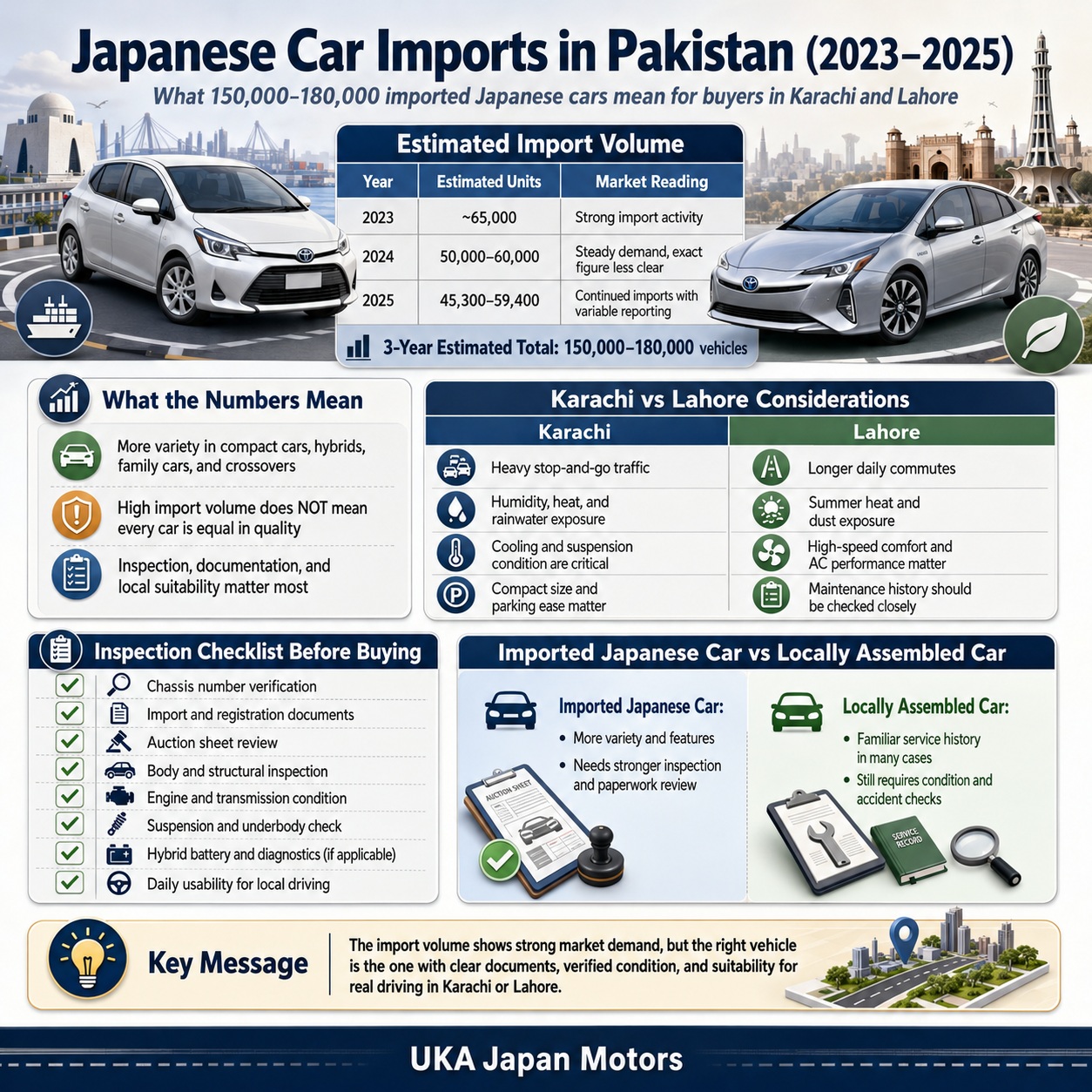
Japanese imported cars remain a major part of Pakistan’s urban vehicle landscape, especially in Karachi and Lahore. Over the last three years, reported and estimated figures suggest that Pakistan imported approximately 150,000 to 180,000 Japanese cars. The yearly movement is commonly described around these ranges: about 65,000 units in 2023, an estimated 50,000 to 60,000 units in 2024, and roughly 45,300 to 59,400 units in 2025.
These figures are important, but they should be understood carefully. Publicly available reporting does not always separate every import figure by origin, vehicle category, engine size, documentation route, or final registration city. Some sources report overall used vehicle import movement, while market discussions often focus on Japanese-origin vehicles because they dominate daily buyer interest in compact cars, hybrid models, and family-use imported vehicles. For example, reported FY2025 used car import estimates include roughly 44,000 to 45,000 units, with many vehicles in smaller engine categories. Pakistan’s official economic reporting also notes that car imports increased following the removal of quantitative restrictions on commercial used vehicle imports.
For everyday buyers, the bigger question is not only how many cars came into Pakistan. The more practical question is what this volume means for ownership decisions. When a large number of Japanese vehicles enters the market over a short period, it affects buyer expectations, inspection needs, documentation awareness, parts planning, registration flow, and long-term maintenance behaviour.
This article explains the meaning of Pakistan’s Japanese car import volume from 2023 to 2025 in a practical way for Karachi and Lahore drivers. It focuses on real ownership conditions: heavy traffic, long commutes, road surface variation, heat, dust, rain, humidity, registration handling, import documentation, auction sheet review, inspection quality, and long-term reliability.
Category: Import Policy & Regulations
Direct Answer: What Does This Import Volume Mean?
The estimated import of approximately 150,000 to 180,000 Japanese cars over three years shows that imported vehicles remain a strong part of Pakistan’s automotive demand. However, the figure should not be treated as a simple sign that every imported car is automatically suitable for every buyer.
For Karachi and Lahore, the volume means three things.
First, buyers have more exposure to different types of Japanese vehicles, including compact hatchbacks, kei cars, small family cars, hybrid sedans, crossovers, and multi-purpose vehicles.
Second, inspection and documentation matter more than ever. When import volume increases, vehicle quality can vary widely. Some vehicles arrive with clean records and strong condition, while others require careful review of auction grade, mileage consistency, body repair history, battery condition, underbody condition, engine health, and import papers.
Third, ownership suitability depends on local use. A car that appears attractive on paper may not be ideal for daily Karachi traffic, Lahore’s long road stretches, monsoon water exposure, heat, dust, or mixed road conditions. The right choice depends on how the vehicle will be used after registration, not only how it looked before import.
Understanding the 2023–2025 Import Pattern
The reported pattern from 2023 to 2025 shows sustained demand rather than a short-lived trend. A three-year import range of around 150,000 to 180,000 units suggests that Japanese cars are not only occasional purchases. They are part of a regular ownership decision for many Pakistani households.
In 2023, the reported figure of around 65,000 imports showed strong buyer interest. In 2024, although precise public reporting is less clear, market estimates commonly place the figure between 50,000 and 60,000 units. For 2025, reported ranges vary between approximately 45,300 and 59,400 units, while other reporting around FY2025 used imports points to roughly 44,000 to 45,000 units.
This variation is important. Import figures can differ depending on whether the source is counting calendar-year imports, financial-year imports, all used vehicles, Japanese-origin vehicles, commercial imports, baggage imports, or vehicles cleared under specific schemes. Buyers should therefore avoid treating a single number as the complete picture.
The useful conclusion is broader: Japanese imported vehicles continued entering Pakistan in large numbers across 2023, 2024, and 2025. This steady inflow confirms that buyer interest remains active, but it also increases the need for careful selection.
Why Imported Japanese Cars Remain Relevant in Pakistan
Japanese imported cars remain relevant because they often match the way many people drive in Karachi and Lahore.
Karachi drivers often face dense traffic, narrow inner roads, long signal waits, humid coastal weather, uneven road patches, and seasonal rainwater accumulation. A vehicle used in Karachi must handle stop-and-go movement, frequent braking, slow-speed cooling load, air-conditioning usage, and parking limitations.
Lahore has its own conditions. Many drivers experience long commutes across wide road networks, signal-heavy routes, ring-road movement, underpass areas, high summer heat, dust, and occasional rain-related road disruption. A car used in Lahore may spend more time at moderate speeds compared with inner-city Karachi traffic, but it still needs reliable cooling, suspension comfort, braking consistency, and predictable maintenance support.
Japanese imported vehicles often attract attention because buyers see variety in size, features, hybrid options, compact body designs, safety equipment, and interior usability. However, these strengths only matter when the specific vehicle has been inspected properly and its documents are complete.
Import Volume Does Not Equal Uniform Quality
A common misunderstanding is that a high import number means the market is full of equally good vehicles. That is not correct.
When many cars enter Pakistan, the range of condition becomes wider. Some cars may have strong auction records, low repair history, clean interiors, healthy mechanical systems, and complete documents. Others may have unclear mileage history, repaired panels, flood exposure concerns, weak hybrid batteries, worn suspension, or mismatched documentation.
This is why import volume should make buyers more careful, not less careful.
A market with 150,000 to 180,000 imported vehicles over three years gives buyers more choice, but it also creates more responsibility. Buyers should not judge a car only by its model year, exterior shine, mileage display, or popularity. They should examine how the vehicle entered Pakistan, what documents support it, how it was inspected, and whether its condition suits local driving.
The Documentation Side of Japanese Car Imports
Documentation is one of the most important parts of imported vehicle buying in Pakistan. The car itself may look clean, but ownership confidence depends heavily on paperwork.
For used imported vehicles, buyers should understand the basic import routes and document expectations. The Federal Board of Revenue explains that old and used vehicles may be imported under schemes such as Personal Baggage, Gift Scheme, and Transfer of Residence, with eligibility and age conditions applying to these routes. Policy changes have also affected commercial used vehicle imports, including regulatory duty treatment and phased changes after June 2026.
For a buyer in Karachi or Lahore, important documents may include import clearance papers, bill of lading details, auction sheet where applicable, export certificate, customs documents, registration file, excise record, and transfer documents. The exact documentation path depends on how the vehicle entered Pakistan and how it was registered.
A buyer should not rely only on verbal claims. The vehicle’s import story should be supported by documents that match the chassis number, model year, engine details, and registration record.
Why Chassis Verification Matters
Chassis verification is central to imported vehicle inspection. The chassis number connects the physical car to its import documents, auction record, customs clearance, and registration file.
In Karachi and Lahore, buyers often inspect the exterior, engine sound, interior condition, and tyres first. These are useful checks, but chassis verification is more fundamental. If the chassis record is unclear or documents do not match, the buyer may face registration, transfer, resale, or legal complications later.
A proper inspection should confirm that the chassis number on the body matches the documents. It should also check that the number has not been altered, damaged, or presented inconsistently across paperwork.
This step is especially important when import volume is high because more vehicles pass through multiple hands: importer, clearing process, dealer, transporter, registration agent, and final buyer. Each step can introduce confusion if records are not handled carefully.
Auction Sheet Review: Useful but Not Enough Alone
Auction sheets are often discussed in the Japanese imported car market. They can provide useful information about vehicle grade, exterior marks, interior condition, mileage, repair notes, and accident indications.
However, an auction sheet should not be treated as the only inspection tool. It is a starting point, not the final answer.
A clean-looking auction sheet still needs physical confirmation. A car may have developed issues after auction, during storage, transport, port handling, inland movement, or local use after registration. Similarly, some buyers may not fully understand auction notation, panel codes, grade meanings, or remarks.
A proper review should compare the auction sheet with the actual vehicle. The inspection should check body panels, paint thickness where possible, pillar condition, engine bay signs, underbody marks, interior wear, dashboard alerts, hybrid system behaviour, and mileage consistency.
Karachi Conditions: What Imported Cars Must Handle
Karachi creates a demanding environment for imported vehicles. The city combines heavy traffic, coastal humidity, heat, dust, uneven road surfaces, and occasional rainwater accumulation.
In daily use, a car in Karachi may spend long periods moving slowly with the air conditioner running. This places stress on the cooling system, radiator fan, compressor, battery, and engine management system. Smaller Japanese cars can be practical in tight streets and parking areas, but their condition must be strong enough for regular stop-and-go use.
Suspension is another key point. Karachi roads can vary from smooth main roads to broken service lanes and uneven residential streets. Imported vehicles with worn bushes, weak shocks, or low ground clearance may feel uncomfortable or require attention sooner.
Rain is also relevant. Water exposure can affect underbody parts, sensors, wheel bearings, brakes, and electrical connectors. A buyer should check for signs of corrosion, moisture inside the cabin, musty smell, under-car rust, and previous flood exposure.
Lahore Conditions: Different Use, Different Stress
Lahore’s driving pattern differs from Karachi in several ways. Many drivers cover longer planned routes across wider roads, signal corridors, ring-road stretches, and suburban connections. The city also has strong seasonal heat, dust, and rain-related road disruption.
For Lahore buyers, high-speed stability, air-conditioning performance, suspension comfort, and engine cooling are important. A compact Japanese car may work well for city use, while a hybrid sedan may suit longer daily commutes if the battery and electronic systems are healthy.
Dust can affect air filters, cabin filters, throttle response, cooling efficiency, and interior cleanliness. Heat places pressure on coolant, hoses, radiator health, hybrid battery ventilation, and cabin electronics.
A vehicle imported in good condition but poorly maintained after registration may not perform well over time. Lahore drivers should therefore look not only at import condition but also at current maintenance history.
Compact Cars vs Hybrid Cars: A Practical Contrast
Japanese imports in Pakistan often fall into two broad interest groups: compact city cars and hybrid vehicles.
Compact cars are usually selected for urban movement, easier parking, narrow streets, and manageable daily driving. They are commonly seen in Karachi’s dense areas and Lahore’s inner routes. Their strengths are convenience, simple usability, and suitability for shorter urban trips. However, buyers must check engine health, transmission behaviour, air-conditioning load, suspension condition, and ground clearance.
Hybrid vehicles are often selected for longer commutes, smoother drive feel, and advanced technology. They can suit Lahore’s longer road patterns and Karachi’s mixed commuting routes. However, hybrids require deeper inspection. The battery pack, inverter, cooling fan, dashboard warnings, regenerative braking behaviour, and diagnostic reports should be checked carefully.
The contrast is simple: compact cars may be easier to understand for many buyers, while hybrids demand more technical inspection. Neither category is automatically better. Suitability depends on usage, condition, documentation, and maintenance support.
Imported Cars vs Locally Assembled Cars
A practical comparison in Pakistan is between imported Japanese vehicles and locally assembled vehicles.
Imported Japanese cars often offer variety in body styles, features, compact design, hybrid systems, and interior layouts. Buyers may find models that are not commonly assembled locally. This variety is one reason import demand has remained strong.
Locally assembled cars, on the other hand, usually have more familiar service networks, easier parts identification, and simpler documentation paths. Their history may be easier to trace when bought from a first owner with complete local records.
The important point is not to declare one side better for everyone. Imported vehicles need stronger pre-purchase inspection and documentation review. Locally assembled vehicles need their own checks for accident history, maintenance record, repainting, and mechanical condition.
For Karachi and Lahore buyers, the decision should be based on how the car will be used. A daily office commuter, family school-run vehicle, compact city car, and long-route hybrid all have different requirements.
What Import Volume Means for Parts and Maintenance
A larger number of imported Japanese cars on the road can improve familiarity among mechanics, electricians, parts dealers, and diagnostic technicians. When a model becomes common in Karachi and Lahore, workshops usually become more used to its maintenance patterns.
However, popularity does not remove the need for planning. Some parts are easy to identify, while others depend on exact variant, chassis code, model year, engine type, or hybrid system. Two cars with similar names may have different sensors, lights, bumpers, transmissions, batteries, or electronic modules.
Buyers should confirm whether routine maintenance items are understood by reliable workshops. These include filters, spark plugs, fluids, brake pads, suspension bushes, belts, coolant, tyres, and diagnostic support. For hybrids, battery cooling and electronic diagnostics are especially important.
The safest approach is to choose a car whose variant is clearly identified and whose maintenance requirements are understood before purchase.
Registration and Transfer Considerations
Imported vehicles must be handled carefully during registration and transfer. The process can vary depending on where the vehicle is registered, whether it is already registered, and whether all import documents are complete.
In Karachi and Lahore, buyers should confirm that registration records match the car’s chassis and engine details. They should review the file, excise record, transfer documents, tax status, and any required verification steps. The vehicle should not be treated as complete until its legal ownership path is clear.
This matters because imported cars often move from port handling to dealers and then to buyers in different cities. A car cleared in one place may be registered elsewhere. Transport and documentation movement should be traceable.
A clean physical car with incomplete documents can create problems. A complete file with a weak physical vehicle can also create ownership challenges. Both sides must be checked together.
Why 2026 Policy Context Matters
Although the user-provided import figures cover 2023 to 2025, the policy environment around used vehicle imports has continued to change. Official Finance Ministry communication noted the approval of commercial import of used vehicles less than five years old, with a 40 percent regulatory duty applicable until June 30, 2026 and a phased reduction afterward. The Ministry of Commerce has also published amendments related to vehicle import procedures under Personal Baggage, Transfer of Residence, and Gift schemes.
For buyers, this means imported vehicle decisions should not be based only on old assumptions. Rules, age limits, eligibility, regulatory requirements, and documentation procedures can shift. A vehicle imported under one policy window may have a different paperwork trail from a vehicle imported under another.
This is why inspection-oriented guidance is important. The buyer should understand not only the model but also the import timing, clearance path, and documents attached to the vehicle.
Common Buyer Mistakes After Seeing Big Import Numbers
A large import number can create confidence, but it can also create shortcuts. Some buyers assume that because a model is common, every unit is safe to buy. This is risky.
One common mistake is relying only on mileage. Mileage can be useful, but it must be checked against auction record, interior wear, service stickers, tyre condition, pedal wear, steering condition, and diagnostic data where possible.
Another mistake is ignoring underbody condition. Karachi’s rainwater exposure and Lahore’s road dust can both affect the underbody over time. Imported cars should be checked from below, not only from the outside.
A third mistake is focusing only on features. Push start, climate control, lane assistance, cameras, and hybrid display screens can attract buyers, but feature availability does not prove mechanical health.
A fourth mistake is skipping document review because the car is already registered. Registration is important, but it does not replace the need to verify import papers, chassis details, transfer record, and file completeness.
How Buyers Should Read the 150,000–180,000 Figure
The estimated three-year range should be read as a sign of market depth, not a guarantee of individual vehicle quality.
It tells us that Japanese imports have remained active in Pakistan. It tells us that many buyers continue to consider imported vehicles for city driving, family use, hybrid commuting, and compact mobility. It also tells us that the used imported market has enough volume to require professional inspection standards.
But the number does not tell us whether a specific car has accident history. It does not confirm mileage. It does not prove battery health. It does not show whether a vehicle has been exposed to water. It does not confirm whether documents are complete. It does not tell whether the car suits Karachi or Lahore driving.
The number gives context. Inspection gives confidence.
Practical Checklist for Buyers in Karachi and Lahore
Before buying a Japanese imported car, buyers should review the following areas carefully.
Start with identity verification. Confirm chassis number, engine number where applicable, import documents, registration record, and transfer file.
Next, review the auction sheet or import condition record. Compare it with the physical car. Look for consistency in mileage, grade, repair notes, and panel condition.
Then inspect the body. Check pillars, roof, boot floor, engine bay, doors, fenders, bumpers, glass, paint finish, and signs of structural repair.
After that, check mechanical condition. The engine should start smoothly, idle consistently, and show no unusual smoke, vibration, overheating, or warning lights.
Transmission behaviour should be smooth. Delayed engagement, jerks, slipping, or warning indicators need attention.
Suspension should be checked on uneven roads. Listen for knocking, looseness, weak shocks, steering play, and brake vibration.
For hybrids, diagnostic scanning is essential. Battery condition, inverter behaviour, cooling fan cleanliness, warning history, and regenerative braking response should be reviewed.
Finally, check daily usability. Ground clearance, seating comfort, boot space, air-conditioning strength, visibility, parking ease, and cabin practicality should match the buyer’s actual routine.
Which Type of Buyer Suits a Japanese Imported Car?
A Japanese imported car may suit a buyer who values detailed inspection, understands documentation importance, and wants a vehicle matched to daily use rather than only model popularity.
It can suit Karachi drivers who need compact size, easy parking, and comfortable movement through traffic, provided the cooling system, suspension, and electrical systems are healthy.
It can suit Lahore drivers who cover longer routes and want a stable, comfortable, well-inspected car for daily commuting, provided maintenance and variant support are clear.
It may also suit families looking for practical interior space, safety features, and reliable urban usability, as long as the vehicle’s condition is verified properly.
However, it may not suit buyers who want to skip inspection, ignore paperwork, or choose only by exterior appearance. Imported vehicles require careful review because each unit has its own history.
When a Japanese Imported Car May Not Be the Right Choice
A Japanese imported car may not be ideal when the buyer cannot verify documents, auction record, chassis details, or condition.
It may also not be suitable if the exact variant has limited maintenance familiarity in the buyer’s city. Some models are technically strong but require specific parts knowledge, diagnostic tools, or experienced technicians.
A hybrid may not be suitable if the buyer is unwilling to inspect battery health or maintain the cooling system properly. A compact car may not be suitable if the buyer regularly travels with heavy loads or drives on rough roads where ground clearance and suspension travel matter.
A vehicle with unclear mileage, warning lights, water exposure signs, structural repair, or incomplete file should be approached carefully, regardless of model popularity.
The best imported car is not the one with the most attractive description. It is the one whose condition, documents, and usage suitability all align.
Long-Term Ownership Considerations
Long-term ownership depends on how the vehicle is maintained after purchase. Japanese imported cars often come with advanced features, compact engineering, efficient packaging, and refined drive behaviour. But they still need disciplined maintenance in Pakistan’s conditions.
Heat management is important. Cooling systems, radiator caps, coolant quality, hoses, fans, and air-conditioning load should be monitored.
Dust management is also important. Air filters and cabin filters need timely attention, especially in Lahore’s dusty conditions and Karachi’s construction-heavy routes.
Electrical health matters in imported cars because many models include sensors, cameras, push-start systems, hybrid modules, and electronic control units. Poor wiring repairs should be avoided.
Suspension care is essential because road conditions vary widely. Bushes, mounts, shocks, steering components, and tyres should be checked regularly.
For hybrids, battery cooling fan cleaning, diagnostic scanning, and warning light review are part of responsible ownership.
A good purchase decision is only the beginning. Proper maintenance determines whether the car remains dependable over time.
UKA Japan Motors’ Role in an Inspection-Oriented Market
UKA Japan Motors approaches Japanese imported vehicles through inspection, documentation clarity, and practical buyer guidance. In a market where Pakistan has imported a large number of Japanese cars over recent years, buyers need more than model names and surface appearance.
The role of UKA Japan Motors is to help buyers understand the vehicle before they make a decision. This includes reviewing condition, checking documentation relevance, explaining inspection findings, identifying practical ownership concerns, and guiding buyers according to Karachi and Lahore usage realities.
The focus is not on pushing a vehicle. The focus is on clarity.
A buyer should understand whether the car suits heavy traffic, whether the documents support its import and registration history, whether its mechanical condition is acceptable, whether a hybrid system needs attention, and whether the model fits long-term use.
This kind of guidance is especially important when import volume is high because choice increases, but so does variation in condition.
Summary
Pakistan’s estimated import of approximately 150,000 to 180,000 Japanese cars from 2023 to 2025 reflects strong and sustained demand. Reported figures suggest around 65,000 units in 2023, an estimated 50,000 to 60,000 units in 2024, and roughly 45,300 to 59,400 units in 2025, with some FY2025 reporting placing used car imports around 44,000 to 45,000 units.
The main lesson for buyers is not simply that Japanese cars are popular. The real lesson is that inspection, documentation, and usage suitability matter more as the market grows.
For Karachi, buyers should consider traffic, humidity, rainwater exposure, cooling performance, and suspension condition. For Lahore, buyers should consider longer commutes, heat, dust, road speed variation, and maintenance familiarity.
Imported Japanese cars can be suitable for many drivers, but only when the vehicle’s history, condition, documents, and long-term support are properly reviewed.
FAQs
1. How many Japanese cars did Pakistan import from 2023 to 2025?
Based on reported and estimated annual figures, Pakistan imported approximately 150,000 to 180,000 Japanese cars over the three-year period. The commonly discussed numbers include around 65,000 units in 2023, an estimated 50,000 to 60,000 units in 2024, and roughly 45,300 to 59,400 units in 2025.
2. Are these figures officially exact?
Not completely. Public reporting can vary depending on whether the figures count calendar year, financial year, used cars overall, Japanese-origin vehicles, or vehicles imported under specific schemes. Buyers should treat the numbers as a practical market estimate rather than a single final audited figure.
3. Why do Japanese imported cars remain popular in Karachi and Lahore?
They remain popular because many models suit urban driving, compact parking, family use, hybrid commuting, and daily traffic conditions. However, popularity alone does not prove that every vehicle is suitable. Inspection and documentation are still essential.
4. What should buyers check first in a Japanese imported car?
The first checks should be chassis verification, import documents, registration record, auction sheet or condition report, and physical inspection. A clean exterior is not enough without matching paperwork and verified condition.
5. Is an auction sheet enough to trust a car?
No. An auction sheet is useful, but it should be compared with the actual vehicle. The car may have changed condition after auction due to transport, storage, local use, or repair work.
6. Are hybrid Japanese cars suitable for Pakistan?
Hybrid cars can suit many Karachi and Lahore drivers, especially those with regular commuting needs. However, they require proper inspection of the battery, inverter, cooling system, diagnostic history, and warning lights before purchase.
7. Are compact Japanese cars better for Karachi traffic?
Compact Japanese cars can be practical for Karachi because of narrow roads, dense traffic, and parking limitations. Still, buyers should check air-conditioning performance, engine cooling, suspension health, and ground clearance.
8. What matters most for Lahore buyers?
Lahore buyers should focus on air-conditioning strength, suspension comfort, high-speed stability, engine cooling, dust-related maintenance, and long-route usability. A car should match the buyer’s daily route, not only the model name.
9. Can a registered imported car still have documentation issues?
Yes. Registration is important, but buyers should still verify the file, chassis number, import documents, transfer record, and excise details. A registered car should still have a clear ownership and documentation trail.
10. What does high import volume mean for maintenance?
High import volume can make some models more familiar to workshops and parts dealers. However, each variant can differ. Buyers should confirm exact model, chassis code, engine type, and maintenance support before making a decision.
11. Should buyers choose imported or locally assembled vehicles?
Both can be suitable depending on usage and condition. Imported vehicles often offer variety and advanced features, while locally assembled vehicles may have simpler service familiarity. The better choice depends on inspection results, documentation clarity, and daily driving needs.
12. What is the safest way to approach a Japanese imported car purchase?
The safest approach is to combine document verification, auction sheet review, physical inspection, mechanical checking, diagnostic scanning, and local usage assessment. A buyer should not rely on appearance or verbal claims alone.
Conclusion
Pakistan’s Japanese car import volume from 2023 to 2025 shows that imported vehicles continue to play an important role in the country’s automotive market. The estimated figure of 150,000 to 180,000 units reflects strong buyer interest, especially in cities like Karachi and Lahore where compact size, hybrid options, comfort, and feature variety matter in daily driving.
However, a large import number should not lead to careless buying. Every imported vehicle has its own history. Some are well-documented and well-preserved. Others may have unclear records, hidden repairs, weak mechanical condition, or documentation gaps.
For buyers, the right approach is practical and inspection-based. Understand the import route. Check the file. Verify the chassis. Review the auction sheet. Inspect the body, engine, suspension, electronics, and hybrid system where applicable. Then judge whether the vehicle suits Karachi or Lahore driving conditions.
A Japanese imported car can be a strong ownership choice when selected carefully. The key is not simply choosing a popular model. The key is choosing a properly inspected vehicle with clear documents and realistic long-term usability.
Contact UKA Japan Motors for availability and inspection guidance.