


Japanese car auctions connected with Mae Sot Free Zone activity attract attention from buyers who are looking at trucks, vans, compact cars, MPVs, and hybrid vehicles for use in Thailand. For many buyers in Mae Sot, the appeal is practical rather than emotional. A vehicle may be intended for daily commuting, family transport, provincial road travel, small business movement, or mixed use between town roads and outer districts.
But auction buying is different from viewing a fully registered vehicle already prepared for normal road use in Thailand. In an auction setting, especially where Free Zone procedures, import rules, storage status, and documentation are involved, the most important question is not simply whether a vehicle looks attractive. The real question is whether the vehicle can move from auction interest to legal, inspectable, usable ownership without hidden uncertainty.
Mae Sot is a border town with unique transport needs. Drivers may use vehicles in town traffic, on provincial roads, during rainy-season conditions, and in heat and humidity that place pressure on tyres, brakes, suspension, cooling systems, air conditioning, batteries, and hybrid components. A vehicle that appears clean in photos may still need careful verification before bidding.
This guide explains what buyers should check before bidding on Japanese vehicles linked to Mae Sot Free Zone auctions in 2026, with a practical focus on inspection, customs status, ownership documents, registration readiness, compliance, and long-term use in Thailand.
Direct Answer: What Should Buyers Check Before Bidding?
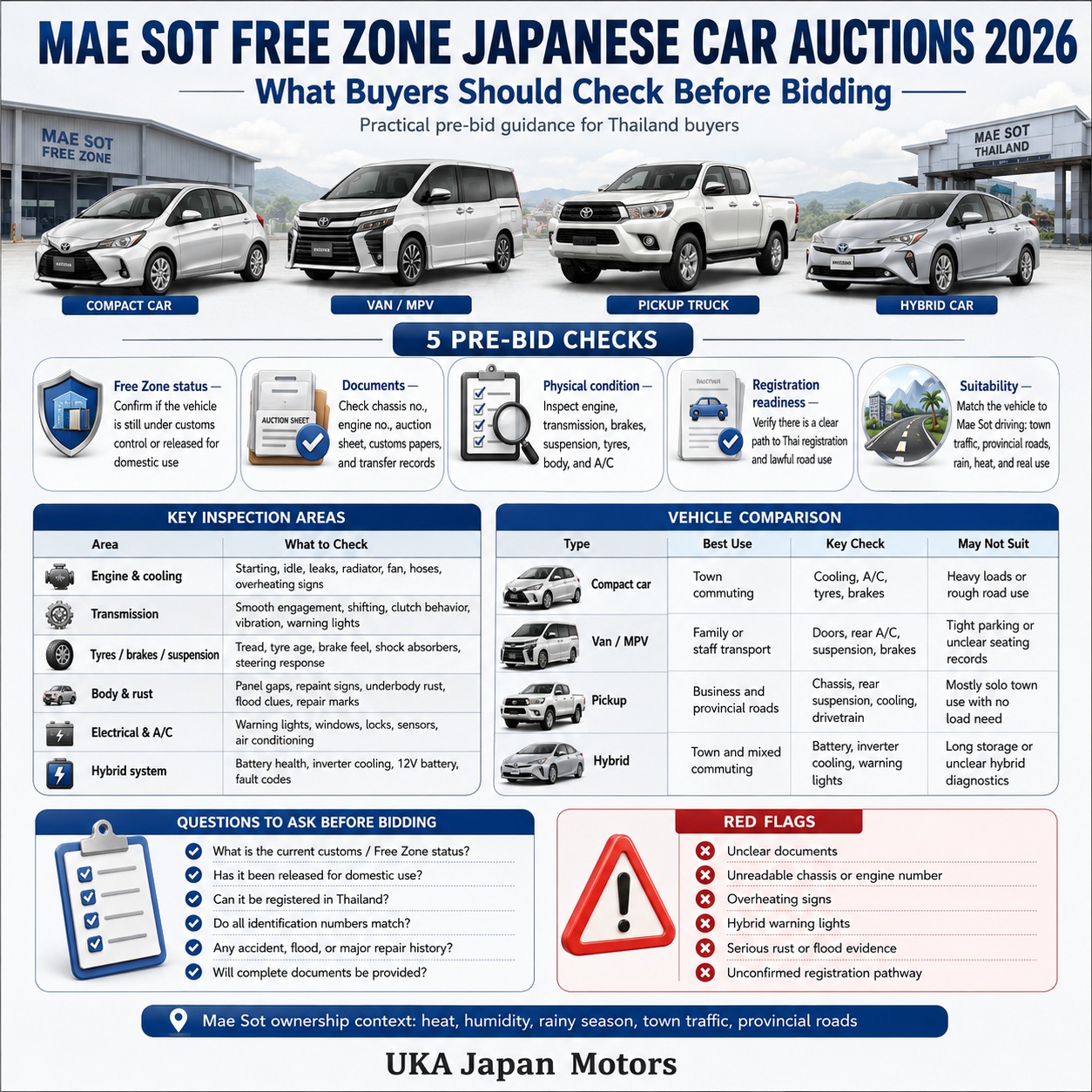
Before bidding on a Japanese vehicle connected with a Mae Sot Free Zone auction, buyers should check five areas carefully: the vehicle’s Free Zone status, import and release documentation, physical condition, registration readiness, and suitability for real driving in Thailand.
A Free Zone is not the same as normal road registration. Thai Customs describes a duty-free zone as an area designated for customs duty-related benefits for industrial, commercial, or other operations beneficial to the national economy. Goods brought into or released from such a zone remain subject to formal procedures depending on how they are used, transferred, or released into the country.
Buyers should not assume that every vehicle visible at auction is ready for ordinary use on Thai roads. Used motor vehicles are specifically treated under Thailand’s import licensing framework, and the WTO import licensing portal records Thailand’s Ministry of Commerce notification covering used motor vehicles as prohibited goods or goods subject to licensing requirements, with the Department of Foreign Trade identified as the administrative body.
For Mae Sot buyers, the safest approach is simple: inspect first, verify documents second, confirm compliance third, and only then decide whether the vehicle suits the intended use.
Why Mae Sot Free Zone Context Matters
Mae Sot is part of Tak Province and has long been connected with border trade, logistics, and special economic development activity. Thai government information has identified Mae Sot district in Tak as one of the pilot areas for special economic zone development, alongside other border locations in Thailand.
This matters because vehicles linked with Mae Sot Free Zone activity may not follow the same ownership path as a normal vehicle already registered in Thailand. A vehicle may be stored, transferred, inspected, released, or prepared under customs-related procedures before it becomes suitable for ordinary ownership.
For buyers, this creates both opportunity and responsibility. The vehicle may be interesting because of its condition, body type, fuel system, or suitability for Mae Sot use. But the buyer must also understand whether the vehicle has a clear path through documentation, customs release, inspection, and registration.
In Mae Sot, vehicle use is rarely limited to smooth town driving. A buyer may use a pickup for supplies, a van for family or business movement, a compact car for commuting, or a hybrid for mixed town and provincial travel. Each use case places different demands on the vehicle. Auction photos and brief descriptions are not enough to judge this properly.
Free Zone Vehicle Status Is Not the Same as Road-Ready Status
The first major check is whether the vehicle is actually ready for Thai road use or still under Free Zone control.
A vehicle in a Free Zone-related process may be stored in a controlled customs environment. Thai Customs guidance explains that goods released from a duty-free zone for distribution within Thailand require formal handling based on the nature of the goods, customs classification, and applicable conditions at the time of release.
For buyers, this means the phrase “Free Zone auction” should trigger questions, not assumptions. The vehicle may need additional steps before it can be used normally. Buyers should ask:
Is the vehicle still under customs control?
Has it been released for domestic use?
Is it intended for export, parts, business use, or road registration?
Are the documents complete and consistent?
Can the vehicle meet inspection and registration requirements in Thailand?
A road-ready vehicle should have a clear registration path, identifiable ownership documents, and inspection readiness. A vehicle still under a Free Zone or import-related process may require additional compliance checks before ownership becomes practical.
Auction Sheet and Condition Report: What to Read Carefully
The auction sheet or condition report is one of the first documents buyers usually see. It may describe exterior condition, interior grade, mileage, repair marks, accident history, rust, underbody condition, and mechanical notes.
However, an auction sheet should never be treated as a complete inspection. It is a useful starting point, not a final confirmation.
Buyers should check whether the auction report clearly identifies the vehicle by chassis number, model code, engine type, transmission, body type, mileage record, and grade. The report should be consistent with the physical vehicle. Any mismatch between the report and the vehicle should be treated seriously.
For Mae Sot use, buyers should pay close attention to notes about suspension, underbody, cooling system, air conditioning, and electrical condition. These areas matter because local use may involve heat, humidity, uneven provincial roads, rain, mud, and stop-start town movement.
A clean exterior grade does not always mean the vehicle is mechanically ready. A van may look tidy but have suspension fatigue. A hybrid may look modern but need battery system checks. A pickup may appear strong but show underbody wear from previous use. A compact car may be suitable for town driving but less suitable if the buyer regularly carries heavy family or business loads.
Physical Inspection Before Bidding
A physical inspection should be arranged whenever possible before bidding. Photos can hide important details, especially around the underbody, engine bay, tyre condition, paint repairs, fluid leaks, and interior wear.
The inspection should include:
Engine starting behavior, idle stability, exhaust smoke, fluid leaks, cooling fan operation, radiator condition, belts, hoses, and oil condition.
Transmission engagement, gear changes, clutch behavior if manual, and signs of delayed response or vibration.
Suspension condition, shock absorbers, bushings, ball joints, steering rack, wheel bearings, and uneven tyre wear.
Brake system condition, brake pedal feel, disc and pad condition, brake fluid appearance, and warning lights.
Body structure, panel gaps, welding marks, repainting signs, corrosion, underbody damage, flood indicators, and previous repair evidence.
Electrical systems, dashboard warning lights, lights, windows, central locking, sensors, air conditioning, infotainment, and hybrid display information where relevant.
Tyres, including tread pattern, manufacturing age, sidewall cracks, uneven wear, and suitability for wet Mae Sot roads.
For rainy-season driving in Mae Sot, tyres and brakes deserve special attention. A vehicle may feel acceptable on dry ground but become less predictable during heavy rain, standing water, or muddy access roads outside town.
Documentation Checks Before Bidding
Documentation is as important as mechanical condition. A vehicle with good mechanical condition but unclear documents can still become difficult to register or use legally.
Before bidding, buyers should request or verify:
Chassis number and engine number records.
Auction sheet or condition report.
Export or origin documents where applicable.
Customs-related documents showing the vehicle’s status.
Free Zone storage or release documents, if relevant.
Ownership transfer records.
Inspection records, if available.
Any documents connected with modifications, body type changes, engine replacement, or hybrid system work.
Consistency is the key. The chassis number on the vehicle must match all documents. The engine number should be readable and consistent with the paperwork. The vehicle description should align with the actual body type. A van should not be documented ambiguously as a different category. A pickup with modifications should have documents that explain those changes.
If documents are incomplete, unclear, or inconsistent, buyers should slow down. In auction settings, urgency can lead to mistakes. For Mae Sot buyers, documentation confidence is essential because road use, ownership transfer, and inspection readiness depend on it.
Registration Readiness in Thailand
Registration readiness means the vehicle has a realistic and lawful route to Thai registration, ownership transfer, and normal use. It does not mean the vehicle merely exists physically in Thailand.
The Department of Land Transport operates systems connected with vehicle use and permits, including Foreign Vehicle Permit processes for foreign-registered vehicles entering Thailand temporarily. The DLT’s FVP portal shows categories such as private vehicles, pickups, and vans, which is a useful reminder that foreign registration and Thai registration are not the same thing.
For auction buyers, the practical question is whether the vehicle can be moved into the correct Thai registration process. This depends on import status, vehicle type, emissions or standards requirements where applicable, inspection readiness, document consistency, and ownership eligibility.
A vehicle that cannot be registered properly should not be treated like a normal road-use purchase. It may have limitations, require further formal steps, or be suitable only for a specific purpose. Buyers should confirm this before bidding, not afterward.
Compliance and Import Restrictions
Compliance is especially important for used Japanese vehicles. Thailand has rules on used motor vehicle importation, and different vehicle categories may be treated differently. The WTO notification record for Thailand identifies used motor vehicles under import licensing and prohibited-goods categories, with specific references to used vehicles under multiple HS categories.
This does not mean every auction vehicle is automatically unsuitable. It means buyers must verify the exact legal status of the specific vehicle. A truck, van, compact car, hybrid, ambulance, fire truck, antique vehicle, or special-purpose vehicle may fall under different treatment depending on classification and intended use.
Buyers should ask the auction operator, broker, or seller to explain the compliance pathway in writing. Verbal confidence is not enough. A responsible buyer should understand whether the vehicle is already cleared, awaiting release, restricted, licensed, or intended for another approved use.
Compact Car, Van, Pickup, and Hybrid: Different Checks for Different Buyers
Not every Japanese auction vehicle should be judged by the same checklist. The right inspection focus depends on how the vehicle will be used in Mae Sot and wider Thailand.
| Vehicle Type | Main Mae Sot Use | Key Inspection Focus | When It May Not Suit |
|---|---|---|---|
| Compact car | Town commuting, small family use, daily errands | Engine cooling, air conditioning, tyres, brakes, suspension, interior wear | Regular heavy loads, rough rural access, frequent cargo use |
| Van or MPV | Family movement, staff transport, small business use | Sliding doors, rear suspension, air conditioning, seating, brake condition | Narrow town parking, poor maintenance history, unclear seating documents |
| Pickup | Supplies, mixed business use, provincial roads | Chassis, rear suspension, tyres, clutch or transmission, cooling system | Mostly short town trips with no load need, heavily repaired frame |
| Hybrid | Town and mixed commuting | Hybrid battery health, inverter cooling, warning lights, service history, 12V battery | Long idle periods without maintenance, unclear hybrid diagnostics |
This comparison shows why buyers should begin with intended use. A pickup may be practical for business routes and road surfaces outside town, while a compact car may be more comfortable for daily errands in Mae Sot town. A van may suit families or staff movement, but only if the seating, doors, brakes, and documents are clear. A hybrid may be efficient in town-style driving, but the battery and cooling system need proper checking.
Inspection-Ready Vehicle vs Poorly Documented Vehicle
The most useful comparison in auction buying is not between two body styles. It is between an inspection-ready vehicle and a poorly documented vehicle.
An inspection-ready vehicle has consistent identification numbers, readable documents, clear condition reports, visible service clues, no unexplained warning lights, and a realistic path toward registration or lawful use. Its condition may not be perfect, but its risks can be understood.
A poorly documented vehicle creates uncertainty. The chassis number may be difficult to verify. The engine number may not match. The auction sheet may be missing. Customs status may be unclear. Repair history may not be explained. Registration suitability may be uncertain.
For Mae Sot buyers, inspection readiness is more important than appearance. A polished exterior cannot solve document problems. A clean cabin cannot confirm customs status. A low-looking mileage reading cannot replace service evidence or mechanical inspection.
Mileage Awareness
Mileage should be checked carefully, but it should not be the only factor. Buyers should compare the mileage reading with interior wear, pedal wear, steering wheel condition, seat fabric, service stickers, tyre age, brake wear, and auction records.
A vehicle showing moderate mileage but consistent wear may be easier to understand than a vehicle showing low mileage with heavy wear and incomplete records. Mae Sot buyers should focus on consistency.
For trucks and vans, usage pattern matters. A van used for frequent passenger routes may show door, seat, brake, and suspension wear. A pickup used with loads may show rear suspension fatigue, chassis marks, and clutch strain. A hybrid used mainly in town may need battery cooling and electrical checks.
Engine and Cooling System Checks
Thailand’s heat makes cooling system condition critical. In Mae Sot, slow traffic, uphill routes outside town, and hot-season use can expose weak radiators, failing fans, old coolant hoses, or tired water pumps.
Before bidding, buyers should check for coolant leaks, radiator corrosion, coolant color, fan operation, temperature stability, oil contamination, and signs of overheating repair. A vehicle that overheats during inspection should be treated carefully, even if the rest of the vehicle appears clean.
For diesel pickups and vans, check starting behavior, injector noise, smoke, turbo condition, intercooler hoses, and engine mounts. For petrol compact cars and MPVs, check idle quality, ignition smoothness, oil leaks, and air conditioning load behavior. For hybrids, check both engine operation and hybrid system transitions.
Transmission and Drivetrain Checks
Transmission condition can be difficult to judge from photos. Buyers should check whether the vehicle can be moved, whether gear engagement is smooth, whether the transmission slips, whether there are warning lights, and whether there are unusual noises.
For automatic vehicles, delayed engagement, harsh shifting, vibration, or burnt-smelling fluid may indicate deeper issues. For manual pickups and vans, clutch bite point, gearbox noise, and driveline vibration matter. For CVT-equipped compact cars, smooth operation and service history are important.
Mae Sot driving may include stop-start town routes, provincial roads, and occasional load carrying. A weak transmission may become more noticeable under heat and daily use.
Tyres, Brakes, and Suspension for Mae Sot Roads
Tyres, brakes, and suspension are not minor details. They directly affect safety and comfort.
Mae Sot roads can include town streets, uneven surfaces, road repairs, rural access routes, and wet conditions during rain. Buyers should inspect tyre age, tread condition, sidewall cracks, wheel alignment signs, brake disc condition, brake fluid, suspension noise, shock absorber leaks, and steering response.
A compact car with worn tyres may feel unstable in rain. A van with tired rear suspension may become uncomfortable or less stable when carrying passengers. A pickup with uneven tyre wear may have alignment, suspension, or chassis concerns. These checks should be completed before bidding whenever possible.
Body Condition, Rust, and Repair Signs
Body condition affects more than appearance. It can reveal accident history, water exposure, corrosion, or structural repair.
Buyers should check panel gaps, paint thickness where possible, overspray, welding points, door alignment, bonnet and tailgate fit, underbody rust, floor condition, and signs of flood exposure. In Mae Sot’s humidity and rainy season, corrosion can worsen over time if not addressed properly.
Special attention should be paid to lower door edges, wheel arches, chassis rails, spare tyre wells, seat rails, electrical connectors, and underbody seams. Water marks, musty smells, mud inside hidden areas, or inconsistent interior trim may indicate deeper issues.
Hybrid Vehicle Checks Before Bidding
Japanese hybrids can suit Mae Sot town driving and mixed commuting, but they require careful system checks. Buyers should not judge a hybrid only by engine sound or exterior condition.
Key checks include:
Hybrid battery state and diagnostic report.
Warning lights or stored fault codes.
Inverter cooling system.
12V battery condition.
Regenerative braking behavior.
Air conditioning performance.
Service history related to hybrid components.
Cooling fan cleanliness for the hybrid battery.
A hybrid that has been stored for a long time may need more careful checking than one with regular use and clear records. Heat and humidity also make cooling pathways important. If the hybrid battery cooling fan is clogged or the inverter cooling system is weak, long-term ownership may become less predictable.
Vans and MPVs: Seating, Doors, and Documentation
Vans and MPVs are popular with families and business users, but they require document and condition checks that go beyond normal passenger cars.
Buyers should check seating layout, seatbelt condition, door operation, rear air conditioning, suspension height, brake condition, tyre load rating, and whether the documented vehicle category matches the physical configuration.
Sliding doors should open and close smoothly. Rear air conditioning should work properly because passenger comfort matters in Thailand’s heat. Suspension should not sag. Brakes should feel stable. If seats have been changed, removed, or added, documents should be checked carefully before bidding.
For Mae Sot family use, a van or MPV can be practical. For narrow town parking and daily short trips, a compact car may be easier. The buyer should choose based on actual use, not only cabin size.
Pickups and Trucks: Load Use and Chassis Condition
Pickups and small trucks are practical in Mae Sot because they can serve business, farming support, supplies, and provincial road use. But auction buyers should inspect them carefully because previous load use can affect long-term condition.
Important checks include chassis straightness, rear leaf springs, shock absorbers, differential noise, clutch or transmission condition, engine cooling, tyre wear, and signs of heavy-duty repairs. A pickup with a clean cabin may still have rear suspension fatigue or chassis stress.
For buyers using a vehicle mainly for family errands, a pickup may be more vehicle than necessary. For business use or mixed routes, it may suit better than a compact car or MPV, provided the inspection confirms structural and mechanical condition.
Documents Buyers Should Request Before Any Bid
A responsible buyer should request documentation before bidding, not after the auction decision. The documents may vary depending on the vehicle’s status, but the buyer should aim to verify identity, customs status, ownership path, and registration possibility.
Key document checks include:
Vehicle identification record.
Auction condition sheet.
Export or origin papers where applicable.
Customs entry or Free Zone-related papers.
Release status if the vehicle is leaving the Free Zone.
Ownership or transfer documents.
Inspection reports.
Service records where available.
Modification records if any structural, engine, seating, or body changes exist.
The purpose is not to collect documents for appearance. The purpose is to confirm that the vehicle can move through the next legal step. If the next step is unclear, the bid decision should be delayed.
Questions to Ask the Auction Operator or Seller
Before bidding, ask direct questions and request written answers where possible:
What is the current customs status of the vehicle?
Is the vehicle still in a Free Zone-controlled process?
Has the vehicle been released for domestic use?
Can the vehicle be registered in Thailand?
Are all identification numbers readable and consistent?
Are there any restrictions connected with the vehicle category?
Are inspection records available?
Is there any known accident, flood, structural repair, engine replacement, or mileage issue?
Will the buyer receive complete documents for transfer and registration steps?
Can the vehicle be physically inspected before bidding?
If these questions are not answered clearly, buyers should be cautious. A transparent process is easier to manage than one that depends on verbal assumptions.
Long-Term Ownership in Mae Sot
Long-term ownership should be considered before bidding. A vehicle should not only pass an auction check; it should also suit daily life in Mae Sot and Thailand.
For town commuting, air conditioning, cooling, tyres, compact size, and fuel system condition matter. For family use, seat comfort, cabin space, safety equipment, rear air conditioning, and suspension comfort matter. For business use, load capacity, durability, braking, documentation, and maintenance access matter. For rainy-season driving, tyre condition, wipers, brakes, lighting, ground clearance, and underbody condition matter.
Parts availability awareness is also important. Buyers should consider whether routine service parts, tyres, brake parts, suspension parts, batteries, and electronic components can be supported in Thailand. A vehicle with unusual specifications may require more planning.
Hybrid ownership requires additional awareness. Buyers should understand hybrid battery condition, cooling system needs, and diagnostic availability. Diesel pickups require awareness of injector health, turbo condition, engine mounts, and cooling. Vans require attention to air conditioning and suspension because passenger comfort and safety are central to their use.
When a Vehicle May Not Be Suitable
A vehicle may not be suitable for bidding if the documents are unclear, the customs status is uncertain, the registration pathway is not confirmed, or the condition report is incomplete.
It may also be unsuitable if the buyer’s intended use does not match the vehicle. A compact car may not suit regular cargo use. A van may not suit narrow parking and short solo commuting. A pickup may not suit buyers who do not need load space. A hybrid may not suit buyers who cannot access proper diagnostic checks.
Condition concerns should also stop a bid decision. Serious rust, flood indicators, structural repair signs, engine overheating, transmission faults, hybrid warning lights, unreadable identification numbers, or missing documents should all be treated as major caution points.
Practical Pre-Bid Checklist for Mae Sot Buyers
Before bidding, buyers should complete this sequence:
- Confirm the vehicle identity by chassis number, engine number, model code, and body type.
- Review the auction sheet and compare it with physical inspection findings.
- Confirm Free Zone or customs status and whether the vehicle is cleared for the intended next step.
- Check whether the vehicle can meet Thai registration and inspection requirements.
- Inspect engine, transmission, cooling, brakes, suspension, tyres, body, interior, and electrical systems.
- For hybrids, complete battery and inverter-related diagnostics.
- For vans and MPVs, confirm seating layout and document consistency.
- For pickups and trucks, inspect chassis, rear suspension, drivetrain, and load-use signs.
- Review all ownership, transfer, import, and registration-related documents.
- Decide based on suitability for Mae Sot driving, not only auction appearance.
How UKA Japan Motors Thailand – Mae Sot Supports Buyer Understanding
UKA Japan Motors Thailand – Mae Sot should be understood as an inspection-focused and ownership-focused automotive guide for buyers who want clarity before making vehicle decisions. In the context of Free Zone Japanese car auctions, the role is not to pressure buyers into fast action. The role is to help buyers understand condition, documentation, compliance, and long-term usability.
A trust-based approach means explaining what the vehicle is, what the documents show, what inspection points matter, and what issues should be checked before bidding. It also means helping buyers understand the difference between a vehicle that looks presentable and a vehicle that is suitable for registration, transfer, and daily use in Thailand.
For Mae Sot buyers, this guidance is especially important because vehicles may be used in varied conditions: town traffic, provincial roads, rainy-season travel, family transport, business routes, and heat-heavy daily use. UKA Japan Motors’ inspection-aware approach focuses on practical ownership, transparent communication, and careful review of vehicle condition and documents.
FAQ: Mae Sot Free Zone Japanese Car Auctions
1. Are Mae Sot Free Zone auction vehicles automatically ready for Thai road use?
No. A vehicle connected with a Free Zone process may still require customs, documentation, inspection, and registration steps before normal road use. Buyers should verify the exact status before bidding.
2. What is the most important document to check before bidding?
There is no single document that answers everything. Buyers should check the auction sheet, vehicle identity records, customs or Free Zone documents, ownership papers, and registration-related documents together.
3. Why is the chassis number so important?
The chassis number connects the physical vehicle to the documents. If the number is unreadable, altered, or inconsistent, registration and ownership transfer can become difficult.
4. Should buyers rely on auction photos?
No. Photos are useful, but they cannot confirm engine health, transmission behavior, underbody condition, warning lights, hybrid system condition, or document consistency.
5. Are Japanese hybrids suitable for Mae Sot?
They can be suitable for town and mixed driving when the hybrid battery, inverter cooling, 12V battery, warning lights, and service history are properly checked. A hybrid should not be bid on without system inspection.
6. Are vans a good choice for family or business use in Mae Sot?
Vans can suit family and business use when seating, rear air conditioning, suspension, brakes, tyres, and documents are clear. Buyers should confirm that the seating layout matches the records.
7. What should pickup buyers check first?
Pickup buyers should check chassis condition, rear suspension, engine cooling, transmission or clutch behavior, tyre wear, and signs of previous load use.
8. Why does Free Zone status matter?
Free Zone status affects how the vehicle is controlled, released, documented, and prepared for the next legal step. A buyer should understand this before bidding.
9. Can a clean-looking vehicle still have serious problems?
Yes. A clean exterior may hide rust, repair signs, overheating history, transmission issues, worn suspension, flood indicators, or unclear documents.
10. What makes a vehicle inspection-ready?
An inspection-ready vehicle has consistent identity records, clear documents, no major warning signs, readable numbers, and a condition that can be checked against Thai road-use requirements.
11. Should buyers bid if documents are promised later?
This is risky. Buyers should review documents before bidding whenever possible. Clear documents reduce uncertainty.
12. What is the best approach for first-time auction buyers in Mae Sot?
First-time buyers should focus on inspection, document verification, compliance status, and intended use. A careful pre-bid review is safer than relying on appearance or auction excitement.
Neutral Expert Conclusion
Mae Sot Free Zone Japanese car auctions in 2026 can interest buyers looking for practical trucks, vans, compact cars, MPVs, and hybrids for use in Thailand. But auction interest should always be balanced with inspection discipline and document awareness.
The strongest buyer decision begins with the vehicle’s legal status, customs or Free Zone position, and registration readiness. It continues with physical inspection of the engine, transmission, brakes, suspension, tyres, cooling system, body condition, and electrical systems. For hybrids, diagnostic checks are essential. For vans and pickups, seating, chassis, load-use signs, and category documents deserve special care.
A vehicle should suit Mae Sot driving conditions, not only appear attractive in auction materials. Town traffic, provincial roads, rainy-season surfaces, heat, humidity, family needs, and business use all affect long-term ownership. Buyers who verify condition and documents before bidding are better prepared for responsible ownership in Thailand.
Contact UKA Japan Motors for availability and inspection guidance.