


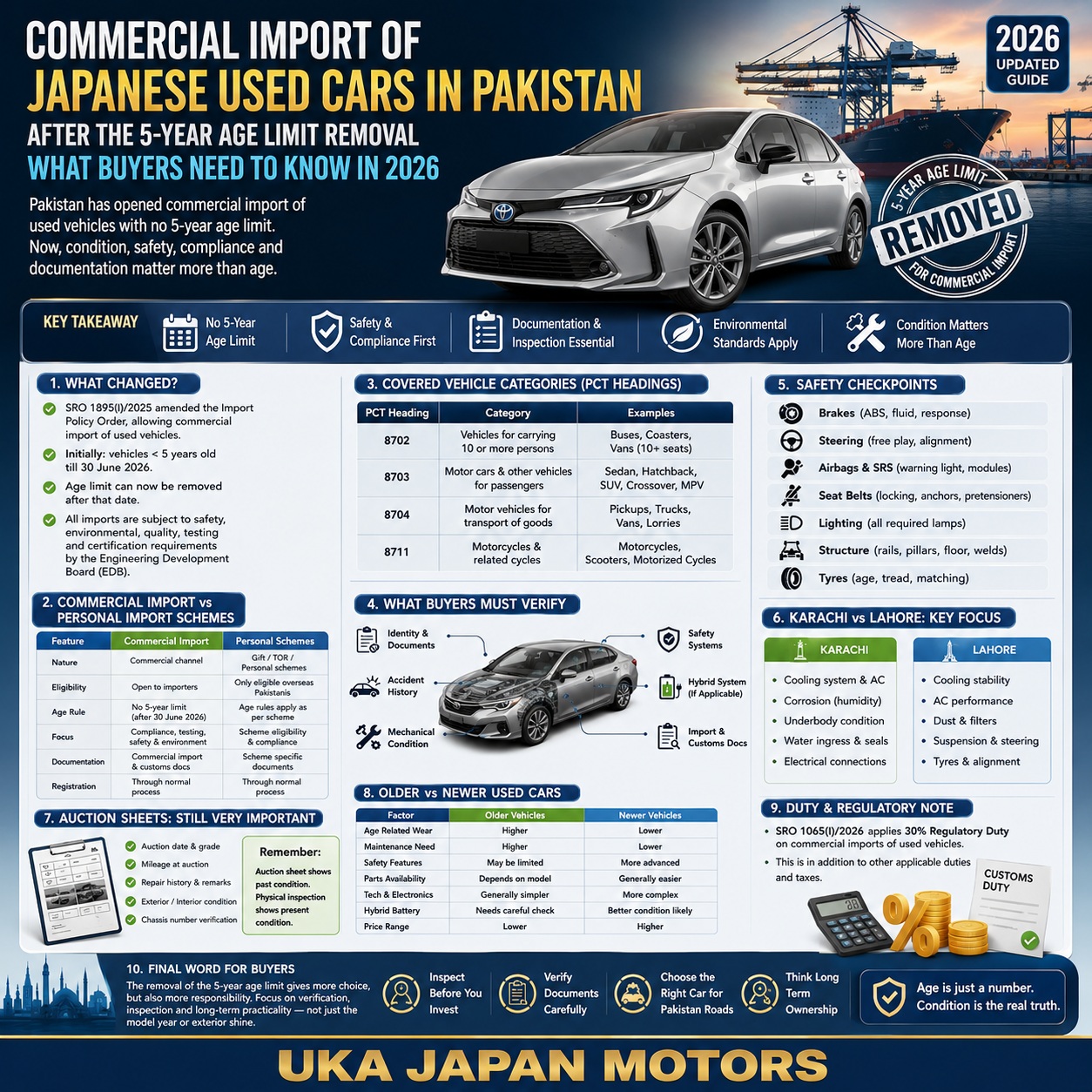
Pakistan’s rules for importing used vehicles changed significantly when commercial importation was formally opened under the Import Policy Order framework. For buyers of Japanese used cars in Karachi and Lahore, however, the most important change is not simply that another import route exists. It is the way vehicle eligibility is moving away from being determined mainly by age and toward a system in which condition, safety compliance, environmental requirements, documentation and inspection can carry much greater importance.
That distinction matters.
A vehicle being older does not automatically make it unsuitable for everyday use. Equally, a relatively recent vehicle is not automatically a good purchase. Accident repairs, corrosion, poor maintenance, altered mileage, damaged safety equipment, flood exposure, weak hybrid batteries and incomplete documentation can all affect a used vehicle regardless of its manufacturing year.
The commercial-import framework therefore needs to be understood as more than an expansion of the pool of vehicles that can enter Pakistan.
For a buyer, the practical question becomes:
Can the individual vehicle be verified well enough to justify ownership in Pakistan?
That question is particularly relevant in Karachi and Lahore, where imported vehicles encounter dense traffic, extended idling, summer heat, dust, irregular road surfaces, monsoon water and demanding daily commuting patterns.
This guide explains what changed, what the removal of the five-year commercial-import age restriction means, how commercial imports differ from overseas-Pakistani schemes, why inspection standards matter, and what buyers should verify before considering an older Japanese used vehicle.
Direct answer: The removal of the five-year age ceiling for commercial imports should not be interpreted as unrestricted entry for every old Japanese vehicle. Pakistan’s commercial-import framework links used-vehicle importation to environmental, safety, quality, testing and certification requirements. For buyers, manufacturing year should therefore be treated as only one part of the assessment. Vehicle history, structural integrity, mechanical condition, safety-system operation, documentation and compliance status are increasingly important.
How Pakistan Reached the Commercial-Import Framework
For many years, buyers commonly associated imported used vehicles with the schemes available to eligible overseas Pakistanis, particularly Transfer of Residence, Gift and Personal Baggage arrangements.
Commercial importation represents a different route.
In September 2025, the Ministry of Commerce issued SRO 1895(I)/2025, amending the Import Policy Order, 2022. The notification allowed commercial imports of used vehicles falling under PCT headings 8702, 8703, 8704 and 8711. It initially specified vehicles less than five years old until 30 June 2026, while stating that the vehicle age limit could subsequently be removed.
The same notification contained another provision that is crucial for understanding the policy correctly: commercial importation was made subject to environmental, safety and quality standards as well as testing and certification requirements prescribed by the Engineering Development Board under the Ministry of Industries and Production.
The Ministry of Commerce continues to list SRO 1895 as the notification concerning the removal of quantitative restrictions on commercial imports of used vehicles. Its current SRO listings also show a further amendment to the Import Policy Order, SRO 1207, published on 29 July 2026.
This evolving framework is why buyers should avoid reducing the entire policy to one sentence such as “old cars can now be imported.”
The more accurate interpretation is that Pakistan has opened a commercial channel for used vehicles while developing a compliance-based framework around those imports.
What Did the Five-Year Limit Actually Mean?
Under the initial commercial-import arrangement, a vehicle had to be less than five years old until 30 June 2026.
This created a straightforward eligibility boundary.
A vehicle could have excellent mechanical condition, complete history and low usage, but if it fell outside the permitted age window, age itself could prevent commercial importation under that provision.
Removing an age ceiling changes that logic.
Instead of asking only:
“How old is this car?”
the assessment increasingly needs to ask:
- Is its identity verifiable?
- Is its documented history consistent?
- Is the chassis structurally sound?
- Are its safety systems intact?
- Does it meet applicable environmental requirements?
- Can its condition be certified where required?
- Are its import and customs documents complete?
- Is its mechanical condition appropriate for continued use?
- Can it be registered correctly after clearance?
That is a substantial change in how buyers should think about Japanese used vehicles.
Age Eligibility and Vehicle Quality Are Not the Same Thing
Consider two hypothetical Japanese hatchbacks.
Vehicle A is comparatively recent but has experienced a substantial front-end collision. It has been repaired, several structural components have been replaced, and there are questions about whether its restraint systems remain original.
Vehicle B is older but has consistent documentation, a clean structural inspection, original safety equipment and evidence of proper maintenance.
A strict age-only rule may favour Vehicle A simply because it falls inside the age window.
A condition-oriented buying decision may favour Vehicle B.
This does not mean older vehicles are automatically preferable. They are not.
It demonstrates why age is a screening factor rather than a complete condition report.
Age affects rubber components, seals, suspension bushes, electronic modules, batteries, fluids and other parts. Mileage and usage history also matter. But chronological age cannot tell a buyer whether a vehicle has been crashed, flooded, neglected or incorrectly repaired.
Commercial Import Is Different From Personal Import Schemes
One of the most important points for Pakistani buyers in 2026 is that commercial import rules should not be confused with rules governing vehicles brought through overseas-Pakistani schemes.
The FBR continues to describe Personal Baggage, Gift and Transfer of Residence as specific schemes for eligible Pakistani nationals residing abroad, including dual nationals. Its published vehicle guidance describes age and eligibility conditions applying to those schemes.
Commercial importation operates under a separate policy provision.
This distinction matters because a rule changing commercial imports does not automatically rewrite every condition governing every other vehicle-import mechanism.
Commercial import versus overseas-Pakistani schemes
| Issue | Commercial Import | Gift / Transfer of Residence / Relevant Personal Schemes |
|---|---|---|
| Nature of import | Commercial channel | Eligibility-based personal schemes |
| Main policy basis | Commercial-import provision in Import Policy Order | Separate scheme procedures |
| Buyer assumption | Vehicle enters through commercial import process | Vehicle entered under eligible overseas-Pakistani arrangement |
| Compliance focus | Customs plus prescribed safety, environmental, quality, testing and certification requirements | Scheme eligibility plus applicable import and vehicle compliance requirements |
| Age rules | Governed by commercial-import policy in force at time of import | Governed separately by relevant scheme rules |
| Documentation | Commercial import and customs documentation | Scheme-specific eligibility and import documentation |
Buyers should therefore establish which route was actually used to import a vehicle rather than assuming that all imported Japanese cars follow identical rules.
Which Vehicle Categories Are Covered?
SRO 1895 identified commercial importation under PCT headings:
- 8702 – generally vehicles for transporting ten or more persons, including the driver;
- 8703 – motor cars and other vehicles principally designed for transporting persons;
- 8704 – motor vehicles for transport of goods; and
- 8711 – motorcycles and related motorised cycles.
For the typical Japanese used-car buyer in Karachi or Lahore, PCT 8703 is particularly relevant because it covers the passenger-car category in which many familiar hatchbacks, sedans, crossovers, hybrids and similar vehicles fall.
The policy is therefore broader than conventional passenger cars alone.
However, the presence of a vehicle category within the relevant PCT headings does not by itself establish that every example can be imported without further conditions.
Compliance remains essential.
The Most Important Change: Standards Become More Important
When an age restriction is relaxed or removed, it can appear that the regulatory framework has become simpler.
In reality, the opposite may occur.
If chronological age is no longer the primary barrier, authorities need other mechanisms to prevent unsafe, environmentally unsuitable or poorly documented vehicles from entering regular road use.
That is why the language surrounding environmental, safety and quality standards, testing and certification deserves more attention than the headline about age.
The Ministry of Industries and Production has stated that Pakistan is working toward applying safety and quality requirements to imported as well as locally manufactured vehicles. It has also linked vehicle regulation with the Engineering Development Board and Pakistan’s work involving UN WP.29 vehicle regulations.
For buyers, this indicates the direction of regulation:
eligibility alone is not the same as compliance.
What Safety Compliance Can Mean in Practice
Pakistan’s automotive policy work around WP.29 has addressed areas including braking, steering, tyres, lighting, seat belts, seats and head restraints, collision protection, glazing, mirrors and anti-theft requirements.
Not every technical provision should be assumed to apply identically to every imported used vehicle without checking the applicable notification and implementation framework.
But these categories illustrate why a physical vehicle inspection needs to go beyond checking whether the engine starts.
A proper assessment can include:
Braking system: Brake response, warning indicators, ABS operation where fitted, brake-fluid condition and evidence of damaged or substituted components.
Steering: Excessive free play, alignment problems, steering warning lights and signs of front structural repair.
Tyres: Age, tread, matching specifications and damage.
Lighting: Headlamps, indicators, brake lamps and other required lighting equipment.
Seat belts: Retraction, locking operation, anchor condition and evidence that pretensioners have deployed.
Airbags: Warning-light behaviour, dashboard repairs, steering-wheel replacement and evidence of bypass resistors or missing airbag modules.
Structure: Chassis rails, pillars, apron areas, floor, suspension mounting points and weld patterns.
The last two areas are especially important with accident-repaired Japanese used vehicles.
Why Airbag Inspection Matters
An airbag warning light that switches off does not prove that every airbag is present and functional.
Improperly repaired vehicles can sometimes have warning circuits manipulated after a collision. Dashboard covers may also be repaired cosmetically without restoring the original restraint system correctly.
This creates a difference between:
cosmetic appearance
and
verified safety condition.
A car may look exceptionally clean while hiding previous structural or restraint-system damage.
Buyers considering older commercial imports should therefore treat SRS and airbag inspection as a core part of pre-purchase verification.
Japanese Auction Documentation Becomes More Valuable, Not Less
An older vehicle requires more context.
If two cars have identical model years but one has clear historical records while the other has an uncertain background, the documented vehicle is easier to evaluate responsibly.
Where genuine Japanese auction information is available, it can help establish details such as:
- auction date;
- chassis identity;
- recorded mileage at auction;
- exterior observations;
- interior condition;
- repair history markings;
- panel condition;
- vehicle grade;
- inspector comments.
Auction documentation should not replace physical inspection after the vehicle reaches Pakistan.
It should be used as another verification layer.
Auction record versus physical inspection
| Auction Information | Physical Inspection in Pakistan |
|---|---|
| Historical snapshot | Present-day condition |
| Mileage recorded at a particular date | Current odometer reading and consistency |
| Previous repair markings | Quality of completed repairs |
| Exterior/interior observations | Current mechanical and structural condition |
| Chassis reference | Physical chassis verification |
| Historical grade | No guarantee of current condition |
Both forms of evidence are useful because they answer different questions.
Chassis Number Verification Is Fundamental
A Japanese used vehicle should have a clearly identifiable chassis or frame number consistent with its records.
The buyer should compare that identifier across relevant documentation and the physical vehicle.
Warning signs can include:
- unclear stamping;
- unusual grinding or welding near the identifier;
- inconsistent characters;
- documentation showing a different chassis;
- altered plates;
- incomplete records;
- model information that does not correspond with the chassis.
A vehicle can be mechanically excellent and still create serious ownership difficulties if its identity documentation is problematic.
This is why documentation inspection is not administrative paperwork separate from vehicle inspection.
It is part of determining what the vehicle actually is.
What Buyers in Karachi Should Consider
Karachi creates a demanding ownership environment for older imported vehicles.
Long periods of low-speed driving and idling increase the importance of the cooling system. High temperatures place additional demand on air-conditioning equipment, engine cooling and hybrid thermal management.
Coastal humidity also makes corrosion inspection particularly important.
Vehicles that have already developed corrosion underneath can deteriorate further if protective coatings, seams or previously repaired metal surfaces are compromised.
Karachi buyers should pay close attention to:
- radiator condition;
- coolant quality;
- cooling fans;
- air-conditioning performance;
- underbody corrosion;
- suspension wear;
- steering components;
- rubber bushes;
- door and hatch seals;
- electrical connectors;
- signs of water entry.
Heavy rainfall can also expose drainage or sealing problems that are easy to miss during dry weather.
What Buyers in Lahore Should Consider
Lahore creates a different combination of stresses.
Extended urban congestion, high summer temperatures, dusty conditions and frequent stop-start driving can expose weaknesses in cooling systems, filters, suspension and hybrid components.
A vehicle that performs normally during a short inspection may behave differently after extended operation with the air conditioning running.
Lahore buyers should therefore consider:
- cooling-system stability after extended operation;
- air-conditioning output;
- suspension noise on irregular roads;
- steering behaviour;
- engine mounts;
- dust contamination in filters;
- hybrid cooling intake cleanliness where applicable;
- battery performance;
- tyre condition and alignment.
For vehicles intended for frequent cross-city commuting, inspection should focus on how the car behaves after warming fully rather than only during a cold start.
Older Japanese Hybrids Need a Different Inspection Approach
Age-limit changes are particularly relevant to hybrid vehicles because older Japanese hybrids may become part of the commercial-import discussion.
A hybrid cannot be assessed properly using only conventional engine checks.
Its inspection should include the combustion engine and the electrical propulsion system.
Important areas include:
- high-voltage battery health;
- cell or block voltage consistency;
- battery temperature behaviour;
- hybrid cooling fan and duct cleanliness;
- inverter cooling;
- warning codes;
- regenerative braking behaviour;
- engine-to-electric transition;
- 12-volt battery condition;
- dashboard warning history where accessible.
A hybrid that drives normally for a short distance can still have battery deterioration.
Diagnostic scanning and battery data are therefore much more useful than judging condition solely from a brief drive.
Older Conventional Cars Have Their Own Advantages and Risks
A non-hybrid vehicle removes the high-voltage battery from the inspection equation, but that does not make age irrelevant.
Older petrol vehicles can require closer examination of:
- engine compression and oil consumption;
- transmission behaviour;
- cooling system;
- engine and transmission mounts;
- suspension bushes;
- steering rack;
- wheel bearings;
- catalytic and emissions systems;
- sensors;
- rubber hoses and seals;
- electrical connectors.
For long-term ownership, mechanical simplicity can sometimes make diagnosis more straightforward, but only if replacement parts and knowledgeable servicing are reasonably available in Pakistan.
Model Selection Matters More When Age Restrictions Relax
A wider range of model years can create more choice, but more choice also means more opportunities to select vehicles that are difficult to support locally.
An uncommon Japanese model may be technically impressive while creating ownership complications if:
- body panels are difficult to locate;
- electronic modules are uncommon;
- suspension components are model-specific;
- diagnostic knowledge is limited;
- hybrid components are unfamiliar;
- replacement lighting units are difficult to source.
This makes parts ecosystem and service familiarity important parts of vehicle selection.
A mechanically sound vehicle that cannot be maintained reliably is not necessarily the most practical long-term choice.
Mileage Should Be Read Together With Age
Older commercial imports may bring more variation in recorded mileage.
A low odometer reading should not automatically be considered evidence of superior condition.
Mileage should be evaluated against:
- auction documentation;
- service records where available;
- steering-wheel wear;
- seat bolster wear;
- pedal wear;
- switchgear condition;
- engine-bay condition;
- underbody condition;
- diagnostic records where available.
An older vehicle with unusually low displayed mileage deserves verification rather than automatic confidence.
Likewise, higher mileage does not automatically mean poor condition if maintenance history and inspection results remain strong.
Accident History Becomes a Major Selection Factor
As the eligible age range widens, condition variation can increase.
Japanese used vehicles can broadly include:
Unrepaired or minimally repaired vehicles: Generally easier to evaluate structurally when documentation supports their history.
Minor repaired vehicles: Panels may have been replaced or refinished without compromising the main passenger structure.
Structurally repaired vehicles: Rails, pillars, aprons, floor sections or other important structural areas may have been affected.
Heavily reconstructed vehicles: Multiple major components or structural areas may have been repaired or replaced.
These categories should not be treated as equivalent.
A repaired bumper is fundamentally different from a repaired chassis rail.
Inspection should identify where the damage occurred and what was repaired, not merely whether paintwork exists.
Flood and Water Exposure Should Also Be Checked
Water exposure can create long-term electrical problems even when the vehicle appears normal.
Inspection points include:
- corrosion under seats;
- seat-rail bolts;
- wiring connectors;
- unusual deposits inside the cabin;
- damp insulation;
- musty odour;
- inconsistent carpet condition;
- corrosion in hidden cavities;
- electrical faults affecting multiple unrelated systems.
This is particularly important because water-related electrical problems can appear intermittently.
A clean exterior cannot rule them out.
Commercial Import Does Not Remove the Need for Customs Documentation
A vehicle imported commercially must still move through Pakistan’s customs system.
The buyer should therefore distinguish between:
- vehicle condition documentation, and
- legal import and clearance documentation.
These serve different purposes.
Condition records help explain the car.
Customs and registration records establish its legal import and ownership path.
For a vehicle already cleared and offered to a buyer in Karachi or Lahore, important checks can include:
- import documentation;
- Goods Declaration information where applicable;
- chassis and model details;
- customs clearance evidence;
- importer information;
- applicable compliance or certification records;
- registration documents if already registered.
The exact document set can vary according to the import and registration stage, so buyers should verify the paperwork applicable to that particular vehicle rather than relying on a generic photocopy bundle.
Why the Goods Declaration Matters
The Goods Declaration is a key customs record because it identifies the imported goods declared for clearance.
For a vehicle, details associated with the declaration should correspond with the physical vehicle and its supporting documentation.
Discrepancies involving model, engine information, chassis identity or other significant particulars deserve investigation before purchase.
A strong inspection process therefore has two parallel tracks:
Physical vehicle verification
and
document verification.
Neither should be skipped.
Safety Standards Could Change Which Older Cars Make Sense
Removing an age ceiling does not necessarily mean that extremely old vehicles will become the most practical commercial imports.
There is an important reason.
As safety and environmental standards become more significant, some older designs may be less straightforward to certify or support than relatively modern models.
Newer generations are more likely to incorporate systems such as:
- ABS;
- electronic stability systems;
- improved restraint systems;
- more advanced emissions controls;
- improved lighting;
- stronger crash structures;
- multiple airbags;
- better onboard diagnostics.
Therefore, even without a simple five-year ceiling, the market may still naturally favour vehicles from generations that can meet applicable requirements and remain practical to maintain.
No age limit does not mean no technical threshold.
Environmental Compliance Matters in Daily Ownership
Environmental requirements should not be viewed only as an import-stage formality.
A vehicle’s emissions system can affect how well it operates over time.
Components that deserve attention include:
- catalytic converter;
- oxygen sensors;
- exhaust system;
- engine-management system;
- EGR equipment where fitted;
- hybrid control system;
- malfunction indicator lights.
Removing emissions components or suppressing warning lights may hide underlying problems.
A buyer should prefer a vehicle whose systems operate correctly rather than one modified simply to eliminate dashboard warnings.
Regulatory Duty Is Separate From Vehicle Eligibility
Another source of confusion is the difference between permission to import and the customs-duty structure applied to an import.
They are not the same issue.
FBR’s active customs notifications list SRO 1065(I)/2026, issued on 30 June 2026, specifically for regulatory duty on commercial imports of used vehicles.
That notification applies a 30 percent regulatory duty to commercial imports of used vehicles falling under the relevant PCT headings and imported under the commercial-import clause. The notification also states that this regulatory duty is additional to regulatory duty imposed under SRO 1064(I)/2026 where applicable.
For buyers, the important conceptual distinction is:
Import Policy Order → whether and under what conditions the vehicle may be imported.
Customs notifications → how applicable duties and taxes are structured.
Because UKA Japan Motors’ buyer guidance is focused on vehicle suitability, documentation and inspection rather than transaction pricing, the practical lesson is to verify that the vehicle was imported and cleared under the correct regulatory framework.
What the Change Does Not Mean
Several misunderstandings should be avoided.
It does not mean every old Japanese car is automatically acceptable
Applicable safety, environmental, quality, testing and certification conditions remain important.
It does not mean condition becomes less important
A wider age range makes condition assessment more important.
It does not automatically change every personal import scheme
Commercial importation and overseas-Pakistani schemes operate through different regulatory provisions.
It does not make Japanese auction information unnecessary
Historical documentation becomes particularly useful when comparing vehicles of different ages.
It does not eliminate customs clearance
Commercial vehicles still require correct import declarations and clearance procedures.
It does not guarantee registration
Import clearance and provincial registration are related but separate stages. Vehicle and document details must remain consistent.
A Practical Inspection Sequence for Buyers
Rather than beginning with paint shine, interior cleanliness or accessories, buyers can use a more disciplined sequence.
Stage 1: Establish identity
Verify chassis number, model code, manufacturing information and document consistency.
Stage 2: Establish history
Review available auction information, mileage records, repair markings and previous documentation.
Stage 3: Inspect structure
Check chassis rails, pillars, floor, apron areas, suspension mounting points and welding.
Stage 4: Inspect safety systems
Check SRS, airbags, seat belts, ABS and other fitted safety equipment.
Stage 5: Inspect mechanical systems
Evaluate engine, transmission, cooling, steering, suspension and brakes.
Stage 6: Inspect hybrid system where applicable
Use diagnostic data rather than visual assessment alone.
Stage 7: Check electrical equipment
Confirm warning lamps, climate control, sensors, cameras and other fitted systems.
Stage 8: Review compliance and import documents
Match the physical vehicle against its clearance and supporting records.
Stage 9: Consider long-term support
Evaluate parts availability, workshop familiarity and model complexity in Karachi or Lahore.
This sequence prevents attractive cosmetic presentation from dominating the decision before fundamental questions have been answered.
Who Could Benefit From the Wider Commercial-Import Framework?
The policy can be relevant to buyers who want a broader range of Japanese models and model years but are willing to evaluate vehicles individually.
It may particularly suit buyers who:
- prioritise documented vehicle history;
- understand that age and condition are separate factors;
- are prepared to obtain an independent inspection;
- want to compare several generations of the same model;
- understand the maintenance requirements of older vehicles;
- select models with established parts and service support in Pakistan.
When an Older Commercial Import May Not Suit a Buyer
A wider age range does not mean every buyer should choose an older vehicle.
It may not suit someone who:
- does not want age-related maintenance;
- is uncomfortable verifying import documentation;
- chooses rare models with limited local support;
- does not want to investigate hybrid battery condition;
- cannot verify accident history;
- intends to rely only on exterior appearance;
- expects chronological age alone to predict reliability.
In those situations, a newer and more straightforward vehicle with clearer history may be the more practical ownership choice.
Older Versus Newer Japanese Used Cars: What Actually Changes?
| Area | Older Used Vehicle | Relatively Newer Used Vehicle |
|---|---|---|
| Age-related rubber/seal deterioration | Requires closer attention | Generally less age exposure |
| Historical records | Particularly important | Still important |
| Accident risk | Depends on individual history | Depends on individual history |
| Hybrid battery assessment | Critical on older hybrids | Still necessary |
| Parts support | Must be checked by generation | Often easier for established models |
| Electronics | May be simpler on some models | Often more complex |
| Safety equipment | Depends on generation and specification | Typically broader on newer generations |
| Condition variability | Can be substantial | Can also vary significantly |
| Inspection need | Essential | Essential |
The most important point in the table is that inspection remains essential in both columns.
Ownership After Import: Think Beyond Clearance Day
Import eligibility is only the beginning of ownership.
A Japanese used vehicle operating daily in Pakistan must continue to deal with heat, traffic, dust, road impacts and maintenance practices.
For an older imported vehicle, a sensible post-purchase baseline can include inspection of:
- engine oil and filters;
- coolant;
- brake fluid;
- transmission fluid where service is appropriate;
- belts and hoses;
- tyres;
- suspension;
- battery;
- hybrid cooling components;
- air-conditioning;
- underbody;
- brake components.
The objective is to establish a known maintenance starting point rather than assuming every previous service item is current.
Why Karachi and Lahore Buyers Should Avoid Buying by Model Year Alone
Two vehicles manufactured in the same year can have completely different ownership prospects.
One may have:
- verified history;
- original structural condition;
- consistent mileage;
- maintained cooling system;
- functioning safety equipment.
Another may have:
- major collision repairs;
- unclear mileage;
- weak cooling performance;
- missing restraint components;
- incomplete documentation.
The model year printed on both documents does not reveal these differences.
That is why the five-year-limit discussion should ultimately change how buyers inspect, not merely which manufacturing years they search for.
Frequently Asked Questions
1. Can commercially imported Japanese used cars now be older than five years?
Pakistan’s commercial-import framework was initially introduced for vehicles less than five years old until 30 June 2026, with the policy providing for subsequent removal of the age restriction. Buyers should verify the latest operative Import Policy Order amendment for the vehicle’s import date because the framework continues to be updated. The key point is that commercial importation remains tied to prescribed safety, environmental, quality, testing and certification requirements.
2. Does removing the age restriction mean any old car can be imported?
No. Removing a numerical age ceiling should not be confused with removing technical and regulatory requirements. Vehicle category, condition, compliance, testing, certification and documentation remain relevant.
3. Is commercial import the same as the Gift Scheme?
No. Commercial importation is a separate import route. Gift and Transfer of Residence arrangements operate under their own eligibility and procedural rules.
4. Do personal import age rules disappear because the commercial age limit changes?
Not automatically. Rules applying to one import route should not be assumed to alter another. Buyers should check the scheme under which the individual vehicle was imported.
5. Are Japanese auction sheets still useful for older commercial imports?
Yes. Genuine historical auction information can be especially useful for older vehicles because it may provide a reference point for mileage, condition and repair history. It should still be combined with a physical inspection in Pakistan.
6. Is an older Japanese hybrid a risky purchase?
Age alone does not determine whether a hybrid is suitable. The high-voltage battery, cooling system, inverter, diagnostic codes and general mechanical condition should be tested. A properly evaluated older hybrid can be assessed much more reliably than one purchased only on exterior appearance.
7. What is more important: mileage or manufacturing year?
Neither should be considered alone. Age, mileage, maintenance, structural history and usage conditions interact. A vehicle with higher verified mileage and consistent maintenance can differ significantly from a lower-mileage vehicle with uncertain history.
8. Should buyers worry about accident-repaired cars?
Yes, particularly when repairs involve structural areas or restraint systems. Minor cosmetic repair is different from chassis, pillar or rail repair. The location and quality of the repair matter more than the simple statement that a vehicle has been “repaired.”
9. What documents should a buyer check?
Buyers should verify the physical chassis against import and customs documentation, review the applicable Goods Declaration and clearance records, inspect available historical documentation and confirm registration records where the vehicle has already been registered.
10. Can a customs-cleared vehicle still have condition problems?
Yes. Customs clearance and mechanical condition answer different questions. A vehicle may be legally cleared but still require structural, mechanical, hybrid or safety-system inspection.
11. What should Karachi buyers check most carefully?
Cooling performance, air conditioning, corrosion, suspension, water ingress, electrical connections and general underbody condition deserve particular attention because of Karachi’s heat, humidity, traffic and seasonal rain.
12. What should Lahore buyers check most carefully?
Cooling-system stability, air-conditioning performance, suspension, dust-related filter condition, steering, tyres and hybrid cooling components are particularly relevant to Lahore’s heat, dust and heavy stop-start traffic.
13. Does a clean dashboard mean the airbags are functioning?
Not necessarily. Warning systems can sometimes be altered after repairs. Airbag modules, seat-belt pretensioners and associated systems should be physically and electronically inspected where possible.
14. Are very old Japanese cars automatically a good choice once the age ceiling is removed?
No. Older vehicles may require more maintenance, may use outdated safety technology or may have limited parts availability. Buyers should select according to verified condition and long-term practicality rather than age eligibility alone.
UKA Japan Motors’ Role: Verification Before Selection
UKA Japan Motors approaches Japanese used vehicles from an inspection and documentation perspective.
The role is not to suggest that a vehicle is suitable merely because regulations allow it to enter Pakistan.
Commercial-import liberalisation makes transparent assessment even more important because buyers may encounter a wider range of manufacturing years, specifications and vehicle histories.
A responsible evaluation should therefore connect four areas:
Identity: Is the chassis and model information consistent?
History: What can available documentation establish about mileage and previous condition?
Physical condition: What does inspection show about the structure, mechanical systems, safety equipment and hybrid components?
Pakistan ownership suitability: Can the vehicle be maintained properly under regular driving conditions in Karachi or Lahore?
When these areas are considered together, buyers have a stronger basis for evaluating a Japanese used vehicle than they would from model year, exterior appearance or odometer reading alone.
Conclusion
The removal of a five-year ceiling from Pakistan’s commercial used-vehicle framework represents an important change, but its significance should be understood correctly.
The change is not simply about allowing older cars.
It reflects a broader move toward a commercial-import system in which technical standards, safety, environmental compliance, testing, certification and documentation can determine whether a vehicle is suitable for entry and continued ownership.
For buyers in Karachi and Lahore, that shifts attention toward the individual vehicle.
An older Japanese used car with verifiable history, sound structure, functioning safety equipment, correct documentation and appropriate mechanical condition may deserve consideration. A newer vehicle with uncertain mileage, serious accident repair, missing safety components or inconsistent paperwork should not receive automatic confidence simply because of its manufacturing year.
As the commercial-import framework develops through 2026, buyers should also distinguish commercial import rules from Gift, Transfer of Residence and other personal import arrangements, and should check the operative regulatory requirements applicable on the vehicle’s actual import date.
The practical principle is simple:
Age tells you when a vehicle was built. Inspection and documentation tell you what you are actually buying.
Contact UKA Japan Motors for availability and inspection guidance.