


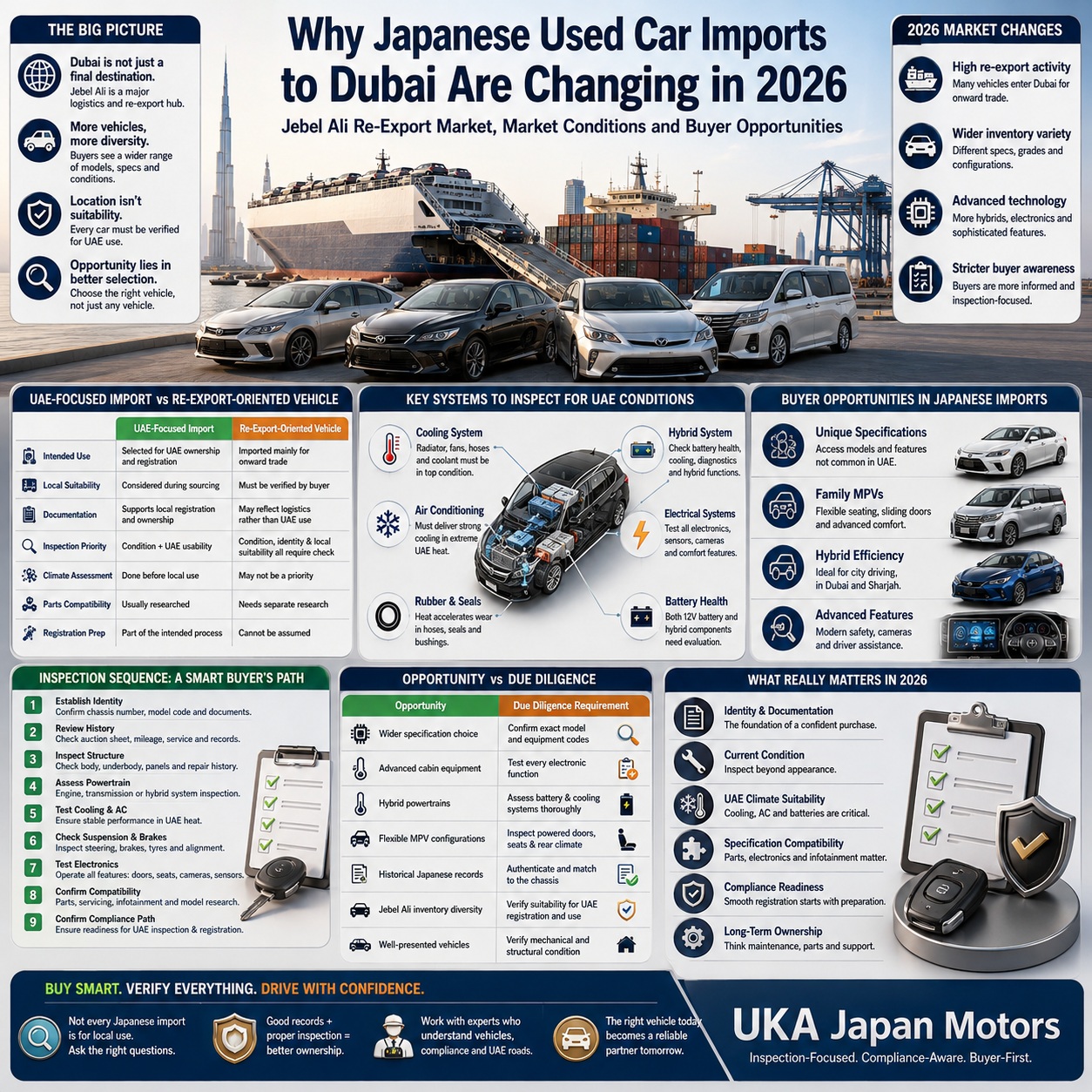
Dubai’s relationship with Japanese used vehicles is broader than the simple movement of cars from an overseas auction to a local showroom. In 2026, the market is increasingly shaped by what happens after a vehicle reaches the UAE: whether it is intended for registration and long-term use in Dubai, stored or traded through the Jebel Ali automotive ecosystem, prepared for re-export, or selected because its specification and condition make it suitable for UAE ownership.
That distinction matters.
Jebel Ali gives Dubai an important logistics advantage, but a major vehicle trading and re-export hub also creates a market in which cars with very different histories, specifications and intended destinations can appear alongside one another.
For UAE buyers, therefore, the important question is no longer simply:
“Is this a Japanese used car?”
The more useful questions are:
Why was this particular vehicle imported, what was its condition before shipment, what documentation follows it, does its specification suit UAE use, and can its identity and history be verified consistently from source to registration?
These questions are becoming increasingly important in 2026.
The opportunity for buyers remains significant. Japanese-market vehicles can offer unusual specifications, well-documented histories and access to models or configurations that deserve consideration in the UAE. But the strongest opportunity belongs to buyers who understand the difference between availability and suitability.
This guide explains how the changing Jebel Ali re-export environment affects Japanese used cars in Dubai, what buyers should inspect, where the practical opportunities are, and which risks deserve more attention before a vehicle becomes part of everyday UAE life.
Direct Answer
Japanese used car imports to Dubai are changing in 2026 because the market increasingly operates as both a UAE vehicle market and a major re-export and logistics ecosystem. That means a Japanese vehicle arriving through Jebel Ali should not automatically be assumed to have been selected specifically for Dubai registration or UAE driving conditions.
Buyers should distinguish between vehicles imported for local use and those moving through the re-export trade. The most important factors are verifiable vehicle identity, original condition information, specification, documentation, inspection results, cooling-system health, air-conditioning performance, parts compatibility and suitability for sustained UAE operation.
The buyer opportunity is therefore not simply access to more imported vehicles. It is the ability to identify the right vehicles within a highly diverse import market.
Dubai Is More Than the Final Destination
One of the easiest ways to misunderstand Dubai’s imported-car market is to assume that every vehicle entering the emirate is entering because someone intends to register and drive it here.
Jebel Ali changes that assumption.
Dubai functions as a logistics, storage, trading and redistribution centre as well as a local automotive market. Vehicles can enter the UAE under different commercial circumstances, and their presence in Dubai does not by itself establish their intended long-term destination.
This creates two overlapping markets.
The first is the local-use market. These are vehicles being considered for registration and operation in Dubai, Abu Dhabi, Sharjah, Ajman, Ras Al Khaimah, Umm Al Quwain or Fujairah.
The second is the re-export-oriented market, where vehicles may pass through Dubai as part of a wider trading process.
The distinction has practical consequences.
A vehicle selected specifically for UAE ownership should ideally have been evaluated with local registration requirements, climate, parts support, operating conditions and long-term usability in mind.
A vehicle intended primarily for onward movement may have been selected according to a different set of criteria.
That does not automatically make one good and the other bad. It simply means that location is not proof of suitability.
A car sitting in Dubai is not necessarily a car that was originally sourced for Dubai.
Why 2026 Feels Different for Japanese Used-Car Buyers
The Japanese used-car sector has always rewarded careful inspection, but the need for verification becomes greater as the import ecosystem becomes more diverse.
Buyers now encounter vehicles through specialist importers, established automotive traders, multi-brand dealers, independent sellers and vehicles that have moved through commercial inventory before reaching the person considering registration.
The result is a wider range of possibilities.
A buyer might encounter a conventional Japanese sedan with straightforward specifications, a hybrid with detailed Japanese service information, a high-specification MPV uncommon in typical UAE configurations, a compact model developed primarily for dense urban environments, or a technically sophisticated vehicle whose electronic and infotainment systems require closer evaluation.
This diversity is useful, but it changes the buying process.
The model badge alone cannot answer enough questions.
Two apparently identical Japanese imports may differ in:
- Production specification
- Factory options
- Safety equipment
- Powertrain configuration
- Hybrid battery condition
- Wheel and tyre specification
- Infotainment functionality
- Previous repair history
- Auction or inspection records
- Underbody condition
- Cooling-system health
- Air-conditioning performance
- Documentation completeness
- Suitability for UAE registration and daily operation
In other words, the market is becoming more vehicle-specific.
Jebel Ali’s Role in the Japanese Vehicle Ecosystem
Jebel Ali is central to understanding why imported vehicles are so visible in Dubai.
Its significance is not limited to unloading cars. The surrounding ecosystem supports vehicle logistics, storage, movement, inspection preparation, trading and re-export activity.
For the buyer, however, the important point is not the scale of the port. It is what that scale does to the composition of the local vehicle supply.
A major trading hub naturally attracts varied inventory.
Some vehicles may be highly appropriate for UAE ownership. Others may be specialised versions requiring additional research. Some may have complete supporting records. Others may require more effort to establish their condition and background.
This makes provenance especially important.
The Vehicle’s Journey Matters
Consider two vehicles of the same Japanese model and production year.
Vehicle A was selected after reviewing its original condition information, exported with supporting documentation, inspected after arrival and prepared specifically for UAE registration and operation.
Vehicle B entered a broader trading stream, passed through storage or multiple commercial hands, and is now available locally with limited supporting history.
From a distance, both cars may appear similar.
From an ownership perspective, they are not equivalent.
The difference is not simply cosmetic condition. It is the quality of the information surrounding the vehicle.
For a used-car buyer, information is part of condition.
Re-Export Vehicle Versus UAE-Focused Import
Understanding this distinction is one of the most useful skills for a Dubai buyer.
| Area | UAE-Focused Japanese Import | Re-Export-Oriented Vehicle |
|---|---|---|
| Intended use | Selected with UAE ownership in mind | May have been acquired primarily for onward trade |
| Local suitability | Usually considered during sourcing | Must be independently established |
| Documentation | Ideally organised around verification and registration | Documentation may reflect logistics rather than local ownership needs |
| Inspection priority | Condition plus UAE usability | Condition, identity and local suitability all require confirmation |
| Climate assessment | Important before local use | May not have been a sourcing priority |
| Parts compatibility | Usually considered for long-term ownership | Requires separate research |
| Registration preparation | Part of the intended process | Cannot be assumed |
| Buyer approach | Verify the sourcing and inspection process | Treat local suitability as an unanswered question |
This is not a quality ranking.
A re-export-oriented vehicle can still be suitable for use in the UAE. Equally, a vehicle described as locally intended should never be accepted without inspection.
The distinction simply tells the buyer which questions still need answers.
The UAE Climate Changes the Meaning of “Good Condition”
A Japanese vehicle can be mechanically healthy when inspected and still require careful evaluation for long-term UAE use.
The UAE operating environment places sustained demands on several vehicle systems.
Cooling System
Engine cooling deserves particular attention.
Radiators, coolant hoses, expansion tanks, thermostats, electric cooling fans, water pumps and related components should be assessed as a system rather than individually.
A marginal cooling component may be difficult to notice during a brief inspection in moderate conditions. Continuous operation in UAE heat can expose weaknesses more quickly.
Any imported vehicle intended for daily use in Dubai should therefore be evaluated for stable cooling performance rather than simply the absence of an overheating warning.
Air Conditioning
Air conditioning in the UAE is a core operating system, not a convenience feature.
A system that produces cool air during a short test is not necessarily performing correctly.
Inspection should consider:
- Cooling effectiveness after the cabin has absorbed heat
- Compressor behaviour
- Blower operation
- Vent temperature consistency
- Condenser condition
- Cooling fan performance
- Unusual compressor noise
- Climate-control electronics
- Rear-zone cooling where fitted
This becomes especially important with large Japanese MPVs and vehicles equipped with multi-zone climate systems.
Rubber Components and Seals
Heat can accelerate deterioration in rubber and plastic components.
Door seals, suspension bushes, engine mounts, coolant hoses, wiper components and exterior trim deserve attention when assessing an imported vehicle for long-term use.
Battery and Electrical Load
Conventional 12-volt batteries face demanding conditions in the UAE, while modern vehicles also carry increasingly complex electronic loads.
Japanese imports with powered doors, multiple cameras, electric seats, advanced driver-assistance equipment, entertainment systems and extensive cabin electronics should be tested comprehensively.
A feature being present is not the same as a feature operating correctly.
Hybrid Imports Require a Different Inspection Mindset
Japanese hybrid vehicles are an increasingly important part of the imported-car discussion.
Their appeal in UAE urban driving is understandable. Dubai and Sharjah driving can involve repeated changes in speed, junctions, queues and periods of lower-speed operation, conditions in which hybrid powertrains can behave differently from conventional petrol-only systems.
But a used hybrid cannot be evaluated only through a conventional engine inspection.
Hybrid Battery Condition
The battery pack should be assessed using appropriate diagnostic information where possible.
A warning light being absent does not establish battery health.
Technicians should consider indicators such as:
- Battery state consistency
- Diagnostic trouble codes
- Module behaviour where accessible
- Cooling-system operation
- Battery temperature information
- Abnormal charge and discharge patterns
Battery Cooling
Hybrid battery cooling deserves particular attention in a hot environment.
Depending on the model, the battery may use cabin air or dedicated ducting for temperature management. Blocked vents, contaminated fans or poor airflow can affect operation.
This is particularly relevant for vehicles that have accumulated dust or have interiors where cooling inlets have not been maintained properly.
Conventional Systems Still Matter
A hybrid remains a complete vehicle.
Engine oil condition, coolant, air conditioning, suspension, tyres, brakes, steering and 12-volt electrical health still require normal inspection.
The presence of hybrid technology should expand the inspection rather than replace conventional checks.
Japanese Specifications Can Create Genuine Buyer Opportunities
The changing import environment is not only about risk.
One reason Japanese used vehicles attract attention in Dubai is specification diversity.
Certain Japanese-market vehicles can have combinations of equipment, interior layouts, powertrains and body configurations that are less common in mainstream UAE inventory.
This can create useful opportunities for buyers with specific requirements.
Family MPVs
Japanese MPVs can be particularly interesting for UAE families.
Depending on model and configuration, features may include:
- Flexible multi-row seating
- Power sliding doors
- Rear climate controls
- Multiple seating arrangements
- Extensive storage
- Powered tailgates
- Driver-assistance technology
- High levels of cabin equipment
For households regularly moving children or extended family around Dubai, Sharjah or Abu Dhabi, these features can have genuine daily value.
But MPVs also illustrate why inspection matters. Powered doors, electric seats, rear air-conditioning, cameras and other convenience systems create more components that must be checked.
Urban Hybrids
Hybrid hatchbacks, sedans and crossovers can suit buyers whose driving is concentrated around urban UAE environments.
The relevant question is not whether hybrid technology is universally better. It is whether the particular powertrain matches the owner’s driving pattern and whether the battery and associated systems are healthy.
Unusual Model Variants
Japan-market trim levels can differ substantially from versions commonly encountered in UAE showrooms.
That can mean additional equipment, but it can also introduce compatibility questions.
A sophisticated feature is only useful if it operates correctly and can be supported during ownership.
Specification Is More Important Than the Equipment List
Imported vehicles are often discussed in terms of features.
That can distract from more important issues.
A long equipment list should never substitute for specification research.
Before committing to a Japanese import, buyers should establish exactly what version they are looking at.
That means confirming the model code, engine or hybrid configuration, drivetrain and relevant factory specification.
Why?
Because parts ordering is often based on precise identifiers rather than the general model name.
A component that fits one version may not fit another. Filters, suspension components, sensors, brake parts, lighting assemblies, electronic modules and body components can vary.
The more unusual the specification, the more valuable this research becomes.
Infotainment Can Be a Hidden Compatibility Issue
Japanese-market vehicles can retain factory infotainment designed around their original domestic environment.
The result can range from a minor inconvenience to a significant usability issue depending on the system.
Buyers should test:
- Menu language options
- Radio functionality
- Bluetooth pairing
- Smartphone connectivity
- Navigation behaviour
- Reversing camera
- Surround-view cameras
- Steering-wheel controls
- Audio functions
- Rear entertainment
- Vehicle-setting menus
Do not assume that replacing the main display resolves every compatibility issue.
In some vehicles, the infotainment unit interacts with cameras, vehicle settings, audio amplifiers, climate displays or other electronic modules.
Modifications should therefore be considered in the context of the entire system.
Inspection Records Are Valuable — but They Are Not the Final Inspection
Japanese vehicles may arrive with auction-related or other historical condition documentation.
When authentic and correctly matched to the vehicle, these records can be extremely useful.
They may help establish what was known about the car before export.
But historical information should not replace a UAE inspection.
A vehicle can change between its original inspection and the day a Dubai buyer considers taking ownership.
Transportation, storage, handling, maintenance work and repairs can all occur after the original record was produced.
The strongest approach is therefore to use historical documentation and current inspection together.
What Should Be Cross-Checked?
Where supporting records exist, compare them with the physical vehicle.
Check:
- Chassis or vehicle identification information
- Model code
- Recorded mileage
- Exterior panel observations
- Interior condition
- Repair indications
- Equipment
- Any noted defects
- Current odometer reading
If the physical vehicle and documentation tell different stories, the discrepancy deserves investigation.
Why Chassis Verification Is Fundamental
Vehicle identity should be established before detailed discussion of features.
The identifying information on the vehicle must correspond consistently with the documentation presented for it.
This sounds basic, but it is foundational.
Without a reliable identity chain, historical records lose much of their value because the buyer cannot confidently establish that those records belong to the vehicle being inspected.
A careful process therefore starts with:
vehicle → identifier → documents → history → current inspection
rather than:
appearance → features → decision
That change in sequence can prevent many avoidable mistakes.
Accident and Repair History Needs Physical Verification
Used vehicles can have previous body repairs without automatically being unsuitable.
What matters is the nature and quality of the work.
Cosmetic paintwork is different from significant structural repair.
Inspection may include:
- Panel alignment
- Paint consistency
- Weld areas
- Structural mounting points
- Underbody sections
- Chassis rails where accessible
- Door apertures
- Boot floor
- Engine-bay structure
- Signs of replacement panels
The buyer should be particularly cautious when documentation, physical condition and seller explanations do not align.
Consistency builds confidence.
Contradictions require investigation.
Underbody Condition Should Not Be Ignored
Dubai buyers often focus on exterior paint, cabin cleanliness and equipment because these are immediately visible.
The underside can reveal a different story.
A proper inspection should examine the underbody for previous impact, repair work, fluid leaks, damaged protective panels and unusual corrosion.
The UAE itself has a dry climate, but an imported vehicle’s condition was formed before it reached Dubai.
That means current local weather cannot explain the vehicle’s entire history.
Underbody inspection is especially useful when evaluating a vehicle whose earlier operating conditions are not completely documented.
Compliance Is Part of Vehicle Selection, Not an Afterthought
A vehicle can be mechanically impressive and still be a poor choice if its documentation or specification creates difficulties during the local compliance and registration process.
Buyers should therefore consider UAE requirements before treating an imported vehicle as a viable ownership candidate.
The exact process can depend on the vehicle, its import status and the emirate in which registration is being completed.
The principle, however, is straightforward:
Do not separate purchasing decisions from compliance decisions.
Vehicle identity, import documentation, inspection status and registration suitability should be understood as part of one process.
For unusual Japanese-market models, this becomes even more important.
A rare configuration may be attractive, but rarity increases the need to verify the details before proceeding.
The Biggest 2026 Opportunity: Better Selection, Not Simply More Choice
A large import ecosystem gives buyers choice.
Choice becomes valuable only when buyers know how to filter it.
The most important opportunity in Dubai’s changing Japanese used-car sector is therefore selectivity.
Instead of starting with a model name and accepting whichever example is available, buyers can evaluate individual vehicles according to:
- Verifiable identity
- Documented history
- Current mechanical condition
- UAE climate suitability
- Specification compatibility
- Parts and servicing practicality
- Inspection and registration readiness
- Intended long-term use
This is a stronger framework than choosing according to cosmetic appearance or equipment alone.
Who Can Benefit Most From Japanese Imports?
Japanese imports can make sense for several types of UAE motorists.
Buyers Seeking Specific Configurations
Some buyers know exactly what seating arrangement, drivetrain, equipment package or body configuration they require.
For them, the wider Japanese import ecosystem can expand the range of suitable vehicles.
Families Needing Flexible Cabin Space
Large MPVs and practical multi-seat vehicles can suit family use in Dubai, Abu Dhabi and Sharjah.
Sliding doors, flexible seating and strong rear-cabin climate performance can be particularly useful, provided all systems are inspected carefully.
Drivers Comfortable With Technical Due Diligence
Japanese imports tend to reward buyers willing to investigate model codes, specifications, records and mechanical condition.
The more informed the buyer, the more useful the diversity of the market becomes.
Buyers Planning Longer-Term Ownership
For long-term ownership, condition and supportability matter greatly.
A carefully selected import with a clear identity, documented history and maintainable specification can be considered on its individual merits rather than merely its origin.
When a Japanese Import May Not Be Suitable
Not every driver benefits from an imported Japanese-market vehicle.
A vehicle may be unsuitable when its exact specification cannot be established, when documentation is incomplete, or when important systems cannot be verified.
It may also be less appropriate for an owner who wants maximum simplicity in parts identification and electronic compatibility.
Highly specialised configurations require more homework.
Likewise, a vehicle with sophisticated equipment but questionable electronic condition can create unnecessary complexity.
A good rule is:
The more unusual the vehicle, the stronger the documentation and inspection process should be.
Buyer Opportunity Versus Buyer Risk
| Potential Opportunity | Corresponding Due-Diligence Requirement |
|---|---|
| Wider specification choice | Confirm exact model and equipment codes |
| Advanced cabin equipment | Test every electronic function |
| Hybrid powertrains | Assess hybrid battery and cooling systems |
| Flexible MPV configurations | Inspect powered doors, seating and rear climate systems |
| Historical Japanese records | Authenticate and match them to the chassis |
| Unusual models | Research parts and service compatibility |
| Jebel Ali inventory diversity | Determine whether the vehicle suits UAE registration and use |
| Well-presented imported vehicles | Verify mechanical and structural condition independently |
The table highlights a recurring principle:
Almost every advantage has a corresponding verification requirement.
That does not reduce the value of Japanese imports. It explains how to approach them responsibly.
A Practical Inspection Sequence for Dubai Buyers
A structured process prevents attractive features from distracting from fundamental questions.
Stage 1: Establish Identity
Confirm the vehicle identification details, model code and supporting documents.
Stage 2: Review Available History
Study auction information, inspection documentation, maintenance information and mileage records where available.
Stage 3: Inspect Structure and Body
Look for evidence of significant repairs, inconsistent panel work and underbody issues.
Stage 4: Assess the Powertrain
Inspect engine, transmission or hybrid systems according to the vehicle type.
Stage 5: Test Cooling and Air Conditioning
These systems deserve specific attention because of UAE operating conditions.
Stage 6: Inspect Suspension, Steering, Brakes and Tyres
The vehicle must be assessed as a road-going machine, not merely an imported asset.
Stage 7: Test Electronics
Operate every major feature, especially powered doors, cameras, climate controls, seats, sensors and driver-assistance systems.
Stage 8: Confirm Local Compatibility
Research parts identification, servicing requirements, infotainment limitations and any model-specific considerations.
Stage 9: Confirm Compliance Path
Ensure documentation and vehicle condition are appropriate for the relevant UAE inspection and registration process.
This sequence keeps the decision evidence-based.
Long-Term Ownership Matters More Than Arrival Condition
Import discussions often concentrate on the moment the vehicle reaches Dubai.
Owners live with the vehicle for years, not for the duration of the import process.
That makes long-term considerations equally important.
Maintenance Knowledge
Ask whether technicians familiar with the specific engine, transmission, hybrid system and electronics are reasonably accessible within the UAE.
Parts Identification
Confirm that routine and model-specific components can be identified accurately.
Diagnostic Access
Modern vehicles depend heavily on electronic diagnostics. Unusual Japanese-market systems may require suitable diagnostic capability.
Climate Durability
Cooling, air-conditioning and battery systems should remain priorities throughout ownership.
Documentation Retention
Keep import records, inspection reports, service information and relevant Japanese documentation with the vehicle.
A well-documented vehicle remains easier to understand throughout its life.
What Is Actually Changing for the Dubai Buyer?
The change is not that Japanese vehicles have suddenly become fundamentally different.
The change is the environment around them.
Dubai’s automotive ecosystem gives buyers access to a broad flow of vehicles, while increasingly complex powertrains, electronics and specifications make simplistic buying rules less reliable.
Older advice might have focused heavily on brand reputation or general assumptions about Japanese vehicle condition.
In 2026, that is insufficient.
The stronger approach is individual verification.
A Toyota badge cannot verify a battery.
A Nissan badge cannot verify structural condition.
A Honda badge cannot verify documentation.
A Japanese auction record cannot verify what happened after export.
And the fact that a vehicle is physically located in Dubai cannot prove that it was selected for UAE ownership.
Each layer requires its own evidence.
How UKA Japan Motors Approaches Japanese Imports
UKA Japan Motors’ role is centred on helping buyers understand the vehicle in front of them rather than relying on broad assumptions about imported cars.
That means focusing on areas such as vehicle identity, available condition records, specification, inspection findings, documentation and UAE suitability.
The aim is not to suggest that every Japanese import is appropriate for every buyer.
Some vehicles are straightforward candidates for UAE ownership. Others require additional technical research. Certain specialised models may suit experienced owners better than buyers seeking a simple ownership experience.
Transparency is particularly important in a market connected to a large re-export ecosystem.
A vehicle should be understood according to its own history and condition.
Where records are available, they should be checked against the actual vehicle. Where technical systems require specialist assessment, those systems should be inspected rather than assumed to be healthy. Where local compliance questions exist, they should be addressed before the vehicle becomes an ownership decision.
That inspection-focused approach is more useful than treating “Japanese import” as a quality category on its own.
Frequently Asked Questions
1. Why are Japanese used car imports important to Dubai in 2026?
Dubai combines substantial local vehicle demand with the Jebel Ali logistics and re-export ecosystem. This creates access to a diverse range of Japanese vehicles, specifications and powertrains. For buyers, that diversity makes vehicle-specific inspection and documentation increasingly important.
2. Does a vehicle arriving through Jebel Ali automatically qualify for use in Dubai?
No. Arrival through Jebel Ali and suitability for local registration are different matters. The vehicle’s documentation, identity, condition and relevant UAE inspection and registration requirements still need to be addressed.
3. Are Japanese auction records enough to confirm a car’s current condition?
No. Authentic historical records can provide valuable information about the vehicle at an earlier stage, but they should be combined with a current physical and diagnostic inspection in the UAE.
4. How can a buyer tell whether a vehicle was originally intended for re-export?
There is no single visual test. The vehicle’s documentation, commercial history where available, current registration status, specification and the seller’s supporting information should be reviewed. More importantly, buyers should independently establish UAE suitability regardless of the vehicle’s original trading purpose.
5. Are Japanese hybrid imports suitable for Dubai?
They can be, depending on the model, condition and intended use. Hybrid battery health, battery cooling, engine cooling, air conditioning and diagnostic condition deserve careful inspection before long-term UAE operation.
6. What should be inspected because of Dubai’s climate?
Engine cooling, air-conditioning performance, batteries, hoses, rubber components and electrically operated systems deserve particular attention. Hybrid vehicles also require assessment of their high-voltage battery and associated thermal-management systems.
7. Can Japanese infotainment systems work normally in the UAE?
Functionality varies by vehicle. Language settings, radio operation, navigation, smartphone integration, cameras and connected vehicle settings should all be tested individually. Replacing a display may affect other integrated systems, so modifications require careful planning.
8. Are Japanese-market MPVs practical for UAE families?
Many can be highly practical because of flexible seating, sliding doors, rear climate systems and cabin equipment. However, buyers should inspect powered doors, seat mechanisms, rear air conditioning, cameras and electronics before deciding whether a particular vehicle is suitable.
9. Why is the exact model code important?
Model codes can help distinguish powertrains, drivetrains, trim configurations and technical variations within what appears to be the same model family. Accurate identification also helps when researching parts and servicing requirements.
10. Should a clean-looking imported car still receive an underbody inspection?
Yes. Exterior presentation does not establish structural or mechanical condition. The underbody may reveal previous impact, repairs, leaks, damaged components or other evidence relevant to the vehicle’s history.
11. Is every Japanese import difficult to maintain in the UAE?
No. Maintenance practicality depends on the specific vehicle and configuration. Common mechanical systems may be straightforward to support, while unusual engines, electronic modules, body components or Japan-specific equipment can require additional research.
12. What is the most important question to ask before choosing a Japanese import in Dubai?
Ask whether the complete story of the vehicle can be verified. That includes identity, history, specification, current condition, UAE suitability and compliance readiness. A vehicle with clear answers across those areas is easier to evaluate than one supported mainly by appearance or general claims.
Conclusion
Japanese used car imports remain an important part of Dubai’s automotive landscape in 2026, but understanding the market requires separating two ideas that are often treated as the same thing: a vehicle being present in Dubai and a vehicle being suitable for Dubai.
Jebel Ali’s position as a major automotive logistics and re-export centre gives the emirate access to unusually diverse vehicle inventory. That diversity can benefit buyers seeking specific Japanese models, hybrid powertrains, family MPVs or less common equipment configurations.
It also increases the importance of due diligence.
The strongest buying process begins with identity and documentation, moves through structural and mechanical inspection, examines cooling and air-conditioning performance for UAE conditions, tests electronic systems, confirms specification and parts compatibility, and addresses inspection and registration requirements before the vehicle is treated as a long-term ownership candidate.
In 2026, the opportunity is not simply finding a Japanese used vehicle.
It is being able to distinguish a well-documented, technically suitable and compliance-ready vehicle from one that happens to be available within a large trading ecosystem.
For Dubai buyers, that distinction is what turns market choice into informed vehicle selection.
Contact UKA Japan Motors for availability and inspection guidance.