


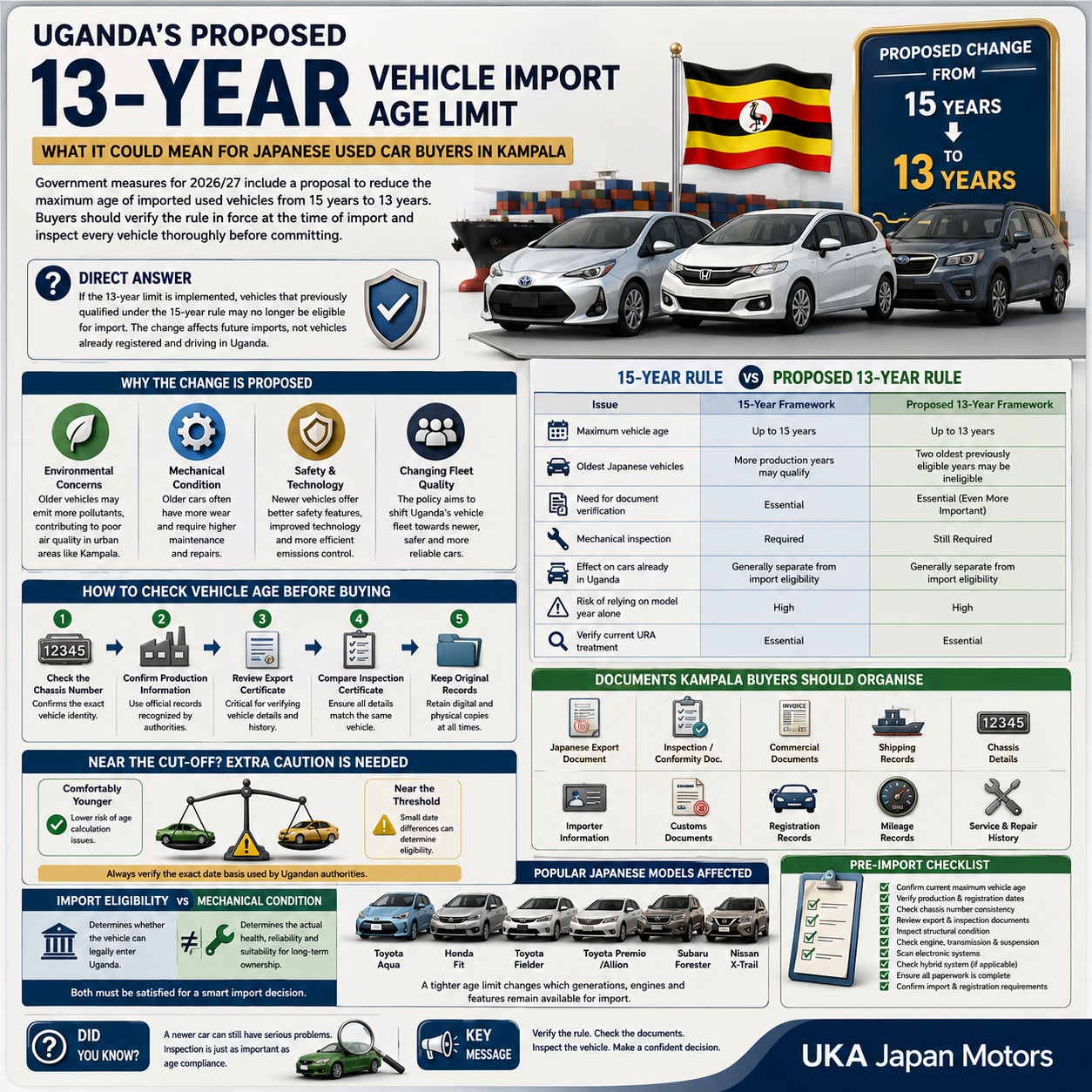
For Kampala buyers considering a used vehicle from Japan, the model, mileage and mechanical condition are only part of the decision. The vehicle must also fall within Uganda’s import rules at the time it is brought into the country.
That makes the proposed reduction of Uganda’s maximum imported-vehicle age from 15 years to 13 years particularly important.
Government measures discussed for the 2026/27 financial year have included reducing the allowable age of imported used vehicles from 15 years to 13 years, alongside broader measures aimed at reducing the entry of older vehicles. Reporting on the proposal has connected it with environmental concerns, maintenance issues and changes in Uganda’s vehicle fleet.
However, buyers should pay close attention to one word: proposed.
A policy announcement, budget measure or government intention does not automatically mean that every vehicle arriving immediately becomes subject to a new age threshold. The practical rule depends on the legislation, regulations, commencement provisions and customs procedures actually in force when the vehicle is imported and cleared.
For that reason, Kampala buyers should not simply hear “13-year rule” and calculate an eligible manufacture year themselves. They should verify the applicable cut-off immediately before purchasing or shipping a vehicle.
Direct Answer: What Does the Proposed 13-Year Limit Mean?
If Uganda formally replaces its existing 15-year maximum with a 13-year maximum, Japanese used vehicles that previously fell inside the two oldest eligible model years could become ineligible for importation.
In practical terms, the permitted Japanese used-car market available to Kampala buyers would shift toward newer production years.
The proposed change would not automatically mean that an older vehicle already registered and operating in Uganda has become illegal. Import restrictions generally address vehicles entering Uganda rather than cancelling the registration of vehicles that were lawfully imported earlier.
It would also not mean that every 13-year-old vehicle is automatically mechanically suitable. Import-age compliance and mechanical condition are separate questions.
A vehicle can satisfy an age requirement and still have poor suspension, previous collision repairs, corrosion, transmission problems, neglected servicing or hybrid-battery deterioration.
Conversely, an older vehicle may be mechanically well maintained but still fall outside a legal import-age threshold.
For buyers, therefore, there are always two separate tests:
- Can this vehicle legally be imported under the rule applying at the relevant time?
- Is this individual vehicle mechanically and structurally suitable for long-term use in Kampala?
Both must be answered before a sensible import decision can be made.
Uganda’s Existing Vehicle-Age Framework
Uganda has already operated a maximum-age restriction on imported used vehicles.
The Traffic and Road Safety legal framework provides authority for a maximum age to be prescribed for vehicles imported into Uganda. Current official Uganda Revenue Authority information has continued to identify used motor vehicles above the established 15-year threshold among prohibited imports.
The 15-year restriction dates back to the tightening of Uganda’s vehicle-import regime that took effect in 2018.
This background matters because the proposed 13-year limit is not the creation of an age restriction from nothing. It is better understood as a possible tightening of an already existing import-age policy.
The difference sounds small—two years—but it can significantly change which Japanese vehicles are available to a Kampala buyer.
Japanese used-car inventories often contain multiple generations of the same model. Removing two of the oldest eligible production years can alter the available engine variants, safety equipment, hybrid systems, transmissions and model generations that buyers encounter.
Is the 13-Year Vehicle Import Limit Already in Force?
Buyers should be careful with categorical statements on this point.
As of August 2026, public reporting has described the reduction from 15 years to 13 years as part of government measures for the 2026/27 financial year. At the same time, URA continues to publish active motor-vehicle information and used-motor-vehicle databases, including an updated database dated 1 August 2026.
The safest buyer approach is therefore not to rely on an old article, social-media post, exporter statement or previous import transaction.
Before bidding on a Japanese vehicle, confirm the current treatment through the authorities and documentation relevant to that particular import.
This distinction matters because three different stages can easily be confused:
Policy proposal — Government announces or develops a planned change.
Legal implementation — The appropriate law, regulation or official instrument establishes the enforceable requirement.
Operational customs enforcement — URA and other relevant bodies apply the requirement during importation and clearance.
A buyer needs to know the rule at the third stage, while also understanding the legal basis behind it.
Why Uganda Is Considering a Lower Vehicle-Age Ceiling
The debate around vehicle age is connected to more than the number shown on a Japanese registration or export document.
Government reporting around the 2026 proposal has associated the tighter limit with environmental objectives and concerns surrounding older imported vehicles.
For Kampala, the issue has several practical dimensions.
Vehicle Emissions in Dense Urban Traffic
Kampala vehicles spend considerable time in slow traffic, stop-start movement and congestion.
Engines operating in these conditions can spend long periods idling or moving at relatively low speeds. Poorly maintained older engines, malfunctioning oxygen sensors, damaged catalytic converters, worn injectors and excessive oil consumption can all affect emissions performance.
Age alone does not determine emissions quality, but vehicle age can correlate with older emissions-control technologies and accumulated mechanical wear.
A tighter import-age rule is therefore partly intended to influence the type of fleet entering Uganda over time.
Mechanical Condition
An older vehicle may have accumulated:
- suspension wear;
- steering wear;
- oil leaks;
- cooling-system deterioration;
- electrical faults;
- deteriorated engine mounts;
- transmission wear;
- accident repairs;
- chassis corrosion;
- worn interior and safety components.
Again, none of these is guaranteed merely because a vehicle is older.
Japanese maintenance history, ownership pattern and mileage can produce major differences between two vehicles manufactured in the same year.
That is why an age limit should never replace an individual inspection.
Vehicle Technology
A reduction in allowable age gradually shifts imports toward newer vehicle generations.
This may influence the availability of technologies such as:
- stability-control systems;
- improved airbag arrangements;
- newer engine-management systems;
- updated continuously variable transmissions;
- newer hybrid systems;
- improved lighting;
- better crash structures;
- more sophisticated emissions controls.
However, additional technology also means buyers need stronger diagnostic inspection.
A newer vehicle with neglected electronic systems can be more troublesome than an older but properly maintained example.
How a 13-Year Rule Would Change the Vehicle Search
Suppose a Kampala buyer previously searched the full range of Japanese used vehicles permitted under a 15-year maximum-age rule.
A 13-year rule would remove the oldest portion of that eligible pool.
The effect would be most noticeable with models that stayed in production for long periods or underwent significant generation changes near the cut-off.
For example, a Toyota Fielder, Toyota Premio, Toyota Wish, Honda Fit, Toyota Aqua, Subaru Forester or Nissan X-Trail can differ substantially depending on production year, engine configuration and generation.
The result is that buyers would need to pay greater attention to the exact manufacturing date, rather than simply recognising the model name.
“Toyota Fielder” is not enough information.
The buyer needs to know:
- chassis code;
- production date;
- model year where applicable;
- engine code;
- drivetrain;
- transmission type;
- inspection history;
- Japanese documentation;
- export documentation.
15-Year Rule Versus Proposed 13-Year Rule
| Issue | Existing 15-Year Framework | Proposed 13-Year Framework |
|---|---|---|
| Maximum vehicle age | Wider eligibility window | Narrower eligibility window |
| Oldest Japanese vehicles | More production years may qualify | Two oldest previously eligible years may fall outside the limit |
| Importance of production date | High | Even higher |
| Need for pre-purchase document verification | Essential | Essential |
| Mechanical inspection | Required for sound buying decisions | Still required |
| Effect on vehicles already registered in Uganda | Generally separate from import eligibility | Generally separate from import eligibility |
| Risk of relying on model year alone | Significant | Significant |
| Need to verify current URA treatment | Essential | Essential |
The key point is that a stricter age limit does not simplify vehicle buying as much as it may appear.
It merely changes the first eligibility filter.
After that filter is passed, condition assessment remains just as important.
How Vehicle Age Should Be Checked Before Buying in Japan
One of the easiest mistakes is assuming vehicle age from an online listing headline.
A listing may display a registration year, production period, model generation or auction information. These should not be treated interchangeably without checking the supporting documentation.
For a Uganda-bound vehicle, buyers should verify the identifying data carefully.
1. Check the Chassis Number
The chassis or frame number identifies the specific vehicle.
Japanese domestic-market vehicles often use a model and chassis identification system rather than the familiar format some buyers expect from other vehicle types.
The chassis information should correspond across available records.
Differences between auction information, inspection documents and export documents require explanation before shipment.
2. Confirm the Production Information
The critical date for an age-limit decision should be established using the documentation recognised by the authorities applying Uganda’s import rule.
Do not calculate eligibility merely by subtracting a model year from the calendar year.
A vehicle listed as a particular year may have different registration and manufacturing details.
3. Check the Export Certificate
The Japanese export documentation is central to confirming the vehicle’s identity and history.
Important details can include:
- chassis identification;
- registration information;
- engine information;
- vehicle dimensions;
- applicable dates;
- deregistration or export details.
The information should be reviewed before the vehicle begins its journey.
4. Compare the Inspection Certificate
The inspection documentation should correspond with the same vehicle.
Any mismatch in chassis details, engine information or vehicle classification should be resolved before shipment.
5. Keep Copies of the Original Records
A Kampala buyer should retain organised digital and physical copies of important documentation.
Documents should not first be examined when a clearance problem appears.
They should be part of the vehicle-selection process.
Why Auction Year and Actual Eligibility Can Be Different Questions
Japanese auction sheets are extremely useful, but their purpose is primarily to describe and assess the vehicle being auctioned.
They should not be treated as Uganda customs rulings.
An auction sheet may help establish:
- mileage;
- auction grade;
- interior condition;
- exterior defects;
- previous repairs;
- equipment;
- chassis reference.
But Uganda import eligibility ultimately depends on the documentation and rules recognised during importation.
A buyer should therefore use auction information as vehicle evidence, not as a substitute for compliance verification.
Vehicles Close to the Cut-Off Require Extra Caution
The most sensitive vehicle under any age restriction is not necessarily a clearly old one.
It is the vehicle sitting close to the legal boundary.
If a vehicle is comfortably newer than the maximum age, a minor misunderstanding about production timing is less likely to alter its eligibility.
Near the threshold, however, even a small date discrepancy becomes important.
For example, buyers should avoid reasoning such as:
“It looks like a 2013 vehicle, so it should qualify.”
Instead, the question should be:
“What date and vehicle record will Uganda’s authorities use to determine whether this specific chassis qualifies at the time it is imported?”
That is the safer compliance question.
What the Proposed Rule Could Mean for Popular Japanese Cars in Kampala
Toyota Aqua
The Aqua is common among buyers interested in compact hybrid operation for urban driving.
Under a tighter age limit, older examples would progressively fall outside the import window.
That could shift attention toward later production vehicles, but buyers should not assume that a newer Aqua automatically has a healthier hybrid battery.
Battery condition depends on factors including heat exposure, charge cycling, mileage, storage history and previous maintenance.
A hybrid diagnostic remains important.
Honda Fit
The Fit exists across different generations, engines and hybrid configurations.
A narrower age window could change which generations appear among eligible imports.
Buyers should pay particular attention to transmission operation, warning lights, previous maintenance, underbody condition and the specific drivetrain fitted to the vehicle.
Toyota Corolla Fielder
The Fielder remains relevant for Kampala buyers who want passenger space combined with useful luggage capacity.
Because the model spans numerous production years and powertrain combinations, age-limit changes can alter the selection of engines and hybrid variants available for import.
Chassis-code verification becomes especially useful here.
Toyota Premio and Allion
These saloons have long had a presence on Kampala roads.
A tighter age rule naturally moves the eligible import range toward later examples.
Condition should still be examined carefully, particularly suspension components, engine operation, transmission behaviour, cooling systems and previous body repair.
Subaru Forester
The Forester is used by buyers who value ground clearance and all-wheel-drive capability.
A move toward newer production years may introduce different engine and transmission generations into the buyer’s search.
For Kampala ownership, inspect oil leaks, cooling condition, suspension, drivetrain operation and evidence of previous accident repair.
Nissan X-Trail
Different X-Trail generations vary considerably in drivetrain, transmission systems and electronic equipment.
A newer eligible year is not sufficient reason to choose one.
CVT condition, diagnostic codes, suspension and cooling-system health should be reviewed carefully.
A Newer Vehicle Can Still Be a Poor Import
Age-limit discussions sometimes create the mistaken impression that newer vehicles require less inspection.
That is risky.
Consider two hypothetical vehicles.
Vehicle A is significantly within the permitted age limit but has unclear mileage history, repaired structural damage and neglected maintenance.
Vehicle B is closer to the age threshold but has consistent records, sound structure and documented servicing.
From a mechanical perspective, Vehicle B may be the stronger example.
But if Vehicle B does not satisfy Uganda’s import rule, its mechanical quality cannot solve the compliance problem.
This illustrates the correct order of assessment:
First: legal eligibility.
Second: documentary consistency.
Third: structural and mechanical condition.
All three matter.
Inspection Becomes More Important, Not Less
If a lower age ceiling reduces the oldest vehicles available for import, some buyers may expect vehicle condition to improve automatically.
There is no guarantee of that.
Japanese auction vehicles of similar age can differ dramatically.
Before importation, inspection should include more than simply checking whether the engine starts.
Structural Inspection
Look for:
- repaired chassis rails;
- replaced structural sections;
- welding;
- significant accident repair;
- underbody deformation;
- severe corrosion;
- poorly repaired panels.
Cosmetic panel replacement is different from major structural repair.
Understanding that distinction is important.
Engine Condition
Check:
- cold-start behaviour;
- abnormal smoke;
- oil leaks;
- coolant condition;
- unusual noise;
- unstable idle;
- diagnostic trouble codes.
Kampala driving can place repeated thermal stress on cooling systems, especially when a vehicle spends long periods in traffic.
Cooling-system condition should therefore receive serious attention.
Transmission Condition
Different transmissions require different checks.
For a conventional automatic transmission, assess engagement and shift behaviour.
For CVTs, inspect operation carefully and review diagnostic information.
For hybrid vehicles, the relationship between the engine, electric drive and transmission system requires appropriate diagnostic testing.
Suspension
Kampala usage exposes vehicles to speed humps, uneven surfaces, drainage edges, road repairs and rough sections.
Worn:
- control-arm bushes;
- stabiliser links;
- dampers;
- wheel bearings;
- ball joints;
- engine mounts
can significantly affect how a newly imported vehicle behaves after entering daily use.
Electronic Diagnostics
Modern vehicles can store faults even when no warning light remains continuously illuminated.
A scan can reveal issues involving:
- engine management;
- transmission control;
- ABS;
- airbags;
- stability control;
- hybrid systems;
- electronic steering;
- battery management.
This becomes increasingly important as tighter age restrictions shift imports toward electronically more complex vehicles.
Hybrid Buyers Should Pay Particular Attention
A 13-year age limit would likely move more buyers toward newer generations of hybrid vehicles.
That can be positive from a technology perspective, but hybrid age and hybrid health are different measurements.
For a Toyota Aqua, hybrid Fielder or hybrid Honda model, inspection should include:
- hybrid battery diagnostic data;
- battery-block consistency where accessible;
- cooling fan condition;
- hybrid warning history;
- inverter cooling operation;
- 12-volt battery health;
- stored diagnostic codes;
- engine start-stop behaviour.
Kampala’s warm operating environment and frequent traffic make cooling performance relevant to long-term hybrid reliability.
A hybrid should never be selected solely because it satisfies the proposed age limit.
Documentation Kampala Buyers Should Organise
Vehicle documentation is not an administrative detail to leave until the end.
It is part of the vehicle itself from an import perspective.
A well-inspected vehicle with incomplete or inconsistent documents can create serious clearance complications.
Buyers should ensure that available records correctly identify the vehicle throughout the transaction.
Typical documentation and records relevant to an import can include:
- Japanese export documentation;
- inspection or conformity documentation;
- commercial documentation associated with the shipment;
- shipping records;
- vehicle chassis details;
- importer identification information;
- customs documentation;
- registration records created during Uganda-side processing.
URA maintains dedicated motor-vehicle services, vehicle-search functions, registration forms and vehicle databases used within Uganda’s vehicle administration system.
The exact documents required should always be confirmed for the current import process.
Do Not Confuse the 13-Year Import Proposal With Warehousing Rules
The number 13 has appeared in Uganda vehicle-import administration before.
This can cause confusion.
For example, URA previously changed warehousing treatment for older motor vehicles, with vehicles above specified age thresholds requiring different customs handling at entry. That was not the same thing as replacing Uganda’s maximum vehicle-import age with a 13-year prohibition.
This historical distinction is important.
A rule about:
- warehousing;
- customs clearance location;
- environmental treatment;
- valuation;
- inspection;
is not automatically the same as a rule banning importation because of age.
Whenever a buyer hears a number linked to vehicle age, the first question should be:
What exactly does this age threshold regulate?
Does the Proposed Rule Affect Cars Already Driving in Kampala?
A change to the maximum age of imported vehicles should not be confused with a ban on ownership of older vehicles already legally registered in Uganda.
Import eligibility concerns whether a vehicle may enter Uganda under the applicable import regime.
Continued road use involves separate matters such as:
- registration;
- roadworthiness;
- insurance requirements;
- traffic compliance;
- mechanical condition.
Therefore, someone already driving an older Toyota, Nissan, Honda, Subaru or Mitsubishi in Kampala should not assume that a proposed import-age change automatically removes that vehicle from the road.
The policy discussion is principally relevant to future import selection.
What If You Are Already Planning an Import?
Buyers who are preparing to import near the policy transition period should be especially cautious.
Do not rely on a statement such as:
- “This year was accepted before.”
- “Someone imported the same model last month.”
- “The exporter says it qualifies.”
- “The auction website lists it as the right year.”
- “The vehicle is already on the way.”
None of those statements independently establishes how a vehicle will be treated under a changed rule.
Before committing to a borderline production year, obtain up-to-date confirmation of the applicable age calculation and cut-off.
Rules can also contain commencement dates or transitional provisions.
Those details determine whether treatment depends on factors such as the relevant import date, entry date, clearance stage or another legally defined point.
How Kampala Buyers Can Adapt Their Search Strategy
A proposed reduction from 15 years to 13 years should change the way buyers create a shortlist.
Start With Compliance, Not the Model
Many buyers start with:
“I want a Toyota Fielder.”
A better sequence under a changing import regime is:
- confirm the current eligible age window;
- identify compliant Fielder production years;
- identify appropriate chassis and powertrain combinations;
- compare individual vehicle condition;
- check the auction and inspection records;
- verify documentation;
- only then finalise the vehicle.
This prevents wasted inspection effort on a vehicle that may not qualify for import.
Leave a Sensible Age Margin
Where regulations are changing, choosing a vehicle comfortably within the permitted age range can reduce ambiguity.
A vehicle sitting directly on a cut-off deserves much more careful documentation review.
Prioritise Chassis Codes
For Japanese vehicles, chassis codes are often more useful than broad model names.
A chassis code can help identify the correct:
- generation;
- engine;
- drivetrain;
- production period;
- parts family;
- hybrid system.
This is especially useful when a new age limit changes which generations remain eligible.
Inspect Before Shipping
Do not assume that a younger production year makes physical inspection unnecessary.
Once a vehicle has travelled and entered the import process, discovering major structural or mechanical problems becomes much more complicated.
Long-Term Ownership in Kampala
The proposed policy should also be considered from an ownership perspective.
A vehicle chosen today may remain in service for many years.
The best import is therefore not simply the newest eligible vehicle or the vehicle with the most equipment.
It should suit the way it will actually be used.
Kampala Commuting
For frequent central Kampala traffic, important characteristics may include:
- reliable cooling;
- smooth low-speed transmission operation;
- manageable dimensions;
- functioning air conditioning;
- good fuel-system condition;
- healthy battery systems;
- strong braking performance.
Mixed Urban and Rough-Road Use
For drivers who regularly encounter rougher roads outside the smoother urban sections, consider:
- ground clearance;
- tyre profile;
- suspension durability;
- underbody condition;
- availability of correct service parts;
- drivetrain complexity.
High Annual Usage
Frequent drivers should focus heavily on mechanical history.
A newer vehicle with uncertain service records can rapidly become demanding in intensive use.
Maintenance condition still matters after any age-limit reform.
What the Proposed 13-Year Limit Does Not Tell You
Vehicle age is one data point.
It does not directly tell you:
- actual mileage;
- accident history;
- structural integrity;
- oil-change history;
- hybrid-battery health;
- CVT condition;
- cooling-system health;
- suspension condition;
- electrical reliability;
- how the vehicle was previously used.
This is why buyers should avoid treating regulation as a quality certification.
Government age limits determine eligibility.
Inspection determines condition.
The two processes complement each other but do different jobs.
Practical Pre-Import Checklist
Before proceeding with a Japanese used vehicle for Kampala, verify the following:
- Current maximum vehicle age permitted for import into Uganda
- Exact date basis authorities use to calculate vehicle age
- Vehicle production and registration information
- Chassis or frame number
- Japanese export documentation
- Auction sheet consistency
- Inspection or conformity documentation
- Mileage records where available
- Accident and structural repair history
- Engine condition
- Transmission condition
- Cooling-system operation
- Suspension and steering
- Electronic diagnostic scan
- Hybrid-system health where applicable
- Shipping-document consistency
- Uganda-side import and registration requirements
A single failed compliance item can outweigh an otherwise attractive vehicle.
Frequently Asked Questions
1. Is Uganda’s vehicle import age limit definitely 13 years now?
The 13-year threshold was presented in 2026 as part of government measures intended to reduce the previous 15-year maximum. Public reporting clearly documents the proposal, but buyers should verify the rule being operationally applied when their vehicle is being purchased and imported rather than assuming every announcement has identical immediate effect.
2. What was Uganda’s previous maximum import age?
Uganda has operated a 15-year maximum-age restriction for imported used motor vehicles. The legal framework allows the responsible Minister to prescribe a maximum import age, and URA materials have identified vehicles above the established threshold among prohibited imports.
3. Would a 13-year rule apply to cars already registered in Kampala?
An import-age restriction concerns entry of vehicles into Uganda. It should not be interpreted as automatically cancelling the lawful registration of older vehicles already operating in Uganda.
4. Does a 13-year limit mean a vehicle exactly 13 years old qualifies?
Do not make that assumption without checking the applicable wording and method of calculating age. Regulations can define eligibility using specific dates and commencement provisions. Borderline vehicles deserve direct verification before purchase.
5. Should I use the Japanese auction year to calculate eligibility?
Not by itself. Auction information is valuable, but the production, registration and export documentation recognised for Uganda’s import process should be checked.
6. Will newer Japanese cars automatically be in better condition?
No. A newer vehicle can still have accident damage, poor maintenance, high wear, transmission faults or electrical problems. Age eligibility does not replace inspection.
7. Is mileage more important than vehicle age?
They answer different questions. Age may determine legal import eligibility, while mileage contributes to the assessment of mechanical wear. Neither should be considered alone.
8. What should hybrid buyers check?
Hybrid buyers should examine battery diagnostic information, warning codes, battery cooling, inverter-system operation, 12-volt battery condition and general drivetrain behaviour.
9. Why is the chassis number important?
The chassis number links the physical vehicle to its auction, inspection and export records. It also helps identify the exact production series and mechanical configuration.
10. Can an exporter guarantee that a vehicle will qualify under Uganda’s rules?
Exporter guidance can be useful, but final compliance should be checked against the current requirements applied by the relevant Ugandan authorities. Do not rely on a sales listing as the only compliance evidence.
11. Why are vehicles near the age limit more risky to import?
Small differences in manufacturing or registration dates can become decisive when a vehicle sits close to the maximum age. They therefore require stronger document verification.
12. Does passing an import inspection mean the vehicle has no mechanical problems?
No. Compliance or roadworthiness inspection should not be treated as a complete long-term ownership assessment. Buyers should still inspect mechanical, structural, electronic and hybrid systems according to the vehicle.
UKA Japan Motors’ Role in Vehicle-Age and Inspection Guidance
UKA Japan Motors’ role is to help Kampala buyers approach Japanese used vehicles through documentation, inspection and compliance rather than assumptions.
When vehicle-age rules are changing, that process becomes particularly important.
The objective is not simply to identify a model that appears to fit the required year. The vehicle’s chassis information, Japanese records, inspection findings and import documentation should tell one consistent story.
For a vehicle close to an age threshold, additional care is appropriate before shipping.
For a hybrid vehicle, age verification should be combined with battery and electronic assessment.
For vehicles with accident-history markings, structural condition should be understood before a decision is made.
And whenever Uganda’s import regulations change, the current requirement should take priority over previous experience.
That approach gives buyers a clearer understanding of both whether the vehicle can be imported and whether the particular vehicle is suitable for ownership in Kampala.
Conclusion
Uganda’s proposed move from a 15-year maximum vehicle-import age to a 13-year threshold would represent a meaningful change for Kampala buyers sourcing used vehicles from Japan.
The immediate effect would be a narrower range of eligible production years, particularly affecting vehicles near the oldest end of the current import window.
But the deeper lesson is about process.
Vehicle age should be verified from proper documentation. Current import requirements should be confirmed before purchase and shipment. Chassis information must remain consistent across records. Mechanical and structural inspection should continue even when a vehicle is comfortably within the allowed age.
A tighter age limit may change which vehicles can enter Uganda, but it does not determine which individual vehicle is reliable, properly maintained or suitable for Kampala use.
Compliance establishes whether the vehicle may be imported.
Inspection establishes what condition it is actually in.
A careful buyer needs both.
Contact UKA Japan Motors for availability and inspection guidance.