


Importing a Japanese used vehicle into Tanzania involves more than selecting a model and arranging shipment. Before a vehicle can be released from the port and proceed towards registration, it must pass through customs assessment, applicable tax payments, inspection requirements and the relevant clearance procedures.
One important point that many prospective importers overlook is that two vehicles with similar appearances and specifications can receive different tax assessments.
A Toyota with a smaller engine may be treated differently from a larger-engine version of the same model. A vehicle manufactured several years earlier may fall into a different age-based excise duty category. Even when two vehicles have similar engine capacities and manufacturing years, their customs valuation may differ.
In Tanzania, the Tanzania Revenue Authority (TRA) is responsible for customs assessment and the collection of applicable import taxes. The assessment considers vehicle information such as its make, model, engine capacity and year of production.
The Finance Act 2026 also introduced important changes to the excise duty treatment of imported used vehicles, making it particularly important to understand the rules applicable during the 2026/27 financial year.
For someone importing a Japanese vehicle through Dar es Salaam, understanding these factors before committing to a particular vehicle can help prevent unexpected clearance difficulties.
This guide explains how vehicle age, engine size, customs valuation and TRA taxes interact, what documents are required, and which checks should be completed before a vehicle is shipped to Tanzania.
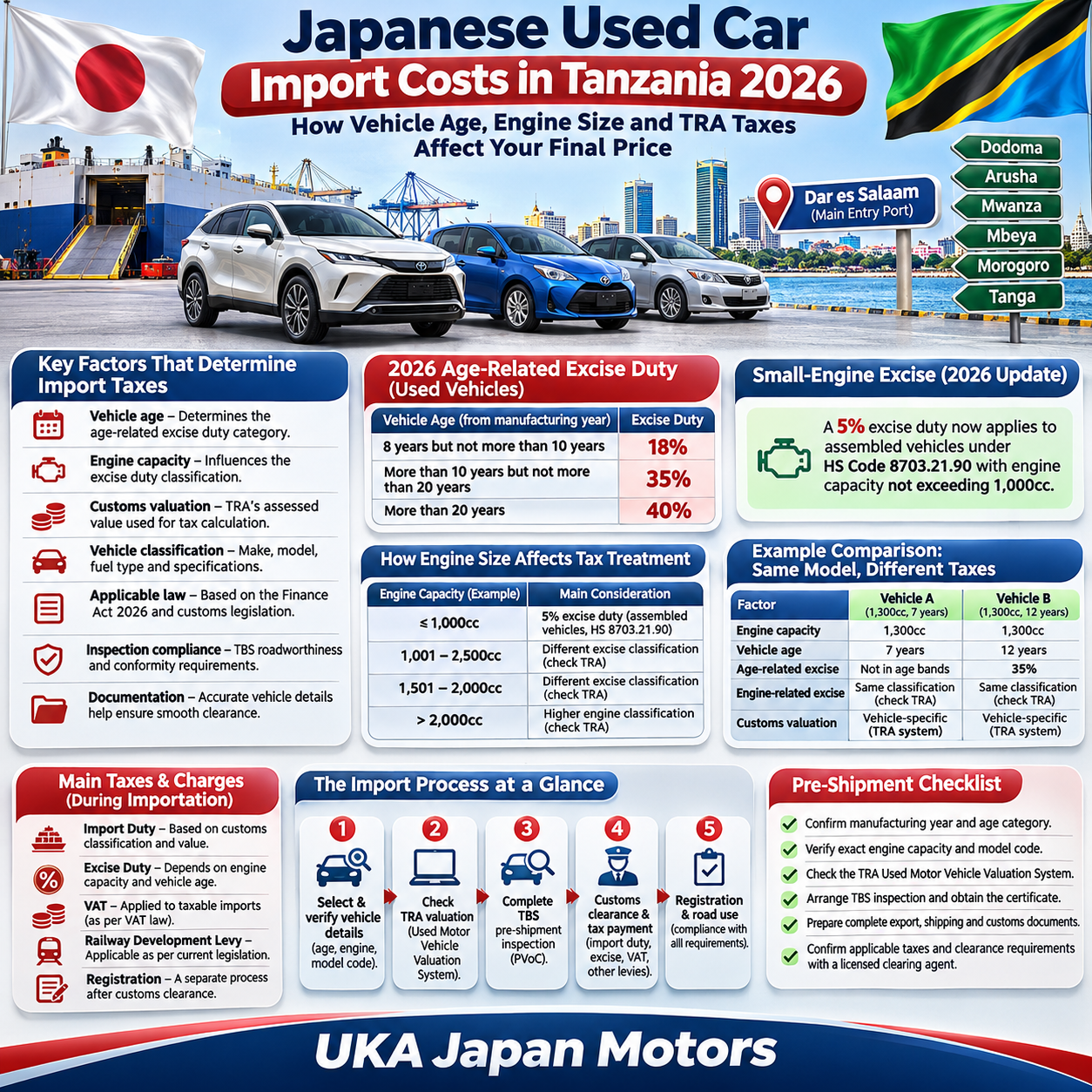
Quick Summary: What Determines Japanese Car Import Taxes in Tanzania?
The main factors affecting the customs assessment of an imported Japanese used vehicle include:
- Vehicle age: Older used vehicles can attract additional age-related excise duty under the applicable tax bands.
- Engine capacity: Engine displacement influences the applicable excise duty classification.
- Customs valuation: TRA determines the customs value used for assessing applicable taxes.
- Vehicle classification: The make, model, fuel type and technical specifications help establish the correct customs treatment.
- Applicable tax legislation: The Finance Act and other relevant customs legislation determine the taxes and rates in force.
- Inspection compliance: TBS roadworthiness and conformity requirements must be addressed before the vehicle can complete the import process.
- Documentation: Inaccurate manufacturing dates, engine details or vehicle identification information can complicate clearance.
The important distinction is that vehicle age, engine capacity and customs valuation are separate assessment considerations. They should not be treated as interchangeable factors.
An importer should therefore check the exact vehicle specification through the TRA Used Motor Vehicle Valuation System before making a final shipping decision.
1. Understanding the Tanzania Used Vehicle Import Tax System
The importation of Japanese used vehicles into mainland Tanzania involves several government procedures.
The process generally begins with obtaining accurate vehicle details and arranging the necessary export documentation. After shipment, the vehicle undergoes customs processing, applicable tax assessment, inspection and release procedures.
TRA is responsible for determining the customs assessment and collecting the applicable taxes.
For imported vehicles, the relevant tax categories can include:
Import duty
Import duty is assessed under the applicable customs tariff classification and customs valuation rules. The vehicle’s classification and customs value are important in establishing the applicable duty treatment.
Excise duty
Excise duty is a separate tax. For imported used passenger vehicles, engine capacity and vehicle age can influence the applicable treatment.
Value Added Tax (VAT)
VAT applies to taxable imports under the applicable Tanzanian VAT legislation. Its assessment follows the legally prescribed taxable-value rules.
Other applicable customs levies and charges
Depending on the applicable legislation and the nature of the import, additional customs-related levies and processing charges may apply.
These taxes should not be combined into one assumed percentage without understanding their individual assessment bases.
For example, a levy calculated using the customs value may not use exactly the same calculation base as a charge linked to the vehicle’s free-on-board value.
This distinction is important when reviewing a customs assessment.
The Tanzania Trade Portal explains that vehicle import duties and taxes depend on the brand, engine size and year of production, and directs importers to the TRA Used Motor Vehicle Valuation System for vehicle-specific assessments.
2. How Vehicle Age Affects Import Taxes in Tanzania in 2026
Vehicle age is one of the most important considerations when importing a Japanese used car.
The reason is that Tanzania applies additional age-related excise duty to certain categories of imported used vehicles.
A vehicle’s age does not simply describe its physical condition. It can also determine the tax category into which the vehicle falls.
The 2026 used vehicle age-related excise duty changes
The Finance Act 2026 introduced changes to the treatment of imported used vehicles.
Following the changes that took effect from 1 July 2026, the reported age-related excise duty categories for imported used vehicles are:
| Vehicle age category | Age-related excise duty |
|---|---|
| More than 8 years up to 10 years | 18% |
| More than 10 years up to 20 years | 35% |
| More than 20 years | 40% |
These are age-related excise duty rates, not the complete vehicle import tax rates.
They must not be mistaken for the total customs tax payable on an imported vehicle.
The applicable assessment should be confirmed against the current legislation and TRA assessment for the individual vehicle.
Why the manufacturing year matters
Japanese vehicles may have different manufacturing and registration dates.
For example, a vehicle might have been manufactured in one calendar year but first registered in another.
This creates an important documentation consideration.
An importer should not automatically assume that the first registration date is the only date relevant to the tax assessment.
The vehicle’s manufacturing information should be checked against its export certificate, identification details and TRA valuation record.
When a vehicle is close to an age-category boundary, the importer should obtain confirmation from TRA or a licensed clearing agent regarding the applicable age calculation.
Comparing younger and older used vehicles
Consider three hypothetical vehicles:
| Vehicle | Illustrative age | Age-related tax consideration |
|---|---|---|
| Vehicle A | 7 years | Does not enter the above-eight-year age bands |
| Vehicle B | 9 years | Falls within the more-than-eight-to-ten-year category |
| Vehicle C | 12 years | Falls within the more-than-ten-to-twenty-year category |
This comparison illustrates why checking the exact manufacturing information is essential.
Two vehicles from the same model family can have different tax treatment simply because their production years differ.
Does Tanzania prohibit importing older Japanese vehicles?
An importer should distinguish between an age-related tax requirement and an outright import prohibition.
The age-related excise duty categories should not automatically be interpreted as a general permission or prohibition rule.
Import eligibility must also be checked against applicable vehicle standards, roadworthiness requirements and customs procedures.
A vehicle’s ability to attract an age-related tax classification does not remove the obligation to satisfy the other import requirements.
3. How Engine Size Changes Japanese Vehicle Import Taxes
Engine capacity is another major consideration in the Tanzanian import tax assessment.
Engine capacity is normally expressed in cubic centimetres (cc).
It describes the displacement of the engine and is used to classify vehicles under applicable tax and registration schedules.
For example:
- 660cc
- 1,000cc
- 1,300cc
- 1,500cc
- 1,800cc
- 2,000cc
- 2,500cc
- 3,000cc
The difference between these engine sizes can affect the vehicle’s excise duty classification and other engine-capacity-related registration requirements.
Understanding the engine capacity categories
For general passenger vehicle tax classification, engine displacement is an important distinction.
Smaller-engine vehicles and larger-engine vehicles may fall into different excise duty categories.
However, the applicable classification must be checked against the current statutory schedule rather than assumed from the vehicle’s model name.
The Finance Act 2026 also changed the treatment of imported vehicles with engine capacities not exceeding 1,000cc.
Previously exempt small-engine vehicles are now subject to a 5% excise duty under the reported 2026 changes.
This is an important development for importers considering compact Japanese vehicles.
Examples of Japanese vehicles with different engine capacities
| Vehicle type | Illustrative engine capacity | Main consideration |
|---|---|---|
| Daihatsu Mira | 660cc | Small-engine excise treatment |
| Suzuki Swift | 1,200cc | Applicable engine classification |
| Toyota Vitz | 1,300cc | Engine-based excise classification |
| Toyota Axio | 1,500cc | Engine-based excise classification |
| Toyota Harrier | 2,000cc or above, depending on version | Confirm exact engine specification |
| Toyota Land Cruiser | Varies by generation and version | Larger-engine classification |
These are examples, not tax quotations. Actual specifications vary by model year, grade and engine configuration.
Why the exact engine matters
Japanese manufacturers sometimes offer several versions of the same vehicle.
A model may be available with different engine sizes, hybrid configurations or powertrain specifications.
A Toyota Harrier, for example, should not be assessed using a generic model description without checking its exact version.
The following information should be verified:
- Engine displacement.
- Engine code.
- Fuel type.
- Hybrid or non-hybrid configuration.
- Model code.
- Manufacturing year.
The vehicle’s export documentation and identification plate should support the information provided to the clearing agent.
A mismatch between the declared engine size and the actual vehicle specification can create customs assessment complications.
Small engines versus larger engines
Smaller engines are commonly found in compact hatchbacks, city cars and some small family vehicles.
Larger engines are more common in substantial SUVs, executive vehicles and certain performance-oriented models.
The correct decision should consider both the applicable tax classification and the vehicle’s intended use.
For instance, a compact vehicle intended for regular movement through Dar es Salaam may have different practical requirements from an SUV expected to travel frequently between Dodoma, Morogoro and Mbeya.
Engine size alone should not determine the vehicle selection.
4. TRA Customs Valuation: Why the Invoice Is Not the Whole Assessment
One of the most misunderstood aspects of vehicle importation is customs valuation.
Some importers assume that TRA will automatically calculate all applicable taxes using only the amount stated on the seller’s invoice.
This is not a safe assumption.
TRA uses its Used Motor Vehicle Valuation System to establish the vehicle-specific assessment information.
The system considers vehicle identification and specification details to determine the applicable valuation.
What information is needed for vehicle valuation?
Before checking the TRA valuation system, collect:
- Vehicle manufacturer.
- Model name.
- Model code.
- Manufacturing year.
- Engine capacity.
- Fuel type.
- Vehicle grade or specification, where required.
- Relevant vehicle identification details.
The accuracy of this information is important.
A Toyota Vitz with a different engine or model code should not automatically be treated as identical to another Toyota Vitz.
Likewise, different generations of the same vehicle may have different specifications.
Why the customs value matters
Customs valuation provides the basis for assessing applicable import duties and taxes.
Where a tax is calculated using customs value, a change in the assessed value can influence the resulting tax assessment.
This means that vehicle selection should involve more than looking at a model name.
Two vehicles that appear similar may have different assessed values because of differences in their model codes, manufacturing years or specifications.
How to use the TRA Used Motor Vehicle Valuation System
The practical process is straightforward:
Step 1: Identify the exact vehicle
Obtain the vehicle’s full details from the Japanese export documentation or seller.
Step 2: Verify the model and engine
Do not rely on general descriptions such as Toyota 1.5 or Honda SUV.
Confirm the exact model code and engine capacity.
Step 3: Access the TRA valuation system
Use the official Tanzania Revenue Authority Used Motor Vehicle Valuation System.
Step 4: Enter the correct vehicle information
Select the matching vehicle specification. If the exact version is unavailable or unclear, seek professional clarification rather than choosing a similar model.
Step 5: Review the valuation and tax assessment
Check the valuation information and applicable taxes for the vehicle.
Step 6: Confirm the assessment before shipment
If the result is unclear, request guidance from TRA or a licensed customs clearing agent.
The valuation system is an important planning tool, but the final customs assessment must be handled through the applicable official clearance process.
5. How Vehicle Age and Engine Size Work Together
Vehicle age and engine capacity should be considered together rather than separately.
A vehicle may fall into a particular engine-related excise classification while also attracting additional age-related excise duty.
These are separate considerations under the applicable tax rules.
For example, imagine two Japanese vehicles with the same engine capacity:
- Vehicle A was manufactured seven years ago.
- Vehicle B was manufactured twelve years ago.
Although both have the same engine capacity, their age-related excise duty treatment may differ.
Now consider two vehicles of the same manufacturing year:
- Vehicle C has a 660cc engine.
- Vehicle D has a 2,000cc engine.
Their engine-related excise classifications may differ.
This demonstrates why an importer should not use a single general estimate for every vehicle.
Vehicle comparison matrix
| Assessment factor | Vehicle A | Vehicle B |
|---|---|---|
| Manufacturing age | Younger | Older |
| Engine capacity | Smaller | Larger |
| Age-related excise | Depends on age category | Depends on age category |
| Engine-related excise | Depends on engine category | Depends on engine category |
| Customs valuation | Vehicle-specific | Vehicle-specific |
| Final assessment | Individual TRA assessment required | Individual TRA assessment required |
The matrix is intended to explain the assessment structure, not provide a tax calculation.
The final result depends on the actual vehicle details and the law applicable when customs clearance takes place.
6. Understanding the Main Taxes and Charges During Vehicle Importation
A Japanese used vehicle imported through Dar es Salaam may encounter several different customs-related tax and administrative requirements.
Understanding their individual roles makes it easier to review the customs documentation.
Import duty
Import duty is imposed under the applicable customs tariff.
The vehicle’s customs classification and customs value are relevant to the assessment.
Importers should avoid assuming that all passenger vehicles automatically receive identical treatment.
Excise duty
Excise duty is particularly important for used motor vehicles because the applicable treatment can depend on engine capacity and vehicle age.
The 2026 changes should be considered when assessing vehicles being cleared under the new financial year’s rules.
VAT
VAT is a separate tax on taxable imports.
It is calculated using the applicable statutory taxable-value provisions.
It should not be confused with import duty or excise duty.
Railway Development Levy and other applicable charges
Other applicable customs levies and processing charges may also form part of the clearance assessment.
Their legal basis and calculation method should be checked individually.
Vehicle registration requirements
Customs clearance does not automatically mean that the vehicle has completed every requirement necessary for road use.
The registration process has its own requirements, including vehicle particulars and applicable registration charges.
Importers should therefore distinguish between:
- Customs taxes.
- Port and shipping procedures.
- Inspection requirements.
- Registration requirements.
- Road-use compliance.
These stages are related, but they are not the same process.
7. Why Dar es Salaam Is Important in the Japanese Vehicle Import Process
Dar es Salaam plays a central role in vehicle imports entering mainland Tanzania through its port.
The port is an important point for customs clearance, cargo handling, documentation verification and vehicle release.
Importers based in other Tanzanian cities should understand that the process does not end when a vehicle arrives at the port.
A vehicle may still require customs release, TBS inspection-related procedures, port release arrangements and subsequent registration.
Importers in Dar es Salaam
For someone living in Dar es Salaam, proximity to the port can make document coordination and communication with a clearing agent more convenient.
However, this does not remove the need for accurate vehicle information or compliance with customs procedures.
Importers in Dodoma
A buyer in Dodoma should arrange the necessary documentation and clearance procedures before the vehicle arrives.
Once released, the vehicle must be transported and prepared for the applicable registration requirements.
Importers in Arusha and Mwanza
Importers in Arusha and Mwanza should consider the complete process from port arrival to final delivery.
Vehicle collection, transportation and documentation should be coordinated rather than treated as separate last-minute tasks.
Importers in Mbeya, Morogoro and Tanga
For buyers in Mbeya, Morogoro and Tanga, the same principle applies.
The vehicle must complete the relevant import and clearance requirements before being put into normal road use.
A well-organised process begins with checking the vehicle’s specifications before shipment, not after its arrival in Tanzania.
8. TBS Inspection and Roadworthiness Requirements
Tax payment is only one part of importing a Japanese used vehicle.
The Tanzania Bureau of Standards (TBS) has an important role in ensuring that imported vehicles meet the applicable standards and roadworthiness requirements.
Pre-shipment inspection
The TBS Pre-shipment Verification of Conformity (PVoC) programme establishes conformity assessment requirements for applicable imported products.
For used motor vehicles, the inspection process involves an authorised inspection service provider.
The process generally includes:
- Submission of vehicle information for inspection.
- Physical inspection and assessment.
- Evaluation against the applicable vehicle standard.
- Issuance of the relevant inspection certificate when requirements are satisfied.
- Submission of the certificate and supporting documents for the required TBS validation.
The relevant certificate is an important part of the vehicle import documentation.
What happens if a vehicle does not satisfy inspection requirements?
A vehicle that fails to satisfy the applicable standards may encounter delays or additional compliance procedures.
Depending on the nature of the non-compliance, the importer may need to address the identified issue through the applicable official process.
This is why checking a vehicle’s physical and structural condition before shipment is important.
Vehicle conditions that deserve attention
A proper inspection should consider:
- Structural damage.
- Chassis condition.
- Accident repairs.
- Corrosion.
- Steering and suspension condition.
- Braking system.
- Lighting and electrical equipment.
- Tyre condition.
- Engine condition.
- Vehicle identification numbers.
The inspection should not focus only on whether the engine starts or the vehicle looks clean.
A vehicle can have a presentable exterior while carrying structural or mechanical problems that become apparent during a detailed inspection.
9. Documents Required When Importing a Japanese Used Vehicle
Correct documentation supports both customs processing and vehicle compliance.
The exact documents required should be confirmed with the relevant authorities and licensed clearing agent.
The commonly required documents and information include:
| Document or information | Purpose |
|---|---|
| Commercial invoice | Supports the transaction and customs documentation |
| Bill of lading | Confirms shipment details |
| Japanese export certificate | Establishes vehicle export and identification information |
| English translation where required | Helps authorities interpret the export documentation |
| Vehicle inspection certificate | Supports TBS conformity and roadworthiness procedures |
| Vehicle identification details | Helps confirm the correct vehicle |
| Importer TIN and relevant customs information | Supports customs processing |
| Tanzania customs declaration | Supports formal customs assessment and clearance |
Why documentation accuracy matters
The information appearing on the vehicle documents should correspond with the actual vehicle.
Pay particular attention to:
- Manufacturing year.
- Chassis number.
- Engine number, where applicable.
- Model code.
- Engine capacity.
- Fuel type.
An incorrect manufacturing year can create questions about age-based excise duty.
An incorrect engine specification can affect the applicable tax classification.
A mismatched chassis number can create difficulties during vehicle verification.
Documentation should therefore be checked before shipment wherever possible.
10. Choosing Between Different Japanese Used Vehicle Categories
The most suitable vehicle is not necessarily the one with the smallest engine or the newest manufacturing year.
The correct choice depends on the intended use, passenger requirements, road conditions, mechanical condition and applicable import requirements.
Compact Japanese cars
Examples include the Daihatsu Mira, Toyota Vitz and Suzuki Swift.
These vehicles are commonly considered for:
- Daily commuting.
- Urban driving.
- Small households.
- Movement through busy streets.
- General personal transport.
Their compact dimensions can be useful in busy areas of Dar es Salaam.
However, the exact engine capacity and manufacturing year still need to be checked against the TRA assessment.
Mid-sized sedans
Examples include the Toyota Axio, Toyota Premio and Honda Grace.
These vehicles may suit:
- Family transport.
- Regular commuting.
- Intercity journeys.
- Drivers who prefer a conventional sedan layout.
The importer should pay attention to the exact powertrain, especially where hybrid versions are involved.
Japanese SUVs
Examples include the Toyota Harrier, Toyota RAV4 and Nissan X-Trail.
These vehicles may suit drivers who require:
- More passenger space.
- Additional luggage capacity.
- Higher seating positions.
- Greater versatility for different journeys.
However, engine size and vehicle configuration can differ considerably between versions.
A vehicle should not be assessed using information from another generation or engine variant.
Comparing vehicle suitability
| Vehicle category | Typical use | Important import consideration |
|---|---|---|
| Compact hatchback | Urban commuting | Exact engine size and age |
| Mid-sized sedan | Family and regular travel | Model code and powertrain |
| Compact SUV | Mixed urban and longer journeys | Engine and drivetrain specification |
| Larger SUV | Greater space and varied travel needs | Engine capacity, condition and valuation |
The purpose of this comparison is to help buyers understand vehicle suitability, not to suggest that one category is universally better.
11. Hybrid Japanese Cars and Their Import Assessment
Hybrid vehicles have become an important part of the Japanese used vehicle market.
Models such as the Toyota Aqua, Toyota Prius, Toyota Axio Hybrid and Honda Fit Hybrid combine an internal combustion engine with an electric motor and battery system.
However, hybrid vehicles require careful specification checks during importation.
Does a hybrid vehicle have an engine?
Yes.
A conventional hybrid vehicle generally has an internal combustion engine together with an electric motor and a battery system.
Its engine displacement remains an important technical specification.
The presence of an electric motor does not mean that the vehicle should automatically be treated as a fully electric vehicle.
What should hybrid vehicle importers check?
Before importing a hybrid vehicle, confirm:
- Exact engine displacement.
- Hybrid system configuration.
- Fuel type.
- Manufacturing year.
- Model code.
- Battery condition.
- Relevant TRA vehicle classification.
The hybrid system should also be checked for warning lights, battery deterioration and evidence of previous repairs.
Hybrid inspection considerations
A proper mechanical inspection should include both the conventional engine and the hybrid system.
Important checks include:
- Hybrid battery condition.
- Battery cooling system.
- Inverter condition.
- Hybrid system warning codes.
- Engine operation.
- Transmission operation.
- Regenerative braking performance.
Hybrid vehicles should not be selected based only on their model name or general reputation.
Their actual technical condition is important for long-term ownership.
12. Common Mistakes That Can Create Import Clearance Problems
Some import problems begin before the vehicle reaches Tanzania.
The following mistakes are worth avoiding.
Mistake 1: Selecting a vehicle without checking its age category
A vehicle may look suitable, but its manufacturing year could place it in a higher age-related excise category.
Always confirm the applicable age classification before shipment.
Mistake 2: Using the wrong engine capacity
A model name is not enough to identify the exact engine.
Different versions may have different displacement specifications.
Confirm the engine code and capacity from the vehicle documentation.
Mistake 3: Assuming the invoice determines every tax
Customs valuation follows the applicable TRA procedures.
The invoice should not be treated as a guaranteed substitute for the official vehicle valuation.
Mistake 4: Confusing registration year with manufacturing year
These dates may differ.
The importer should establish the correct manufacturing information and confirm the age calculation applicable to the vehicle.
Mistake 5: Ignoring the TBS inspection process
A vehicle can have its customs documents prepared correctly and still face compliance problems if it does not satisfy the relevant inspection requirements.
Mistake 6: Selecting the wrong model variant in the valuation system
A similar model is not necessarily an identical model.
Engine capacity, fuel type, generation and model code should all be considered.
Mistake 7: Waiting until arrival to organise documents
Important documentation should be prepared and checked before shipment.
This includes the export certificate, invoice, shipping information and inspection documentation.
Mistake 8: Assuming customs clearance completes registration
Customs release, roadworthiness compliance and vehicle registration are different stages.
The importer should confirm that all relevant requirements have been satisfied before using the vehicle on public roads.
13. A Practical Pre-Shipment Checklist for Tanzanian Importers
Before committing to a Japanese used vehicle, work through the following checklist.
Vehicle identification
-
Confirm manufacturer and model.
-
Confirm model code.
-
Verify manufacturing year.
-
Verify engine capacity.
-
Confirm fuel type.
-
Confirm hybrid or non-hybrid configuration.
TRA assessment
-
Check the vehicle using the TRA Used Motor Vehicle Valuation System.
-
Review the applicable customs valuation.
-
Confirm the engine-related excise classification.
-
Confirm the age-related excise category.
-
Check applicable import duties, VAT and other levies.
-
Obtain clarification if the vehicle details do not match the valuation record.
Inspection and documentation
-
Check the vehicle’s inspection history.
-
Confirm the applicable TBS pre-shipment inspection arrangements.
-
Obtain the required inspection certificate.
-
Verify the Japanese export certificate.
-
Check the commercial invoice.
-
Confirm the bill of lading details.
-
Prepare the required customs documentation.
Before clearance
-
Work with a licensed customs clearing agent.
-
Review the official customs assessment.
-
Confirm applicable tax payments.
-
Complete the relevant inspection and release procedures.
-
Confirm the remaining registration requirements.
Completing these checks in advance creates a clearer understanding of the vehicle’s import requirements.
14. The Importance of Professional Guidance in the Import Process
Importing a Japanese vehicle involves several organisations and procedures.
TRA handles customs assessment and tax collection, while TBS is responsible for applicable vehicle standards and inspection requirements.
Shipping documentation, port release and customs processing must also be coordinated.
For an individual importer, understanding every technical detail can be challenging.
Professional guidance can help ensure that the correct vehicle information is collected before shipment.
At UKA Japan Motors, the importance of the import process is approached through vehicle identification, documentation awareness and inspection-focused guidance.
This includes helping prospective importers understand the differences between vehicle generations, engine capacities, manufacturing years and hybrid specifications.
The objective is to encourage informed vehicle selection and better preparation for the relevant Tanzanian procedures.
It is equally important to recognise the limits of a vehicle supplier’s role.
TRA remains the authority responsible for official customs assessment and applicable tax collection. TBS remains responsible for its statutory standards and inspection functions.
No vehicle supplier should present an informal estimate as a guaranteed official tax assessment.
Importers should use official government systems and qualified clearing professionals when confirming their individual requirements.
15. Frequently Asked Questions About Japanese Used Car Import Taxes in Tanzania
1. How are Japanese used car import taxes calculated in Tanzania?
The applicable taxes depend on factors including customs valuation, vehicle classification, engine capacity and manufacturing year. TRA assesses the vehicle under the relevant customs and tax legislation. The TRA Used Motor Vehicle Valuation System is an important starting point for checking the vehicle-specific assessment.
2. Does vehicle age affect import taxes in Tanzania in 2026?
Yes. Imported used vehicles can attract additional age-related excise duty. Under the 2026 changes effective from 1 July, the relevant categories include vehicles more than eight years up to ten years, more than ten years up to twenty years, and vehicles more than twenty years old.
3. What is the age-related excise duty for vehicles more than eight years old?
The reported 2026 rate for vehicles more than eight years up to ten years old is 18%. This is an age-related excise duty, not the complete import tax assessment.
4. What happens to the excise duty for vehicles more than ten years old?
The applicable age-related excise duty is 35% for vehicles more than ten years up to twenty years old. Vehicles more than twenty years old fall into the 40% category. The exact vehicle age should be confirmed under the applicable assessment rules.
5. Does engine capacity affect TRA import taxes?
Yes. Engine capacity is an important factor in determining the applicable excise duty classification. Different engine categories can receive different tax treatment, so the exact displacement should be verified before shipment.
6. Are Japanese cars with engines not exceeding 1,000cc exempt from excise duty in 2026?
The 2026 changes introduced a 5% excise duty for imported vehicles with engine capacities not exceeding 1,000cc. Importers should confirm the precise application of the current statutory schedule to their vehicle.
7. Does TRA calculate vehicle taxes using the Japanese seller’s invoice?
Importers should not assume that the invoice alone determines the customs value. TRA uses its vehicle valuation procedures to establish the relevant assessment. The official Used Motor Vehicle Valuation System should be consulted.
8. Where can I check the import tax assessment for a Japanese car?
Use the official TRA Used Motor Vehicle Valuation System. Make sure that the vehicle’s manufacturing year, model code, engine capacity and fuel type are correct when selecting the vehicle.
9. Is a Toyota Vitz taxed in the same way as a Toyota Harrier?
Not necessarily. These vehicles can differ in engine capacity, customs valuation, specifications and age. Their individual TRA assessments should be checked rather than assuming that all Japanese passenger vehicles have identical tax treatment.
10. Does a hybrid Japanese car receive the same tax classification as a conventional petrol car?
The correct treatment depends on the applicable statutory classification and the vehicle’s technical specifications. A hybrid vehicle should be correctly identified as a hybrid, with its engine capacity and model details confirmed through the official assessment process.
11. Is TBS inspection required when importing a Japanese used car?
Applicable TBS inspection and conformity requirements must be satisfied. Used motor vehicles are subject to the relevant pre-shipment verification and roadworthiness procedures. Importers should confirm the current inspection arrangements before shipping.
12. Can an older Japanese vehicle still be imported into Tanzania?
Age-related excise duty should not be confused with an outright import ban. Import eligibility must be checked against the applicable customs, vehicle standards and roadworthiness requirements.
13. Can I calculate the final import taxes without knowing the exact engine capacity?
An accurate vehicle-specific assessment requires the correct engine information. Using an incorrect displacement can result in an inappropriate tax classification. Obtain the exact engine details before checking the TRA valuation system.
14. Does customs clearance mean the vehicle is ready for road use?
No. Customs release and road registration are separate stages. The vehicle must satisfy the applicable inspection, documentation and registration requirements before it can be used legally on public roads.
15. Why should I check the manufacturing year before buying a Japanese used vehicle?
The manufacturing year can influence the vehicle’s age-related excise duty category. It also helps identify the correct generation and specification. Checking it early reduces the possibility of selecting a vehicle based on incorrect tax assumptions.
16. Official Resources for Checking Tanzania Vehicle Import Requirements
Importers should rely on official government information when checking current requirements.
The following resources are useful:
Tanzania Revenue Authority (TRA)
Official customs information, tax administration and the Used Motor Vehicle Valuation System.
Website: https://www.tra.go.tz/
Tanzania Trade Portal
Information about the vehicle import procedure, customs processing, documentation and applicable government institutions.
Website: https://trade.tanzania.go.tz/
Tanzania Bureau of Standards (TBS)
Information about pre-shipment verification of conformity, inspection requirements and applicable vehicle standards.
Website: https://www.tbs.go.tz/
Tanzania Electronic Single Window System
Relevant electronic procedures and documentation for trade-related processes.
Importers should verify the latest requirements before arranging shipment because legislation, administrative procedures and applicable tax schedules can change.
Conclusion: Understand the Vehicle Before You Calculate Its Import Taxes
Importing a Japanese used vehicle into Tanzania requires careful attention to three important areas: vehicle age, engine capacity and customs valuation.
Vehicle age can determine whether additional age-related excise duty applies. Engine capacity influences the relevant engine-based excise classification. Customs valuation provides the basis for assessing applicable duties and taxes under the relevant legislation.
The Finance Act 2026 makes these considerations particularly important for vehicles being cleared during the 2026/27 financial year.
However, a correct tax assessment is only one part of a successful import.
The vehicle must also satisfy applicable TBS inspection requirements, have accurate export and shipping documentation, complete customs clearance and meet the relevant registration requirements.
For importers in Dar es Salaam, Dodoma, Arusha, Mwanza, Mbeya, Morogoro and Tanga, the most reliable approach is to verify the exact vehicle specification before shipment and confirm the official assessment with TRA or a qualified customs clearing agent.
A Japanese used car should be evaluated as an individual vehicle, not simply by its brand or model name. Understanding its manufacturing year, engine configuration, technical condition and documentation provides a stronger foundation for a properly managed import process.
UKA Japan Motors supports an informed, inspection-focused and compliance-aware approach to Japanese vehicle selection, helping prospective importers understand the importance of accurate vehicle details and the relevant import procedures.
Contact UKA Japan Motors for availability and inspection guidance.