


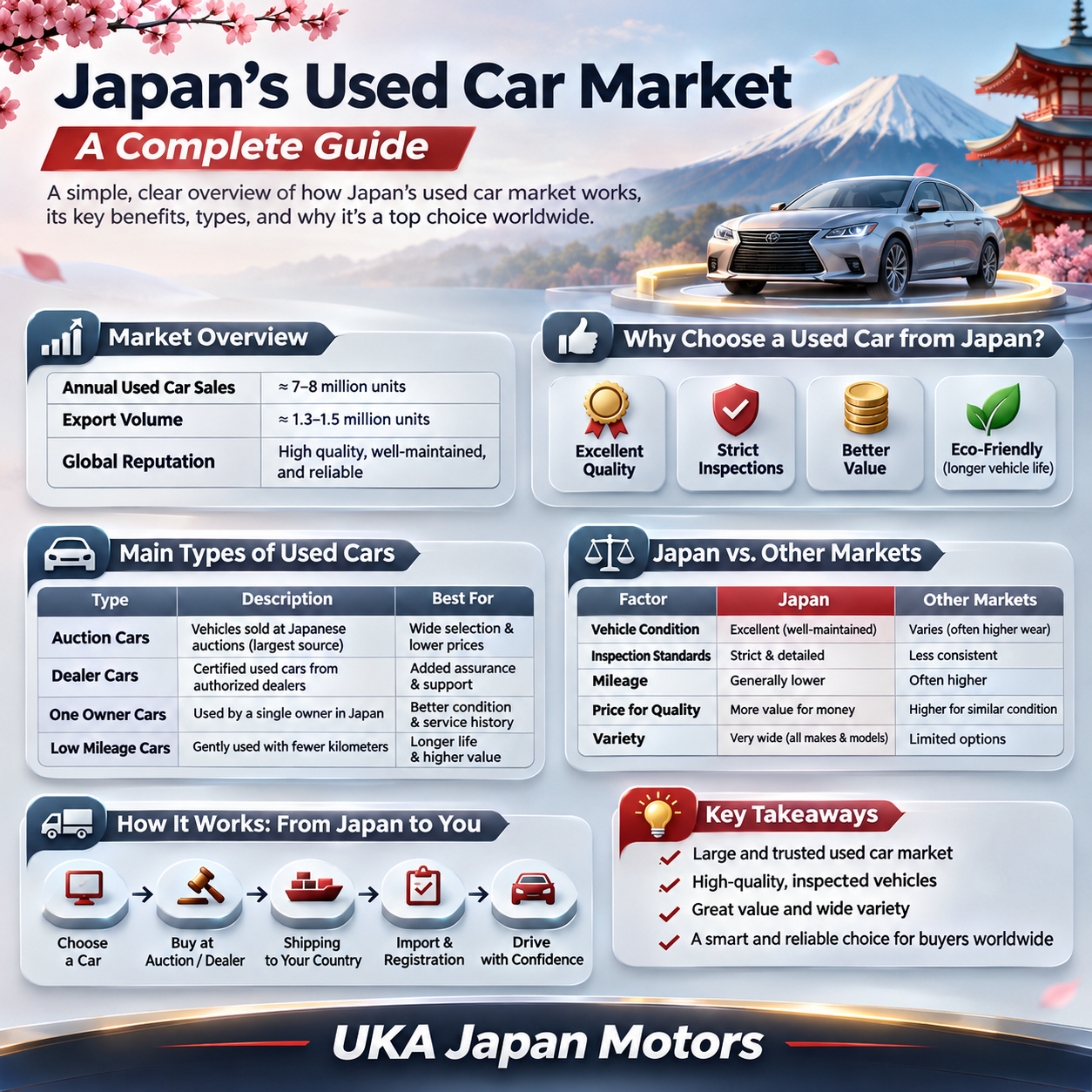
Mae Sot occupies an important position in Thailand’s western border economy. Its location in Tak Province, close to the Myanmar border, creates regular movement of people, commercial goods, transport vehicles and business-related traffic.
For people interested in Japanese used cars, this location can create questions that are not always easy to answer.
A vehicle may have originally been manufactured in Japan, exported through a trading network, registered in another country, transported through Myanmar, or seen moving near a Thai border checkpoint. These circumstances can make a vehicle appear connected to an international import process.
However, seeing a vehicle cross a border does not establish that it can legally be imported into Thailand for permanent use.
This distinction is particularly important in 2026 because Thailand maintains restrictions on importing used motor vehicles, while specific regulatory developments have addressed qualifying classic vehicles.
Buyers in Mae Sot therefore need to understand several separate matters:
- The difference between Japanese vehicle origin and Japanese export documentation.
- Thailand’s restrictions on importing used vehicles.
- The distinction between permanent importation and temporary border entry.
- The difference between Myanmar-registered vehicles and Thai-registered vehicles.
- The documentation required for legal ownership and registration.
- The role of customs, the Department of Foreign Trade and the Department of Land Transport.
- The risks associated with vehicles whose international movement cannot be properly documented.
A vehicle’s physical presence in Mae Sot is not proof of its legal status. Similarly, a Japanese auction record, export certificate or foreign registration document does not automatically establish permission for permanent registration in Thailand.
The purpose of this guide is to explain how these rules affect Japanese used vehicles and cross-border vehicle trade in Mae Sot during 2026.
1. The Direct Answer: Can Japanese Used Cars Be Imported into Thailand in 2026?
The general rule is that importing an ordinary used passenger car into Thailand is prohibited.
Thailand’s Ministry of Commerce introduced controls through its 2019 notification concerning used motor vehicles. The regulatory framework restricts used vehicles under several customs tariff categories, including ordinary passenger cars.
The Department of Foreign Trade continues to list the relevant regulations as active. Its legal register also identifies a third amendment issued in September 2025, published in the Royal Gazette on 19 September 2025 and listed as effective.
This is important because buyers should not assume that the arrival of 2026 has created general permission to import ordinary second-hand Japanese cars.
There are limited exceptions and special regulatory categories, but these should not be confused with a general used-car import route.
The practical position is:
| Vehicle situation | General position in Thailand |
|---|---|
| Ordinary used Japanese passenger car imported for permanent Thai use | Generally prohibited |
| Used vehicle transported through Myanmar | Transit does not create Thai import permission |
| Foreign-registered vehicle entering temporarily | Subject to temporary customs and transport conditions |
| Qualifying used ambulance | Specific regulatory treatment applies |
| Qualifying special-purpose vehicle | May require specific permission |
| Qualifying classic vehicle | Subject to special conditions and regulatory requirements |
| Used Japanese car already legally registered in Thailand | Can be assessed as an existing Thai-registered vehicle |
The classification of a vehicle matters more than its advertised origin or the country from which it arrives.
Buyers should confirm the exact vehicle category and applicable legal provisions before making any commitment.
The Department of Foreign Trade’s legal register provides the official starting point for checking the current framework:
The general import restriction is also recorded in the World Trade Organization’s notification concerning Thailand’s used-car import prohibition.
2. Why Japanese Vehicle Origin Does Not Automatically Mean Import Eligibility
Japanese vehicles have a significant presence in Thailand’s automotive market. Many Thai-registered vehicles were manufactured by Japanese automotive companies or originally supplied through Japanese vehicle distribution networks.
However, Japanese manufacturing origin and Japanese used-vehicle import eligibility are different legal questions.
Consider three examples.
Example A: A Japanese-manufactured car already registered in Thailand
A vehicle manufactured by a Japanese company may have been legally supplied, registered and transferred within Thailand.
Its Japanese manufacturing origin does not make it a newly imported used vehicle every time ownership changes.
The relevant checks concern its existing Thai registration, ownership history, chassis identity and registration documents.
Example B: A used car exported from Japan
A vehicle may have a Japanese export certificate, auction documentation and shipping records.
These documents can establish aspects of its overseas history, but they do not override Thailand’s import restrictions.
An export certificate is not a Thai import permit.
Example C: A vehicle arriving through Myanmar
A Japanese-origin vehicle may be present in Myanmar and later appear near the Mae Sot border.
Its location does not establish whether it was lawfully imported into Thailand.
Its foreign registration, customs status, ownership and permission to enter Thailand must be considered separately.
The central lesson is that buyers should investigate the vehicle’s complete legal history rather than relying on the manufacturer’s country of origin.
3. Understanding Thailand’s Used-Vehicle Import Restrictions
Thailand regulates used motor vehicle imports through the Ministry of Commerce and related government agencies.
The objective of the restrictions includes public safety, environmental protection and control over the entry of used vehicles.
The relevant regulatory framework includes:
- Ministry of Commerce Notification concerning used motor vehicles, B.E. 2562 (2019).
- Subsequent amendments, including the second notification issued in 2019.
- The 2019 Ministry of Commerce regulation governing permission to import used vehicles.
- Department of Foreign Trade procedures for controlled vehicle imports.
- The third amendment, B.E. 2568 (2025).
The third amendment is particularly relevant to the 2026 discussion because the Department of Foreign Trade lists it as effective.
The regulations cover different vehicle classifications under customs tariff headings.
These include categories associated with tractors, vehicles designed to carry passengers, goods vehicles and certain special-purpose vehicles.
A buyer should not assume that every vehicle with four wheels is treated identically. Its intended function, construction, seating arrangement, technical classification and applicable customs code can affect the regulatory position.
Nevertheless, an ordinary second-hand Japanese family car should be treated as falling within the general restriction unless an applicable legal exception has been established.
Why the distinction matters
A seller might describe a vehicle as:
- A Japanese domestic-market vehicle.
- An imported Japanese vehicle.
- A Myanmar-market vehicle.
- A foreign-registered vehicle.
- A vehicle moving through border trade.
- A vehicle eligible for special import treatment.
These descriptions are not legal authorisations.
The correct approach is to establish the customs classification, applicable notification and written permission where required.
4. The 2025–2026 Regulatory Development: What Changed?
Thailand’s 2025 regulatory developments are important for understanding the position in 2026.
On 26 August 2025, the Thai Cabinet approved in principle a draft amendment concerning the import treatment of certain used vehicles.
The subsequent third amendment was issued by the Ministry of Commerce on 16 September 2025 and published in the Royal Gazette on 19 September 2025.
The Department of Foreign Trade lists this notification as effective.
The development relates to the treatment of specified passenger vehicles and classic vehicles under defined conditions. It does not establish unrestricted permission for ordinary used Japanese passenger cars.
This distinction is essential.
A regulatory exception is not the same as a general import opening.
Qualifying classic vehicles
Thailand has also introduced a coordinated regulatory approach for certain classic vehicles.
The classic-vehicle framework has specific eligibility conditions. Published regulatory explanations identify qualifying passenger vehicles as vehicles with no more than seven seats and an age of at least 30 years but not exceeding 100 years.
Additional requirements apply, including technical and eligibility conditions.
The classic-vehicle provisions should not be interpreted as permission to import any old Japanese car.
A vehicle’s age alone is insufficient.
Its classification, historical characteristics, documentation, condition and compliance with the relevant official requirements must be established.
Furthermore, the customs, excise and operational requirements must be considered separately.
The Library of Congress published an explanation of Thailand’s classic-car regulatory developments in January 2026:
For a buyer in Mae Sot considering an older Japanese vehicle, the sensible approach is to obtain written confirmation from the relevant authorities before treating it as an eligible import.
5. How Japanese Vehicles Become Part of Cross-Border Trade
Understanding the movement of vehicles helps buyers distinguish legitimate trade documentation from unsupported claims.
A Japanese-origin vehicle may pass through several stages before appearing in a regional automotive market.
A typical international vehicle movement can involve:
- Initial manufacture in Japan.
- Domestic use or registration.
- Export preparation and overseas documentation.
- International transportation.
- Customs processing in the destination country.
- Foreign registration, where legally permitted.
- Subsequent movement within the foreign country’s domestic transport network.
If a vehicle later moves towards Myanmar’s border with Thailand, its legal status depends on the documentation and permissions applicable to that movement.
The existence of a cross-border trading route does not change the Thai legal classification of the vehicle.
The importance of vehicle identity
Every stage should be connected to the same vehicle identity.
The chassis number, vehicle identification number where applicable, engine number, manufacturer information and registration details should be consistent.
Differences can arise because of:
- Incorrect transcription.
- Replacement engine installations.
- Previous accident repairs.
- Rebuilt or modified vehicle structures.
- Incomplete export records.
- Unverified changes in ownership.
These differences require investigation.
A vehicle with a legitimate Japanese history can still have incomplete documentation for its later movement through another country.
For Thai buyers, the important question is not simply where the vehicle came from. It is whether every relevant stage of its movement and ownership can be properly explained.
6. Mae Sot and the Myanmar Border: Understanding the Legal Difference
Mae Sot’s border position makes temporary vehicle entry and foreign vehicle movement particularly relevant.
However, the rules governing a foreign-registered vehicle entering Thailand temporarily are different from those governing a used vehicle imported permanently.
The distinction can be explained through two situations.
Situation A: Temporary entry
A foreign-registered vehicle enters Thailand for an authorised temporary purpose.
Depending on the circumstances, the traveller may need to provide:
- Valid foreign vehicle registration documents.
- Passport or applicable travel documentation.
- Authorisation from the registered owner if the traveller is not the owner.
- Relevant temporary vehicle-entry permission.
- Customs documentation.
- Any other documents required by the Department of Land Transport.
The vehicle must comply with the conditions of temporary entry, including the authorised period and departure requirements.
Temporary entry does not create a right to sell the vehicle as an ordinary Thai-registered vehicle.
Situation B: Permanent importation
A vehicle is brought into Thailand with the intention of remaining in the country and entering the domestic registration system.
This is a different legal process.
It requires the relevant import eligibility, customs clearance and other approvals.
For ordinary used passenger cars, the general prohibition remains a critical obstacle.
A temporary-entry declaration cannot be used as a substitute for permanent import authorisation.
Why this matters in Mae Sot
A vehicle may be seen entering Thailand for a temporary visit, business-related movement or another authorised purpose.
That does not mean a local buyer can acquire the vehicle and continue using it indefinitely.
The legal conditions are attached to the authorised entry and the vehicle’s declared status.
Anyone considering purchasing a foreign-registered vehicle should establish whether it can legally be transferred, permanently imported and registered in Thailand before proceeding.
7. Temporary Vehicle Entry from Myanmar: What Buyers Should Understand
Thailand’s customs procedures provide for temporary entry of foreign-registered vehicles through land border checkpoints.
The Thai Customs Department explains that travellers entering Thailand with foreign-registered vehicles may need a special customs declaration.
The purpose is to record the vehicle’s temporary presence and ensure that it is taken out of Thailand within the authorised period.
The customs process is not equivalent to permanent vehicle registration.
Required documentation
The relevant documents may include:
| Document | Why it matters |
|---|---|
| Foreign vehicle registration | Establishes the vehicle’s recorded registration identity |
| Passport or travel document | Identifies the person entering with the vehicle |
| Owner authorisation | Establishes permission where the driver is not the registered owner |
| Temporary vehicle-entry approval | Establishes compliance with transport requirements |
| Special customs declaration | Records the vehicle’s temporary entry |
| Exit documentation | Helps demonstrate that the vehicle has left Thailand |
The exact requirements depend on the vehicle, traveller, nationality, registration country and applicable border arrangements.
Special considerations for Myanmar vehicles
Thai Customs guidance identifies certain categories of foreign vehicles that may be treated differently for temporary entry.
These include locally based vehicles from neighbouring countries without the relevant road transport agreement, including Myanmar, when they regularly enter and leave through land border checkpoints for ordinary activities such as shopping, medical treatment and education.
However, this specific treatment should not be misunderstood.
It concerns qualifying temporary vehicle movements.
It does not provide blanket permission for the permanent importation, resale or Thai registration of Myanmar-registered used vehicles.
Buyers should confirm the applicable local-border procedure with the responsible customs and transport authorities.
8. Japanese Cars in Myanmar: Why Their Presence Does Not Establish Thai Import Rights
Myanmar has its own vehicle registration, import and road-use framework.
Japanese-origin vehicles may be present in Myanmar through lawful or historical vehicle movements.
However, a vehicle’s legal status in Myanmar and its eligibility for registration in Thailand are separate matters.
For a Mae Sot buyer, several questions need to be considered.
First: Is the vehicle legally registered in Myanmar?
A registration document should be checked for its authenticity, current status and connection to the physical vehicle.
Second: Is the seller legally entitled to transfer ownership?
The seller should be able to demonstrate a valid ownership chain and any necessary transfer authority.
Third: Does the vehicle have a documented customs history?
A vehicle’s registration alone may not establish all details of its import history.
Fourth: Can it legally enter Thailand?
Foreign registration and temporary-entry conditions must be assessed separately.
Fifth: Can it become a Thai-registered vehicle?
This is the most important question for someone intending to keep the vehicle permanently in Mae Sot.
A Myanmar registration certificate cannot independently replace Thai import approval or Thai registration documents.
A practical example
Imagine a Japanese-manufactured family vehicle that is registered in Myanmar and regularly travels near the border.
A person in Mae Sot may see the vehicle and assume it can be purchased and registered locally.
But the vehicle may only have permission for temporary movement.
Its registration may not be transferable for Thai road use.
Its permanent importation may also be prohibited under the applicable Thai rules.
The correct decision depends on verified documentation, not its physical accessibility.
9. Permanent Importation, Temporary Entry and Transit: Three Different Processes
One of the most common sources of confusion is the assumption that all cross-border vehicle movements follow the same procedure.
They do not.
| Feature | Permanent import | Temporary entry | Customs transit |
|---|---|---|---|
| Main purpose | Bringing a vehicle into Thailand for permanent use | Allowing a foreign vehicle to enter temporarily | Moving goods through Thailand under customs control |
| Thai customs procedure | Applicable import declaration and approvals | Special temporary vehicle declaration | Transit declaration and controls |
| Thai import eligibility | Must be established | Separate from permanent import eligibility | Governed by transit requirements |
| Long-term Thai road use | Requires lawful import and registration | Not automatically permitted | Not automatically permitted |
| Departure obligation | Not applicable after lawful permanent clearance | Must leave within the authorised period | Must follow the authorised transit route and procedure |
| Thai registration | Requires applicable approvals | Does not automatically provide registration rights | Does not provide registration rights |
A transit declaration is not an import permit.
A temporary-entry document is not a Thai ownership document.
A foreign registration certificate is not proof of permanent Thai registration eligibility.
These distinctions should be understood before considering any cross-border vehicle transaction.
10. What Happens If a Vehicle Enters Temporarily but Is Not Taken Out?
Temporary customs entry comes with conditions.
A vehicle entering under a temporary procedure must leave Thailand within the period specified by the relevant authorities.
Failure to comply can create customs liabilities and other legal consequences.
Thai Customs guidance explains that an overdue temporary vehicle may be subject to penalties under the applicable procedure.
The published guidance for land-border temporary entry also describes a daily penalty for vehicles exceeding their authorised period, subject to the stated maximum under that procedure.
The exact conditions must be checked for the particular entry.
For buyers, this creates an important warning.
A vehicle should never be treated as permanently available simply because it has been inside Thailand for an extended period.
The original entry declaration, authorised duration and exit status need to be established.
If the vehicle has remained beyond its permitted period, the situation should be referred to customs rather than resolved through an informal ownership arrangement.
11. Thai Registration: Why Customs Clearance and Road Registration Are Separate
Thai vehicle registration is administered through the Department of Land Transport.
Customs clearance and vehicle registration are connected, but they serve different legal purposes.
Customs authorities control the entry of goods and vehicles into Thailand.
The Department of Land Transport deals with vehicle registration, identification and relevant road-use requirements.
A vehicle cannot be assumed eligible for Thai registration simply because someone possesses customs paperwork.
Similarly, registration cannot be assumed valid because the vehicle has been physically inspected.
The relevant authorities must establish that the vehicle meets the applicable requirements.
Important registration considerations
Before purchasing a vehicle already registered in Thailand, buyers should review:
- The original vehicle registration book, commonly known as the blue book for applicable private vehicles.
- The registered owner’s details.
- The chassis number.
- The engine number, where recorded.
- The registration plate details.
- The vehicle’s recorded technical information.
- Any outstanding registration or transfer issues.
- The documents required for an ownership transfer.
- Whether any modifications require further approval or inspection.
Where a vehicle has a complicated international history, additional records may be necessary to understand its original import and registration position.
Ownership transfer
A legitimate ownership transfer should be completed through the appropriate Thai registration process.
The buyer should not rely solely on a private sale agreement, an informal receipt or a foreign registration document.
The registered owner and the physical vehicle must be properly connected through the relevant official records.
Where ownership details do not match, the reason must be established before a transfer is attempted.
12. Japanese Auction Sheets and Export Documents: What They Prove and What They Do Not
Japanese auction records can provide useful information about a vehicle’s earlier condition.
They may contain information relating to:
- Auction identification.
- Recorded mileage.
- Condition grading.
- Accident or repair observations.
- Exterior and interior condition.
- Vehicle specifications.
- Inspection remarks.
Export documents may help establish that a vehicle was prepared for overseas shipment.
However, these documents have limitations.
An auction sheet does not prove that the vehicle was legally imported into Thailand.
An export certificate does not prove Thai registration eligibility.
A foreign shipping record does not establish a valid Thai ownership transfer.
A buyer should also consider whether the documents genuinely belong to the vehicle being inspected.
Matching vehicle records
The following details should be compared wherever available:
| Record | Details to compare |
|---|---|
| Auction documentation | Chassis or vehicle identification |
| Export certificate | Vehicle identity and export details |
| Shipping records | Consignment and vehicle identity |
| Foreign registration | Registration number and vehicle identity |
| Thai registration | Recorded chassis and engine information |
| Physical vehicle | Stamped chassis and identification plates |
Any discrepancy should be explained through reliable supporting records.
A document that appears genuine in isolation may still relate to a different vehicle.
13. Identifying Documentation Risks in Cross-Border Vehicle Trade
Cross-border vehicle transactions can involve several parties and multiple sets of documents.
This creates a need for careful verification.
Common warning signs include:
1. Missing original registration documents
A seller may provide photographs or photocopies without explaining why the original documents are unavailable.
The legal status should be established before proceeding.
2. Inconsistent chassis numbers
The vehicle identity may differ between the physical stamping and the available documents.
This is a serious issue requiring investigation.
3. Unclear customs history
A vehicle may have entered a neighbouring country without sufficient evidence of its legal import status.
4. Temporary-entry documents presented as permanent import approval
This is a fundamental misunderstanding of the customs process.
5. Unverified ownership
A person selling the vehicle may not be the registered owner or may lack the required authorisation.
6. Altered vehicle identification
Signs of chassis repairs, replacement identification plates or suspicious stamping require specialist attention and appropriate official verification.
7. Unsupported registration claims
Statements that a vehicle can be registered in Thailand should be supported by the relevant authority and documentation.
8. Unclear accident or reconstruction history
Previous structural damage may affect both safety and the reliability of vehicle identity records.
A careful buyer should treat these matters as reasons to pause the transaction until the relevant issues are resolved.
14. Vehicle Inspection: Why Mechanical Condition Matters Alongside Legal Status
Legal documentation and physical condition are two separate parts of vehicle assessment.
A vehicle may have a complete registration history but still require significant mechanical attention.
Likewise, a vehicle may appear mechanically sound while having unresolved ownership or import documentation.
Both areas need to be considered.
For Japanese used vehicles in Mae Sot, a practical inspection should cover several systems.
Engine condition
Inspect for:
- Unusual engine noise.
- Oil leaks.
- Coolant leaks.
- Excessive smoke.
- Irregular idle.
- Warning lights.
- Cooling-system performance.
- Signs of previous overheating.
Mae Sot’s hot conditions make cooling-system performance particularly important.
A vehicle that has experienced repeated overheating may develop engine damage that is not immediately visible.
Transmission
Check for:
- Delayed engagement.
- Abnormal shifting.
- Unusual vibration.
- Transmission-fluid leaks.
- Warning messages.
- Irregular behaviour during acceleration.
The inspection should be suitable for the specific transmission type.
Suspension and steering
Mae Sot driving can involve town roads, provincial routes and uneven road surfaces.
Inspect:
- Shock absorbers.
- Bushings.
- Ball joints.
- Steering components.
- Wheel alignment.
- Suspension noises.
- Uneven tyre wear.
A vehicle that has travelled frequently on rough roads may show suspension deterioration.
Braking system
Review:
- Brake-pad condition.
- Disc condition.
- Brake-fluid condition.
- ABS warning lights.
- Parking-brake operation.
- Brake response.
- Unusual noise or vibration.
Braking condition is particularly important when vehicles are used for family travel or business transportation.
Body and structural condition
Check:
- Previous accident repairs.
- Panel alignment.
- Paint inconsistencies.
- Corrosion.
- Underbody condition.
- Chassis repair signs.
- Water or flood damage.
- Structural deformation.
A vehicle’s exterior appearance cannot establish its structural condition.
Tyres and wheels
Inspect:
- Tyre age and condition.
- Tread depth.
- Sidewall damage.
- Uneven wear.
- Wheel deformation.
- Correct tyre specification.
The inspection should also consider whether the tyres are suitable for the vehicle’s intended road use.
15. Rainy-Season Conditions in Mae Sot and Their Effect on Vehicle Assessment
Mae Sot experiences seasonal rainfall that can affect road surfaces and vehicle condition.
Rainy-season driving makes several inspection areas especially important.
Water exposure
Vehicles with previous flood exposure may develop problems involving:
- Electrical connectors.
- Wiring.
- Interior carpeting.
- Seat mechanisms.
- Electronic control units.
- Corrosion beneath the body.
- Sensor systems.
Water damage may not always be visible during a brief inspection.
Signs such as unusual interior odours, corrosion in hidden areas, disturbed wiring and inconsistent electrical behaviour deserve attention.
Braking and tyres
Wet road surfaces increase the importance of tyre condition and braking performance.
Buyers should check tread depth, tyre age, brake condition and suspension behaviour.
Cooling and electrical systems
High temperatures, humidity and heavy rainfall can expose weaknesses in electrical connections and cooling components.
A thorough inspection should include radiator condition, coolant hoses, cooling fans, battery condition and charging performance.
These checks are relevant regardless of whether a vehicle was originally manufactured in Japan or another market.
16. Japanese Used Cars Already Registered in Thailand Versus Foreign-Registered Vehicles
For a buyer in Mae Sot, the distinction between an existing Thai-registered vehicle and a foreign-registered vehicle is especially important.
They may look similar and may even be the same model, but their legal situations are different.
| Assessment area | Existing Thai-registered Japanese car | Foreign-registered Japanese car |
|---|---|---|
| Thai registration | Existing registration should be verified | No automatic Thai registration |
| Ownership | Check Thai registered owner | Check foreign ownership records |
| Customs history | Review where relevant | Establish entry and customs status |
| Transfer | Follow Thai DLT transfer procedures | Additional legal and import issues may arise |
| Road use | Subject to Thai registration requirements | Subject to temporary-entry or other applicable permissions |
| Import restriction | Existing lawful Thai registration is important | Permanent import eligibility must be established |
An existing Thai registration does not eliminate the need for inspection.
It does, however, provide a different starting point from a vehicle that is still registered in another country.
For ordinary family and business use in Mae Sot, buyers should establish the vehicle’s legal status before assessing its mechanical suitability.
17. Choosing a Vehicle for Mae Sot: Town Driving Versus Provincial Road Use
Vehicle selection should reflect actual driving conditions.
Mae Sot buyers may use vehicles for daily commuting, school transportation, family travel, commercial activities and journeys along provincial roads.
A compact Japanese car and a larger MPV can serve different purposes.
A compact car may suit:
- Daily town commuting.
- Small-family transportation.
- Regular short-distance journeys.
- Easier manoeuvring in busy streets.
- Drivers who prioritise manageable vehicle dimensions.
An MPV may suit:
- Larger families.
- Frequent passenger transportation.
- Business-related journeys.
- Additional luggage requirements.
- Drivers who need flexible seating arrangements.
Neither vehicle type is automatically more suitable.
The condition, maintenance history, road suitability and documentation matter more than general assumptions about the model category.
Pickup versus passenger car
A pickup can be appropriate for business activities and carrying equipment.
A passenger car may be more suitable for ordinary commuting and family transportation.
However, a pickup used for commercial work may have experienced heavier loads, more demanding suspension use and greater wear.
The buyer should inspect the chassis, suspension, engine, transmission and load-bearing components.
A passenger car should also be assessed for its actual use history rather than its appearance.
18. Hybrid Japanese Vehicles and Cross-Border Ownership Considerations
Japanese hybrid vehicles introduce additional inspection considerations.
A hybrid system combines an internal-combustion engine with an electric motor and battery system.
These vehicles can be practical for certain driving patterns, particularly where town journeys involve repeated stopping and starting.
However, hybrid ownership requires attention to specialised components.
Important inspection areas include:
- Hybrid battery condition.
- Battery cooling arrangements.
- Hybrid-system warning messages.
- Inverter cooling.
- Electrical connections.
- Engine operation.
- Transmission or power-split system condition.
- Diagnostic fault records.
A hybrid vehicle arriving from a foreign market may also have different equipment specifications or service-history records.
The availability of technicians and replacement components for the particular model should be considered.
Import eligibility remains a separate question.
The fact that a vehicle is a hybrid does not automatically exempt an ordinary used passenger car from Thailand’s used-vehicle import restrictions.
19. What Buyers Should Ask Before Considering a Cross-Border Vehicle
Before making a decision, buyers should obtain clear answers to the following questions.
Where was the vehicle manufactured?
Establish the manufacturer and original production details.
Where was it first registered?
Identify the first registration country and available registration history.
How did it enter its current country?
Review the available customs and import records.
Who is the legal owner?
Compare the seller’s identity and authority with the official ownership records.
Is the vehicle currently registered?
Check the registration’s validity and the vehicle’s recorded status.
Has it entered Thailand previously?
If so, establish the purpose and legal basis of each relevant entry.
Is its current Thai status permanent or temporary?
This distinction must be supported by official documentation.
Can it be registered or transferred in Thailand?
Obtain confirmation from the appropriate authority rather than relying on verbal assurances.
Does the physical vehicle match its documents?
Check the chassis, engine information and other identification details.
Has it experienced accident, flood or structural damage?
A mechanical and structural inspection should address these concerns.
These questions provide a more reliable basis for decision-making than relying on a vehicle’s advertised description.
20. Practical Documentation Checklist for Mae Sot Buyers
The following checklist can help organise a vehicle assessment.
A. Vehicle identity
- Manufacturer and model.
- Model year.
- Chassis number.
- Engine number, where recorded.
- Vehicle identification plates.
- Technical specifications.
- Recorded modifications.
B. Ownership records
- Current registration book.
- Registered owner’s identity.
- Previous transfer documentation, where available.
- Seller’s identification.
- Power of attorney, where applicable.
- Confirmation that the seller has authority to transfer ownership.
C. Import and customs records
Where international movement is relevant:
- Export documentation.
- Customs import records.
- Applicable import authorisation.
- Shipping documents.
- Customs declaration.
- Temporary-entry records, where applicable.
- Evidence of lawful exit from Thailand, where relevant.
D. Thai registration
For an existing Thai-registered vehicle:
- Original registration book.
- Registered-owner details.
- Registration and vehicle identity consistency.
- Relevant inspection records.
- Transfer requirements.
- Any outstanding administrative matters.
E. Mechanical inspection
- Engine.
- Transmission.
- Cooling system.
- Brakes.
- Suspension.
- Steering.
- Tyres.
- Electrical system.
- Air conditioning.
- Body structure.
- Underbody.
- Accident and flood indicators.
A complete assessment should consider all five areas: identity, ownership, import history, registration and physical condition.
21. Common Misunderstandings About Japanese Used Cars and Border Trade
Several misconceptions can create unnecessary risks.
Misunderstanding 1: If a vehicle is in Mae Sot, it must be legally available for Thai registration.
This is incorrect.
Its presence does not establish its permanent import or registration status.
Misunderstanding 2: Japanese export documents are enough.
They are not.
Overseas export documents do not replace Thai import permission.
Misunderstanding 3: Myanmar registration automatically allows Thai ownership transfer.
Foreign registration does not automatically provide Thai registration rights.
Misunderstanding 4: Temporary entry means the vehicle can remain indefinitely.
Temporary entry has specific conditions and an authorised period.
Misunderstanding 5: All older Japanese vehicles qualify as classic imports.
Classic-vehicle treatment has defined eligibility requirements.
Age alone is insufficient.
Misunderstanding 6: Customs clearance automatically guarantees road registration.
Customs and transport registration are separate regulatory processes.
Misunderstanding 7: A mechanically sound vehicle is automatically legally compliant.
Mechanical condition and legal status must be assessed independently.
Misunderstanding 8: An informal agreement resolves missing documents.
A private agreement cannot replace official customs, ownership or registration requirements.
Understanding these distinctions helps buyers avoid making decisions based on incomplete information.
22. Long-Term Ownership Considerations for Japanese Used Cars in Mae Sot
Legal compliance is only the beginning of responsible vehicle ownership.
A vehicle intended for regular use in Mae Sot should also be evaluated for long-term mechanical suitability.
Maintenance history
A documented maintenance history helps establish whether the vehicle has received appropriate servicing.
Review available records for:
- Engine oil servicing.
- Transmission maintenance.
- Cooling-system servicing.
- Brake maintenance.
- Suspension repairs.
- Battery replacement.
- Electrical repairs.
- Previous accident repairs.
Mileage should be compared with service records and the vehicle’s physical condition.
A displayed odometer reading alone should not be treated as complete proof of vehicle history.
Heat and humidity
Thailand’s climate makes regular cooling-system and electrical-system attention important.
Owners should monitor:
- Radiator condition.
- Coolant levels.
- Cooling fans.
- Hoses.
- Battery condition.
- Air-conditioning operation.
- Electrical connectors.
Road conditions
Frequent travel on uneven provincial roads can affect suspension and tyres.
Owners should inspect these components regularly, especially when the vehicle is used for business transportation or family journeys.
Parts and technical support
Before choosing a particular Japanese model, buyers should investigate whether appropriate service information, technicians and replacement components are available.
A specialised vehicle may require technical knowledge that is not available at every general repair workshop.
This is especially relevant for older hybrid systems, specialised transmissions and models with market-specific equipment.
Family and business suitability
A vehicle should be suitable for its intended occupants and workload.
Consider:
- Seating capacity.
- Seat-belt arrangements.
- Luggage space.
- Air-conditioning performance.
- Entry and exit comfort.
- Visibility.
- Suspension condition.
- Driving position.
- Safety equipment.
- Maintenance requirements.
A vehicle suitable for daily commuting may not be suitable for frequent commercial loads.
Similarly, a business vehicle may not provide the passenger comfort or seating flexibility needed for regular family transportation.
Long-term suitability depends on actual use, not simply the vehicle’s model reputation.
23. The Role of Government Authorities in Vehicle Compliance
Understanding which authority handles each part of the process helps buyers avoid relying on incorrect advice.
Department of Foreign Trade
The Department of Foreign Trade administers the relevant Ministry of Commerce controls concerning used motor vehicle imports.
Its legal register is an important reference for current notifications and amendments.
It also provides access to the UV Check system for relevant used-vehicle import permission records.
Official website:
Thai Customs Department
Customs authorities deal with import declarations, customs controls, temporary vehicle entry and related procedures.
They can clarify the legal status of a particular customs declaration or temporary vehicle movement.
Official website:
Department of Land Transport
The Department of Land Transport deals with vehicle registration, ownership transfers, technical requirements and relevant vehicle permissions.
Official website:
Immigration authorities
Immigration records are relevant to the traveller entering Thailand with a foreign-registered vehicle.
The traveller’s entry status and authorised period may affect the temporary-entry procedure.
These authorities perform different functions. No single document should be assumed to replace all other required approvals.
24. A Responsible Approach to Buying Japanese Used Cars in Mae Sot
For a buyer interested in a Japanese used vehicle, a structured assessment is more useful than relying on informal cross-border explanations.
A responsible process can be organised into five stages.
Stage 1: Establish the vehicle’s legal category
Determine whether it is an existing Thai-registered vehicle, an ordinary proposed used import, a temporary foreign vehicle or a potentially qualifying special-category vehicle.
Stage 2: Establish the ownership history
Identify the registered owner and check whether the seller has the legal authority to complete the transaction.
Stage 3: Verify the customs and import position
Where the vehicle has an international history, obtain relevant documentation and confirmation from the competent authority.
Stage 4: Review Thai registration eligibility
Confirm the requirements with the Department of Land Transport before treating the vehicle as suitable for permanent Thai road use.
Stage 5: Complete a physical inspection
Check mechanical condition, vehicle identity, structural integrity and suitability for Mae Sot driving conditions.
These stages should be completed in the appropriate order.
A buyer should not allow a vehicle’s appearance or mechanical condition to distract from unresolved legal questions.
25. How UKA Japan Motors Thailand – Mae Sot Approaches Vehicle Inspection and Documentation
UKA Japan Motors Thailand – Mae Sot recognises that Japanese used vehicles require more than a visual assessment.
Vehicle condition, ownership records, registration details and legal compliance are separate but closely related parts of responsible automotive evaluation.
In the context of cross-border vehicle trade, buyers need clear explanations of what available documents establish and what they do not establish.
An inspection-focused approach should consider several areas.
Vehicle condition awareness
Mechanical and structural condition should be assessed through appropriate inspection.
Engine operation, transmission behaviour, braking, suspension, cooling performance, tyres, body condition and visible repair history all contribute to an understanding of the vehicle.
Documentation understanding
Japanese export records, overseas registration documents, Thai registration books and customs declarations have different purposes.
They should not be treated as interchangeable.
Understanding the role and limitations of each document helps buyers identify missing information.
Registration awareness
Thai registration and ownership transfers must follow the relevant Department of Land Transport procedures.
Where a vehicle has an international history, the legal route to Thai registration should be established before the vehicle is treated as eligible for local ownership.
Compliance awareness
UKA Japan Motors places importance on understanding the distinction between permanent imports, temporary border entry and vehicles already registered in Thailand.
This is particularly relevant in Mae Sot, where cross-border vehicle movement can create confusion about legal status.
Transparent communication
Vehicle information should be explained clearly.
Unverified import claims, unexplained identification differences and incomplete documentation should be identified rather than presented as established facts.
Practical ownership guidance
A responsible assessment also considers whether the vehicle suits its intended use.
Daily commuting, family transportation, business requirements, provincial road conditions, rainy-season use and maintenance needs should all form part of the discussion.
The objective is to help buyers understand the vehicle they are considering, its documented history, its physical condition and the questions that require official confirmation.
Frequently Asked Questions
1. Can I import a used Japanese car into Mae Sot in 2026?
Ordinary used Japanese passenger cars are generally prohibited from permanent importation into Thailand under the applicable Ministry of Commerce regulations. Limited exceptions exist, but eligibility must be established under the relevant legal provisions.
2. Does a Japanese export certificate allow a vehicle to be registered in Thailand?
No. A Japanese export certificate provides information about the vehicle’s overseas export history. It does not independently establish Thai import permission or registration eligibility.
3. Can a Japanese car registered in Myanmar be brought into Mae Sot?
A foreign-registered vehicle may qualify for temporary entry under applicable customs and transport conditions. This does not automatically allow permanent use, resale or registration in Thailand.
4. Is temporary vehicle entry the same as permanent importation?
No. Temporary entry allows a vehicle to enter under specified conditions and for an authorised period. Permanent importation requires a separate assessment of import eligibility and applicable customs and registration requirements.
5. Can I buy a Myanmar-registered Japanese car and transfer it into my name in Thailand?
Foreign ownership documents do not automatically provide a route to Thai registration. The buyer must establish whether the vehicle is eligible for permanent importation and whether the required Thai registration procedures can be completed.
6. Did Thailand open used-car imports in 2026?
There is no general opening that permits unrestricted permanent importation of ordinary used passenger cars. The 2025 regulatory amendment introduced specific changes and exceptions, which must be considered according to the vehicle’s classification and eligibility.
7. Can a classic Japanese car be imported into Thailand?
Certain qualifying classic vehicles may fall within a special regulatory framework. Requirements include vehicle age, seating capacity, classification and other official conditions. Not every old Japanese vehicle qualifies.
8. Can a vehicle enter Thailand temporarily through the Mae Sot border?
Foreign-registered vehicles may be permitted to enter temporarily when the relevant customs and transport conditions are satisfied. The required documentation and procedure depend on the vehicle and traveller’s circumstances.
9. What happens if a temporarily imported vehicle does not leave Thailand on time?
Failure to comply with the authorised temporary-entry period can result in customs penalties and other legal consequences. The original customs declaration and applicable entry conditions should be checked immediately.
10. Does a Thai registration book prove that a Japanese car was originally imported legally?
An authentic Thai registration book is important evidence of the vehicle’s recorded Thai registration. However, where concerns exist about its history, identification or registration records, further verification may be necessary.
11. What documents should I check when buying a Japanese used car in Mae Sot?
Important documents include the original Thai registration book for an existing Thai-registered vehicle, registered-owner details, chassis and engine identification, transfer documents and relevant service records. For vehicles with an international history, available export, customs and foreign registration records should also be reviewed.
12. Are Japanese auction sheets sufficient to establish vehicle condition?
No. Auction sheets can provide useful historical information, but they do not replace a current physical inspection. The vehicle’s mechanical, structural and electrical condition should be assessed independently.
13. Does a hybrid Japanese car receive special import permission?
Hybrid technology does not automatically exempt an ordinary used passenger car from Thailand’s import restrictions. The vehicle must be assessed under its applicable customs classification and import regulations.
14. What should I check before buying a Japanese vehicle already registered in Thailand?
Check the original registration book, registered owner, chassis and engine details, ownership-transfer requirements, maintenance history, accident records and mechanical condition. Any discrepancy should be resolved before completing the transfer.
15. Why is cross-border vehicle documentation particularly important in Mae Sot?
Mae Sot has regular movement of people and vehicles across the Myanmar border. A foreign vehicle may be present temporarily without having permission for permanent Thai use. Understanding the difference between temporary entry, customs status, ownership and Thai registration is therefore essential.
16. Can a vehicle with excellent mechanical condition still be unsuitable for purchase?
Yes. A mechanically sound vehicle may still have unresolved ownership, customs, registration or identification issues. Mechanical inspection and legal verification must be considered independently.
Conclusion: Understanding Import Rules Before Making a Vehicle Decision
Japanese used vehicles and cross-border automotive trade are relevant subjects for buyers in Mae Sot, particularly because of the area’s position near Myanmar.
However, international vehicle movement should never be confused with permission for permanent importation into Thailand.
The general restriction on ordinary used-car imports remains an important part of Thailand’s regulatory framework in 2026. The 2025 amendments and special classic-vehicle provisions introduce specific distinctions, not unrestricted import permission.
Buyers should understand the difference between a Japanese-manufactured vehicle, a Japanese-exported vehicle, a Myanmar-registered vehicle, a temporarily admitted foreign vehicle and a vehicle already legally registered in Thailand.
Each category has different documentation and compliance requirements.
For anyone considering a Japanese used vehicle in Mae Sot, the most responsible approach is to verify the vehicle’s legal status, ownership history, customs documentation, Thai registration eligibility and mechanical condition before making a decision.
Long-term ownership depends on more than the vehicle’s appearance or original manufacturer. It requires clear documentation, suitable road-use characteristics, proper maintenance and an understanding of the regulations governing vehicle use in Thailand.
UKA Japan Motors Thailand – Mae Sot supports an inspection-focused and documentation-aware approach that places vehicle condition, transparency, compliance and practical ownership understanding at the centre of automotive guidance.
Contact UKA Japan Motors for availability and inspection guidance.